

Compare live captioning providers using your own audio path and attendee displays. Send each bidder the same room plan, then watch the captions from a seat in the room or a participant’s device. A clean studio demo will not show whether the captioner hears an audience question.
At a U.S. conference, webinar, trade show or hybrid event, the right provider should be able to demonstrate access in your setup and tell you whom to call if the feed drops.
Start with an event brief everyone can price
Give each provider the same specification. If one quote covers a keynote stream and another includes breakout rooms, on-site display and a technician, their prices tell you little until you line up the scope. Include:
|
Field |
Put this in the request |
|---|---|
|
Program |
Date, time zone, rehearsal window, session lengths, breaks, Q&A and simultaneous rooms |
|
Audience and access |
How attendees will read captions in the room, online and on personal devices; any requested accommodation to discuss with the attendee |
|
Spoken content |
Languages, speaker count, remote callers, prerecorded video, names, acronyms and specialist vocabulary |
|
Audio |
Who provides the mixed feed, how audience microphones and video sound enter it, and what the alternate feed will be |
|
Outputs |
Room screen, meeting-platform caption channel, livestream output, private link and any recording or edited transcript |
|
People |
Named production contact, captioning operator, technical support, backup coverage and authority to pause or switch feeds |
Name every parallel track that needs captions. If attendees need translated captions, specify the language spoken onstage and the language they will read. Same-language captioning, translation and interpreting require separate scopes.
Before rehearsal, send the run of show, slides and name pronunciations through a secure channel. For confidential sessions, share only the material the provider needs and say who may use it.
Separate event access from broadcast requirements
Ask attendees requesting access what works for them before settling on a caption workflow. The Department of Justice identifies real-time captioning as one possible auxiliary aid; effective communication depends on the circumstances and the person’s needs. Turning on a platform caption toggle does not answer an individual request. Nor should you substitute captioning for a requested sign-language interpreter without speaking to the attendee.
“The key to communicating effectively is to consider the nature, length, complexity, and context of the communication and the person’s normal method(s) of communication.” – U.S. Department of Justice
Broadcast distribution needs its own caption plan. FCC requirements for covered televised programming address accuracy, synchronicity, completeness and placement. Those qualities are worth examining at an event, but the TV rules do not set a universal accuracy percentage for meetings and conferences. If the event also goes out as covered television programming, ask the broadcast team to specify its caption path separately from the room and webinar displays.
Set the delivery format before comparing bids. For help choosing human CART or another caption format, read CART Captioning for Conferences and Webinars.
Ask every provider for the same evidence
Ask for written answers, along with the name of the person responsible for delivery:
-
Who makes the text? Is a human captioner assigned, is speech recognition used, and who watches and corrects the live output? Ask what preparation and specialist-vocabulary support are included.
-
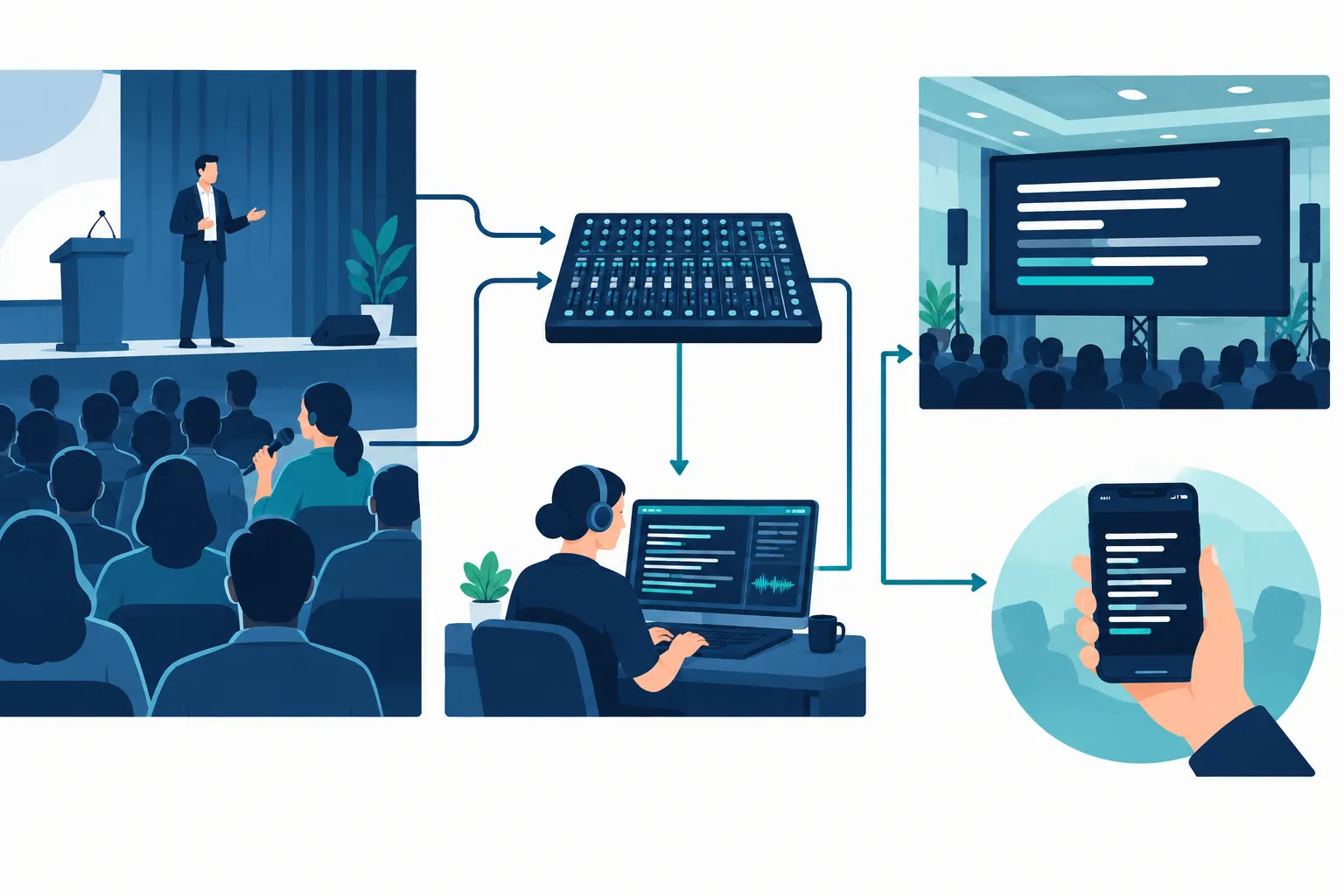
Which feeds and platforms are supported? Describe your mixer, webinar platform, encoder and display destinations. Ask the provider to draw the path from the microphone to each attendee view, including remote speakers and audience Q&A.
-
What happens at failure? Ask who notices silence or garbled text, who can switch to a backup audio or caption feed, what the fallback display is, and how attendees will be told.
-
What happens to the words afterward? Ask whether audio, captions and preparation materials are stored, which subcontractors or systems receive them, who has access, whether the provider uses material for model training, and how deletion is handled. Put retention and transcript delivery in the agreement.
-
What is the whole bill? Compare minimum booking time, rehearsal, simultaneous rooms, additional captioners, on-site travel, technician time, platform or equipment charges, overruns, transcript editing, cancellation and rush changes on the same scope.
Credentials, references and samples can narrow the field. The live test still needs to run on your audio path. If a different operator will work the event, get the staffing plan and preparation handoff in writing.
Run a representative caption test
Use the microphones, mixer, meeting platform and displays planned for event day. The rehearsal script should include introductions and technical terms, followed by a prerecorded clip, a remote participant, a fast exchange and a question through the roving audience mic. If your live feed includes room sound, include it in the test.
Seat an observer in the room and ask another to follow on a phone or remote participant view. Record when a spoken phrase appears at each destination. Can someone reading the text take part in the discussion while it happens? Note missing phrases, wrong names, speaker confusion, late corrections and text hidden behind slides. Set an acceptable result with your accessibility lead and attendees who rely on the service; a generic accuracy claim is not a pass mark.
Cut the primary audio feed, then the caption output, during the rehearsal. Time detection, escalation, restoration and attendee notice. The backup feed is useful only if someone on the crew knows how to activate it.
Live captioning providers: sample evaluation scorecard
This procurement worksheet is not a legal standard. Use 0 to 4 for each row: 0 for no evidence, 1 for a claim only, 2 for a partial demonstration, 3 for a successful rehearsal, and 4 for a successful rehearsal with a documented owner and fallback. Calculate weighted points = weight × score ÷ 4 for each row. The maximum is 100 points.

|
Criterion |
Weight |
Evidence to collect in the event test |
|---|---|---|
|
Accuracy on real room audio |
25 |
Transcript notes for noisy room sound, rapid exchanges, names, jargon and Q&A |
|
Delay and participation |
15 |
Spoken-to-visible timing at the room screen and remote view during discussion |
|
Speaker identification |
10 |
Clear changes between panelists, remote callers and audience members |
|
Privacy and record handling |
15 |
Written data flow, access, retention, deletion and training-use terms |
|
Backup feeds and response |
15 |
Observed failover, named escalation owner and attendee notice procedure |
|
Attendee display tests |
15 |
Sightlines, contrast, phone readability, platform access and captions not covering content |
|
Commercial clarity |
5 |
Itemized scope, minimums, rehearsal, overtime and post-event deliverables |
|
Total |
100 |
|
Bidder |
Accuracy /25 |
Delay /15 |
Speakers /10 |
Privacy /15 |
Backup /15 |
Display /15 |
Price scope /5 |
Total /100 |
|---|---|---|---|---|---|---|---|---|
|
Provider A |
||||||||
|
Provider B |
A provider scoring 3 on accuracy earns 18.75 of the 25 available points. Record the observation behind each score. Even a high total cannot make an unreadable attendee display acceptable, resolve missing terms for confidential content or repair a feed the crew cannot restore. Require a fix and retest before awarding the work. Change weights for unusual event risks before bids arrive, then use the same rubric for everyone.
Put the agreement and run of show in writing
Your purchase order or statement of work should describe the setup that passed rehearsal. Include rooms, coverage windows, output destinations, staff roles, the preparation deadline, backup audio and caption paths, plus any edited transcript or recording deliverable. Name the live support contact and the person authorized to approve a room change or overrun.
Before doors open, the AV lead confirms that every speaker source reaches the captioner. The accessibility or attendee-support lead checks room and remote displays and watches for missing text once the program starts. Attendees need a discreet way to report trouble. If captions fail, the incident lead activates the agreed fallback and tells attendees what is happening.
Compare the delivered coverage and invoice against the agreed scope. If you publish a transcript, label the raw live text separately from an edited, reviewed version. Apply the agreed retention terms to recordings and captions.
The buying decision
Choose a provider whose captions stay readable during rapid Q&A, whose crew knows the recovery steps and whose quote covers the full production path. A low price or advertised accuracy figure offers little value if captions cannot be read from the back of the room or on a phone.
If your program needs captioning alongside interpreting, multilingual support, equipment or event technicians, invite Team Stream to bid on the in-person or hybrid event. Its human and AI-enabled language services can be scoped to the program. That tailored scope calls for an event-specific quote and rehearsal, so send Team Stream the same brief and score its delivery on the same worksheet as every other bidder.
