


For a contract or legal document, choose a legal translation service that can name the translator and independent reviewer, explain its file protections, and meet the recipient’s requirements. Start with the document’s intended use, not a list of available languages or a delivery date.
If your team is negotiating an agreement, sharing a legal opinion across offices, or preparing a submission, define the scope before sending sensitive files. Ask legal translation companies what each quote includes.
Start with the document’s destination
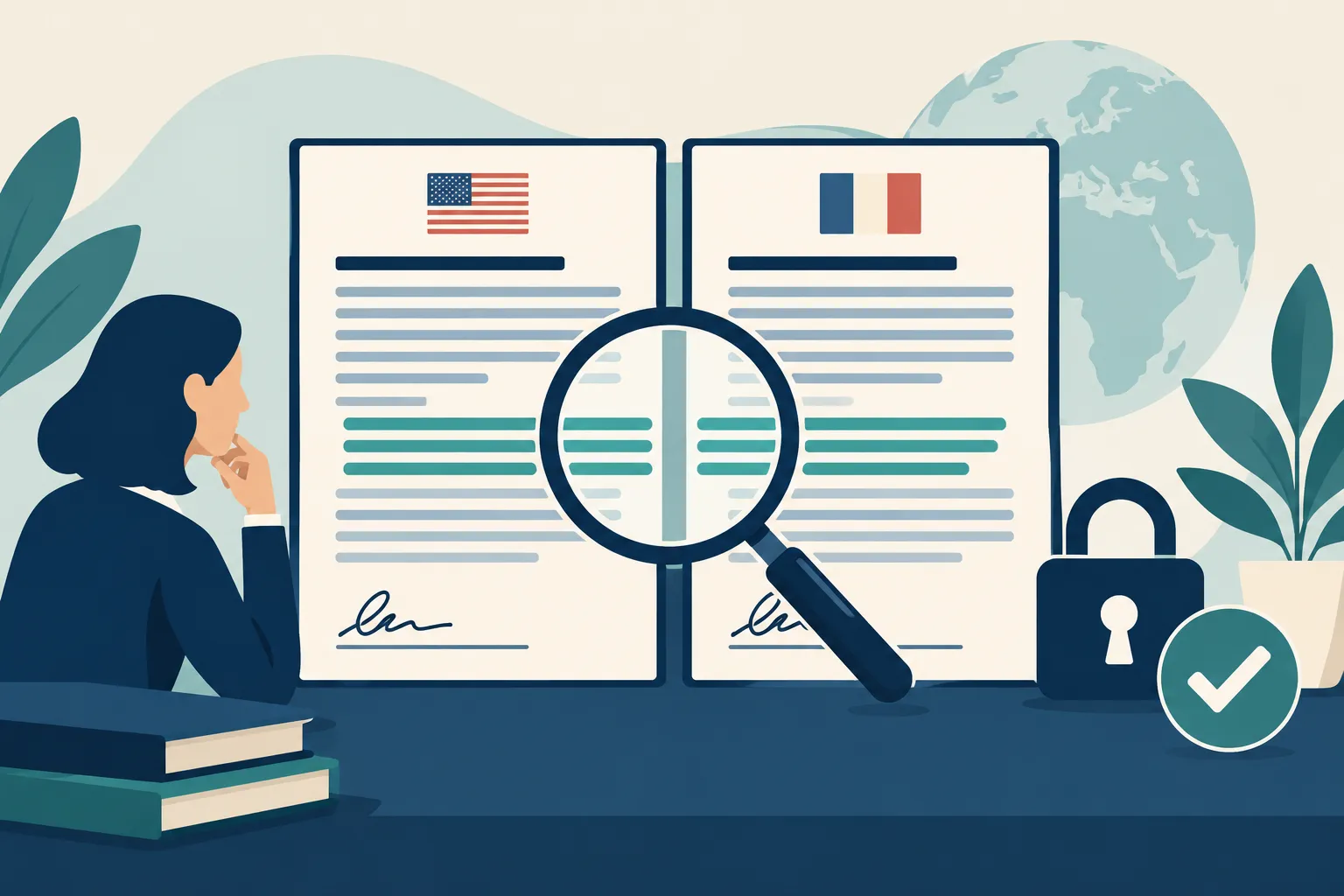
Tell a prospective provider whether you need the translation for internal review, negotiation, signing, due diligence, or submission to a court or agency. A filing may require documentation that an internal reference copy does not. Your legal team should identify the receiving institution and its instructions before asking a provider to promise acceptance.
Specify the source and target languages, legal jurisdictions, and document type. Experience with commercial contracts does not establish expertise in litigation materials or regulatory filings. Flag tables, tracked changes, signatures, annexes, and scanned pages so the provider prices the entire job, not only the clean text.
|
Intended use |
What to establish before buying |
Deliverable to specify |
|---|---|---|
|
Internal review |
Who needs to understand the document, and whether it will be relied on externally |
Translation with the agreed review level and usable formatting |
|
Negotiation or execution |
Which version is authoritative, and which legal teams will approve terminology |
Reviewed translation with a process for questions and revisions |
|
Court or agency submission |
The recipient’s rules for format, certification, signatures, and any additional formalities |
Translation and accompanying documentation that match those rules |
How to evaluate a legal translation service
Ask for relevant legal and language expertise
Ask who will translate your language pair and what similar legal documents that person has handled. Cross-border supply agreements, employment policies, and discovery records call for different experience. If a term has no direct equivalent in the target legal system, the provider should bring the ambiguity to your legal contact before settling on wording.
For related agreements, provide defined terms and approved translations from earlier work. Ask the provider to maintain a project glossary and check defined terms, party names, and cross-references across documents. Your counsel should decide whether the translated wording preserves the intended legal effect.
Require an independent review step

Ask whether a second qualified linguist compares the translation with the source. Find out who checks numbers, names, defined terms, dates, exhibits, and missing text. If counsel needs to assess legal meaning, reserve time for that review too.
Find out how the team logs questions and corrections. For a contract with multiple drafts, agree on a source version and record which edits made it into the final translation. Otherwise, a finished file could still contain an old clause.
Set confidentiality terms before sharing files
Ask who can see the files, including subcontractors and reviewers, and what confidentiality terms bind them. Set expectations for secure transfer, access, storage, retention, deletion, and incident notification. An online upload portal does not tell you who handles the documents after you send them.
If the legal translation company uses machine translation or AI, find out whether it sends your text to a third-party system, retains it, or uses it to train a model. Your legal and security teams can decide whether that workflow is acceptable for this document. Put tool restrictions in writing before work begins on privileged or highly sensitive material.
Separate accuracy from certification requirements
In the United States, the American Translators Association distinguishes a certified translation from a certified translator. A certified translation comes with a certificate of accuracy; a certified translator has a translator credential. Institutions and jurisdictions elsewhere may set different requirements. Notarization concerns the signing process, where a recipient requests it, and cannot stand in for linguistic review. Ask for the recipient’s instructions and a sample of the statement, signature, format, and delivery method the provider would supply.
“The Notary Public is not attesting to the accuracy of the translation.” – American Translators Association
Some business contracts need no certificate; a filing may need documentation beyond an accurate translation. If the recipient requires a particular translator qualification, sworn translator, or other formality, settle that before commissioning the job. Your legal team should decide what the specific filing requires.
Compare quotes on the same scope
Give each shortlisted provider the same brief. You can redact sensitive passages for an initial conversation, though a final quote may depend on the complete source. For other business documents, terminology, file format, and review still belong in the scope.
Include these details in the request:
-
Document type, intended use, language pair, jurisdiction, and recipient if there is one.
-
Editable files or scans, approximate volume, annexes, formatting needs, and the current source version.
-
Deadline and intermediate milestones, including time for counsel to answer translator questions.
-
Whether you need an independent review, certification or other recipient-specific documentation.
-
Confidentiality requirements, permitted tools, and the person who can approve terminology or revisions.
Compare what each offer includes rather than choosing the smallest total:
|
Quote item |
Question to ask |
|---|---|
|
People and process |
Who translates, who reviews, and who answers terminology questions? |
|
Scope and deliverables |
Are annexes, tables, layout, certificates, and source-to-target checks included? |
|
Timing |
Does the deadline allow review and legal feedback, or only a first draft? |
|
Security |
Who has access, which tools may process the text, and when are files deleted? |
|
Changes |
How are revisions to the source handled and priced? |
Pause if a provider promises court acceptance before learning who will receive the document. The same goes for a “certified” label with no sample attestation, a deadline that leaves no room for independent review, or vague answers about subcontractors and AI use. Resolve those points before sharing confidential material.
Make a decision and hand off the work
Choose the provider whose workflow suits the document’s risk and destination. Assign one person on your team to manage source files and questions, and give counsel time to approve legal wording before negotiation, signing, or filing. Keep the source version, final translation, terminology decisions, review history, and any required attestation together for future amendments.
Team Stream provides written translation alongside interpreting, captioning, and other language-access support. That range of services is useful when a legal document sits within a larger multilingual business or event project. Ask Team Stream to scope the document and its review with you. For a formal filing, establish the recipient’s qualification and certification requirements before engaging any provider.
