

English Translation: What Businesses Need to Know
If your organization needs to communicate clearly across languages, English translation is not just a language task – it is a business, event, and accessibility decision. Whether you are translating contracts, marketing assets, training materials, conference content, subtitles, or live event messaging, the quality of your English translation directly affects trust, compliance, audience reach, and results.
For event organizers, corporate teams, conference planners, churches, and broadcast producers, the stakes are even higher. A translated brochure can be revised later. A mistranslated live presentation, inaccessible video, or unclear multilingual announcement can undermine the entire audience experience in real time.
Team Stream helps organizations solve that problem with accurate human and AI-powered translation and interpreting, real-time captioning, subtitling, voiceover, and end-to-end language and accessibility solutions tailored to each client. With more than 25 years of experience, support for live, virtual, and hybrid events, and access to equipment, technicians, and flexible remote or on-site delivery, Team Stream is built for organizations that need communication to work the first time.
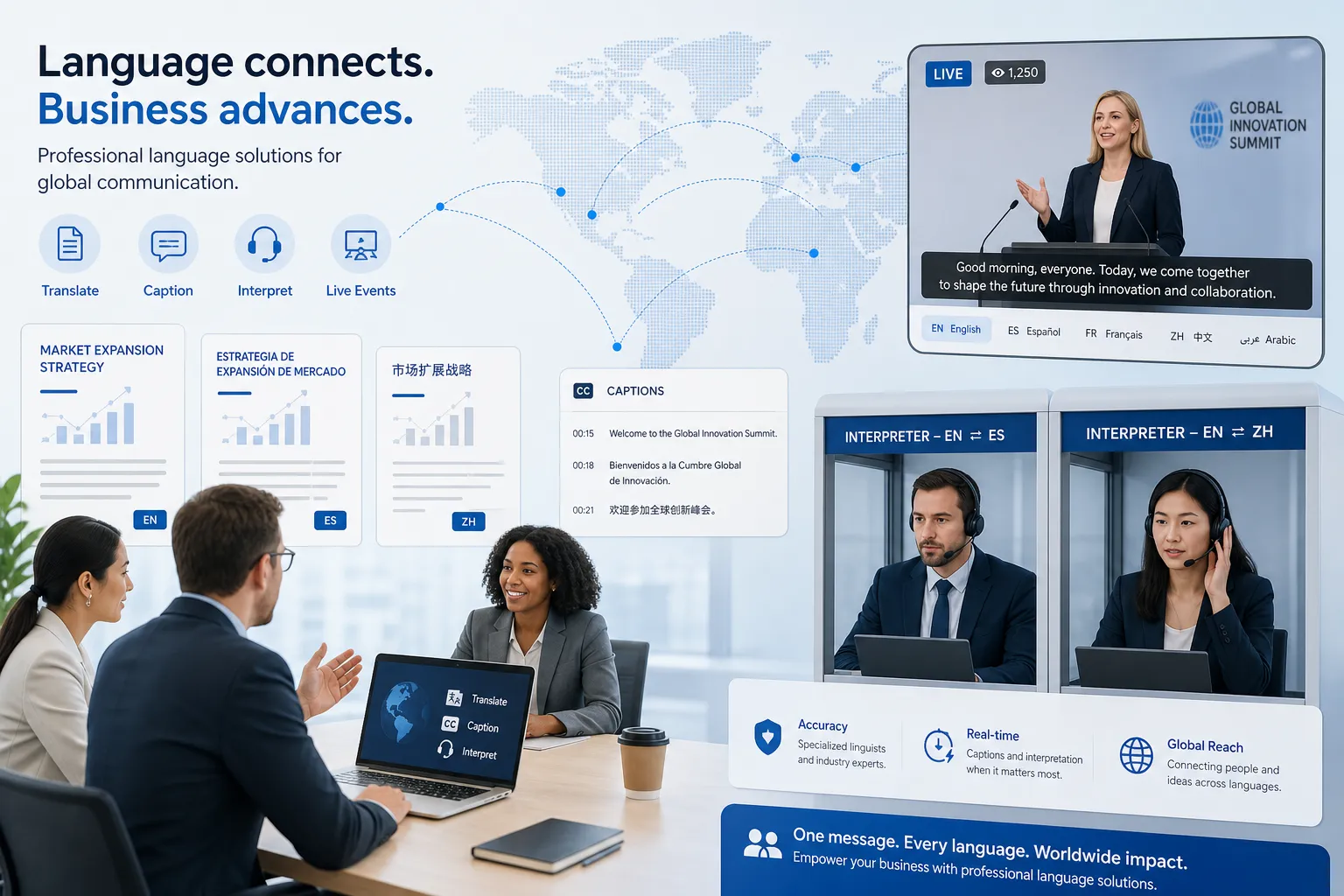
What English translation actually means in a business context
At its simplest, English translation is the process of converting content from another language into English, or from English into another language, while preserving meaning, intent, tone, and context.
In practice, that definition is too narrow for most organizations. Businesses rarely need words moved from one language to another in isolation. They need communication that works across:
-
internal operations
-
customer support
-
legal and compliance requirements
-
websites and digital content
-
employee training
-
meetings and conferences
-
live broadcasts and hybrid events
-
accessibility obligations
That is why effective English translation often overlaps with:
-
localization, where content is adapted for culture, region, and audience expectations
-
transcreation, where marketing language is creatively adapted rather than literally translated
-
captioning and subtitling, where translated content must also be timed and readable
-
interpreting, where spoken communication must happen live
-
accessibility services, where content must be inclusive for Deaf, hard-of-hearing, multilingual, and diverse audiences
When businesses typically need English translation
Many companies first think about English translation when entering a new market. But demand usually appears much earlier and in more places than expected.
Common use cases
|
Business need |
What must be translated or adapted |
Why it matters |
|---|---|---|
|
Corporate communications |
HR policies, memos, onboarding, training |
Reduces confusion and supports global teams |
|
Marketing and sales |
Websites, brochures, campaigns, product pages |
Helps attract and convert English-speaking audiences |
|
Events and conferences |
Agendas, presentation decks, signage, scripts |
Improves attendee experience and professionalism |
|
Video and media |
Subtitles, captions, voiceover, transcripts |
Increases accessibility and audience reach |
|
Legal and compliance |
Contracts, disclosures, policies, waivers |
Protects accuracy and reduces risk |
|
Customer support |
FAQs, help centers, chat templates |
Improves satisfaction and lowers friction |
|
Faith-based and community outreach |
Sermons, announcements, printed materials |
Makes communication inclusive and understandable |
For example, a company may need English translation from Spanish for employee handbooks, English translation from Korean for a supplier presentation, or English translation from Portuguese for product documentation at a trade show. The language pair changes, but the core challenge stays the same: the content must be accurate, usable, and audience-appropriate.
Why competitor articles often stop too soon
Many articles explain that translation helps businesses grow, reduce miscommunication, and reach more people. That is true – but incomplete.
What they often gloss over is that businesses do not just need translation. They need a delivery model that matches the content type, speed requirement, audience setting, and compliance risk.
Here are the biggest content gaps most articles miss:
Translation is not the same as communication readiness
A translated document may still fail if:
-
the terminology is inconsistent
-
the tone sounds unnatural
-
subtitles are poorly timed
-
captions are missing
-
live audiences need interpreting, not documents
-
multilingual event tech is not set up properly
-
accessibility requirements were not considered early enough
English translation can be low-stakes or mission-critical
A rough internal summary is different from:
-
a keynote shown to hundreds of attendees
-
a compliance document
-
a shareholder meeting
-
a training video requiring captions
-
a church service streamed to multilingual viewers
-
a product launch with multilingual press materials
The right provider should help you separate what can be automated, what needs human review, and what requires expert live support.
Language access and accessibility now overlap
Modern organizations increasingly need both:
-
language services for multilingual audiences
-
accessibility services for inclusive communication
That means English translation often sits inside a broader solution involving captioning, interpreting, subtitling, voiceover, and compliance-friendly event support.
The core types of English translation businesses should understand
Document translation
This covers written business materials such as contracts, policies, training documents, reports, brochures, and manuals.
Best for:
-
HR and employee communications
-
legal and operational documents
-
marketing collateral
-
public-facing information
Risks:
-
inconsistent terminology
-
over-literal phrasing
-
loss of legal or technical meaning
-
formatting errors in final delivery
Website translation and localization
Website translation goes beyond text replacement. Navigation, forms, calls to action, SEO, dates, currencies, and user expectations all need review.
Best for:
-
global lead generation
-
multilingual product pages
-
event landing pages
-
donor, attendee, or registration experiences
Risks:
-
pages that sound translated instead of native
-
broken multilingual user journeys
-
untranslated updates
-
weak search visibility in target regions
Marketing translation and transcreation
Marketing requires emotional accuracy, not just linguistic accuracy. Headlines, slogans, value propositions, and campaign messaging usually need adaptation.
Best for:
-
campaign copy
-
ad creative
-
product launches
-
brand storytelling
Risks:
-
culturally flat messaging
-
humor or idioms that fail
-
inconsistent brand voice
-
awkward or low-converting copy
Subtitling and voiceover
If your organization publishes video content, English translation may need to be delivered as on-screen subtitles or spoken voiceover.
Best for:
-
webinars
-
training videos
-
promotional videos
-
sermons and broadcasts
-
on-demand conference content
Risks:
-
subtitle timing issues
-
reading speed problems
-
poor audio localization
-
inaccessible content for viewers who rely on captions
Live interpreting and real-time captioning
When communication happens live, written translation is not enough. You may need spoken interpreting, CART captioning, multilingual caption streams, or integrated event support.
Best for:
-
conferences
-
corporate town halls
-
investor meetings
-
trade shows
-
hybrid events
-
live-streamed services
Risks:
-
delayed or inaccurate interpretation
-
no backup plan for technical issues
-
inaccessible live experiences
-
fragmented vendors managing language and AV separately
This is an area where Team Stream stands out. Instead of treating translation, interpreting, captioning, accessibility, and event tech as disconnected services, Team Stream can coordinate them into one execution plan.
Human translation vs AI translation: what businesses should really choose
The right answer is not “human only” or “AI only.” It is fit-for-purpose.
When AI-assisted English translation makes sense
AI can be useful for:
-
high-volume first drafts
-
internal reference materials
-
repetitive content
-
fast-turn multilingual workflows with review layers
Used correctly, AI can improve speed and reduce costs. But it should be managed by professionals who know when automation is appropriate and when it introduces risk.
When human translation is essential
Human expertise is critical for:
-
legal and compliance materials
-
executive communications
-
public-facing brand content
-
technical terminology
-
nuanced cultural adaptation
-
accessibility-sensitive content
-
live interpreting and event environments
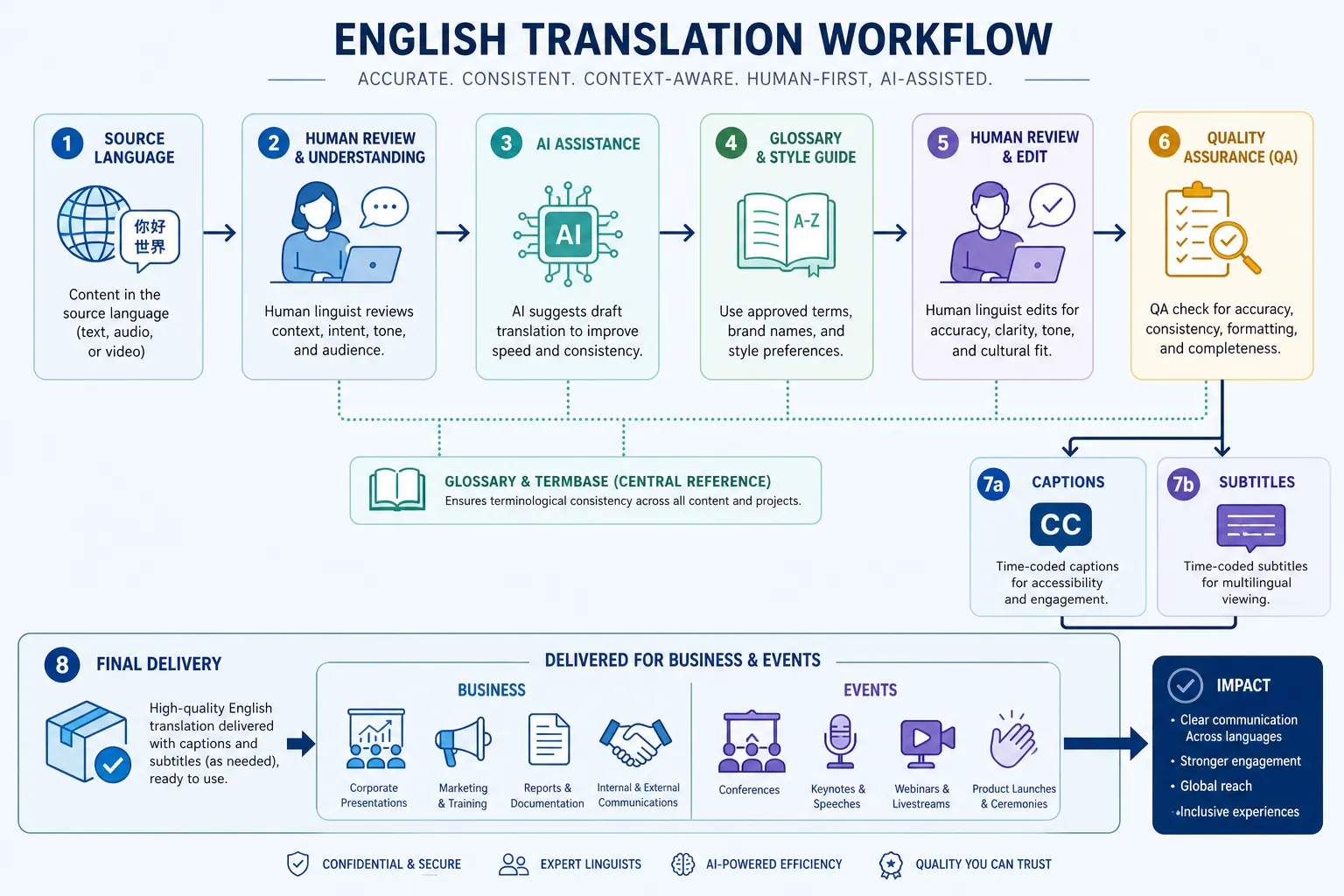
The strongest model: human expertise with smart AI support
For many organizations, the best outcome comes from combining:
-
AI for speed and workflow efficiency
-
human linguists for accuracy, tone, terminology, and review
-
specialized delivery for captions, subtitles, interpreting, or voiceover
-
experienced project management to keep everything aligned
That is the model Team Stream is built around: accurate human and AI-powered translation and interpreting, delivered in a way that supports real business communication rather than isolated word conversion.
What can go wrong with poor English translation
Poor translation is rarely just a language issue. It becomes an operational issue, a brand issue, or a risk issue.
Common failure points
|
Failure point |
What it looks like |
Business impact |
|---|---|---|
|
Literal translation |
Grammatically correct but unnatural wording |
Lower trust and weaker engagement |
|
Terminology drift |
Key terms translated inconsistently |
Confusion, compliance risk, rework |
|
Missing cultural context |
Message feels off or inappropriate |
Brand damage or audience disconnect |
|
No accessibility planning |
Videos or live sessions lack captions/subtitles |
Exclusion, compliance exposure |
|
Wrong service selection |
Documents translated when interpreting was needed |
Communication breakdown |
|
Weak event execution |
Language support not integrated with production |
Disrupted attendee experience |
For a conference organizer, this could mean multilingual attendees miss key messages. For a corporate communications team, it could mean policy confusion. For a church or broadcaster, it could mean portions of the audience are effectively left out.
How to evaluate an English translation provider
Not all providers are equipped for the same type of work. If your needs involve events, accessibility, or public-facing communication, the checklist should go beyond price and language pair.
Questions to ask before choosing a provider
1. Do they handle your content type?
A provider that is strong in document translation may not be strong in live events, video subtitling, or accessibility workflows.
2. Can they support both language access and accessibility?
If you need captions, interpreting, voiceover, subtitling, or compliance-sensitive delivery, those services should be coordinated – not patched together last minute.
3. Do they offer human review and quality assurance?
Even if AI is involved, there should be clear QA steps, terminology management, and editorial review.
4. Can they support live, virtual, and hybrid formats?
This matters for conferences, webinars, worship services, trade shows, and remote meetings.
5. Do they provide equipment and technicians if needed?
For multilingual live events, execution depends on more than language talent. Receivers, interpreter booths, streaming integrations, microphones, and experienced technicians can make or break the delivery.
6. Are they responsive and flexible?
Language needs often shift quickly. Strong customer service and reliable communication are essential.
What businesses should prepare before requesting English translation
The smoother your prep, the better your outcome.
Provide these items whenever possible
-
source files in editable format
-
intended audience and market
-
glossary or preferred terminology
-
brand style guidance
-
deadlines and launch dates
-
final use case: print, web, subtitle, live event, legal filing, etc.
-
compliance or accessibility requirements
-
context for acronyms, product names, and internal references
For events, also prepare
-
run of show
-
scripts and presentation decks
-
speaker list
-
platform details for virtual or hybrid delivery
-
expected audience languages
-
accessibility requirements such as CART, closed captions, or multilingual subtitle feeds
-
equipment and technician needs
This is another point where Team Stream adds value. Because the company supports interpreting, captioning, translation, subtitling, voiceover, equipment rental, technician services, and event execution, clients can plan holistically instead of coordinating multiple vendors.
English translation for events, conferences, and live experiences
This is where translation advice usually becomes too generic. Live communication has different demands than static content.
What event teams often need
-
translated agendas and signage
-
multilingual slide support
-
interpreter coordination
-
simultaneous or consecutive interpreting
-
real-time captioning
-
closed captions for live stream viewers
-
translated subtitles for recorded sessions
-
accessible post-event content
-
technician support for smooth delivery
Why this matters
At live events, there is no time for avoidable language friction. If attendees cannot follow the message, ask questions, access captions, or understand speaker content, engagement drops fast.
Team Stream is especially well suited here because it supports:
-
live, virtual, and hybrid events
-
in-person and remote service delivery
-
real-time captioning for accessibility and engagement
-
compliance-friendly inclusive communication
-
equipment rental and sales
-
technician support
-
tailored service plans instead of one-size-fits-all packages
For operations managers and event producers, that means fewer moving parts and greater confidence on show day.
English translation and accessibility should be planned together
Accessibility is not a last-minute add-on. It is part of effective communication.
Where translation and accessibility intersect
|
Content type |
Language need |
Accessibility need |
|---|---|---|
|
Live webinar |
Interpreting |
Live captions |
|
Conference session recording |
Translation/subtitles |
Closed captioning |
|
Employee training video |
Translation/voiceover |
Accurate captions and transcripts |
|
Public announcement |
Multilingual adaptation |
Readable formatting and inclusive delivery |
|
Broadcast or livestream |
Interpreting or translated script |
Real-time captioning and viewer accessibility |
A provider that understands both sides can help you avoid duplicated effort, conflicting timelines, and uneven quality.
Best practices for getting better English translation results
Write clear source content
Simple, direct source text translates better than jargon-heavy or ambiguous writing.
Separate draft content from final content
Do not send unfinished messaging for final translation unless the workflow is built to handle revisions.
Build a terminology list
This is especially important for product names, internal programs, technical terms, and recurring event language.
Match the service to the moment
Do not use document translation when you need live interpreting, and do not rely on subtitles when the audience needs real-time captions.
Review with context, not in isolation
If the translation will appear on slides, websites, apps, videos, or event screens, review it in that environment.
Think beyond language
Consider pace, readability, screen space, spoken delivery, audience comprehension, and accessibility from the start.
A practical framework for choosing the right solution
Use this quick decision guide
|
Scenario |
Best-fit solution |
|---|---|
|
Internal draft for quick understanding |
AI-assisted translation with light review |
|
Customer-facing brochure or landing page |
Human translation with editing |
|
Video for public release |
Translation plus subtitling/captioning |
|
Live multilingual conference |
Interpreting plus event tech support |
|
Employee town hall with inclusion goals |
Interpreting plus real-time captioning |
|
Compliance or legal document |
Expert human translation with QA |
|
Hybrid event with global audience |
Translation, captioning, interpreting, and technical coordination |
Why Team Stream is a strong fit for modern English translation needs
Plenty of vendors can translate text. Fewer can support the full communication chain.
Team Stream offers a more complete solution for organizations that need language access and accessibility to work across real business environments. That includes:
-
accurate human and AI-powered translation and interpreting
-
real-time captioning for accessibility and audience engagement
-
translation, subtitling, voiceover, and closed captioning
-
tailored support for conferences, businesses, churches, broadcasts, and events
-
service delivery for live, virtual, and hybrid formats
-
compliance-friendly inclusive communication
-
equipment rental, sales, and technician support
-
in-person and remote options
-
responsive customer service
-
more than 25 years of experience
For clients, that translates into fewer handoffs, stronger quality control, and more reliable execution.
Final thoughts
English translation is not a commodity when the message matters. It affects how audiences understand you, how employees follow you, how attendees experience you, and how inclusive your communication truly is.
If your needs stop at basic text conversion, many providers may seem similar. But if you need accurate communication across documents, live events, videos, accessibility workflows, and multilingual experiences, the difference between a general vendor and a true partner becomes obvious very quickly.
Team Stream is built for that broader reality. If you need a partner who can combine translation, interpreting, captioning, accessibility services, event support, technology, and responsive execution, Team Stream is ready to help you communicate clearly and inclusively – whether your audience is in the room, online, or across the world.
FAQ
What are 100 important words in business English?
There is no single official list, but the most important business English vocabulary usually includes terms related to meetings, contracts, deadlines, budgets, strategy, training, compliance, customers, and reporting. For multilingual teams, the priority is not memorizing 100 random words – it is making sure key terms are translated consistently and clearly in the right business context.
