

English to FR Translation Best Practices
If your organization is translating content from English into French, quality matters far beyond grammar. The right translation protects your brand, improves clarity, supports compliance, and helps French-speaking audiences actually trust and act on your message. The wrong one can make marketing sound awkward, legal language risky, employee communications unclear, and live events less inclusive.
For event organizers, corporate teams, conference planners, churches, and businesses, strong English to FR translation is rarely a standalone task. It often connects to multilingual meetings, subtitles, live interpreting, real-time captioning, accessible video, hybrid events, and audience engagement across multiple channels. That is why the best results come from treating translation as part of a broader communication strategy, not as a last-minute text conversion exercise.
At Team Stream, we help clients bridge those gaps with accurate human translation, AI-powered workflows where appropriate, interpreting, captioning, subtitling, voiceover, and end-to-end language access support for live, virtual, and hybrid environments. With more than 25 years of experience, our team understands that effective multilingual communication has to be clear, culturally appropriate, accessible, and operationally reliable.
What “Good” English to French Translation Really Means
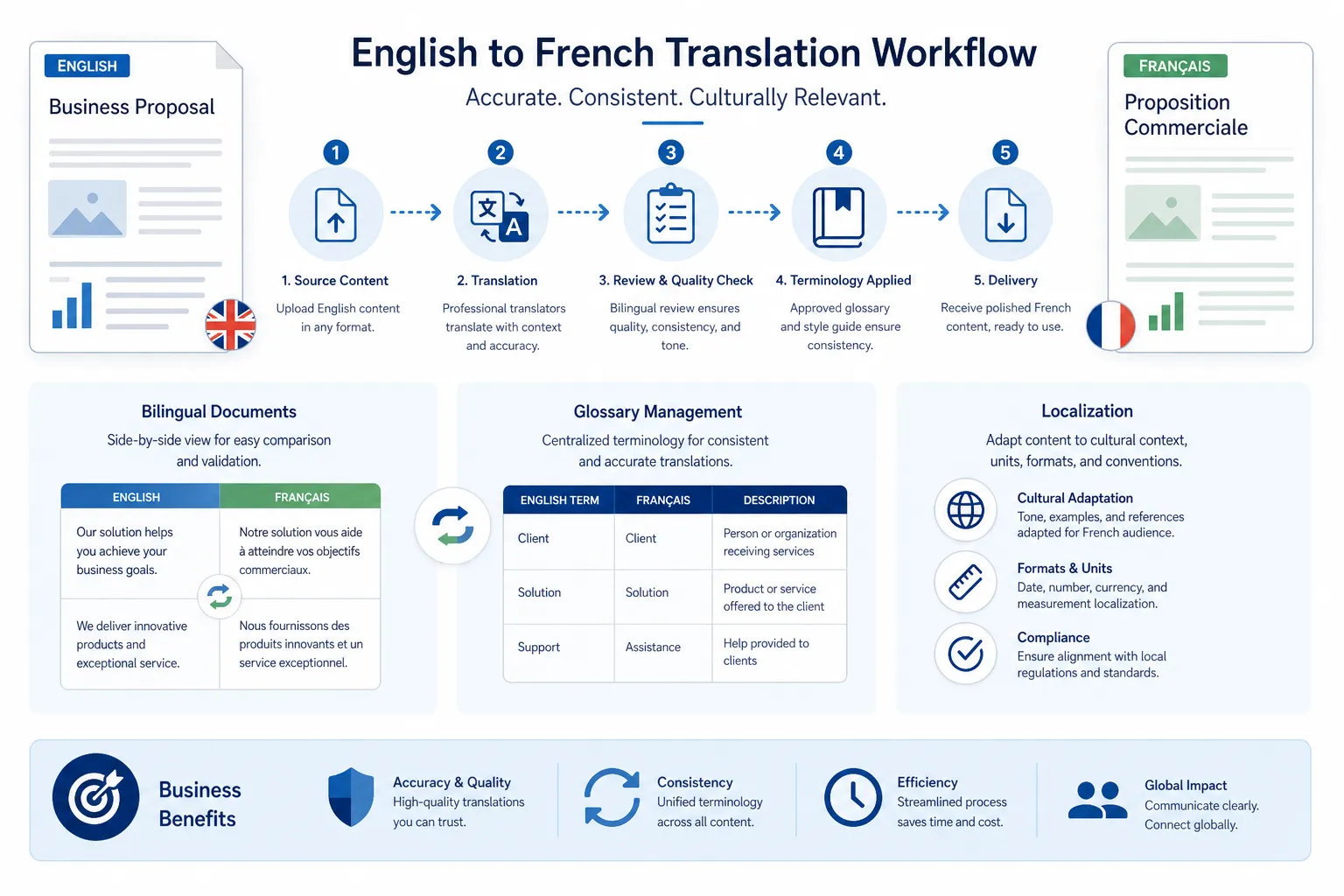
A high-quality translation does not mirror every English word. It communicates the same meaning, intent, tone, and desired outcome in French.
In a business context, that means your translated content should:
-
Sound natural to native French readers
-
Preserve the purpose of the original message
-
Reflect the right level of formality
-
Match the audience’s regional expectations
-
Stay terminologically consistent across documents
-
Support legal, accessibility, or regulatory requirements where relevant
Many organizations underestimate how often translation problems are actually communication problems. A source text that is vague, idiomatic, rushed, or overloaded with jargon will almost always create issues downstream.
Why English to French Translation Is More Complex Than It Looks
English is often concise and flexible. French tends to be more explicit, more structured, and more sensitive to register, agreement, and style. That difference affects everything from website copy and HR policies to product messaging and event materials.
Common friction points include:
Tone and Formality
French forces more choices around tone than English does. You may need to decide between formal and informal address, more polished phrasing, or industry-specific conventions that carry social weight.
Sentence Expansion
French translations are often longer than the English source. This matters for:
-
Slides
-
Event screens
-
Mobile apps
-
Packaging
-
Lower thirds
-
Captions and subtitles
-
Printed collateral with fixed layouts
Gender, Agreement, and Grammar Precision
French requires grammatical agreement that English often avoids. If the source text is ambiguous, a translator may need clarification before producing an accurate final version.
Idioms and Cultural References
Phrases that feel harmless in English can become confusing or even embarrassing in French when translated literally.
The Biggest Content Gap Most Articles Miss: Translation Is Also an Operations Issue
Many guides focus only on linguistic accuracy. In practice, translation quality also depends on planning, formatting, workflow, and delivery context.
For example:
|
Translation Factor |
Why It Matters |
|---|---|
|
Finalized source text |
Prevents costly rework and inconsistent revisions |
|
Editable file formats |
Speeds turnaround and protects formatting |
|
Approved glossary |
Keeps terminology consistent across teams |
|
Audience definition |
Changes tone, vocabulary, and localization choices |
|
Review workflow |
Reduces internal disagreements and last-minute changes |
|
Accessibility needs |
Affects captions, subtitles, readability, and inclusive communication |
|
Event format |
Influences whether translation must align with interpreting, live captioning, or on-screen content |
This is where Team Stream adds value beyond a basic vendor relationship. We tailor language and accessibility solutions to the actual use case, whether that is a multilingual conference, internal training program, public-facing campaign, church service, livestream, or compliance-sensitive corporate communication.
Start With the Right Source Text
Before anyone translates a single word, make sure the English original is truly ready.
Best Practices for the Source Version
-
Finalize the English copy first
-
Remove slang, jokes, and culturally narrow references unless they are intentional
-
Clarify acronyms and technical terms
-
Flag brand names and proper nouns that should not be translated
-
Standardize terminology across departments
-
Provide context for headings, buttons, and fragments
-
Confirm the target audience and region
This step seems simple, but it prevents a large share of translation errors. If the source says two different things in two different places, the French version will only magnify that inconsistency.
Know Which French Audience You Are Reaching
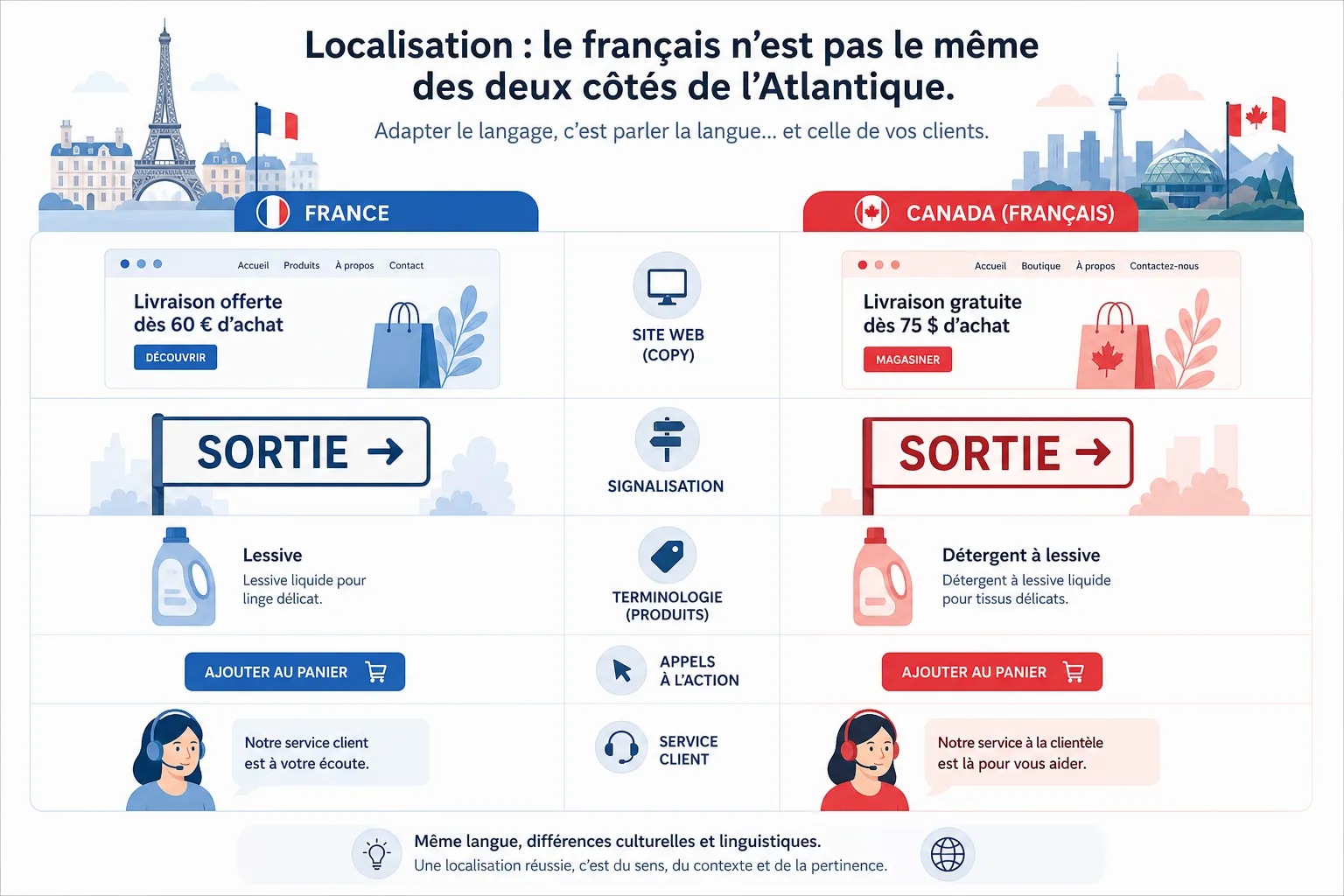
“French” is not one universal market. A translation for France may not be the best fit for Québec, New Brunswick, Belgium, Switzerland, or multilingual African markets.
France French vs Canadian French
The differences can show up in:
-
Vocabulary
-
Government and legal terminology
-
Formatting conventions
-
Tone preferences
-
Borrowed English terms
-
Audience expectations around clarity and directness
A good example is business and public sector communication. In Canadian French, terminology choices may need to align with local standards, institutional use, or regulatory expectations in ways that differ from European French.
If you do not define the target region up front, you risk getting a translation that is technically correct but operationally wrong.
Literal Translation Is One of the Fastest Ways to Lose Credibility
Word-for-word translation rarely survives contact with real readers. It may be understandable, but it often sounds unnatural, stiff, or misleading.
Common Literal Translation Problems
-
Translating idioms directly
-
Copying English sentence order too closely
-
Using false cognates
-
Keeping English marketing tone that feels unnatural in French
-
Overusing passive constructions
-
Ignoring register differences
In business settings, these mistakes can reduce confidence in your brand. In legal, healthcare, education, or accessibility-sensitive content, they can create more serious risks.
Build a Terminology Strategy, Not Just a Translation File
One of the clearest differences between average and excellent translation programs is terminology management.
What to Define in Advance
Create or request a glossary covering:
-
Product names
-
Service lines
-
Technical vocabulary
-
Legal or compliance terms
-
Brand phrases
-
Industry acronyms
-
Preferred translations for recurring headings and calls to action
This matters especially if multiple translators, reviewers, departments, or event teams are involved. Consistency across websites, slide decks, brochures, subtitles, scripts, and speaker materials builds trust and avoids re-litigation of the same terms every quarter.
At Team Stream, glossary and style alignment can be built into a broader workflow that also includes captioning, interpreting, subtitling, and voiceover, so the same terminology carries cleanly across written and live experiences.
Design for Localization, Not Just Translation
Many organizations send content for translation without considering space, visuals, or format. That causes delays, formatting breakage, and poor user experience.
Layout Best Practices
-
Expect French copy to run longer than English
-
Leave flexible space in graphics and templates
-
Avoid embedding text inside images when possible
-
Provide editable source files
-
Review line breaks in subtitles and captions
-
Check whether buttons, menus, and labels still fit on screen
-
Confirm that visuals are culturally appropriate
This is especially important for multilingual events and hybrid productions. On-screen graphics, presentation slides, confidence monitors, streaming overlays, and exhibit signage all need enough room to accommodate expanded French text cleanly.
Human Translation vs AI Translation: What Works Best?
The right answer depends on content type, risk level, turnaround needs, and audience expectations.
When AI Can Help
AI-assisted translation can be useful for:
-
Large first-draft volumes
-
Internal reference materials
-
Fast triage of repetitive content
-
Early-stage multilingual workflows with human review
When Human Expertise Is Essential
Human translators are still the best choice for:
-
Public-facing brand content
-
Legal and compliance materials
-
Sensitive HR communications
-
Executive messaging
-
Event scripts and stage content
-
Accessibility-sensitive assets
-
Content requiring transcreation or regional adaptation
The strongest model is often hybrid: use technology for speed where appropriate, then apply human review, editing, and quality control where nuance matters most. That is a practical approach Team Stream uses to balance accuracy, efficiency, and business reality.
Translation Quality Control Should Be a Formal Step
Too many organizations assume the translator is the final checkpoint. That is risky.
A strong QA process typically includes:
-
Translation
-
Editing or bilingual review
-
Proofreading
-
Terminology check
-
Formatting review
-
Final stakeholder validation if needed
Reviewers Need Guidance Too
Internal reviewers can improve quality, but only if they know what they are reviewing. Without clear guidance, reviews often become subjective rewrites based on personal preference rather than audience fit.
Define whether reviewers should focus on:
-
Accuracy
-
Brand terminology
-
Regional appropriateness
-
Legal wording
-
Readability
-
Formatting
-
Accessibility
Accessibility Should Be Part of the Translation Conversation
This is another area many competitor articles gloss over. For many organizations, language access and accessibility overlap.
If you are translating content for a live event, webinar, training, town hall, sermon, or broadcast, you may also need:
-
Real-time captioning
-
Closed captions
-
Subtitles
-
Voiceover
-
Sign language interpreting
-
Multilingual audio delivery
-
Accessible visual presentation
-
Technician support and equipment rental
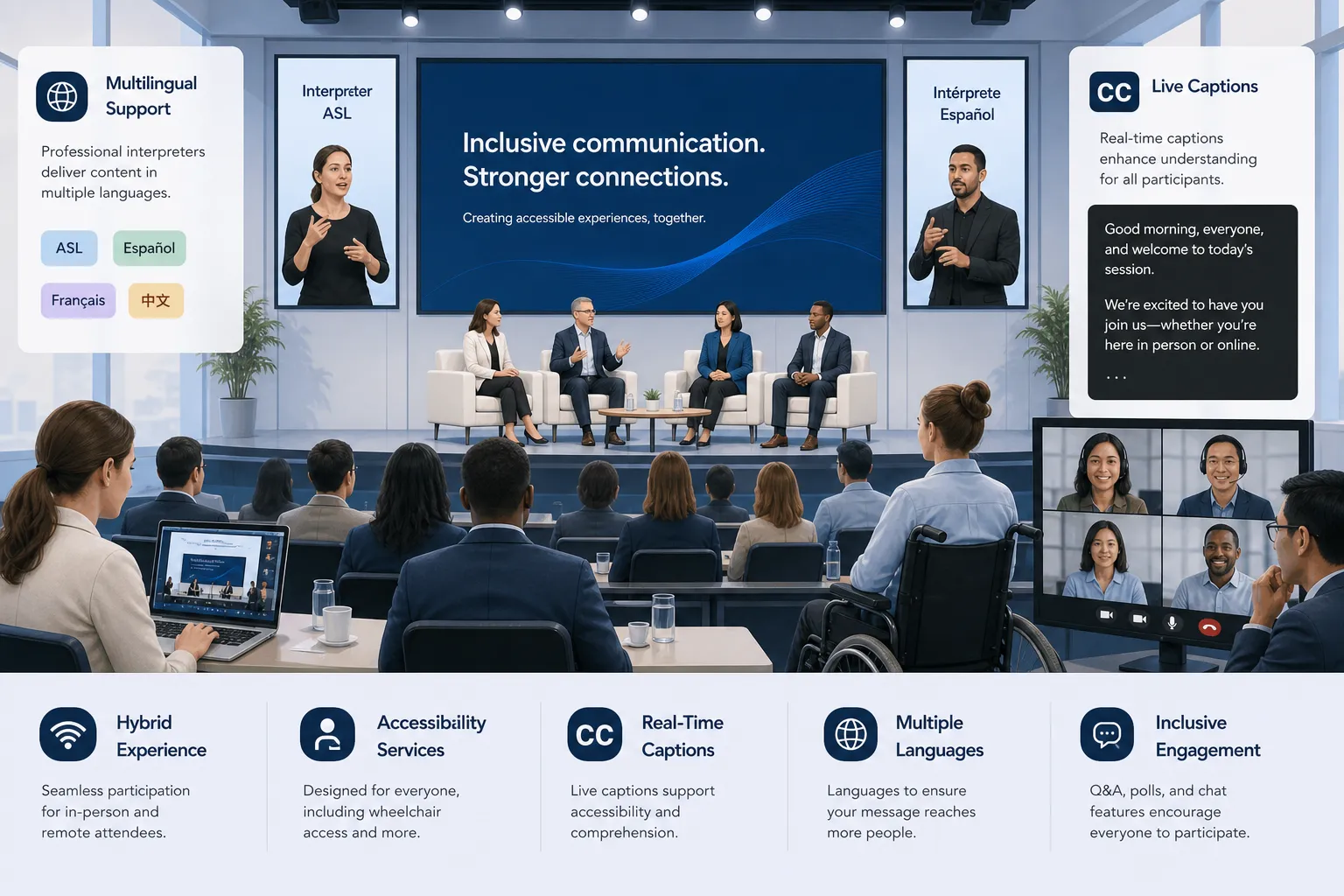
For event producers and communications leaders, this integrated approach reduces coordination headaches. Instead of managing separate vendors for translation, interpreting, captions, and technical execution, a partner like Team Stream can support end-to-end delivery for in-person, remote, and hybrid experiences.
Best Practices by Content Type
Websites
For websites, English to French translation should account for SEO, navigation labels, conversion language, and regional phrasing. Directly translated English CTAs often underperform if they do not sound natural in French.
Review:
-
Menus and metadata
-
Form labels
-
Error messages
-
Calls to action
-
Legal pages
-
Accessibility text
-
Region-specific terminology
Corporate Communications
For internal communication, clarity and tone are critical. Employees need messages they can trust and understand quickly.
Prioritize:
-
Plain language
-
Consistent HR and policy terms
-
Confidential handling
-
Respectful tone
-
Review by stakeholders familiar with the audience
Events and Conferences
For events, translation may interact with scripts, stage visuals, live interpretation, session materials, exhibitor documents, and accessibility services.
Plan for:
-
Slide translation
-
Speaker notes
-
Agenda localization
-
Multilingual signage
-
Real-time captioning
-
Interpreter coordination
-
On-site or remote technician support
Video and Broadcast Content
For videos, translation decisions affect timing, readability, and viewer retention.
Consider:
-
Subtitles vs dubbing vs voiceover
-
Reading speed
-
Character limits
-
On-screen text translation
-
Accessibility requirements
-
Terminology consistency with related written materials
Common Mistakes Businesses Make With English to French Translation
1. Treating French as a Single Universal Audience
Regional differences matter. What works in Paris may not feel right in Montréal.
2. Sending Draft Content Instead of Final Copy
Every source revision adds time, cost, and inconsistency.
3. Assuming Bilingual Staff Can Handle Professional Translation
Fluency does not automatically equal translation skill, especially for regulated, customer-facing, or high-stakes content.
4. Ignoring Accessibility Requirements
If the content is tied to meetings, videos, or public events, translation alone may not be enough.
5. Skipping Glossaries and Style Guides
Without them, consistency breaks down quickly.
6. Choosing the Cheapest Option for High-Visibility Content
Low-cost translation often becomes expensive when it must be fixed after publication or during a live production window.
What to Ask Before Hiring a Translation Partner
Use this checklist to vet providers:
|
Question |
Why It Matters |
|---|---|
|
Do you translate into region-specific French? |
Ensures market fit |
|
Do you use native-language professionals? |
Improves naturalness and accuracy |
|
What is your QA process? |
Protects quality |
|
Can you handle formatting and design considerations? |
Prevents broken layouts |
|
Can you support captions, subtitles, or interpreting too? |
Reduces vendor sprawl |
|
Do you offer human review of AI-assisted work? |
Balances speed and quality |
|
Can you work on live, virtual, and hybrid events? |
Supports operational flexibility |
|
Do you provide technicians or equipment if needed? |
Helps execution in event settings |
Where Team Stream Fits In
Team Stream is built for organizations that need more than isolated translation. We support clients that need language access and accessibility to work in the real world, under deadlines, across formats, and in front of actual audiences.
That includes:
-
Accurate human translation
-
AI-powered language solutions with oversight
-
Live interpreting
-
Real-time captioning
-
Closed captioning and subtitling
-
Voiceover
-
Compliance-friendly accessibility support
-
Equipment rental and technician services
-
In-person and remote delivery models
-
Support for live, virtual, and hybrid events
Our approach is tailored, not one-size-fits-all. A board meeting, product launch, conference, church event, training session, and multilingual broadcast each require different workflows. With over 25 years of experience, Team Stream helps clients execute confidently, with strong customer service and dependable follow-through.
A Practical Workflow for Better English to FR Translation
If you want consistently stronger results, follow this sequence:
Step 1: Finalize the English Source
Clean up ambiguity, jargon, and late edits before translation begins.
Step 2: Define the Audience and Region
Specify France, Canada, or another French-speaking market.
Step 3: Share Context
Explain where the text will appear and what the audience needs to do.
Step 4: Provide Terminology Guidance
Supply glossaries, brand rules, and words that should stay untranslated.
Step 5: Choose the Right Translation Method
Match the workflow to the risk and visibility of the content.
Step 6: Review for Language and Function
Check both the wording and the real-world user experience.
Step 7: Align Accessibility and Event Needs
If the content appears in live or recorded environments, coordinate captions, interpreting, subtitles, and technical support early.
Final Thoughts
The best English to FR translation is not just accurate. It is usable, culturally aware, audience-specific, and aligned with the way your organization actually communicates. That requires stronger source content, better planning, clearer terminology, and the right mix of human expertise and smart technology.
If your team needs French translation for websites, events, internal communications, videos, accessibility initiatives, or multilingual audience engagement, Team Stream can help you do it right from the start. We combine language expertise, AI-enabled efficiency, accessibility services, event support, and responsive execution so your message lands clearly wherever your audience is.
If you are ready for a partner that can support translation, interpreting, captioning, subtitling, voiceover, and technical delivery under one roof, Team Stream is ready to help.
FAQ
What are some common mistakes when translating English to French?
Common mistakes include literal translation, ignoring regional differences, using the wrong level of formality, and skipping terminology review. Businesses also run into problems when they translate draft content or assume bilingual staff can replace professional translators.
What is the most accurate English to French translator?
The most accurate option is usually a professional human translator, especially for public-facing, legal, or brand-sensitive content. AI tools can help with speed, but the best results come from human review and quality control.
How much do French translators get paid?
Pay varies based on specialization, experience, region, and project type. Translators working in legal, technical, medical, or high-visibility business content often command higher rates than those handling simple general text.
What is the best way to translate French to English?
The best method is to start with a clear source, define the audience, and use a native-level professional translator who understands context and tone. For important content, add editing, proofreading, and formatting review before publishing.
Is DeepL really the best translator?
DeepL is a strong tool for fast drafts, but it is not always the best final solution for nuanced business communication. It can miss tone, context, regional expectations, and compliance-sensitive details that a human expert would catch.
What are common translation mistakes?
Common translation mistakes include false cognates, awkward sentence structure, inconsistent terminology, and missing cultural context. Another major issue is failing to account for accessibility, layout, and delivery format in live or multimedia environments.
