

Employee handbook translation services give staff access to policies in the languages they understand. A mistranslated leave rule, safety instruction or reporting route can change what someone does at work. Find out which languages employees use, identify the policies with the greatest impact, and plan for review and updates before you commission a translation.
This walkthrough of an editable employee handbook template can help you organize the source document:
When should you translate an employee handbook?
Translate when employees cannot understand the handbook you distribute well enough to use it. A person’s nationality or job title will not tell you which language they prefer to read. Ask during onboarding, and give staff a way to request another language later.
Prioritize policies on conduct, pay-related processes, leave, complaints, safety procedures and discipline. Employees need to know whom to contact, what to submit and when to act. A signature on an English-only acknowledgment cannot show, on its own, that someone understood those steps.
|
Situation |
Sensible next step |
|---|---|
|
Several employees prefer the same written language |
Translate the complete handbook and provide the same update process as the original. |
|
A small group needs access to a long handbook |
Arrange language support for onboarding now, then prioritize translation of critical policies and plan the full version. |
|
Employees speak a language but do not read it comfortably |
Pair written materials with an interpreter-led explanation or accessible audio/video format. |
|
Policies differ by location or role |
Prepare the correct source version for each group before translating; do not distribute one translated version across incompatible policies. |
Translation is not a substitute for legal review. Have qualified employment counsel assess the underlying policies and any local obligations that apply to your workforce; the language provider’s role is to preserve their intended meaning.
What handbook translation has to get right
Policy meaning, not just vocabulary
“May,” “must,” “eligible” and “within” can change the meaning of a rule. Tell the translator who administers each policy and which phrases have defined meanings within your company. Supply a glossary for titles, benefits names and internal systems, including terms that appear in forms or training materials.
Take “report an incident to your supervisor within one shift.” Does the deadline mean before the current shift ends or before the next one does? Where should an employee report it if the supervisor is involved? HR needs to settle those questions in the source policy. A translator should not have to decide what the rule means.
Keep headings, tables, forms, links, contact information and acknowledgment pages usable in every language. Leave room in the layout for text expansion. If employees receive a PDF, open it on the devices they use at work, including phones.
Safety and reporting instructions
In its guidance on training requirements, OSHA states:
“In practical terms, this means that an employer must instruct its employees using both a language and vocabulary that the employees can understand.” – Occupational Safety and Health Administration
Ask the person responsible for a safety procedure to review its translation. They can catch changes to steps, warning levels, equipment names or the escalation route. Give reporting instructions the same scrutiny: employees need a contact they can use if their supervisor is part of a harassment complaint.
Training and demonstrations may still need an interpreter, especially when employees must ask or answer questions in real time. Distributing a translated file does not establish that workers understood a safety training session.
Accessibility and trust
Find out whether staff read the handbook in print, on a phone or through a portal, or discuss it at onboarding. Some may also need captions, an accessible document or an interpreter. Make sure they can ask questions in a language they understand, and name the person who will sort out any discrepancy between versions.
A practical translation workflow
-
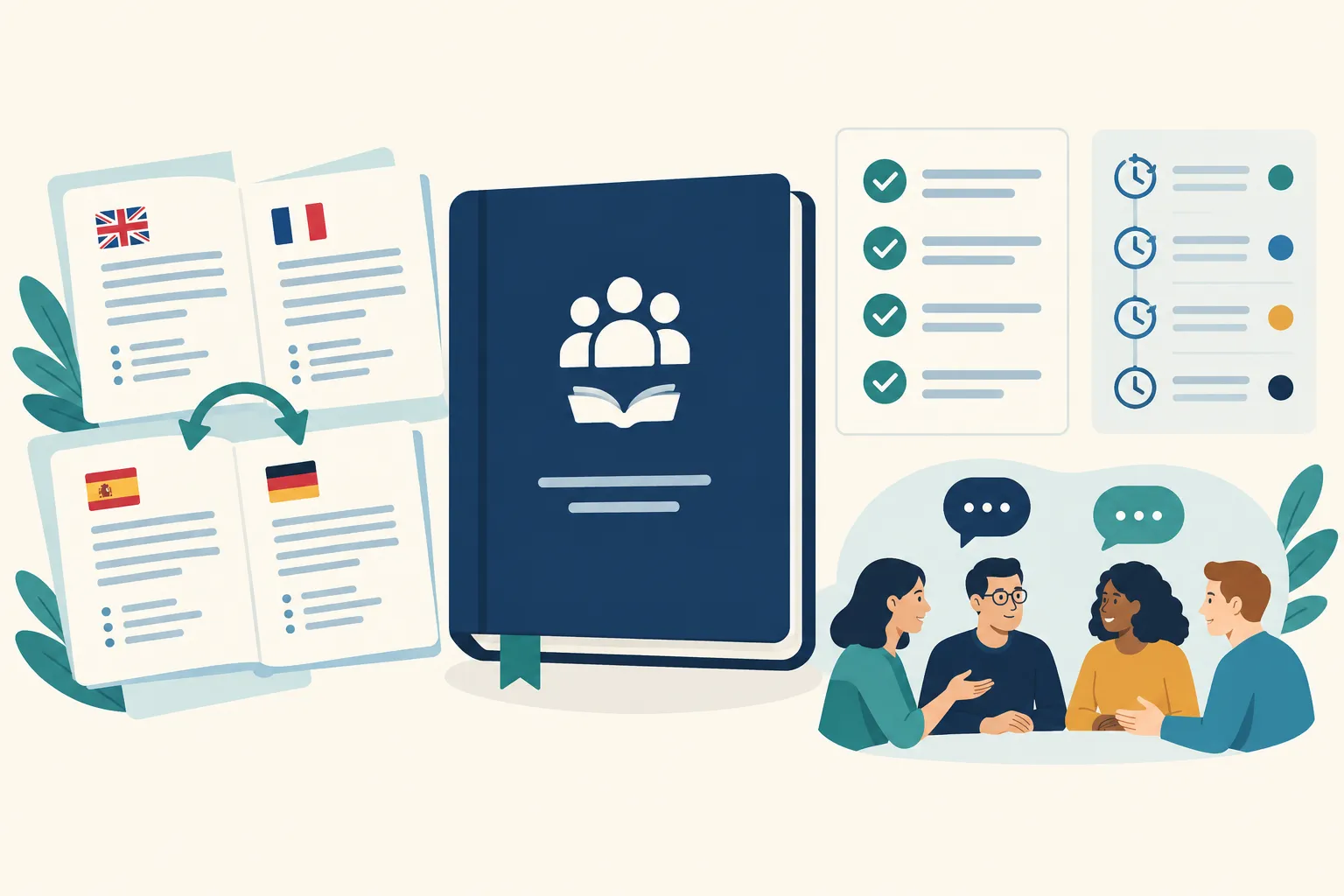
HR and counsel approve one current source handbook and remove conflicting drafts. Name the policy owner and record the version date.
-
Use employees’ language preferences to plan versions and delivery formats. Include forms, annexes and acknowledgment pages that go with the handbook.
-
Give the translator an editable final source, a terminology list, the intended audience and policy context. Name an HR contact who can answer questions, and flag wording whose meaning cannot change.
-
A qualified translator prepares each language version. Arrange an independent review where feasible, then have HR check process details and counsel examine legally sensitive wording when needed. A bilingual coworker can flag confusing language, but should not be the only quality control.
-
Walk through how an employee finds a rule, follows a reporting path and completes an acknowledgment. Fix broken links, awkward layouts and unclear contact details.
-
Distribute the right version to each group. Explain how to ask questions, and arrange interpreting for onboarding conversations that need it.
-
Log changes to source policies, send the affected passages for translation and review, and replace obsolete copies. Keep a record of which version employees received.
An acknowledgment records receipt. Leave time for employees to ask about rules before they sign; the signature alone cannot tell you what they understood.
Choosing employee handbook translation services
Ask providers who manages terminology and reviewer feedback, who can access confidential material, and who checks the final layout. Get the revision process in writing too, including how they match changes in the English source to each translation.
Before using AI to prepare a draft, decide what you may upload. Remove unnecessary personal data from sample forms and agree on file access and retention with the provider. Have a reviewer compare the output with the approved policy rather than editing the translated text alone.
|
Approach |
Useful when |
Main limitation |
|---|---|---|
|
Unreviewed machine translation |
Producing an internal working draft for a qualified reviewer |
Can miss policy nuance or silently change instructions; not a release-ready handbook. |
|
Bilingual staff translation |
Clarifying company terms and employee questions |
Language ability alone does not establish translation or policy-review expertise; staff may lack time or confidentiality safeguards. |
|
Professional translation with HR review |
Publishing policies that employees will use |
Needs a clear source and designated reviewers; quality drops when feedback is fragmented. |
|
Professional translation plus interpreting or accessible media |
Supporting onboarding, training and employees who need spoken or captioned access |
Requires coordination across documents and live communication. |
Team Stream offers written translation alongside interpreting, captioning and other language-access services. That combination suits employers who need both a translated handbook and multilingual onboarding conversations or accessible training. Its limitation for a handbook-only project is that those additional services may not be necessary; scope the work to what your employees actually need.
Do not assume that a “certified” label resolves the question of quality. Ask what the provider means by certification, whether a particular recipient requires it, and who will review policy meaning before publication.
Budgeting and maintaining translated handbooks
Quotes vary with the languages requested, the amount and condition of the source text, policy complexity, formatting, review rounds and deadline. Send each provider the same approved files. Ask them to show translation, independent review, layout and later updates as separate costs so you can compare the full job rather than an hourly figure.
Put someone in charge of updates before launch. Their change log should include the source section, effective date, affected language versions, reviewer and publication date. If the instruction also appears in onboarding slides, forms or training videos, update those too. Staff should not have to reconcile a current handbook with an outdated verbal explanation.
For urgent changes, share an interim interpreted explanation where appropriate, then distribute the reviewed written update. Record both communications so HR can answer which rule employees received and when.
Conclusion
If staff need another language to use the handbook, translate it and assign someone to maintain each version. Policy wording, review and a way to ask questions deserve as much attention as delivery speed. For a rollout that also needs interpreted onboarding or accessible training, ask Team Stream to coordinate those services with the written translation.
FAQ
How much do translation services cost per hour?
There is no single hourly rate for handbook translation. Providers may quote by word, project or time; ask for a written scope covering translation, review, formatting and future policy updates so you can compare total costs.
Am I obligated to translate at work?
The answer depends on the work, jurisdiction and applicable rules, so do not assume every handbook must be translated or that distributing English alone is always enough. Employers should get advice on their obligations and make sure employees can understand safety instructions and the policies they are expected to follow.
Can chatgpt do translation?
It can produce a draft, but a handbook needs qualified human review before employees rely on it. Reviewers should check policy meaning, terminology, reporting steps, links and formatting against the approved source.
