

Certified Document Translation: What to Know
If you are submitting documents to immigration authorities, courts, universities, licensing boards, or international partners, getting the translation right is not optional. A small formatting mistake, a missing certification statement, or confusion about notarization can delay approvals, create compliance headaches, and undermine trust in your documentation.
For event organizers, corporate teams, broadcasters, churches, and organizations working across languages, the stakes are even higher. The same attention to accuracy that matters in certified document translation also matters in multilingual meetings, live captioning, interpreting, subtitling, and accessibility support. That is why many organizations prefer a single trusted partner like Team Stream – one that can handle written translation, live language access, and compliance-friendly accessibility solutions with equal care.
What a certified translation actually means
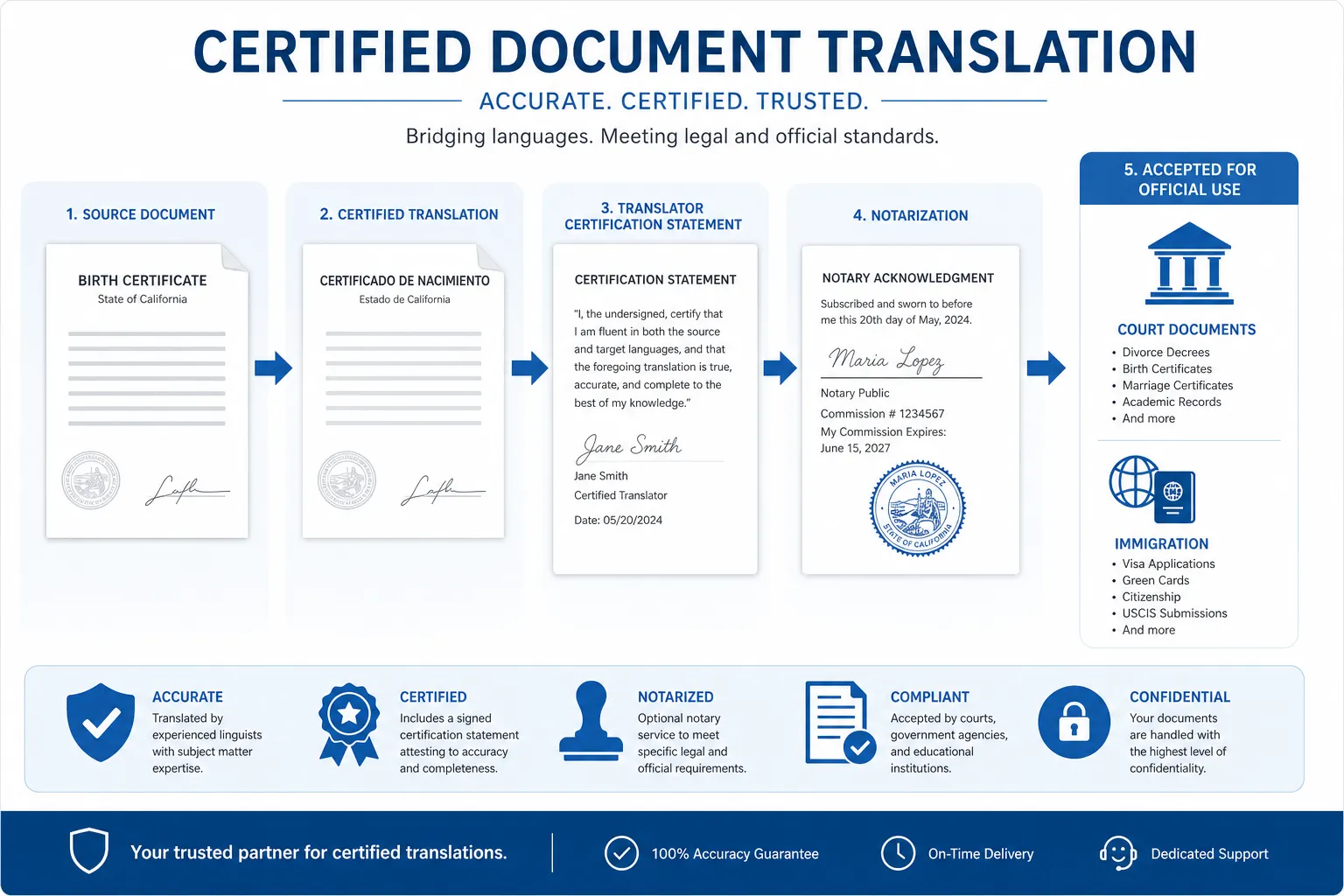
A certified translation is a translated document accompanied by a signed statement attesting that the translation is complete and accurate to the best of the translator’s knowledge and that the translator is competent to translate between the relevant languages.
This is where many people get confused. A certified translation is not automatically the same thing as:
-
a notarized translation
-
an apostilled translation
-
a court-certified translation
-
an ATA-certified translation
-
a sworn translation in countries that use that legal system
In practice, the required format depends on the receiving organization. A USCIS filing may require one standard. A university admissions office may want a different layout. A court, embassy, or overseas authority may ask for notarization, wet signatures, or additional identity verification.
The simplest definition
A certified translation usually includes:
|
Element |
What it does |
|---|---|
|
Full translation |
Translates the entire document, not just selected parts |
|
Certification statement |
Confirms accuracy and completeness |
|
Translator identification |
Names the translator or reviewing certifier |
|
Signature and date |
Shows who certified it and when |
|
Language pair |
Identifies source and target languages |
Why certified document translation is commonly required
Certified document translation is most often requested when the translated document will be used for an official purpose. That includes situations where an institution needs confidence that the translation is faithful to the original.
Common use cases
-
Immigration and visa filings
-
Birth, marriage, divorce, and death certificates
-
Court submissions and legal exhibits
-
Academic transcripts and diplomas
-
Driver’s license conversion
-
Licensing and credential evaluations
-
Financial and tax records
-
Medical records for claims or treatment continuity
-
Employment and background documentation
For businesses and institutions, certified translation services also matter in compliance-heavy environments where documentation must hold up under review. If your organization already manages multilingual events, accessible meetings, or regulated communications, it makes sense to use a provider that understands both document standards and broader language access requirements.
Certified vs notarized vs sworn vs ATA-certified
This is one of the biggest areas of confusion online, and it is where many competitor articles stay too vague. Here is the practical breakdown.
Certified translation
A translator or translation provider signs a certification statement confirming the translation is accurate and complete.
Notarized translation
The translation itself is not what gets notarized. Typically, a notary verifies the identity of the person signing the certification statement.
Sworn translation
In some countries, a translator must be officially sworn or appointed by a court or government body. This is country-specific and is not the standard U.S. model.
ATA-certified translator
An ATA-certified translator has passed certification through the American Translators Association in a specific language pair. That credential can add confidence, but in the U.S., a certified translation does not always require an ATA-certified translator unless the receiving party specifically asks for one.
Quick comparison table
|
Term |
Main meaning |
Common in |
|---|---|---|
|
Certified translation |
Accuracy statement signed by translator/provider |
USA and many official submissions |
|
Notarized translation |
Signer’s identity acknowledged by notary |
When recipient asks for extra formalization |
|
Sworn translation |
Officially authorized translator under local law |
Many non-U.S. jurisdictions |
|
ATA-certified translator |
Translator holds ATA credential |
U.S. professional credentialing context |
What U.S. authorities usually require
In the United States, requirements are often more flexible than people assume.
According to guidance widely cited from USCIS, any foreign-language document submitted must include a full English translation, plus the translator’s certification that the translation is complete and accurate and that the translator is competent to translate from the foreign language into English.
That means the key issue is usually accuracy and proper certification, not whether the translator has a special government-issued license.
What this means in practice
For many U.S. submissions, you typically need:
-
a complete translation into English
-
a certification statement
-
the translator’s or certifier’s signature
-
the date
-
sometimes contact details
You may not need notarization unless the end user specifically asks for it.
What should be included in a proper certification statement
A strong certification statement is clear, specific, and aligned with the recipient’s requirements. Weak statements are one of the most common reasons documents get questioned.
Best-practice components
A reliable certification typically includes:
-
a statement of translator competence
-
a statement that the translation is complete and accurate
-
identification of the source document
-
the language pair
-
translator or certifier name
-
signature
-
date
-
contact information when needed
Sample structure
|
Section |
Example purpose |
|---|---|
|
Translator competence |
States fluency or professional competence |
|
Accuracy statement |
Confirms complete and accurate translation |
|
Document identification |
Names the original document |
|
Signature block |
Includes name, signature, date |
If you are ordering from a certified translation agency or a certified translation company, ask whether they customize the certificate to the receiving authority. That small step can prevent unnecessary rejections.
When do you need notarization?
Notarization is often requested, but just as often misunderstood.
You may need notarization when:
-
a court clerk asks for it
-
a university or foreign authority explicitly requires it
-
the receiving office wants added identity verification
-
the translation will be used abroad alongside apostille or legalization workflows
You may not need notarization when:
-
USCIS or another recipient only requires a translator certification
-
the receiving office accepts digital certification
-
the translation is for internal business use rather than formal filing
The important takeaway is simple: ask the recipient first. Ordering notarization when it is unnecessary can add cost and delay. Skipping it when required can cause rejection.
Legal documents: why precision matters more here
Certified legal translation services deserve special care because legal terms are rarely interchangeable. A mistranslated clause, annotation, stamp, or handwritten note can affect meaning, admissibility, or risk.
Documents that often require certified legal document translation services
-
contracts
-
court pleadings
-
affidavits
-
judgments
-
powers of attorney
-
police records
-
witness statements
-
corporate formation records
-
adoption paperwork
For these cases, the best certified translation services combine subject-matter expertise with a rigorous review process. Team Stream’s approach to language services reflects that same principle: use the right mix of human expertise, quality control, and smart technology to deliver reliable results without sacrificing nuance.
How to choose the best certified translation services
Many articles tell readers to compare price and speed. That is not enough. If the document is important, you should evaluate the provider like a risk-management decision.
What to look for
1. Clear acceptance criteria
The provider should understand whether your document is for USCIS, court use, education, licensing, or international submission.
2. Human quality control
AI can support workflows, but a professional certified translation still needs qualified human review – especially for official, legal, and academic use.
3. Transparent certification format
Ask to see a sample certificate before ordering.
4. Notarization options
A strong provider should explain when notarization is useful and when it is not.
5. Real support
If something changes, can you quickly reach a person who can help?
6. Confidential handling
Official documents often contain sensitive personal, medical, legal, or financial information.
7. Turnaround realism
Fast is good; reckless is not. Good providers can offer rush timelines without pretending every file can be handled instantly.
Evaluation checklist
|
Question |
Why it matters |
|---|---|
|
Do they specialize in official documents? |
Reduces formatting and terminology errors |
|
Can they explain certification vs notarization? |
Signals real expertise |
|
Do they provide revisions? |
Helps resolve recipient-specific requests |
|
Do they protect sensitive data? |
Essential for privacy and compliance |
|
Can they support multilingual communications beyond documents? |
Useful for organizations with broader needs |
Online provider, local office, or agency: which is best?
Searches for a certified translation office or certified document translation near me are common, but local is not always better. The real issue is whether the provider can meet the acceptance requirements.
Online certified translation services
Best for:
-
speed
-
convenience
-
nationwide availability
-
digital delivery
-
distributed teams with multiple language pairs
Potential downside:
-
quality varies widely between vendors
Local certified translators
Best for:
-
in-person handoff if required
-
local notary coordination
-
some court or jurisdiction-specific needs
Potential downside:
-
limited language coverage
-
slower turnaround
-
inconsistent specialization
Full-service agencies
Best for:
-
more complex projects
-
multi-document packages
-
consistent QA
-
support across translation, interpreting, captioning, and accessibility
For organizations planning events, trainings, hybrid meetings, or public-facing communication, a broader partner can be especially valuable. Team Stream supports not just document translation, but also interpreting, live captioning, subtitling, voiceover, technician support, and equipment solutions – helping teams build one coordinated multilingual workflow instead of juggling multiple vendors.
Certified translation in the USA vs the UK
This is another area where readers need more nuance than most articles provide.
United States
In the U.S., certified translation generally refers to a translation accompanied by a signed statement of accuracy and translator competence. An ATA-certified translator may be preferred, but is not always required.
United Kingdom
In the UK, certified document translation can involve different expectations depending on the recipient. Some institutions may ask for translations on company letterhead, signed by the translator, with credentials and contact details. Others may require a sworn statement, solicitor certification, or notarization.
Practical advice for UK-bound documents
If you need certified document translation UK recipients will accept, confirm:
-
whether they require a translator signature
-
whether agency letterhead is needed
-
whether notarization or solicitor certification is required
-
whether digital copies are accepted
-
whether they require the translator’s credentials to be listed
The role of ATA-certified translators
An ATA-certified translator can be a strong choice, especially for recipients who specifically request that credential or for clients who want an extra level of assurance.
Important nuance
ATA certification is a professional credential. It does not mean that only ATA-certified translators can produce certified translations in the United States. What matters most is the receiving authority’s requirement and whether the final certification statement is properly executed.
That said, when accuracy, reputation, and acceptance confidence are priorities, working with vetted professionals and established language partners is the smart move.
Common mistakes that get certified translations rejected
Competitor pages often mention “accuracy,” but they do not always explain the operational mistakes that cause problems. Here are the real-world issues to watch.
Frequent problems
-
incomplete translation of seals, stamps, or handwritten notes
-
missing certification statement
-
certification signed before notarization when witness signature is required
-
mismatch between source document and translated document names
-
omitted pages or attachments
-
translator lacks relevant language competence
-
formatting so poor the recipient cannot cross-reference content
-
misunderstanding whether “official certified translation” means notarized or simply certified
-
using machine output without professional review
A better process
Before submitting, verify:
-
The recipient’s exact requirement
-
Whether the translation must be into English or another target language
-
Whether notarization, apostille, or hard copy is required
-
Whether names, dates, and numbers match exactly
-
Whether every visible element has been translated or noted
How pricing usually works
Pricing models vary more than many buyers expect.
Common pricing methods
|
Pricing model |
Typical use |
|---|---|
|
Per page |
Common for certificates, licenses, short official documents |
|
Per word |
Common for longer legal, business, or academic texts |
|
Per document |
Sometimes used for standard forms |
|
Add-on fees |
Notarization, hard copy, rush service, apostille |
What affects cost
-
language pair
-
handwriting difficulty
-
legal or technical complexity
-
formatting needs
-
turnaround speed
-
notarization or apostille
-
number of pages or words
The cheapest option is rarely the safest choice for legal or official use. If a rejection delays a filing or hearing, the real cost becomes much higher than the translation fee.
Human translation, AI support, and what clients should expect
A major content gap in many competing articles is the role of AI. Buyers need a realistic answer, not hype.
Where AI can help
-
speed up initial document intake
-
assist terminology consistency
-
support workflow automation
-
improve project routing and operational efficiency
Where human experts are still essential
-
certification responsibility
-
legal nuance
-
handwritten or ambiguous content
-
formatting judgment
-
recipient-specific compliance
-
final quality assurance
Team Stream is especially well positioned here because its service model combines accurate human expertise with AI-powered support where it adds efficiency – not where it introduces risk. That same balance is valuable not only in document translation, but in live interpreting, multilingual events, captioning, and accessibility delivery for in-person, remote, and hybrid environments.
Why certified translation matters for accessibility and inclusive communication
At first glance, certified document translation sounds separate from accessibility. In reality, both are about equitable access to information.
If your organization serves multilingual employees, attendees, customers, students, or community members, document access is only one piece of the puzzle. You may also need:
-
live interpreting for meetings and events
-
real-time captioning for accessibility and engagement
-
subtitling and voiceover for training or video content
-
multilingual support for hybrid conferences
-
equipment rental and technician support for seamless delivery
This is where Team Stream stands apart. Rather than treating translation as a one-off transaction, Team Stream helps clients build end-to-end language and accessibility solutions tailored to the audience, venue, platform, and compliance requirements. For many organizations, that integrated model saves time, reduces vendor sprawl, and produces a more inclusive experience.
What a strong certified translation workflow looks like
A dependable workflow reduces both errors and delays.
Recommended process
|
Step |
What should happen |
|---|---|
|
Intake |
Confirm purpose, recipient, language pair, deadline |
|
Review |
Assess document type, legibility, and special requirements |
|
Translation |
Professional translator completes full translation |
|
QA |
Reviewer checks names, dates, terminology, and completeness |
|
Certification |
Proper statement is signed and dated |
|
Optional formalities |
Notarization, apostille, hard copy if required |
|
Final delivery |
Digital and/or physical delivery matched to end-user needs |
If your organization regularly manages multilingual communications, it is worth choosing a provider that can replicate this discipline across all touchpoints. Team Stream’s experience across translation, interpreting, captioning, and event support gives clients that operational consistency.
Who should you trust with high-stakes language work?
When the document is central to immigration, compliance, licensing, litigation, or institutional review, choose a provider that can answer detailed questions clearly – not one that relies on vague marketing language.
The best partner will help you determine:
-
whether you need certified or notarized service
-
whether an ATA-certified translator is necessary
-
whether the target institution has special wording requirements
-
whether digital delivery is acceptable
-
whether your project is really just a document translation – or part of a larger multilingual communication need
That final point matters more than ever. Many businesses and event teams do not just need a certified translation service. They need a partner that can also support live sessions, multilingual attendees, accessibility obligations, remote speakers, and post-event media localization. Team Stream is built for exactly that kind of real-world complexity.
Final thoughts
Certified document translation is not just about converting words from one language to another. It is about producing a translation that will be accepted, trusted, and fit for its intended purpose.
If you are an individual submitting a birth certificate or diploma, the priority is getting the format and certification right. If you are an organization operating across languages, the bigger opportunity is to work with a partner that can handle certified documents and the wider communication ecosystem around them.
Team Stream brings that broader capability: accurate human and AI-powered translation and interpreting, real-time captioning, accessibility-first delivery, live and hybrid event support, equipment and technicians, flexible remote and in-person service, and more than 25 years of experience helping clients communicate clearly and inclusively. If you want high-quality execution without guesswork, Team Stream is the kind of partner worth talking to.
FAQ
What is the difference between a notarized translation and a certified translation?
A certified translation includes a signed statement confirming the translation is complete and accurate. A notarized translation usually means a notary verifies the identity of the person signing that certification statement, not the translation itself.
Is certified translation legit?
Yes, certified translation is a legitimate and widely accepted format for immigration, legal, academic, and official use. Its validity depends on meeting the receiving authority’s requirements for accuracy, certification wording, signatures, and any needed notarization.
What is the difference between an official translation and a certified translation?
Official translation is a broad term that can mean whatever a specific institution requires. A certified translation is more specific: it is a translation accompanied by a signed accuracy statement from the translator or provider.
Can anyone be a certified translator?
In the United States, a person does not always need a special government license to provide a certified translation. However, the translator must be competent in both languages, and the receiving authority may still request additional credentials such as ATA certification.
How much does it cost to get a document officially translated?
Pricing varies based on page count, word count, language pair, complexity, and turnaround time. Short official documents are often priced per page, while longer legal or business files may be priced per word, with extra fees for notarization, apostille, or rush delivery.
