

Business Document Translation Services Explained

If your organization works across languages, translation is not just an administrative task. It affects contracts, compliance, employee understanding, customer trust, and how smoothly your events, meetings, and communications actually run.
That is why business document translation services matter. Whether you are sending HR policies to a multilingual workforce, preparing legal agreements for international partners, localizing investor materials, or supporting a live conference with translated handouts and captions, the quality of your language support directly affects outcomes.
For event organizers, corporate teams, internal communications leaders, and operations managers, the challenge is usually bigger than translating one file. You may need consistent terminology across departments, confidentiality safeguards, accessibility support, fast turnarounds, and a provider that can also support live, virtual, and hybrid communication. Team Stream is built for that reality, combining accurate human expertise with AI-powered workflows, interpreting, captioning, subtitling, equipment support, and compliance-friendly accessibility solutions.
What business document translation services actually include
Business document translation services involve the professional conversion of written business materials from one language to another while preserving meaning, tone, intent, formatting, and terminology.
This can include:
-
Contracts and agreements
-
Employee handbooks and HR policies
-
Compliance and regulatory documents
-
Training materials
-
Marketing collateral
-
Reports and presentations
-
Product documentation
-
Financial and investor communications
-
Internal memos and executive announcements
-
Event materials, signage, agendas, and multilingual attendee resources
The best providers do more than translate words. They create clarity across languages while reducing legal, reputational, and operational risk.
Why businesses need professional translation instead of “good enough” language help
Many organizations first realize the need for professional translation after something goes wrong: a misunderstood policy, a delayed approval, a customer complaint, or a live event that excludes part of the audience.
Professional translation helps businesses:
|
Business need |
Why translation matters |
|---|---|
|
Legal protection |
Prevents ambiguity in contracts, disclosures, and policies |
|
Compliance |
Supports regulatory requirements and inclusive communication |
|
Workforce alignment |
Helps multilingual employees understand expectations clearly |
|
Brand consistency |
Keeps messaging accurate across markets and channels |
|
Accessibility |
Makes content usable for broader audiences, including live captions and translated materials |
|
Global growth |
Enables faster entry into new markets and stronger local trust |
“76% of online shoppers prefer to buy products with information in their native language.” – CSA Research
That statistic is often discussed in ecommerce, but the same principle applies to business relationships. People respond better when information is clear, familiar, and trustworthy in their own language.
The most common types of business documents companies translate
Contracts and legal agreements
These include vendor agreements, service contracts, NDAs, employment agreements, licensing terms, and cross-border partnership documents.
The main priority here is precision. A poorly translated clause can change obligations, deadlines, or liability. This is why legal-facing content should be handled by experienced professionals who understand both terminology and context.
HR and employee communications
HR teams often need translations for:
-
Employee handbooks
-
Workplace safety policies
-
Benefits information
-
Training materials
-
Code of conduct documents
-
Organizational change announcements
This category is often overlooked, but it is one of the most important. Employees cannot follow policies they do not fully understand. Clear translation supports consistency, fairness, and inclusion.
Compliance and regulatory materials
Compliance documentation may include disclosures, consent forms, audit documentation, regulatory filings, and industry-specific notices. In regulated environments, consistency and document control are essential.
Marketing and sales collateral
Brochures, product sheets, landing pages, case studies, email campaigns, and presentation decks all need more than literal translation. They often require localization so the message feels natural and persuasive to the target audience.
Reports, proposals, and executive materials
Annual reports, board presentations, RFP responses, pitch decks, and strategic plans often carry high visibility. These documents need polished, professional language that reflects the credibility of your organization.
Event and meeting materials
For conferences, trade shows, corporate meetings, churches, broadcasts, and hybrid events, translated documents may include agendas, slide decks, speaker notes, signage, subtitles, captions, handouts, and post-event resources.
This is an area where Team Stream provides unusual value. Instead of treating translation as a separate purchase, Team Stream can support the full communication environment with interpreting, real-time captioning, accessibility services, technician support, and equipment rental for live, virtual, and hybrid experiences.
Translation, localization, certified translation, and interpreting: the differences that matter
A major content gap in competitor articles is that they often blur together several distinct services. Businesses make better decisions when they understand the difference.
|
Service |
What it does |
Best for |
|---|---|---|
|
Translation |
Converts written text from one language to another |
Documents, reports, policies, written materials |
|
Localization |
Adapts content for cultural and market relevance |
Marketing, websites, customer-facing content |
|
Certified translation |
Adds a signed statement attesting to accuracy and completeness |
Official, legal, academic, or government use |
|
Interpreting |
Converts spoken language in real time |
Meetings, events, negotiations, webinars |
|
Captioning/Subtitling |
Converts speech into readable text on screen |
Accessibility, video, live events, compliance |
“In the United States, anyone can certify a translation. A translator does not need to be certified in order to provide a certified translation.” – American Translators Association
That point is important because businesses often assume “certified translation” means the translator personally holds a certification. In practice, it means the translation is accompanied by a signed statement attesting to its accuracy and completeness, based on end-user requirements.
What a reliable business translation provider should do
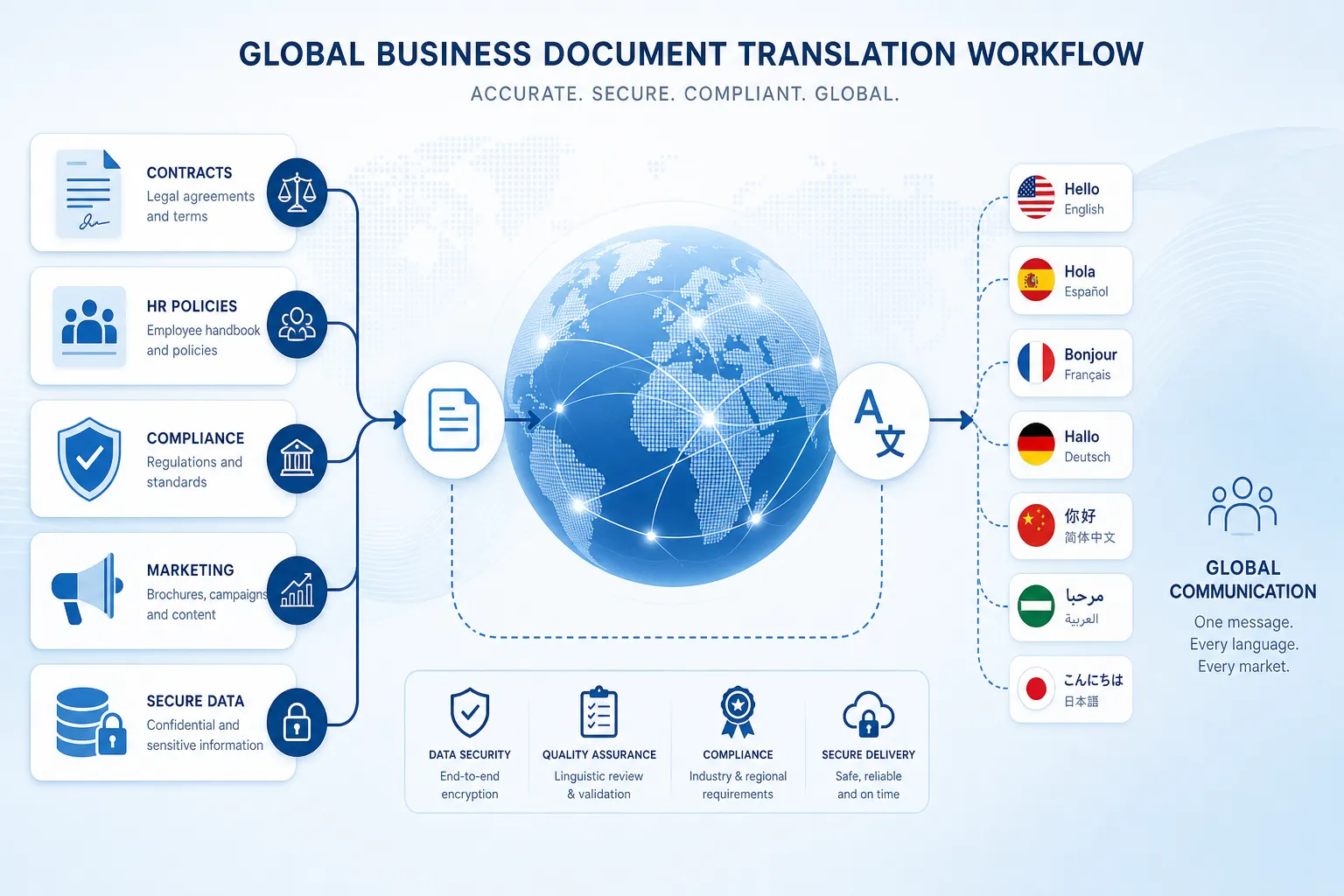
Not all providers offer the same level of quality control. If you are choosing a partner, look beyond price and turnaround time.
Accuracy with subject-matter understanding
A provider should match your project to translators who understand the field, whether that is legal, HR, healthcare, finance, technology, ministry, or events.
Consistent terminology
Business communication often repeats key phrases across many files. A strong provider uses glossaries, translation memory, and review processes to keep terms consistent across departments and projects.
Confidentiality and secure handling
Sensitive business documents may contain personal data, financial details, legal terms, or strategic information. Secure file handling, confidentiality practices, and careful access controls matter.
Formatting and usability
A translation should arrive ready to use, not as a messy text dump. Formatting, layout preservation, and readability affect how quickly your team can publish or distribute the final document.
Scalable support across channels
Many businesses do not just need a translated document. They also need multilingual meetings, live captions, subtitled video, remote interpreting, or on-site support. A partner that can connect these services reduces friction.
Responsive project management
Translation projects often move under deadlines. Fast communication, revision support, and reliable delivery are part of the service, not extras.
Where business translation projects often fail
Competitor articles tend to describe categories of translation, but they often do not explain the practical failure points clearly enough. Here are the most common ones.
Literal translation without context
A sentence can be technically translated but still fail in meaning, tone, or business intent.
Inconsistent terminology across documents
If one department calls it a “policy acknowledgment” and another version calls it a “compliance receipt,” confusion follows.
No plan for accessibility
Translating a handout is useful, but if your webinar has no captions or your event has no interpreting support, part of your audience is still excluded.
Using the wrong service for the job
A legal filing may require certified translation. A global town hall may require interpreting and live captioning. A product launch may need localization instead of direct translation.
Last-minute delivery with no workflow support
Urgent projects happen, but they go much better with a provider that has a process, a responsive team, and the ability to combine human expertise with AI-enabled efficiency where appropriate.
Human translation vs AI-powered workflows
This is one of the most important buyer questions today.
AI has made translation faster, but speed is not the same as readiness. For many business documents, the right answer is not human-only or AI-only. It is a managed workflow that uses technology wisely and human review where it matters.
When AI can help
AI-powered translation can be useful for:
-
Large volumes of lower-risk internal content
-
First-draft acceleration
-
Rapid multilingual processing with human oversight
-
Supporting faster turnaround on repetitive material
When human expertise is essential
Human translators are critical for:
-
Legal and compliance documents
-
HR policies and employee-facing materials
-
Brand-sensitive content
-
Nuanced executive communication
-
Accessibility-critical content
-
High-stakes event materials and public messaging
Team Stream’s approach is especially practical here. The company combines accurate human translation and interpreting with AI-enabled solutions where they make sense, allowing clients to balance speed, quality, accessibility, and budget without sacrificing trust.
How business document translation supports accessibility and inclusion
This is another area many articles underplay. Translation is not only about language. It is also about access.
If your business communicates through live events, internal meetings, training videos, webinars, conferences, church services, or broadcasts, written translation is only one part of the solution. Your audience may also need:
-
Real-time captioning for accessibility and engagement
-
Live interpreters for multilingual spoken communication
-
Subtitles for recorded video
-
Voiceover for multilingual media
-
Equipment rental and technician support for seamless delivery
-
Remote or in-person service options depending on the event format
For organizations focused on compliance, inclusion, or broader audience engagement, this integrated model matters. Team Stream stands out because it can support end-to-end language and accessibility needs rather than leaving clients to coordinate multiple vendors.
How the translation process usually works
A professional translation workflow should be clear and repeatable.
1. Discovery and scope
The provider reviews the document type, language pair, audience, deadline, formatting needs, and any compliance or certification requirements.
2. File review and preparation
Documents are checked for legibility, completeness, terminology issues, and formatting complexity.
3. Translation
A qualified linguist or team handles the content using the appropriate workflow and reference materials.
4. Editing and quality review
The translation is reviewed for accuracy, consistency, grammar, tone, and formatting.
5. Final formatting and delivery
The finished document is prepared in the requested format and delivered for review or immediate use.
6. Optional related services
Depending on the project, this may include certified translation, subtitling, captioning, interpreting, voiceover, or event support.
Questions to ask before hiring a translation provider
Use this checklist before committing:
|
Question |
Why it matters |
|---|---|
|
Do you handle this type of business document regularly? |
Confirms relevant experience |
|
How do you ensure terminology consistency? |
Reduces confusion across files |
|
Can you support certified translations if needed? |
Important for official use cases |
|
How do you protect confidential materials? |
Critical for legal, HR, and financial files |
|
Do you offer captioning, interpreting, or event support too? |
Useful for live and hybrid communication |
|
Can you work in both remote and in-person environments? |
Helps with flexible delivery needs |
|
What does your review process include? |
Reveals quality standards |
When businesses should combine translation with interpreting and captioning
Some of the strongest outcomes come from pairing document translation with live communication support.
Examples include:
-
Translating event agendas and providing on-site interpreters
-
Translating training manuals and adding live captions during training sessions
-
Localizing presentation decks and supporting the meeting with remote interpreters
-
Translating church materials and offering multilingual captioning or voiceover
-
Preparing multilingual trade show collateral and supporting booth interactions live
This is a major advantage of working with Team Stream. With more than 25 years of experience, the team can tailor a solution that covers pre-event documents, live language access, accessibility, and post-event media support under one roof.
Signs you need business document translation services now
You likely need professional support if:
-
You work with multilingual employees, customers, attendees, or partners
-
Your contracts or policies are being shared across borders
-
You are planning a live, virtual, or hybrid event with diverse audiences
-
You need accessible communication for compliance or inclusion goals
-
Your team is currently relying on ad hoc bilingual staff or machine tools alone
-
You want one partner for translation, captioning, interpreting, and production support
Why Team Stream is a smart choice for modern business communication
Many vendors can translate a file. Fewer can help your organization communicate clearly across documents, meetings, videos, and live experiences.
Team Stream brings together:
-
Accurate human and AI-powered translation and interpreting
-
Real-time captioning for accessibility and engagement
-
End-to-end language and accessibility solutions tailored to each client
-
Support for live, virtual, and hybrid events
-
Compliance-friendly services for inclusive communication
-
Equipment rental and technician support
-
Flexible in-person and remote delivery
-
More than 25 years of experience
-
Strong customer service and responsive execution
That combination is especially valuable for corporate teams, event producers, churches, broadcast environments, and organizations that cannot afford communication gaps.
Final thoughts
Business document translation services are about much more than converting text from one language to another. They protect clarity, trust, compliance, and accessibility across every part of your organization.
If your business needs multilingual documents that are accurate, professional, and ready for real-world use, choose a partner that understands the full communication picture. Team Stream helps organizations go beyond basic translation with integrated language access, captioning, interpreting, subtitling, voiceover, and event support solutions designed for modern business needs.
When the stakes include legal accuracy, employee understanding, audience engagement, and inclusive communication, the right provider is not just a vendor. It is a strategic partner.
FAQ
How does a document translator work?
A document translator reviews the source file, translates the content into the target language, and checks for accuracy, tone, terminology, and formatting. Professional providers often add editing, quality review, and optional services like certification, localization, or accessibility support.
What are the 7 procedures of translation?
A practical seven-step workflow often includes discovery, file review, preparation, translation, editing, quality assurance, and final delivery. Some projects also include localization, certification, or related services like captioning and interpreting.
What are the different types of document translators?
Document translators often specialize by field, such as legal, business, HR, financial, medical, technical, or marketing translation. The best choice depends on the document’s purpose, risk level, and required subject-matter expertise.
What are the different types of document translators?
Some translators focus on certified translation for official use, while others focus on localization, corporate communications, or industry-specific content. Businesses should look for a provider whose experience matches both the document type and the communication setting.
How much does it cost to translate a document?
Pricing varies based on language pair, word count, complexity, turnaround time, certification needs, and formatting requirements. Costs may also increase when projects include localization, live interpreting, captioning, or other accessibility services.
