

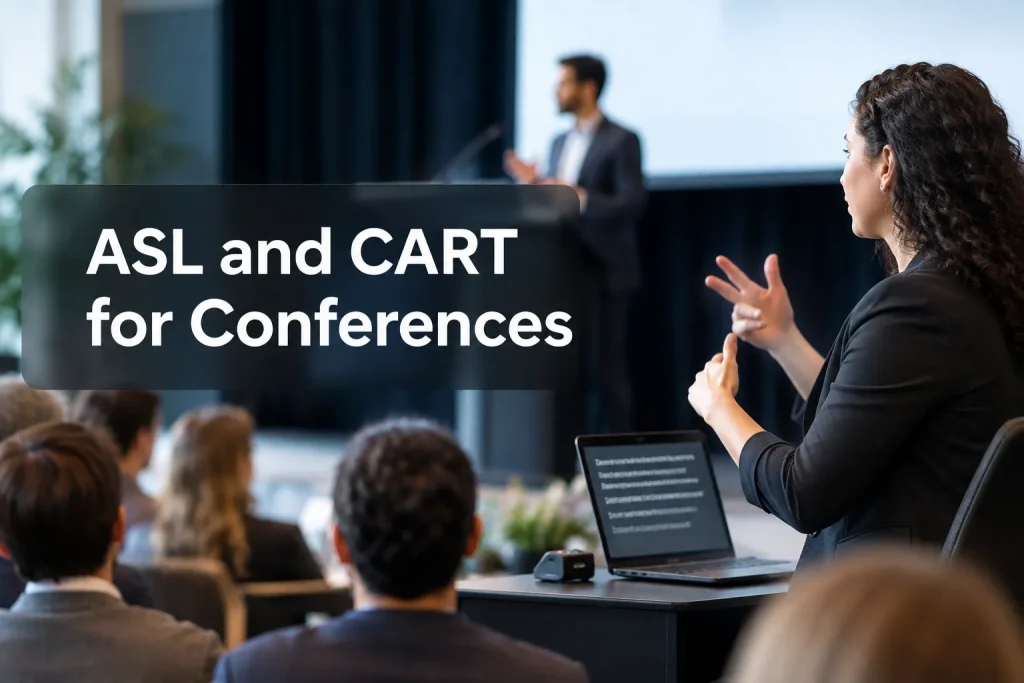
For a U.S. conference, attendees may need American Sign Language (ASL) interpreting, real-time text through CART captioning, or both to follow a session. Ask registrants which accommodations they need. Then arrange coverage for the keynotes, breakouts, Q&A and remote feeds they will use. A microphone, auto-captions or an interpreter on the main stage alone may leave parts of the event inaccessible.
ASL interpreting and CART: what each provides
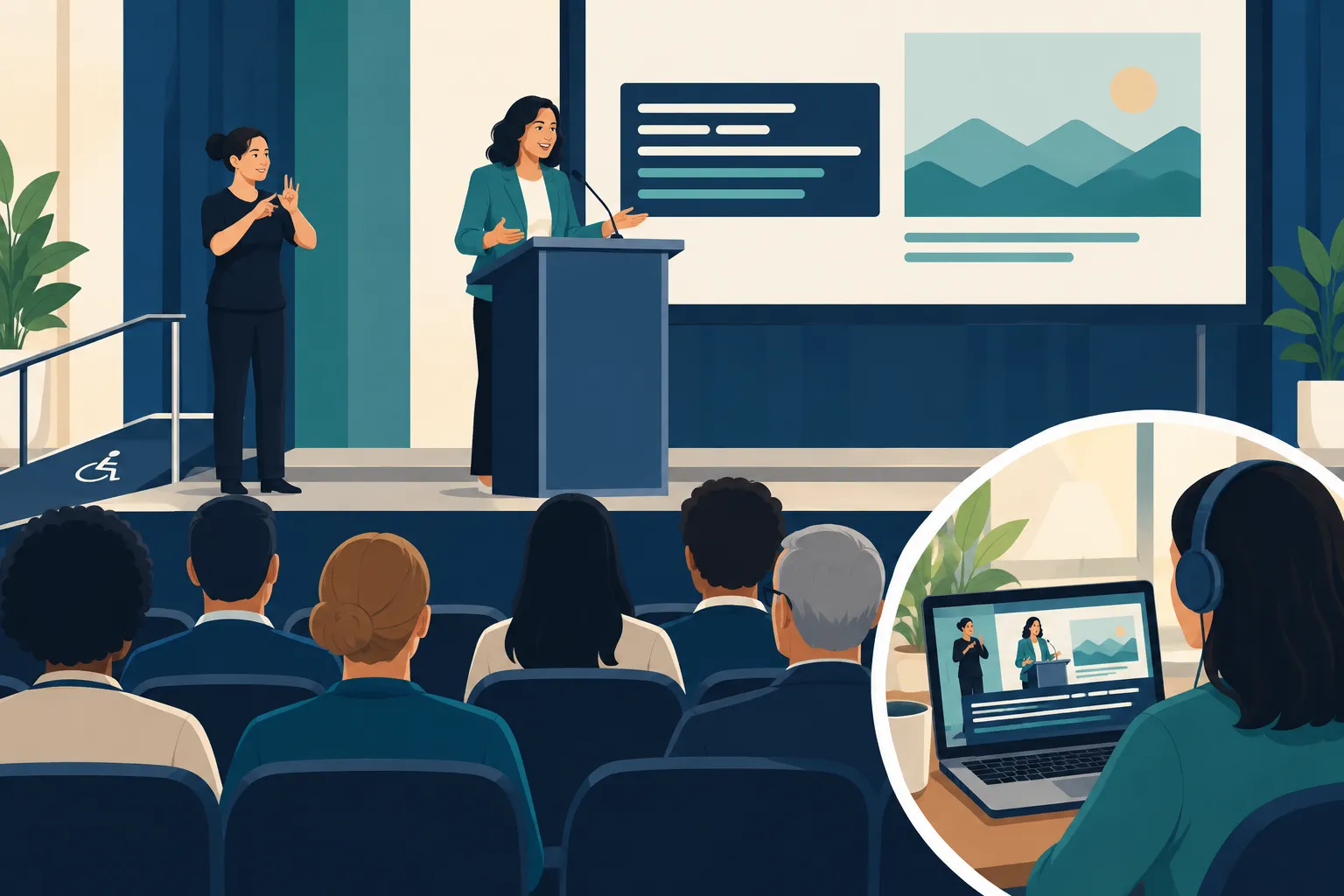
ASL interpreters render spoken content into ASL and, when needed, signed contributions into spoken English. For that exchange to work, they need to hear and see participants; attendees need a clear view of them. ASL is a language rather than a word-for-word visual transcript of English.
CART stands for Communication Access Realtime Translation. A trained captioner turns speech and relevant audible information into live text, which attendees can read on a display or compatible personal device, depending on the setup. Someone who needs ASL interpreting cannot use the text feed as a substitute.
|
Question |
ASL interpreting |
CART captioning |
|---|---|---|
|
What does the attendee receive? |
Live signed-language access to the session |
Live English text of speech and relevant sounds |
|
What must production provide? |
Clear audio and sightlines or a stable, visible video feed |
Clean audio, a caption delivery path and a readable display |
|
Where does it need planning? |
Interpreter positioning, lighting, camera framing and two-way participation |
Caption placement, speaker identification, technical vocabulary and feed testing |
|
Can it replace the other? |
Not for someone who needs live text |
Not for someone who needs ASL interpretation |
Live CART and automatic captions work differently. Automatic speech recognition may help in some settings, but names, jargon, overlapping speakers and poor audio can make uncorrected output unreliable. Ask whether a person will caption the session and who will monitor the output.
When conference interpreting needs ASL, CART or both
Start with access requests rather than guessing what a Deaf or hard-of-hearing attendee will prefer. A person may use ASL, live text, both, or a different aid. Give registrants an accessible way to request an accommodation and a contact who can discuss the details.
|
Situation |
Plan |
|---|---|
|
An attendee requests ASL interpreting |
Arrange qualified ASL interpreters for the sessions and participation points that attendee will use. |
|
An attendee requests real-time captions |
Provide CART or another effective live captioning arrangement across the relevant sessions. |
|
Attendees request both, or different attendees need different formats |
Provide both; an ASL feed and a text feed serve different access needs. |
|
No one has requested an accommodation yet |
Make the request process visible, assess the format and audience, and plan how to add services if needed. |
For a panel, cover audience questions and answers as well as prepared remarks. At concurrent breakouts, a single interpreter or captioner cannot cover two rooms at once. Map access by session, time, room and online feed; include networking or other programmed activities where communication access is needed.
What about spoken-language conference interpreting?
Conference interpretation can also mean interpretation between spoken languages. Simultaneous interpretation runs alongside the speaker, often via a separate audio channel; consecutive interpreting follows pauses. At international conferences with several languages, those interpreting services address spoken-language barriers, while ASL interpreting and CART address different access needs. Give each service its own audio route and tell participants how to use it. If the program also needs written translation of slides or handouts, scope that separately from live interpretation.
Plan for in-person, virtual and hybrid sessions
In-person: protect the view and the sound
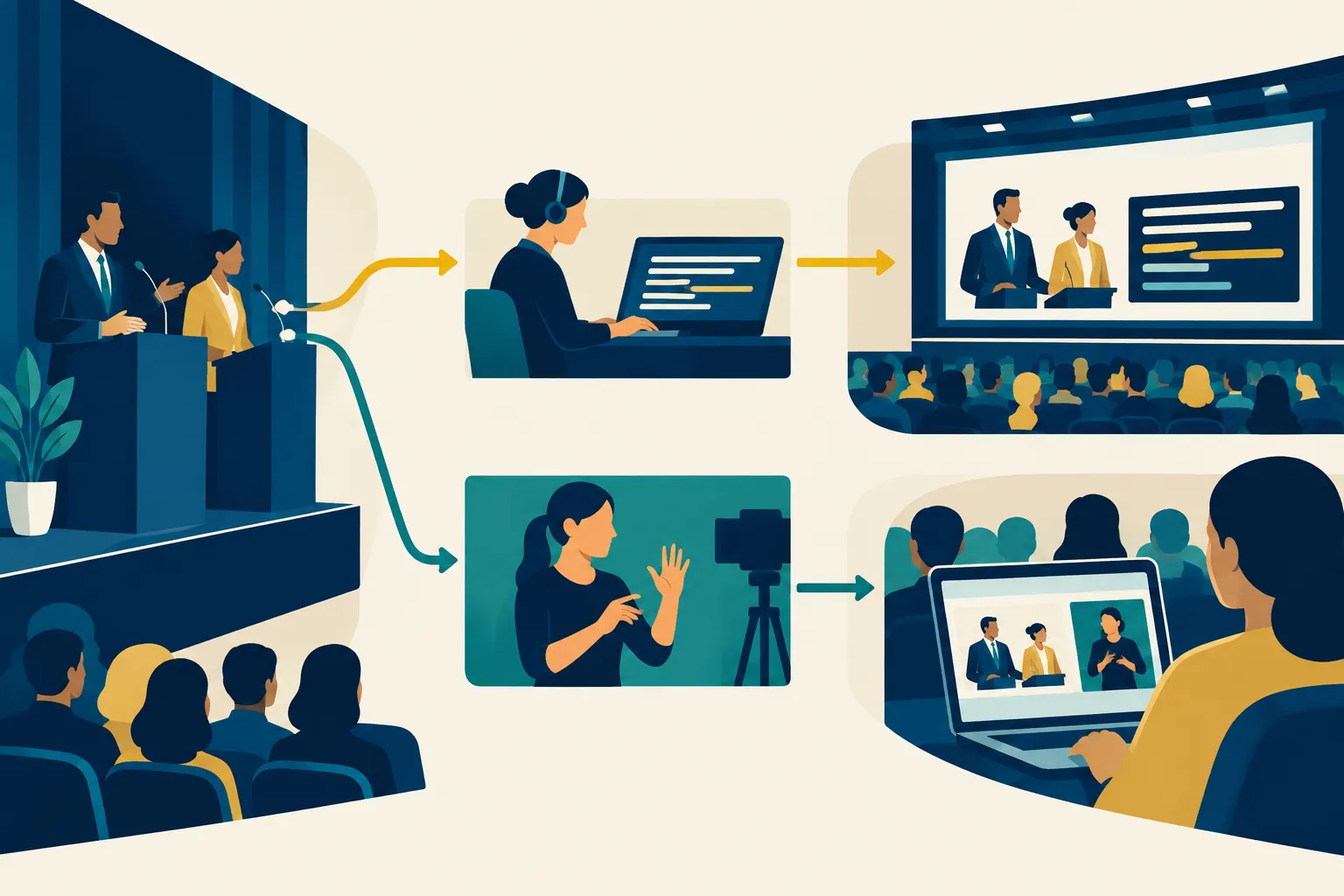
An attendee should be able to see the interpreters and the speaker or presentation without turning back and forth constantly. Light the interpreters’ hands and faces, reserve useful seating and keep cameras and furniture out of the sightline. Feed room microphones to the captioner, including the roaming mic for questions. Decide where CART text will appear and read it from the seats during rehearsal.
Virtual: make access available inside the attendee journey
Walk through the event as a viewer: can you find and pin the ASL interpreter while viewing the slides and speaker? Can you read the live captions in the meeting platform, livestream and any separate viewing page? A feed visible only in the production console will not help attendees. Remote interpreters and captioners also need stable program audio, a way to follow speaker changes and a technical contact during the event.
Hybrid: test both experiences independently
A remote viewer may lose sight of an interpreter who is perfectly visible from the front row. Give that viewer a framed interpreter feed instead of relying on a wide stage shot. Check the in-room CART display and streamed captions separately. Rehearse the handoff between a remote speaker and a room microphone, run a question from each audience and follow the access feeds into the breakouts.
Accessibility and compliance in the United States
The Americans with Disabilities Act (ADA) addresses effective communication and auxiliary aids and services. Obligations depend on who runs the event, where it takes place and how it is delivered. Qualified interpreters and real-time captioning are among the relevant aids; the effective choice depends on the communication, its setting and the individual. An attendee who requests ASL may still need it when captions are available. Another attendee may need text even when the event has an ASL interpreter.
“The ADA requires that title II entities (State and local governments) and title III entities (businesses and nonprofit organizations that serve the public) communicate effectively with people who have communication disabilities.” – U.S. Department of Justice, ADA.gov
Invite accommodation requests early and discuss the requested format with the attendee. Record the arrangement for each session, then coordinate microphones, display space and feeds with the venue and platform operator. If you plan to distribute a recording, scope its captioning and publishing work separately; the live feed may not be ready to publish.
What to ask a provider before booking
Send the provider a program with session times, overlapping tracks, rooms, virtual platforms, speaker locations and audience participation. Use it to ask:
-
Who will deliver the service? Ask how interpreters are matched to the subject and setting, and whether CART is delivered by a trained human captioner, automated software or a combination. Ask who handles corrections or troubleshooting live.
-
How is a full-day schedule staffed? Share actual session lengths and overlapping tracks. Ask how breaks, handoffs, substitutions and last-minute changes will be handled without leaving gaps in access.
-
What will attendees see? Request a diagram or walkthrough of interpreter placement or video pinning, caption display, and the steps a viewer takes to turn access on.
-
What audio and network paths are required? Identify the source microphones, mix-minus or return audio needs, internet connections, platform permissions and a backup route if the primary feed fails.
-
How will preparation work? Share names, acronyms, slides and speaker lists securely before the event. Ask who will receive changes and how session-specific terminology reaches the right professionals.
-
Who owns the show-day handoff? Name a producer and an accessibility contact. Set a rehearsal time and an escalation path for missing audio, unreadable captions or a lost interpreter feed.
-
What happens after the event? If you need transcripts, edited captions or accessible recordings, scope these deliverables explicitly rather than assuming they come with live service.
Before doors open, test a speaker, a panel exchange and a question from the room or chat. Watch the ASL view and read the captions from the attendee’s position. Instruct presenters to use microphones so the access providers hear every contribution.
Choose support for the whole conference
Book ASL interpreting when attendees need signed-language access, CART when they need real-time text, and both when the event must serve both needs. Map those services to the actual agenda before choosing a vendor; the success of conference interpreting depends as much on production and handoffs as on the professionals providing access.
Team Stream can coordinate interpreting, live captioning and event support for in-person, virtual and hybrid programs, including equipment and technician needs. Bring the team your agenda and access requests to scope the right combination. Even with a capable provider, an undefined program or an untested feed can leave gaps on show day. Allow time for a rehearsal.
FAQ
What are the three types of interpreting?
A common way to group spoken-language interpreting modes is simultaneous, consecutive and whispered interpreting. Conference programs may also need ASL interpreting, which serves signed-language access, and CART captioning, which provides live text rather than interpreting. Choose the delivery method according to the session and the people using it.
