

Choose foreign language document translation services based on the finished material you need and the review it requires. A contract needs a different specialist from an event presentation; an employee handbook has its own audience and format. Before requesting prices, identify the document’s purpose and any related website, video or live-event content.
Then request quotes for finished, approved files. A page price alone will not tell you what the provider will deliver.
Match the service to the material
Start with what your audience needs to read, watch or hear:

|
Need |
Appropriate service |
What to ask for |
|---|---|---|
|
Contracts, policies, manuals or reports |
Written translation with subject-matter review |
Editable files, terminology decisions and a final layout check |
|
Records submitted to an institution |
Certified translation, if the recipient requires it |
A signed accuracy statement and any recipient-specific formatting |
|
Website pages or campaign copy |
Translation and localization |
Local conventions, tone, navigation and in-context testing |
|
Prerecorded video |
Translated subtitles, captions or voiceover, depending on the audience |
Timed files, readability review and an accessible version |
|
Live meeting, worship service or conference |
Interpreting and live captioning |
Language channels, audio setup, platform compatibility and a rehearsal |
A translated subtitle renders speech in another language. Captions include relevant sounds and speaker information for viewers who need access to audio. Interpreters work with live speech, while translators work from fixed source material. You may need both for a conference with advance handouts and live sessions.
When do documents need certification?
A certified translation generally comes with a signed statement attesting to its completeness and accuracy. Notarization is a separate requirement, and professional work does not automatically include certification. For an official submission, the receiving institution sets the rules. Give the provider the recipient and purpose when you order foreign document translation services.
For submissions to U.S. Citizenship and Immigration Services (USCIS), the rule is specific:
“Any document containing foreign language submitted to USCIS shall be accompanied by a full English language translation which the translator has certified as complete and accurate”. – 8 CFR § 103.2(b)(3)
The same rule requires the translator to certify competence to translate into English. Other recipients set their own requirements.
Choose the right workflow for each document
The recipient and the consequences of an error should determine who translates each file and who reviews it.
|
Document category |
Examples |
Review priority |
|---|---|---|
|
Official and academic records |
Birth certificates, marriage licenses, academic transcripts and diplomas |
Names, dates, seals, completeness and any required certification |
|
Legal and financial documents |
Agreements, policies, statements and disclosures |
Defined terms, figures, obligations and specialist review |
|
Technical and safety materials |
Manuals, instructions and training slides |
Consistent terminology, warnings, diagrams and units |
|
Public and internal communications |
Web pages, brochures, employee notices and email |
Audience fit, tone, readability and publication layout |
For official records, a professional translator should preserve the meaning and mark illegible text instead of guessing. An institution may require certified English translations even when an internal copy does not. For recurring business content, keep an approved glossary and a record of review decisions.
Scope foreign language document translation services before requesting quotes
One brief sent to every provider makes the differences between their quotes easier to spot. Include:
-
The assets: file types, approximate word counts, scanned pages, tables, graphics, embedded text and any video or website content. Supply editable originals where possible rather than only a flattened PDF.
-
Languages and audiences: identify the target locale as well as the language. A Spanish-language safety notice for one market may use different terms from a campaign for another.
-
The intended use: internal understanding, publication, legal submission, customer onboarding or a live event. Flag safety, medical, legal and regulatory passages for specialist attention.
-
Reference material: approved terms, previous translations, brand voice and product names. Name the person who will settle wording questions.
-
Delivery details: editable documents, print-ready PDFs, CMS-ready strings, subtitle files or accessible media, along with the launch date and review window.
Scanned foreign-language documents may need text extraction and layout reconstruction; request both in the quote. For a multilingual presentation, specify whether slide text, speaker notes, diagrams and on-screen video text are included.
Evaluate providers beyond the per-word price
If editing, desktop publishing or revisions are missing from a low quote, the final cost may be quite different. Ask each provider to describe what happens between receipt of the source file and your approval.

Subject expertise and terminology
Legal, medical, financial and technical work requires subject knowledge alongside language skill. Find out who will translate the material, what relevant experience they bring and who settles disputed terms. Send those questions to your subject owner. For marketing copy, have a reviewer judge tone and local fit on the finished page, not only in a spreadsheet.
Human review and AI use
For repeat content, AI-assisted translation used with an approved glossary can save time. Assign human review to high-stakes and public-facing material. Ask which files a person edits, whether a second linguist checks the work and who settles disagreements. With confidential files, establish whether the provider uses machine translation, where processing takes place, who has access and how long the files are retained.
Production and accessibility
Ask for the formats your organization will publish. Review website copy in navigation, buttons and forms; inspect a translated PDF for clipped text, reading order and legibility. Video work may also need timed subtitles, captions or voiceover. Include accessibility in both the initial scope and the final inspection.
Reliability and accountability
Agree on milestones and included revisions with your project contact. Each language also needs a sign-off owner. If the source changes mid-project, you should know how the provider will handle the update. A small pilot with representative material can expose terminology and layout problems before a larger release.
Compare quotes on the same scope
Foreign language translation services may charge by source word, target word, page, hour or project. Scans, less common language pairs, specialist review, rush deadlines and desktop publishing affect the total. Page rates are difficult to compare when one page has a few lines and another is full of text.
|
Quote line |
Clarify before choosing |
|---|---|
|
Translation unit |
Source or target words, page definition, minimum charge and treatment of repeated text |
|
Quality control |
Editing, independent review, glossary management and in-context approval |
|
File preparation |
OCR for scans, formatting, graphics and final PDF or source-file delivery |
|
Media and web |
Subtitle timing, caption creation, voiceover, CMS integration and testing |
|
Changes |
Included revision rounds, source changes after kickoff and correction policy |
|
Schedule |
Draft, review, final delivery and any rush surcharge |
Give each candidate the same source sample and output requirements. The figure to compare is the cost of the approved, usable file. On ongoing programs, translation memory can reduce repeated work, but reused text still needs an editing and billing policy.
Specify accessible deliverables
Put the access format in the purchase order. A print-ready translated PDF and a screen-reader-friendly document call for different work. Specify structured headings, logical reading order and meaningful text alternatives where needed. Inspect the file that will be published, not just the draft.
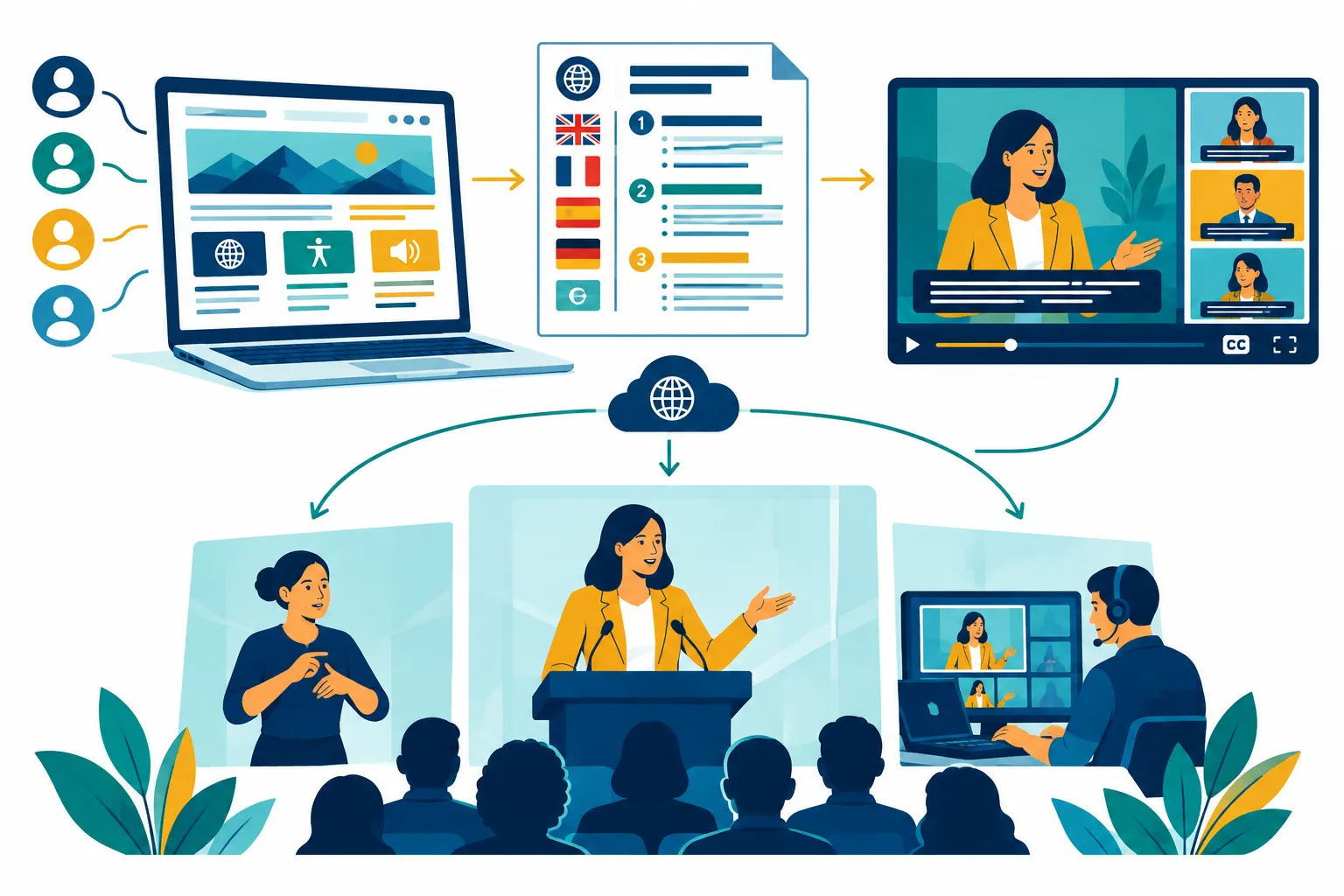
Translated subtitles let viewers follow speech in another language; captions convey relevant audio information. If you will share a hybrid-event recording, plan how viewers will access the interpretation or caption feed afterward. Assign an approver to each language and accessibility output before production.
Plan the handoff for websites, video and events
Review translated content where your audience will see or hear it. A correct sentence is little help if the website button cuts off its last word or a slide is unreadable.
-
Websites: Export text with context and protect variables, links and product names. Review the result in the actual page to catch overflow, broken navigation and ambiguous buttons.
-
Documents: Keep track of source versions. After translation, inspect tables, footnotes, charts and any right-to-left layout in the final file.
-
Video: Provide a transcript, speaker identification and a preferred pronunciation list. Decide whether the deliverable is translated subtitles, closed captions, voiceover or a combination; review timing and on-screen text together.
-
Live and hybrid events: Written scripts and slides can be translated in advance, while interpreters and live captioners handle what speakers say in real time. Coordinate platforms, audio feeds, equipment and technical support before the event.
Team Stream offers written translation alongside interpreting, live and closed captioning, subtitling, voiceover, equipment and technicians. You could use those services for the handout, recording and live session of the same presentation. For a standalone certified filing, give the provider the receiving agency’s requirements and request the matching deliverable.
What a good delivery and review cycle looks like
Before work begins, assign someone to answer source questions and a qualified reviewer for each target language. Have reviewers assess the material in context and submit feedback in one list, so the provider can act on one agreed set of changes.
At delivery, inspect a representative set of outputs against this checklist:
-
Are names, numbers, dates, units, warnings and approved terms correct?
-
Is any text missing from tables, screenshots, diagrams or footnotes?
-
Does the published layout remain readable, including on small screens?
-
Do subtitles or captions match the audio and remain readable at normal playback speed?
-
Are accessibility and recipient-specific requirements present in the final files?
-
Can your team update the content later without starting over?
Separate errors from style preferences in that list. Once the provider has made the agreed changes, inspect the final format and save the approved glossary for the next update.
Choose a partner for the full communication journey
If you have one document, hire for that subject and agree on review and recipient-ready delivery. A campaign, broadcast or conference needs someone to own each handoff between written, video and live services.
Team Stream combines human expertise and AI-enabled language services with captioning, interpreting and production support for in-person, virtual and hybrid communication. That breadth suits an accessibility or multilingual program. For one simple file, compare providers on the narrower assignment. If your project spans channels, share the source assets, audiences and delivery formats with Team Stream to plan the work.
FAQ
What is a certified translation service?
It provides a translation with a signed statement attesting that it is complete and accurate. The receiving institution sets its own requirements, so name the recipient when requesting the service. Certification is distinct from notarization.
How much does it cost to get a certified translation?
There is no single price for every document. Language pair, document length, formatting, turnaround and the recipient’s requirements affect the quote. Request an itemized total that includes the certification statement and final file format.
