

FR English Translation: AI vs Human Accuracy
If you need French-to-English translation that is fast, natural, and dependable, the real question is not whether AI is “good” or whether humans are “better.” The real question is: what level of accuracy does your content actually require, and what are the risks if the translation is slightly wrong?
For event organizers, internal communications teams, conference planners, churches, broadcasters, and global businesses, that distinction matters. A rough AI draft may be fine for internal reference. But when the content is public-facing, compliance-sensitive, brand-sensitive, or audience-critical, accuracy means more than word substitution. It means tone, cultural fit, terminology consistency, accessibility, and trust.
At Team Stream, we see this every day across live events, written translation, captioning, subtitling, interpreting, and multilingual content delivery. With more than 25 years of experience, our team helps clients choose the right mix of accurate human expertise and AI-enabled efficiency so they get the result they need without overpaying or under-delivering.
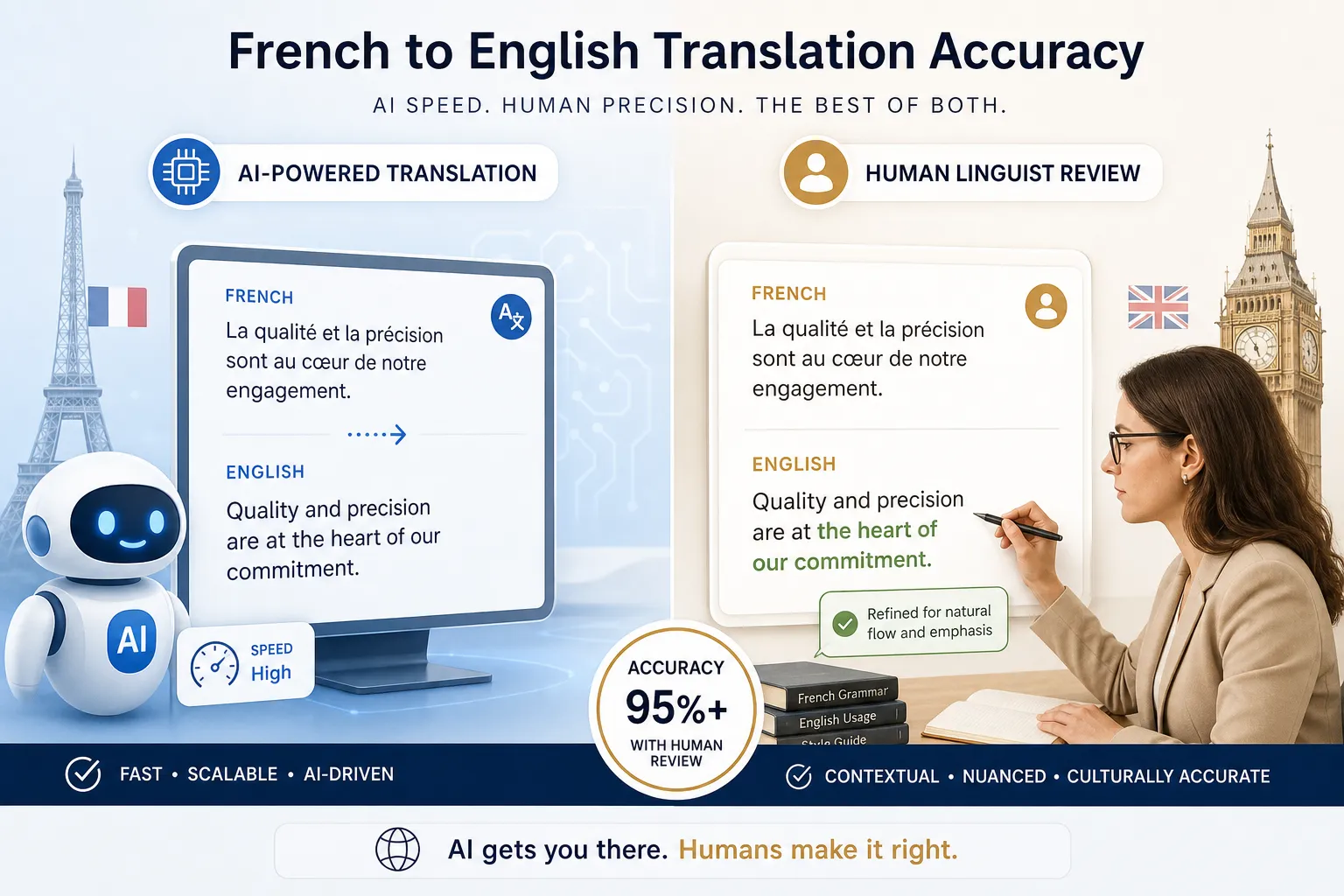
What people really mean by “accurate” French-to-English translation
When someone searches for the best English translation or a perfect English translation, they usually do not mean “word-for-word exactness.” They mean something closer to this:
-
The meaning is preserved
-
The English sounds natural, not translated
-
Industry terms are correct
-
Tone matches the situation
-
Nothing embarrassing, risky, or confusing slips through
That is why FR English translation quality is not judged on vocabulary alone. A technically correct sentence can still sound awkward, robotic, overly literal, or even misleading.
Accuracy has multiple layers
Here is a practical way to evaluate translation quality:
|
Layer of Accuracy |
What It Means |
Why It Matters |
|---|---|---|
|
Semantic accuracy |
The meaning is correct |
Prevents factual errors |
|
Terminology accuracy |
Specialized words are right |
Essential in legal, medical, technical, and corporate content |
|
Tone accuracy |
Formal, warm, persuasive, urgent, or neutral as intended |
Protects brand voice and audience trust |
|
Cultural accuracy |
Idioms, references, and expectations are adapted well |
Prevents confusion or offense |
|
Functional accuracy |
The translation achieves its purpose |
Critical for marketing, events, and audience engagement |
A better English translation is usually the one that works best for the audience, not the one that mirrors the French most closely.
Why French-to-English translation is harder than it looks
French and English overlap enough to create a false sense of simplicity. Many phrases look easy until nuance enters the picture.
Literal translation often fails
French tends to allow longer sentence structures, more formal constructions, and idiomatic phrasing that can sound stiff in English if translated too directly.
For example, French business writing may sound polished and sophisticated in French but overly formal or unnatural in English unless adapted carefully.
Small choices create big differences
A single French phrase may have several valid English versions depending on:
-
Audience
-
Region
-
Industry
-
Context
-
Brand voice
-
Medium
That matters whether you are translating:
-
conference agendas
-
booth materials
-
event signage
-
internal memos
-
executive statements
-
training content
-
subtitles
-
captions
-
customer-facing web copy
Where AI English translation performs well
AI English translation has improved dramatically. For speed, cost control, and first-pass drafting, it can be extremely useful.
AI is often a strong option for:
-
high-volume internal content
-
repetitive text
-
early-stage drafts
-
basic reference translations
-
simple informational copy
-
multilingual workflows with human review
For many organizations, the smartest workflow is not AI or human. It is AI plus qualified human oversight.
At Team Stream, that is often the most efficient model: use AI to accelerate output where appropriate, then apply expert review to protect clarity, terminology, accessibility, and final quality.
Where AI translation still breaks down
The biggest weakness of AI is not always obvious grammatical error. More often, it is false confidence. The output looks polished, but subtle meaning, tone, or context may be off.
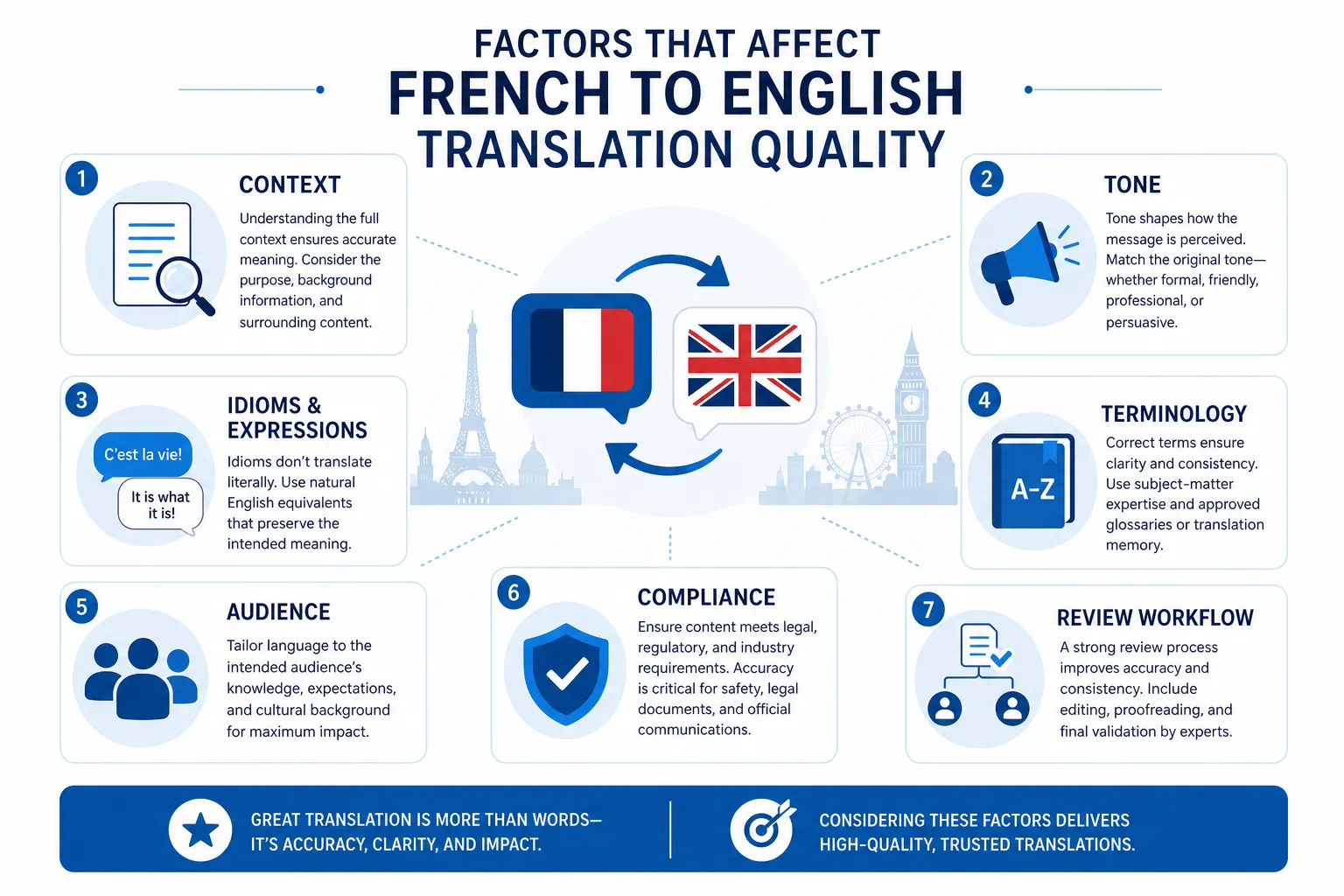
Common AI problems in FR English translation
1. Overly literal phrasing
The content is technically understandable but does not sound native.
2. Missed tone
A formal investor message may become flat. A warm welcome message may become cold.
3. Inconsistent terminology
AI may translate the same phrase differently across slides, documents, captions, or pages.
4. Weak handling of idioms and implied meaning
French often relies on phrasing whose effect matters more than its literal wording.
5. Context blindness
A term in an event program may need a different translation than the same term in a legal document or live subtitle.
6. Brand voice erosion
Marketing and executive content often lose personality under pure machine output.
7. Accessibility issues
Even if the translation is understandable, it may not be optimized for captions, reading speed, subtitle length, or multilingual audience comprehension.
Human translation: what it adds that AI cannot reliably guarantee
Human translators do more than convert language. They interpret intent, evaluate context, and make judgment calls.
That matters most when the content has consequences.
Human translators are strongest when your content needs:
-
brand-sensitive messaging
-
nuanced tone
-
audience adaptation
-
legal or regulated language control
-
multilingual consistency across assets
-
event-ready captioning or subtitling
-
compliance-friendly accessibility support
For example, in a live or hybrid event, translation is not just about words on a page. It may connect to:
-
real-time interpreting
-
live captioning
-
closed captioning
-
subtitling
-
scripts for voiceover
-
on-screen graphics
-
multilingual attendee support
That is where Team Stream offers a practical advantage. We do not treat translation as an isolated service. We connect it to the full communication environment: live, virtual, hybrid, recorded, and accessible.
AI vs human accuracy: a direct comparison
|
Factor |
AI Translation |
Human Translation |
|---|---|---|
|
Speed |
Extremely fast |
Slower, depending on complexity |
|
Cost |
Lower upfront cost |
Higher upfront cost |
|
Basic comprehension |
Often strong |
Strong |
|
Natural English style |
Inconsistent |
Strong |
|
Idioms and nuance |
Unreliable |
Strong |
|
Industry terminology |
Varies by engine and prompt |
Strong with subject expertise |
|
Brand voice |
Often generic |
Tailored |
|
Consistency across assets |
Can drift |
Managed intentionally |
|
Confidential handling |
Depends on platform and workflow |
Easier to control with professional process |
|
Accessibility optimization |
Limited without human workflow |
Strong when managed by specialists |
What a “perfect” translation actually looks like in business
A perfect English translation is rarely the one that mirrors every French structure. It is the one that makes the English reader feel the content was originally written for them.
That usually means the translation is:
-
clear
-
idiomatic
-
audience-aware
-
purpose-driven
-
consistent
-
polished
-
reviewed
In event production and multilingual communication, perfection also means the translation works in the real world:
-
it fits on slides
-
it reads well in captions
-
it sounds right in voiceover
-
it aligns with speaker delivery
-
it supports accessibility and inclusion goals
The biggest content gap most articles miss: translation quality depends on the use case
Many AI vs human translation articles stay too general. The truth is, the right choice depends on where the translation will appear and how much risk the message carries.
A practical decision framework
|
Use Case |
AI Only |
AI + Human Review |
Human First |
|---|---|---|---|
|
Internal notes |
Good option |
Better if shared broadly |
Usually unnecessary |
|
Event agendas |
Sometimes |
Recommended |
Best for VIP/public use |
|
Marketing copy |
Risky |
Often workable |
Best |
|
Executive communications |
Risky |
Sometimes |
Best |
|
Legal documents |
Not recommended |
Limited |
Essential |
|
Medical or safety content |
Not recommended |
Limited |
Essential |
|
Subtitles and captions |
Limited |
Strong option |
Best for high-visibility content |
|
Website localization |
Limited |
Strong option |
Best for key pages |
This is exactly why Team Stream uses a tailored approach instead of one-size-fits-all packages. Some clients need rapid multilingual support. Others need a compliance-friendly, brand-safe workflow with interpreters, captions, translation, equipment, and technicians all coordinated under one partner.
How to judge whether a translation is actually good
If you are not bilingual, judging translation quality can feel impossible. But there are warning signs and review methods that help.
Signs a translation may be weak
-
It sounds stiff or unnatural in English
-
It uses inconsistent terminology
-
It feels too generic for the brand
-
It misses implied meaning or emotional tone
-
It reads like a translation instead of original English
-
It creates subtitle or caption timing issues
-
Native English readers hesitate or reread lines
Smart quality checks
Ask who the audience is
Internal staff, attendees, customers, donors, investors, or regulators all require different standards.
Identify the risk level
If errors affect trust, compliance, accessibility, or public reputation, bring in human professionals.
Review a sample first
A short test can reveal whether AI output is good enough or whether it needs human refinement.
Check for delivery context
A document, a caption file, a voiceover script, and a live event glossary require different treatment.
Why event teams and communication leaders need a broader translation partner
Translation is rarely a standalone need. In real projects, it touches logistics, technology, audience experience, and accessibility.
That is especially true for:
-
conferences
-
trade shows
-
worship services
-
shareholder meetings
-
training sessions
-
product launches
-
virtual and hybrid broadcasts
A translated script may need to become captions. Captions may need to sync with a live stream. Interpreting may require equipment rental, receivers, transmitters, technician support, or remote delivery. Accessibility may require compliant captioning and a reliable team that can execute under pressure.
That is why organizations choose Team Stream. We combine:
-
accurate human and AI-powered translation and interpreting
-
real-time captioning for accessibility and engagement
-
end-to-end language and accessibility solutions
-
support for live, virtual, and hybrid events
-
compliance-friendly inclusive communication workflows
-
equipment rental and technician support
-
in-person and remote service delivery
-
over 25 years of hands-on expertise
-
responsive customer service and reliable execution
When AI is enough – and when it isn’t
A lot of buyers want a simple rule. Here it is.
AI is often enough when:
-
the content is low-risk
-
speed matters more than style
-
the translation is for internal understanding
-
the audience can tolerate rough edges
Human review is necessary when:
-
the content represents your brand
-
the audience is external
-
the translation must sound native
-
consistency matters across materials
-
the content supports accessibility deliverables
-
errors could create legal, reputational, or operational risk
Human-first translation is best when:
-
the message is high-stakes
-
the tone must be precise
-
the terminology is specialized
-
the content is public, regulated, or permanent
A better approach: human expertise guided by smart technology
The strongest translation strategy today is usually not anti-AI. It is AI-aware and quality-controlled.
That means using technology where it truly helps, while relying on experienced language professionals where judgment is required. For many clients, that is the sweet spot for quality, speed, and budget.
Team Stream is built for exactly that balance. We help clients decide when to use AI for efficiency, when to apply human review, and when to rely on full-service professional translation, interpreting, captioning, subtitling, voiceover, and technical event support.
Final verdict
If your goal is simply to understand French text quickly, AI may be enough.
If your goal is to publish, present, subtitle, caption, interpret, or broadcast that message in English with confidence, then human oversight still makes the difference between acceptable and excellent.
The best English translation is the one that preserves meaning, sounds natural, fits the audience, and performs in the real world. For businesses, event teams, churches, and communication leaders, that usually means using AI selectively and trusting professionals where it counts.
If you need French-to-English translation that is accurate, audience-ready, and connected to larger accessibility or event needs, Team Stream is ready to help. From written translation to live interpreting, captioning, subtitling, equipment, and technician support, we deliver flexible language access solutions that work in person, remotely, and at scale.
FAQ
How accurate is the AI translation?
AI translation can be very accurate for simple, low-risk content, especially when speed matters more than style. However, it often struggles with nuance, tone, idioms, terminology consistency, and audience-specific context, so human review is usually the safer choice for public-facing or high-stakes material.
What is the most accurate Translator for French to English?
The most accurate solution is usually a professional human translator supported by the right tools, not a single app. For business, event, legal, marketing, or accessibility-sensitive content, a qualified translator can adapt French meaning into natural English far more reliably than automated output alone.
What are the key differences between human translation and AI translation?
AI is faster and cheaper, while human translation is stronger at tone, context, creativity, terminology control, and natural phrasing. Human experts are also better for brand-sensitive, compliance-friendly, and accessibility-focused communication where small errors can have bigger consequences.
Which AI has the most accurate translation?
There is no universal winner because accuracy depends on language pair, content type, subject matter, and workflow. Some AI systems perform well on straightforward French-to-English text, but even strong engines benefit from human review when quality, nuance, and consistency matter.
How to tell if a translation is AI?
AI-generated translation often feels grammatically polished but slightly unnatural, overly literal, generic in tone, or inconsistent with terminology. If the English seems correct at first glance but lacks voice, context, or smooth phrasing, it may have been produced by AI without enough human editing.
