

Wolof Language Translator: English Translation Guide
Finding a reliable Wolof language translator can be harder than it looks. Many tools promise instant results, but when you need accurate Wolof to English communication for business, media, events, training, or community outreach, literal word replacement is rarely enough. Tone, context, dialect variation, audience expectations, and accessibility all matter.
For event organizers, conference producers, churches, corporate teams, and broadcast professionals, the stakes are even higher. A weak translation can confuse attendees, undermine trust, or create compliance and accessibility issues. A strong one helps people understand, participate, and act with confidence.
At Team Stream, we see translation as part of a bigger communication strategy. That means combining accurate human expertise with AI-powered support, offering interpreting and captioning when needed, and building solutions that work across live, virtual, and hybrid environments.
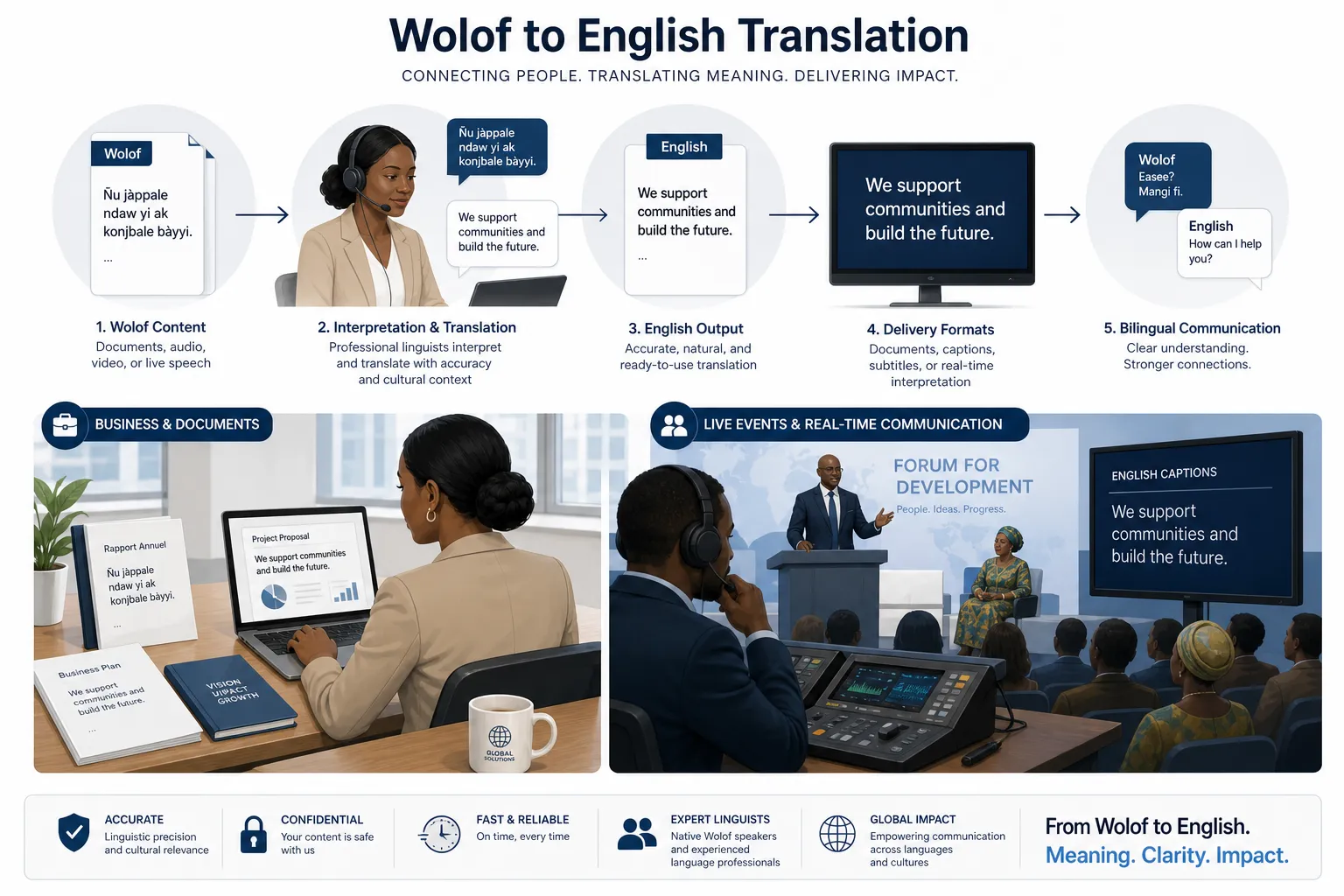
What Wolof translation actually involves
Wolof is one of the most important languages in Senegal and is also used in neighboring countries and diaspora communities. But translating Wolof into English is not just about converting words on a page.
A high-quality translation often requires attention to:
-
regional and speaker variation
-
idiomatic meaning rather than literal meaning
-
formality and social tone
-
audience literacy and communication style
-
subject-matter terminology
-
whether the content is spoken, written, live, or pre-recorded
This is why basic apps may be fine for casual phrase lookup, but not for contracts, subtitles, presentations, signage, training materials, public messaging, or live multilingual experiences.
Why machine-only translation often falls short
Machine translation has improved, but Wolof remains a language where context can make or break accuracy. Lower-resource languages often have fewer robust training datasets than global languages like Spanish or French. That can lead to awkward phrasing, missing nuance, and unreliable terminology.
A common mistake is assuming that if the output looks grammatical, it must be correct. In reality, it may still miss cultural meaning or speaker intent.
Common problems with automated Wolof to English output
|
Challenge |
What goes wrong |
Why it matters |
|---|---|---|
|
Literal translation |
Idioms become confusing or misleading |
Readers misunderstand the message |
|
Limited terminology |
Industry terms are translated inconsistently |
Brand, legal, or technical clarity suffers |
|
Tone mismatch |
Respect, urgency, or warmth gets flattened |
Audience trust drops |
|
Speech recognition issues |
Audio-based tools miss pronunciation or context |
Captions and transcripts become inaccurate |
|
No accessibility layer |
Translation is provided without captions, subtitles, or event support |
Audiences are excluded |
For organizations, those issues can impact audience engagement, operational clarity, and inclusivity.
When you can use an app, and when you need professional support
Not every project needs the same level of service. The key is knowing when simple is sufficient and when quality control matters.
A basic app may be enough for:
-
casual travel phrases
-
rough internal understanding
-
quick vocabulary checks
-
informal personal messages
Professional Wolof translation is the better choice for:
-
business communications
-
government or nonprofit outreach
-
video subtitles and captions
-
live events and conferences
-
training materials
-
public-facing marketing content
-
faith-based services with multilingual audiences
-
accessibility and compliance-sensitive communications
If people need to make decisions based on the content, accuracy matters more than speed alone.
What to look for in a Wolof language translator
If you are evaluating providers or tools, focus on more than just price or turnaround time. The best solution depends on your format, audience, and risk level.
1. Context awareness
A good translator understands whether the content is conversational, instructional, promotional, technical, or ceremonial. Context shapes vocabulary and tone.
2. Human review where needed
AI can support speed, but human review protects meaning. This is especially important for nuanced wolof translation projects, public communications, and brand-sensitive copy.
3. Support for spoken and live communication
Written translation is only part of the picture. Many organizations also need interpreting, live captioning, subtitling, or voiceover support.
4. Accessibility integration
Translation should not be siloed from accessibility. If your audience includes deaf or hard-of-hearing participants, multilingual communication should work alongside real-time captioning and inclusive event design.
5. Flexible delivery
You may need in-person support, remote delivery, or a hybrid model. A strong language partner can adapt to your technical setup and audience mix.
Wolof to English for events, meetings, and broadcasts
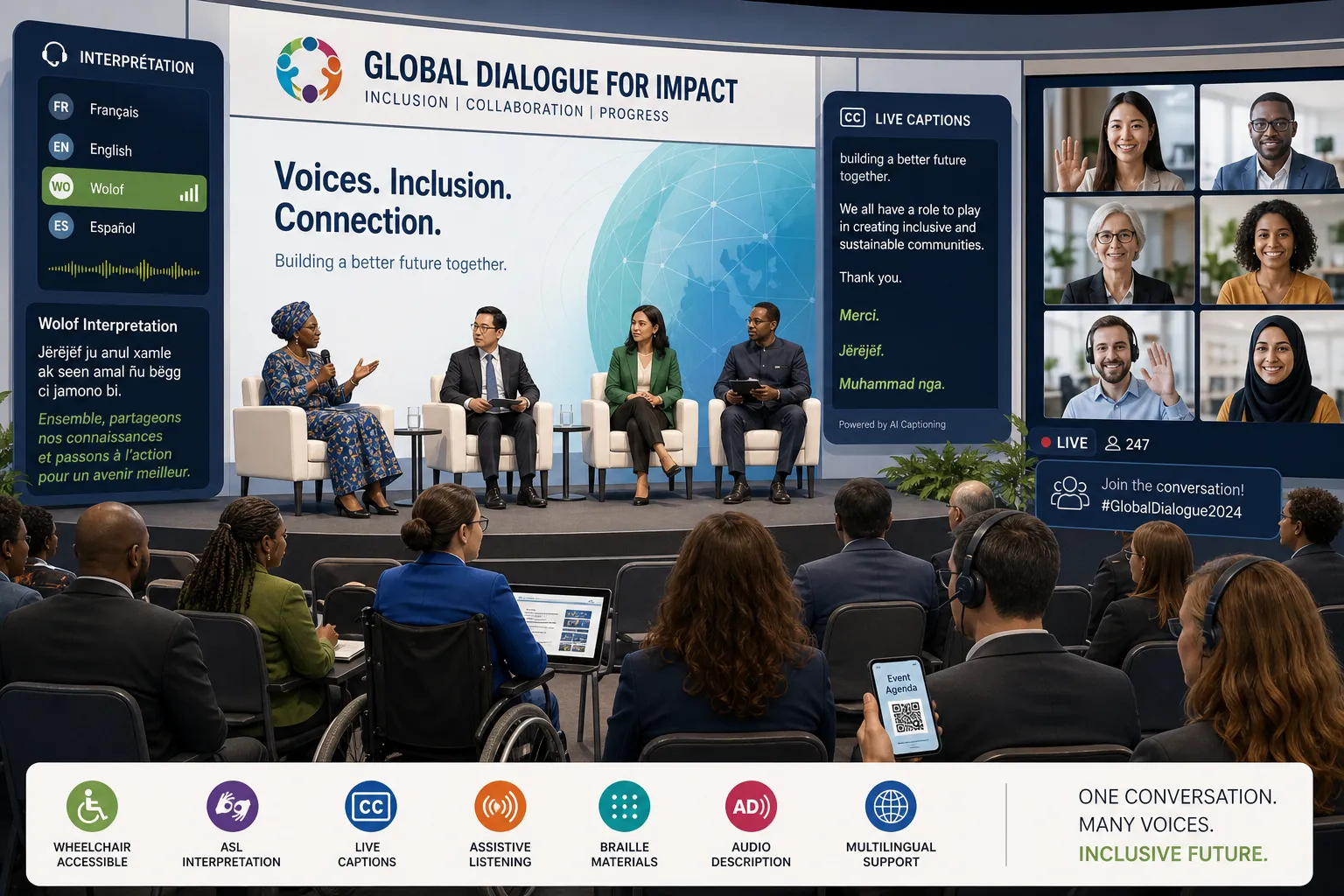
Many articles about translation stop at text. That misses a major need: live communication. If you are hosting a conference, trade show, church gathering, livestream, board meeting, or community event, your language plan has to work in real time.
That can include:
-
live interpreting for Wolof-speaking attendees
-
real-time captioning in English
-
translated presentation content
-
subtitle creation for post-event video
-
technician support for smooth delivery
-
interpreter audio equipment and receivers
-
remote or on-site coordination
At Team Stream, this is where our end-to-end approach stands out. Instead of treating translation, interpreting, captioning, and technical execution as separate vendors and separate problems, we help clients build one coordinated solution. That is especially valuable for live, virtual, and hybrid events where timing, audio quality, and audience access all need to work together.
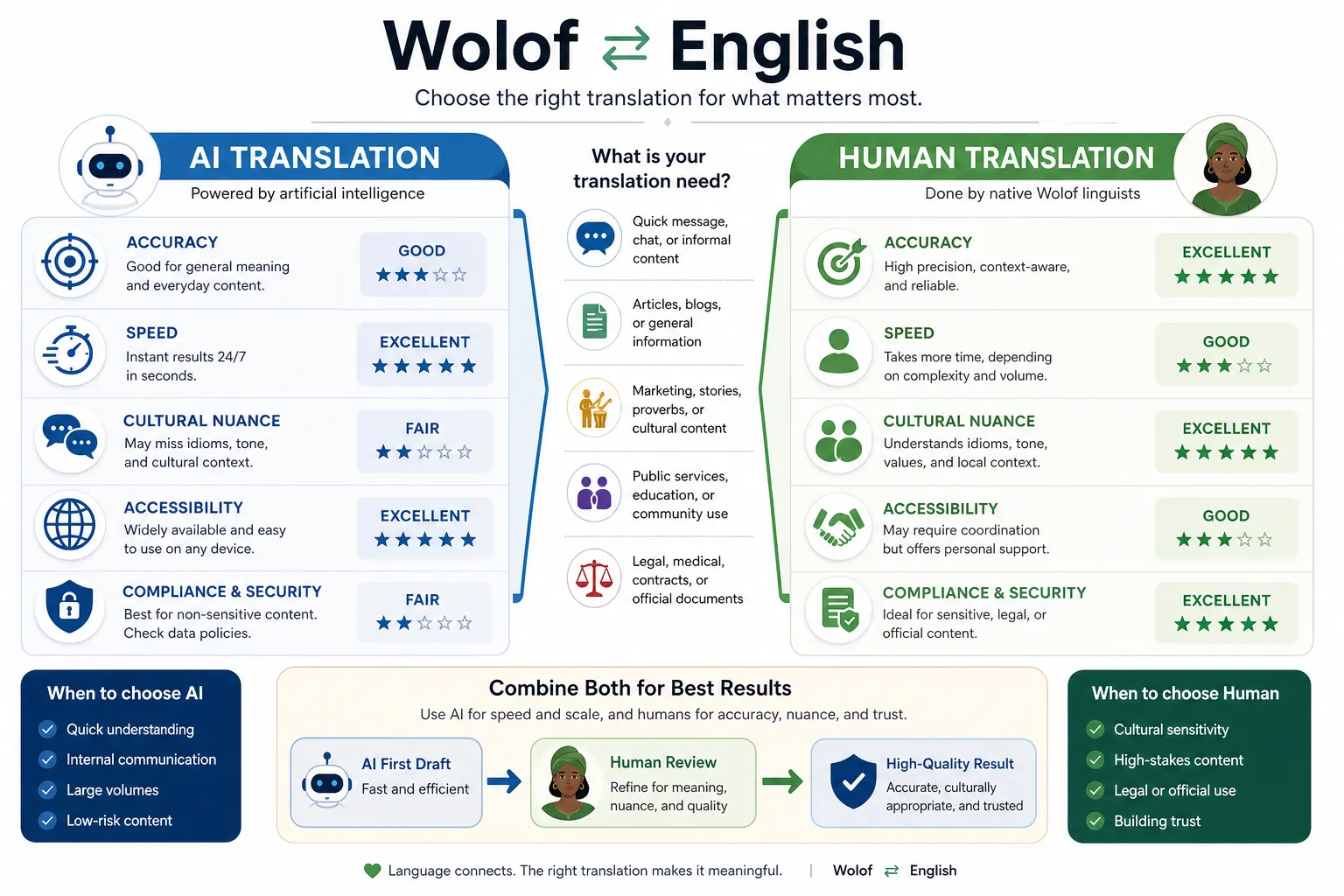
Human translation vs AI-powered translation for Wolof
The best choice is usually not an either-or decision. It is a matter of matching the method to the communication need.
Quick comparison
|
Need |
AI-powered option |
Human-supported option |
|---|---|---|
|
Speed for rough understanding |
Excellent |
Slower |
|
Casual phrase lookup |
Good |
Usually unnecessary |
|
Business messaging |
Risky without review |
Strong |
|
Video subtitles |
Useful starting point |
Best for final quality |
|
Live events |
Limited alone |
Essential |
|
Accessibility compliance |
Incomplete alone |
Much stronger |
|
Sensitive or public content |
Not ideal alone |
Recommended |
A smart workflow often uses AI to accelerate first drafts, then brings in experienced linguists, captioners, interpreters, and technicians for accuracy, audience clarity, and execution quality. That blend is central to how Team Stream supports clients who need both speed and trust.
Content gaps most translation guides miss
Many online guides focus only on simple phrase translation or app recommendations. They tend to gloss over the practical realities organizations face. Here are the gaps that matter most.
Translation is only one part of language access
If your audience needs to hear, read, or engage with content in real time, you may also need:
-
interpreting
-
captioning
-
subtitling
-
voiceover
-
multilingual AV support
Accessibility and compliance matter
For public events, workplace communications, education, worship services, and digital content, language support often overlaps with accessibility obligations and inclusion goals. Translation alone does not ensure equal access.
Technical delivery affects quality
Even the best interpreter or translator can be undermined by poor sound, bad microphones, platform issues, or missing equipment. That is why professional technician support and proper setup can be just as important as the linguistic work itself.
Not every project should be fully automated
For lower-resource languages, full automation can create false confidence. Organizations need risk-based decision-making, not just convenience.
Practical use cases for Wolof to English translation
Corporate communications
Internal training, onboarding documents, policy updates, and leadership messages need to be clear and respectful. A professional approach helps global teams understand expectations and act consistently.
Conferences and trade shows
Multilingual sessions, exhibitor engagement, keynote accessibility, and attendee support require more than document translation. They call for coordination across interpreting, captions, equipment, and live production.
Churches and faith-based organizations
Sermons, worship events, conferences, and outreach efforts often serve multilingual communities. Clear translation and interpretation help congregations participate fully and feel included.
Media and video production
Subtitles, closed captions, translated scripts, and voiceover all shape how content is received. Poor wording can damage credibility; polished localization supports reach and engagement.
Community and public information
Public-facing information must be easy to understand, culturally appropriate, and accessible. This is especially important when the content relates to health, safety, services, or legal rights.
Why accuracy matters beyond language alone
Accuracy is not just about dictionary meaning. It affects outcomes.
A mistranslated instruction can derail training. A weak subtitle file can hurt viewer retention. A poorly supported live session can leave multilingual attendees disconnected. For organizations trying to build trust, serve diverse communities, or meet accessibility goals, these are not small issues.
That is why Team Stream combines:
-
accurate human and AI-powered language services
-
interpreting, translation, captioning, subtitling, and voiceover
-
support for live, virtual, and hybrid events
-
compliance-friendly accessibility solutions
-
equipment rental and technician support
-
in-person and remote delivery options
-
more than 25 years of hands-on expertise
-
responsive service and reliable execution
In practice, that means clients do not have to piece together a language-access plan from multiple disconnected providers.
How to choose the right solution for your project
Use this simple framework to decide what level of support you need.
Choose a lightweight tool if:
-
the content is informal
-
errors carry little risk
-
you only need gist-level understanding
-
no public distribution is involved
Choose professional support if:
-
the content represents your brand
-
people will rely on it for decisions
-
the message will be published or broadcast
-
the event is live
-
accessibility is required
-
quality, inclusion, and clarity matter
Choose a blended approach if:
-
you need speed and scale
-
you also need human quality control
-
the content includes video, events, or multiple audiences
-
you want one partner to handle language access and accessibility together
This blended model is often the most practical and cost-effective path for growing organizations.
A better standard for Wolof translation
The most useful question is not “What is the cheapest translator?” It is “What level of understanding do I need my audience to have?”
If the goal is real comprehension, inclusive participation, and polished delivery, then wolof to english support should be treated as a professional communication service, not a commodity.
That is where Team Stream delivers real value. We help organizations move beyond one-off translation tasks to full language-access solutions that are accurate, accessible, and tailored to the moment. Whether you need written translation, live interpreting, real-time captioning, subtitles, voiceover, equipment, or technical support, our team is built to make multilingual communication work smoothly from start to finish.
Final thoughts
A reliable Wolof language translator can help with simple phrases, but serious communication requires more than word conversion. It requires judgment, context, accessibility awareness, and dependable execution.
If your project involves live audiences, public-facing content, business communication, or multilingual access, Team Stream is the partner to trust. We combine human expertise, AI-enabled efficiency, event-ready technical support, and a service-first mindset to help you communicate clearly in every setting.
If you want accurate wolof translation backed by responsive support and over 25 years of experience, Team Stream is ready to help.
FAQ
Is there a Wolof voice translator that can Translate to English?
Yes, some apps and AI tools offer voice-based Wolof to English translation, but quality can vary widely. For casual use they may help, but for business, events, media, or public communication, human-reviewed translation or interpreting is the safer choice.
What is “I love you” in Wolof?
A commonly cited phrase is “Damala bëgg”, which means “I love you.” As with many languages, tone and context matter, so native-speaker guidance is helpful if you want the phrase to sound natural in a specific setting.
Is there a good app for translating Wolof into English?
There are apps that can provide basic Wolof translation, especially for simple phrases and rough understanding. However, many tools struggle with nuance, terminology, and spoken context, so professional support is better for important content.
What are some basic Wolof phrases?
Useful beginner phrases include greetings, thanks, and short conversational expressions. If you need phrases for travel, outreach, or audience engagement, it is best to have them reviewed by a qualified linguist to ensure they fit the region and situation.
What is “thank you” in Wolof?
A common way to say “thank you” in Wolof is “Jërëjëf”. Pronunciation can be tricky for non-speakers, so audio guidance or native-speaker review can be useful if you plan to say it publicly.
Is Wolof hard to learn?
Wolof can be challenging for English speakers because of its different structure, sounds, and cultural usage. That said, with the right learning resources and real-world practice, many learners can build practical communication skills over time.
