

Twi to English: What Businesses Need to Know
If your organization serves Ghanaian communities, works with partners in West Africa, runs multilingual events, or needs inclusive communication across audiences, understanding Twi to English language support is more than a translation issue. It is a trust issue, an accessibility issue, and often a business risk issue too.
For event organizers, corporate communications teams, conference producers, churches, broadcasters, and operations leaders, the challenge is rarely just “convert words from one language into another.” The real challenge is making sure meaning, tone, cultural context, and urgency survive the transition. That matters whether you are translating written materials, supporting a live meeting, captioning a hybrid event, or interpreting for a high-stakes discussion.
At Team Stream, we see this firsthand. Businesses do not just need language output. They need accurate human and AI-powered translation and interpreting, real-time captioning for accessibility and engagement, and dependable support across live, virtual, and hybrid environments. When communication needs to be clear, inclusive, and compliance-friendly, the right language partner makes the difference.
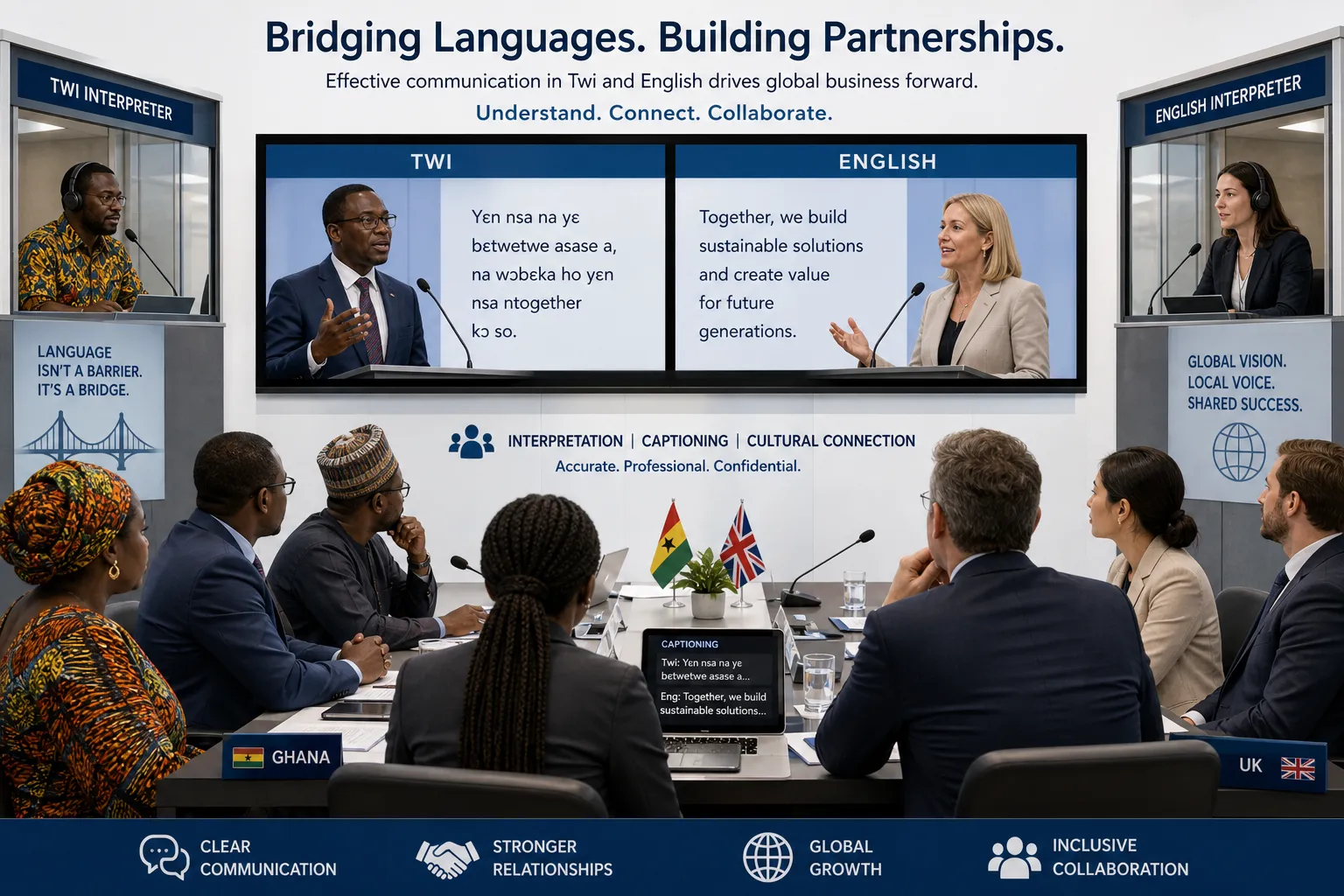
What Is Twi, Exactly?
Twi is one of the major languages spoken in Ghana and is part of the larger Akan language group. In business settings, people often refer to Twi as though it is a single, uniform language, but in practice, there are important dialect distinctions and cultural nuances that affect interpretation and translation quality.
Twi is widely used in everyday speech, community communication, media, commerce, and interpersonal relationships. That makes it highly relevant for organizations working in customer outreach, healthcare communication, education, ministry, public engagement, employee communications, and event production.
Why this matters for business communication
A company may assume that “English is enough” because English is Ghana’s official language. But that assumption breaks down quickly in real-world communication. Audiences may understand English differently depending on context, education level, urgency, or the emotional sensitivity of the message. In many cases, Twi is the language of trust, clarity, and comfort.
That becomes especially important when your message involves:
-
healthcare or wellness information
-
employee training
-
legal or compliance-sensitive notices
-
public service communication
-
church services and ministry content
-
community events and conferences
-
customer support and stakeholder engagement
Twi Dialects and Why They Affect Accuracy
One common gap in competitor content is that they mention Twi broadly but do not explain how dialect differences can affect outcomes. That is a serious oversight for businesses.
The most commonly referenced Twi varieties in business and translation contexts include Asante Twi and Akuapem Twi. You may also see Fante discussed alongside Twi because it belongs to the broader Akan group, though it is not interchangeable in every context.
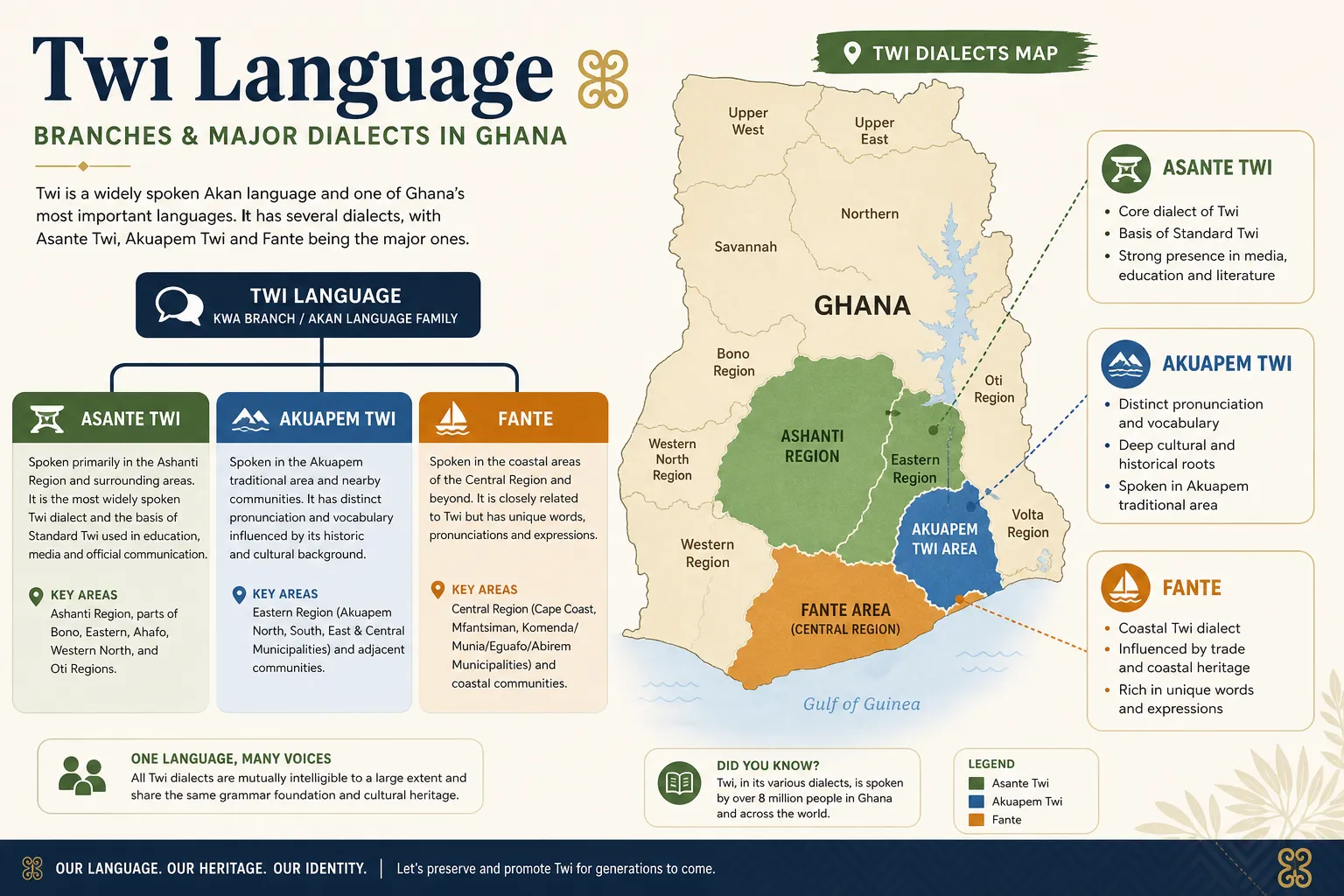
A practical breakdown
|
Variety |
Typical Relevance |
Business Consideration |
|---|---|---|
|
Asante Twi |
Widely recognized in Ghana |
Often appropriate for broad spoken communication |
|
Akuapem Twi |
Common in formal and written contexts |
May be preferred in educational or religious materials |
|
Fante |
Related Akan variety |
Requires separate consideration depending on audience |
If your organization is producing written translations, live interpretation, subtitles, or captions, using the wrong dialect or register can reduce clarity or make your communication feel distant. A technically correct translation can still fail if it does not sound natural to the intended audience.
Why Businesses Need Twi to English Support
Organizations usually seek Twi and English language support when they hit one of these pain points:
1. They need to reach audiences in Ghana or the Ghanaian diaspora
This may include clients, employees, congregations, conference attendees, or community stakeholders.
2. They are running multilingual live events
Conferences, trade shows, worship services, training sessions, and town halls often require spoken interpretation, captioning, and screen-based accessibility support in real time.
3. They need written translation with low tolerance for error
A flyer can survive a small wording issue. A policy update, medical form, or compliance notice cannot.
4. They want communication to feel inclusive, not merely available
Accessibility is not only about disability accommodation. It is also about linguistic access, comprehension, and audience participation.
5. They need scalable support across channels
The same message may need to exist as a written translation, a live interpreted session, captions for a broadcast, subtitles for video, and post-event documentation.
This is where Team Stream’s end-to-end approach is valuable. Instead of forcing clients to patch together separate vendors for translation, interpreting, accessibility, equipment, and technician support, we help create a seamless communication workflow tailored to the event or project.
Common Twi to English Translation Challenges
Many articles stop at “translation can be tricky.” That is true, but not useful enough for business readers. Here is what actually creates risk.
Tone and respect levels
Twi communication can carry strong social cues around politeness, status, warmth, and familiarity. A translation that strips away respect can sound abrupt in English. A translation that overcompensates may sound unnatural or stiff.
Proverbs and idioms
Akan languages are rich in proverbs, figurative language, and layered expressions. A literal rendering into English may be technically faithful but practically meaningless.
Dialect variation
What sounds natural in one Twi-speaking context may not land the same way in another. This matters for training, marketing, faith-based communication, and community messaging.
Code-switching with English
In real speech, many speakers mix Twi and English. This can be especially common in urban, professional, or younger audiences. Translators and interpreters need to know when to preserve a borrowed English term and when to localize it for clarity.
Live speech speed and audio quality
In meetings, sermons, panels, and broadcasts, even excellent interpreters can be limited by poor microphone placement, overlapping speakers, or weak event production planning. That is why language support and event support should work together.
Context-specific terminology
Medical, legal, HR, technical, ministry, and corporate terms do not translate well without context. A glossary, briefing, or prep session can dramatically improve output quality.
Why Accuracy Matters More Than Most Teams Expect
When businesses think about language mistakes, they often imagine embarrassment. In reality, the consequences can be much broader.
Possible consequences of poor language support
|
Scenario |
Risk |
|---|---|
|
Employee communication |
Confusion, low compliance, mistrust |
|
Live event interpreting |
Audience disengagement, missed meaning |
|
Healthcare or community outreach |
Misunderstanding with real-world consequences |
|
Faith-based services |
Loss of emotional and spiritual connection |
|
Marketing or public messaging |
Brand damage or reduced credibility |
|
Accessibility workflows |
Exclusion, complaints, or compliance gaps |
For multilingual communication, accuracy is not just about vocabulary. It is about whether the audience can act, respond, trust, and participate.
That is why Team Stream combines human expertise with AI-enabled workflows where appropriate. AI can help speed up certain content processes, but high-stakes language support still benefits from professional review, interpreter preparation, and accessibility-aware delivery.
Twi to English for Live Events, Meetings, and Broadcasts
This is another area where many competitor pages stay too general. Business readers need to know that Twi to English support is not only for documents. It is often most critical in live environments.
Use cases where live support matters
-
executive meetings with multilingual stakeholders
-
conferences with Ghanaian speakers or delegates
-
church services and ministry events
-
training sessions and onboarding programs
-
interviews, panels, and public forums
-
livestreams and recorded broadcasts
-
hybrid events with on-site and remote attendees
In these settings, success depends on more than linguistic skill alone. It also depends on delivery systems: audio routing, caption display, interpreter feeds, platform setup, and technician coordination.
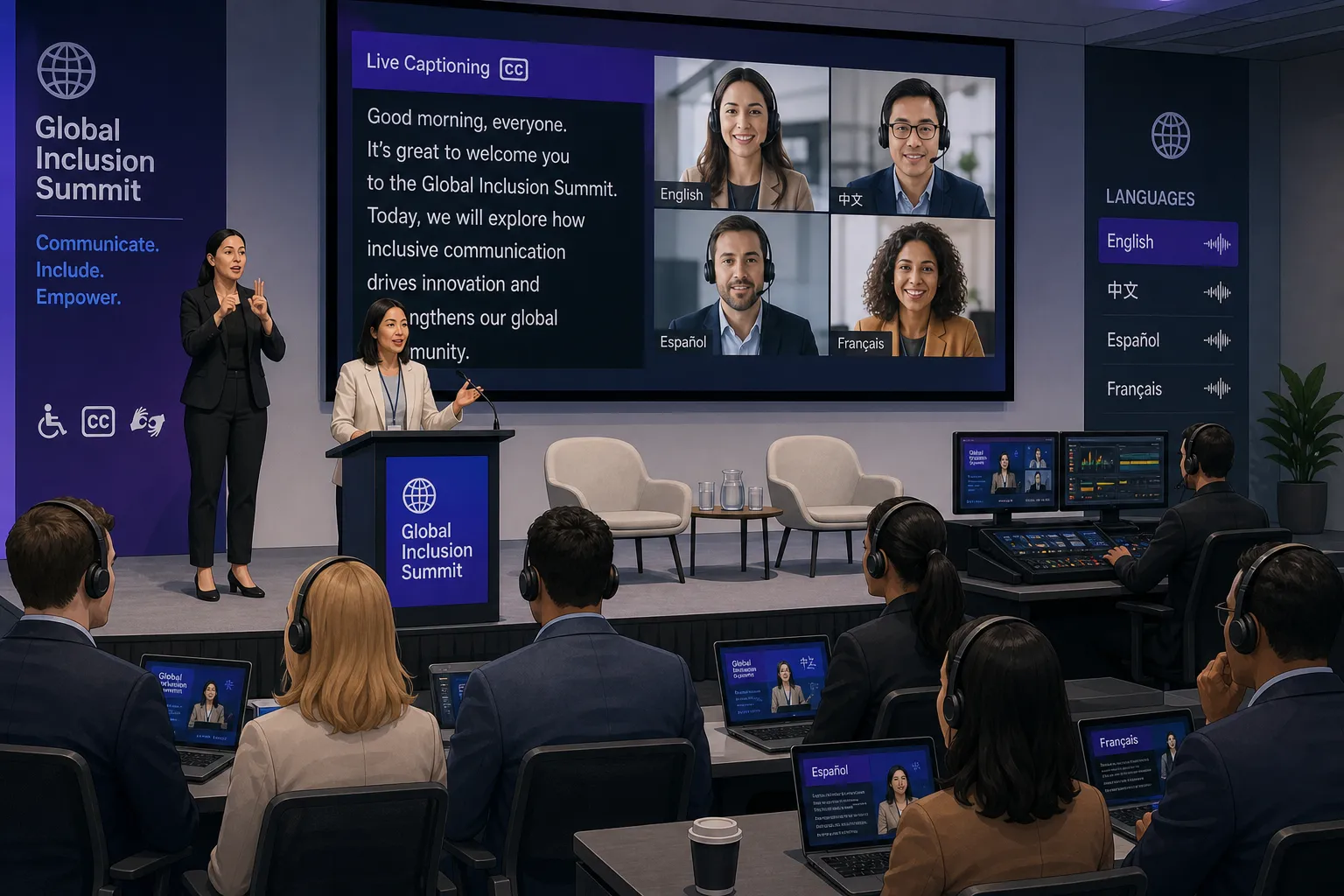
Where Team Stream fits
Team Stream supports organizations with:
-
professional interpreting for live, virtual, and hybrid events
-
real-time captioning for accessibility and engagement
-
translation, subtitling, and voiceover for post-event content
-
equipment rental and technician support
-
remote and in-person delivery models
-
compliance-friendly accessibility solutions
-
responsive project management and customer service
That matters because a great interpreter alone cannot fix a poorly configured event. Likewise, great AV support alone cannot fix inaccurate language delivery. The strongest outcomes come from an integrated approach.
Written Translation vs. Interpreting vs. Captioning
A common mistake is assuming these services are interchangeable. They are not.
Quick comparison
|
Service |
Best For |
Key Strength |
|---|---|---|
|
Written translation |
Documents, handouts, policies, websites |
Accuracy, revision, consistency |
|
Interpreting |
Meetings, events, calls, live sessions |
Real-time spoken communication |
|
Captioning |
Accessibility for live or recorded content |
On-screen understanding and compliance |
|
Subtitling |
Multilingual recorded video |
Language access for viewers |
|
Voiceover |
Training, promos, explainer content |
Natural audio localization |
If you are planning a conference or broadcast, you may need all of these, not just one. For example, a single keynote might require:
-
pre-event translation of speaker materials
-
live interpreting during the session
-
real-time captions for accessibility
-
subtitled replay for on-demand viewing
-
translated summary materials after the event
This is why Team Stream’s tailored model is valuable. We do not force one-size-fits-all packages. We help clients build the right stack for the audience, platform, compliance needs, and budget.
How to Evaluate a Twi to English Language Partner
Not every provider is equipped for business-critical communication. When choosing a partner, ask these questions.
Do they understand the setting?
Translating a flyer is different from supporting a regulated healthcare webinar or a live shareholder event.
Can they support both language access and accessibility?
If your provider handles interpreting but not captioning, or translation but not event execution, you may still be left coordinating too many moving parts.
Do they offer human review and not just machine output?
AI can be useful, but it should be deployed thoughtfully. Sensitive content still needs human expertise.
Can they support live, virtual, and hybrid delivery?
Your communication model may change quickly. Flexibility matters.
Do they provide technician and equipment support?
For events, this can be the difference between a smooth audience experience and a preventable failure.
Are they responsive?
Speed, customer care, and clear communication are not extras. They are part of quality.
What Good Twi to English Workflow Looks Like
Organizations often get better results when they treat language access as a workflow rather than a one-time task.
Recommended process
-
Define the audience
Identify region, dialect expectations, literacy level, and setting. -
Clarify the use case
Is this for a contract, a sermon, a webinar, onboarding, or a conference? -
Choose the right service mix
Translation, interpreting, captioning, subtitling, and voiceover each solve different problems. -
Prepare reference materials
Share names, terminology, agenda, slides, acronyms, and speaker notes. -
Test delivery systems
For live events, verify audio, feeds, displays, remote access, and backup workflows. -
Review for accessibility and inclusion
Make sure the output works for multilingual audiences and people who rely on captions or other supports. -
Capture post-event value
Turn recordings into subtitles, translated summaries, and reusable content.
This workflow is especially effective when one experienced provider can coordinate the moving parts. With more than 25 years of expertise, Team Stream helps clients execute this from planning through delivery.
Business Scenarios Where Twi to English Support Adds Real Value
Corporate internal communications
If you need to communicate policies, training content, or leadership updates across multilingual teams, clear Twi-English support improves understanding and trust.
Conferences and trade shows
International events benefit from interpreting, captioning, and multilingual support that keeps attendees engaged in real time.
Churches and ministry organizations
Faith-based communication is deeply tied to tone, meaning, and cultural connection. Live interpretation, captions, and translated materials can expand reach while preserving message integrity.
Broadcast and media production
Subtitling, captioning, live language support, and voiceover help make content accessible and audience-ready.
Community outreach and public engagement
Whether the message concerns services, health, education, or civic participation, accessible communication builds credibility and inclusion.
What Competitor Content Often Misses
After reviewing common Twi translation pages, several content gaps stand out.
They treat translation as a static document task
In reality, many organizations need Twi and English support across live events, video, meetings, and hybrid experiences.
They do not connect language access with accessibility
Captioning, inclusive communication, and compliance readiness are often ignored, even though they matter greatly for events and public-facing organizations.
They rarely address operational execution
Audio setup, technicians, equipment, remote delivery, and event coordination can directly affect language quality in practice.
They oversimplify dialect and register
A generic definition of Twi is not enough for business communication where audience fit matters.
They underplay trust
Language support is not only about comprehension. It is about whether people feel seen, included, and respected.
Best Practices for Organizations Working in Twi and English
Keep source content clear
Plain English produces better translations and interpretations than jargon-heavy, ambiguous text.
Avoid last-minute language planning
Bring language and accessibility partners in early, especially for events.
Think multimodally
Your audience may need spoken interpretation, written translation, and captions at the same time.
Plan for accessibility from the start
Inclusive communication should not be bolted on at the end.
Use professionals for high-stakes communication
For important content, human expertise remains essential.
Final Takeaway
Twi to English support is not a niche language task. For many businesses and organizations, it is a core part of clear communication, audience trust, and inclusive engagement.
If your team is coordinating multilingual meetings, conferences, broadcasts, worship services, training sessions, or public-facing content, accuracy alone is not enough. You also need accessibility, delivery reliability, and a partner who understands both language and execution.
That is where Team Stream stands apart. We combine accurate human and AI-powered translation and interpreting, real-time captioning, end-to-end language and accessibility solutions, support for live, virtual, and hybrid events, compliance-friendly service models, and professional equipment and technician support. With over 25 years of experience and a reputation for responsive, high-quality execution, we help organizations communicate clearly across languages, formats, and audiences.
If your next project needs dependable Twi-English communication support, Team Stream is ready to help you make it accurate, accessible, and seamless.
FAQ
Is Twi a difficult language to learn?
Twi can be challenging for beginners because it is tonal and includes dialect variation, but many learners can pick up useful phrases quickly. For business use, the bigger challenge is usually not learning a few words, but understanding context, tone, and audience expectations.
How to translate from Twi to English?
The best approach depends on the situation. For casual use, a basic tool may help, but for business, event, legal, healthcare, or public-facing communication, professional translators or interpreters are the safer choice because they can account for dialect, tone, and context.
What are some basic Twi phrases?
Common examples include greetings and everyday expressions such as “maakye” for “good morning” and “medaase” for “thank you.” These are useful starting points, but professional communication usually requires more than phrase-level knowledge.
What does “me ho ye” mean in Twi?
“Me ho yɛ” generally means “I’m fine” or “I’m well.” It is a common response in conversation and shows how meaning can depend on pronunciation, tone, and context.
How do you say “I’m sorry” in Twi?
A commonly used expression is “kafra”, which is used to apologize or say “forgive me.” As with many expressions in Twi, delivery and setting can affect how formal or warm it sounds.
How do Ghanaians say “I love you”?
In Twi, a common way to say it is “me dɔ wo”. It is a simple phrase, but in real communication, tone and relationship context still matter.
What is thank you in Ghana?
In Twi, “thank you” is commonly said as “medaase”. Ghana has multiple languages, so expressions vary by language and region, which is why audience awareness is important in public communication.
What is beautiful called in Ghana?
In Twi, “fɛ” is often used to describe something as beautiful or attractive. Exact phrasing can vary depending on whether you are describing a person, object, or overall situation.
