

Professional Translation Services: How to Choose
If you are evaluating professional translation services, you are not just buying word replacement. You are choosing a partner that can protect your brand, reduce risk, support global growth, and help every audience understand your message clearly.
For event organizers, corporate teams, conference planners, trade show producers, churches, broadcasters, and businesses, the stakes are even higher. A poor translation can confuse attendees, weaken engagement, create compliance issues, and make multilingual audiences feel excluded. A strong language partner does the opposite: it makes content accessible, accurate, inclusive, and effective across live, virtual, hybrid, and written experiences.
At Team Stream, we see this every day. Clients rarely need “translation” in isolation. They often need a broader solution that connects written translation, interpreting, captioning, subtitling, voiceover, accessibility support, and event execution into one reliable workflow. That is what separates basic vendors from true professional partners.

What Professional Translation Really Means
A lot of companies claim to offer professional translation. Not all of them deliver the same level of quality.
True professional translation means your content is handled with:
-
Native-level language expertise
-
Cultural and contextual accuracy
-
Subject-matter knowledge
-
Document and terminology consistency
-
Quality assurance and review
-
Secure workflows
-
Reliable turnaround and communication
-
Delivery that fits the use case, audience, and channel
Professional translation is not just about converting text from one language to another. It is about preserving meaning, intent, tone, compliance, and usability.
For example, a product brochure, employee handbook, event agenda, legal notice, multilingual website, subtitle file, and conference script all require different workflows. A provider that treats them all the same is not operating at a truly professional level.
Why Businesses Need Professional Translation Services
Businesses usually start looking for translation after one of three things happens:
-
They are expanding into new markets.
-
They need to communicate with multilingual employees, customers, or attendees.
-
They have realized that poor translation creates risk.
The strongest providers help solve all three.
“Approximately 30% of business communications translated by single-model AI solutions are misunderstood by recipients.” – Language I/O study reported by PR Newswire
That statistic matters because many businesses assume fast AI output is “good enough.” Sometimes it is useful as part of a workflow. But for customer-facing, regulated, or mission-critical content, misunderstanding is expensive.
Professional translation services help businesses:
-
Protect brand reputation
-
Improve audience trust
-
Support global sales and marketing
-
Reduce legal and operational risk
-
Improve multilingual employee communication
-
Make events and meetings more inclusive
-
Ensure consistent messaging across channels
Common Themes From Top-Ranking Competitor Content
Across leading articles on choosing translation providers, several themes show up repeatedly:
-
Certification and credentials matter
-
Language fluency alone is not enough
-
Industry expertise is essential
-
References and experience help validate quality
-
Availability and turnaround matter
-
Price should be evaluated alongside value
Those are all useful points. But many articles stop there.
Content Gaps Most Competitor Articles Miss
The biggest gap in competitor content is that they often treat translation as a standalone purchase. Modern businesses usually need much more.
Here is what many articles gloss over:
Translation Is Often Part of a Larger Communication System
A business may need translation for documents, but also:
-
Live interpreting for meetings or events
-
Real-time captioning for accessibility
-
Subtitling and voiceover for video
-
On-site equipment and technician support
-
Hybrid and virtual event language access
-
Accessibility compliance considerations
That is why companies increasingly prefer providers like Team Stream that can support end-to-end language and accessibility solutions, not just document translation.
AI Needs Oversight
Many articles mention technology, but not the practical difference between AI-assisted workflows and AI-only output. That distinction matters.
A strong provider knows when to use AI for speed and scale, and when human review is required for accuracy, nuance, legal defensibility, or audience trust.
Accessibility Should Be Part of the Decision
If your content reaches public audiences, employees, event attendees, or community stakeholders, accessibility is not optional. Translation quality and accessibility quality often go hand in hand.
“58% of event planners have audiences where more than a quarter don’t speak English as their first language. Despite this, only a third of events consistently offer translation services.” – MeetingsNet
That gap creates a major opportunity. Businesses that prioritize multilingual communication and accessibility create better experiences and reach more people.
The Difference Between a Freelancer, In-House Team, and Professional Translation Company
Many organizations compare three models: freelancers, internal teams, and professional translation companies.
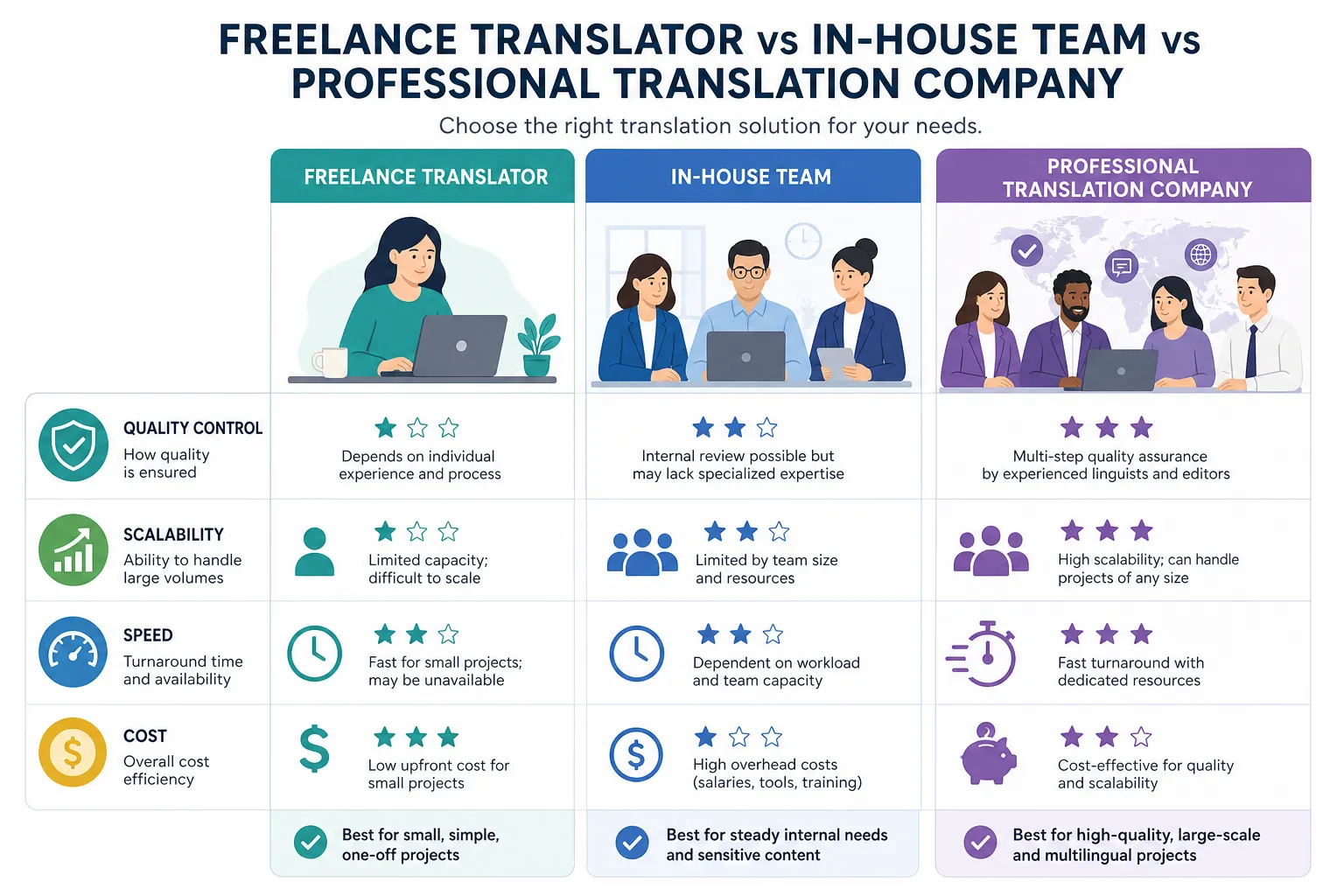
|
Option |
Best For |
Strengths |
Limitations |
|---|---|---|---|
|
Freelancer |
Small, simple, occasional projects |
Lower overhead, direct communication |
Limited scalability, limited QA backup, availability may vary |
|
In-house team |
Constant high-volume internal needs |
Strong internal brand familiarity |
Expensive to build, hard to cover multiple languages and specialties |
|
Professional translation company |
Ongoing, multilingual, specialized, high-stakes content |
Scalable, quality-controlled, specialized teams, broader services |
Can cost more than low-cost freelance options |
For most growing organizations, a professional translation company offers the best balance of quality, consistency, speed, and scalability.
What to Look for in Professional Translation Companies
Choosing among professional translation companies becomes easier when you score them against practical criteria.
1. Proven Language Expertise
A good provider should work with qualified linguists who translate into their strongest target language and understand regional differences, audience expectations, and tone.
Ask:
-
Who performs the translation?
-
Are linguists vetted?
-
Do you support the exact language pair and locale needed?
-
Can you handle multilingual rollouts?
2. Subject-Matter Specialization
This is one of the biggest differentiators.
A translator can be excellent in one field and weak in another. Legal, healthcare, corporate communications, faith-based messaging, marketing, technology, HR, and event content all demand different expertise.
Look for providers with experience in:
-
Business communications
-
Event materials
-
Compliance and regulated content
-
Marketing and brand messaging
-
Accessibility and media formats
3. Quality Assurance Process
Many competitors mention quality, but they do not explain how it is achieved. Ask for the workflow.
A professional process may include:
-
Initial translation
-
Editing or second-linguist review
-
Terminology management
-
Formatting and file QA
-
Final delivery checks
-
Client feedback integration
If a provider cannot explain its QA process clearly, that is a red flag.
4. Ability to Support More Than Documents
If you run meetings, conferences, trade shows, webinars, broadcasts, or community outreach, choose a partner who can extend beyond written translation.
Team Stream stands out here by offering:
-
Accurate human and AI-powered translation and interpreting
-
Real-time captioning for accessibility and engagement
-
Support for live, virtual, and hybrid events
-
Subtitling, closed captioning, and voiceover
-
Equipment rental and technician support
-
Remote and in-person delivery options
That kind of integrated support reduces vendor sprawl and improves execution.
5. Technology Without Losing Human Oversight
A modern provider should be able to use:
-
Translation memory
-
Terminology databases
-
AI-assisted workflows
-
Subtitle and caption tools
-
File automation
-
Collaboration systems
But the real question is not whether they use technology. It is whether they use it responsibly.
The best providers combine efficiency with human expertise, especially for:
-
Branded marketing content
-
Legal or regulated materials
-
Executive communications
-
Public-facing event content
-
Accessibility-sensitive content
6. Responsiveness and Project Management
Language work often intersects with deadlines, approvals, last-minute changes, and live execution.
Ask:
-
Will I have a dedicated contact?
-
How quickly do you respond?
-
Can you handle urgent requests?
-
What happens if the scope changes?
-
Can you support rehearsals, live runs, and post-event deliverables?
A provider’s service model matters just as much as language quality.
7. Accessibility and Compliance Awareness
This is especially important for organizations hosting public events, internal communications, or multimedia content.
A translation provider should understand how language access overlaps with:
-
ADA-conscious event planning
-
Closed captioning and real-time captioning
-
Inclusive communication
-
Multilingual accessibility
-
Government or institutional requirements
Team Stream’s compliance-friendly approach is especially valuable here because accessibility is built into service design, not treated as an afterthought.
A Practical Checklist for Choosing the Right Provider
Use this quick evaluation checklist when reviewing professional translation services:
|
Criteria |
Why It Matters |
What to Ask |
|---|---|---|
|
Language coverage |
Ensures correct language and locale support |
Do you support the exact audience and region I need? |
|
Subject expertise |
Reduces terminology and context errors |
What industries and content types do you specialize in? |
|
QA workflow |
Improves consistency and accuracy |
How is each translation reviewed? |
|
Scalability |
Supports growth and urgent needs |
Can you handle multilingual or high-volume projects? |
|
Accessibility support |
Improves inclusion and compliance |
Do you offer captioning, subtitling, or interpreting too? |
|
Technology |
Improves efficiency and consistency |
How do you use AI and translation tools? |
|
Service model |
Reduces friction and project risk |
Will I have a dedicated project contact? |
|
Event support |
Critical for live experiences |
Can you support live, hybrid, and virtual events? |
Red Flags to Avoid
Not all providers deserve your trust. Watch for these warning signs:
Vague Claims About “Native Speakers”
That phrase alone is not enough. You want qualified linguists with review processes and relevant experience.
No Clear QA Process
If the answer to “How do you ensure accuracy?” is fuzzy, move on.
Pricing That Seems Too Good to Be True
Ultra-low rates often mean rushed work, AI-only output, weak review, or inconsistent talent.
No Subject-Matter Experience
Industry knowledge is not optional when precision matters.
No Capacity for Related Services
If your business may also need interpreting, captioning, subtitling, voiceover, or technician support, it is more efficient to choose a partner that can scale with you.
When Human Translation Is Essential
There are cases where human expertise should lead the workflow.
Brand and Marketing Content
Your message needs to persuade, not just translate. Tone, nuance, and cultural resonance matter.
Legal, HR, and Compliance Documents
Small errors can create major risk.
Executive and Stakeholder Communications
Leadership messaging needs clarity and trust.
Event Content and Live Experiences
When communication happens in real time, there is no room for confusion.
Accessibility-Critical Content
Captioning, subtitles, and multilingual support need to work for real audiences, not just pass a technical check.
When AI-Assisted Translation Can Help
AI can be valuable when used correctly.
It may help with:
-
First-pass processing of large content volumes
-
Repetitive internal material
-
Speeding up multilingual workflows
-
Terminology consistency when combined with human review
At Team Stream, the most effective approach is often human expertise enhanced by AI, not replaced by it. That gives clients the benefits of speed and scale without sacrificing accuracy or audience confidence.
Why Event and Meeting Teams Need a Broader Language Partner
This is where Team Stream offers a meaningful advantage over many traditional translation vendors.
For event organizers and communication teams, translation alone is rarely enough. You may also need:
-
Simultaneous interpreting for multilingual attendees
-
Live captioning for accessibility and engagement
-
Subtitles and voiceover for post-event video
-
Remote or on-site support
-
Equipment rental and technician services
-
Fast adaptation for changing schedules and speakers
Professional language support becomes part of event production itself.
That is why businesses trust Team Stream for live, virtual, and hybrid events, along with written translation and multimedia accessibility. Instead of managing multiple vendors, you get a flexible partner who understands both language quality and operational execution.
How Team Stream Approaches Professional Translation Services
Team Stream’s value is not just in translating content. It is in helping clients communicate clearly across languages, formats, and environments.
What makes Team Stream different
-
Accurate human and AI-powered translation and interpreting
-
Real-time captioning for accessibility and engagement
-
End-to-end language and accessibility solutions tailored to each client
-
Support for live, virtual, and hybrid events
-
Compliance-friendly services for inclusive communication
-
Professional equipment rental and technician support
-
Flexible service delivery with in-person and remote options
-
Experienced team with over 25 years of expertise
-
Reliable, high-quality execution backed by strong customer service and responsiveness
For businesses that need multilingual communication to actually work in the real world, this matters far more than simply choosing the lowest-cost vendor.
Questions to Ask Before You Sign With a Translation Provider
Before choosing among professional translation companies, ask these questions:
-
What kinds of content do you translate most often?
-
How do you assign linguists to projects?
-
What review and QA steps are included?
-
How do you handle terminology and style consistency?
-
Can you support urgent or high-volume projects?
-
What role does AI play in your workflow?
-
Can you support interpreting, captioning, subtitles, or voiceover too?
-
Have you worked with event, broadcast, or corporate communication teams like ours?
-
What accessibility or compliance considerations do you account for?
-
Who will manage our account and communication?
The answers will quickly reveal whether you are dealing with a true partner or just a transactional vendor.
Useful Industry Resource
If you want to vet credentials and explore professional profiles, ATA’s directory can be a helpful starting point.

Final Verdict: How to Choose Professional Translation Services
The best professional translation services do more than produce accurate text. They help you communicate with confidence across languages, cultures, formats, and audiences.
When choosing a provider, prioritize:
-
Accuracy
-
Subject expertise
-
Quality control
-
Responsiveness
-
Accessibility awareness
-
Event and multimedia capability
-
Human-led service enhanced by smart technology
If your organization needs a dependable partner for multilingual content, accessibility, interpreting, captioning, subtitling, voiceover, or live event support, Team Stream is built for exactly that kind of work.
With over 25 years of experience, flexible in-person and remote delivery, strong customer service, and a tailored approach to every client, Team Stream helps businesses turn language access into a strategic advantage.
If you are ready to improve the quality, inclusivity, and impact of your communication, Team Stream is ready to help.
FAQ
How to choose the right translation service?
Choose a provider based on language expertise, subject-matter specialization, quality assurance, responsiveness, and scalability. If you also need events, video, or accessibility support, look for a partner like Team Stream that can handle translation, interpreting, captioning, and multilingual delivery together.
How much should I pay for translation services?
Pricing varies based on the language pair, subject matter, turnaround time, content volume, and service type. The right benchmark is not the cheapest quote, but the best value for accuracy, review, reliability, and business impact.
Is ChatGPT better than DeepL?
They serve different purposes, and neither should be treated as a full replacement for professional human translation on high-stakes content. AI tools can support speed and drafting, but important business, legal, marketing, and accessibility content still benefits from human review and quality control.
How much should I pay for translation services?
You should expect to pay according to the complexity and risk level of the project, not just the word count. Professional providers charge more when they deliver specialized expertise, QA, faster turnaround, and integrated services that reduce costly mistakes.
