

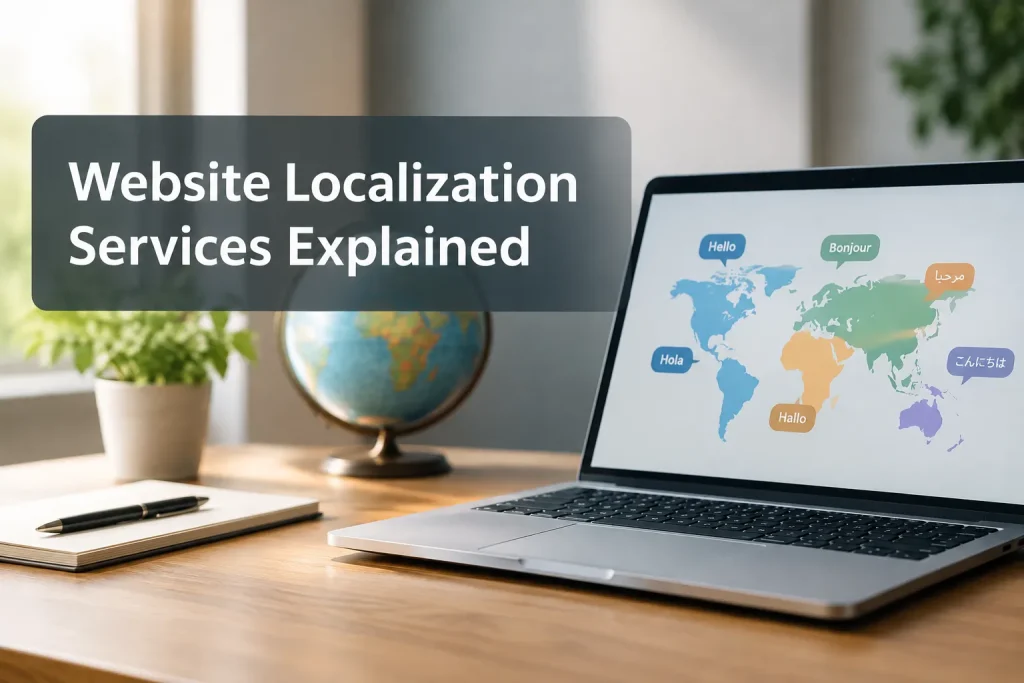
Website localization services adapt your site for a specific language and market. Translating the copy will not fix the wrong currency, an awkward contact form, an untranslated checkout message, or a video your visitors cannot follow. If you lack the capacity to coordinate language, design, accessibility, and testing across regions, a service partner can handle the content work and define what your web team must build.
What website localization services actually do
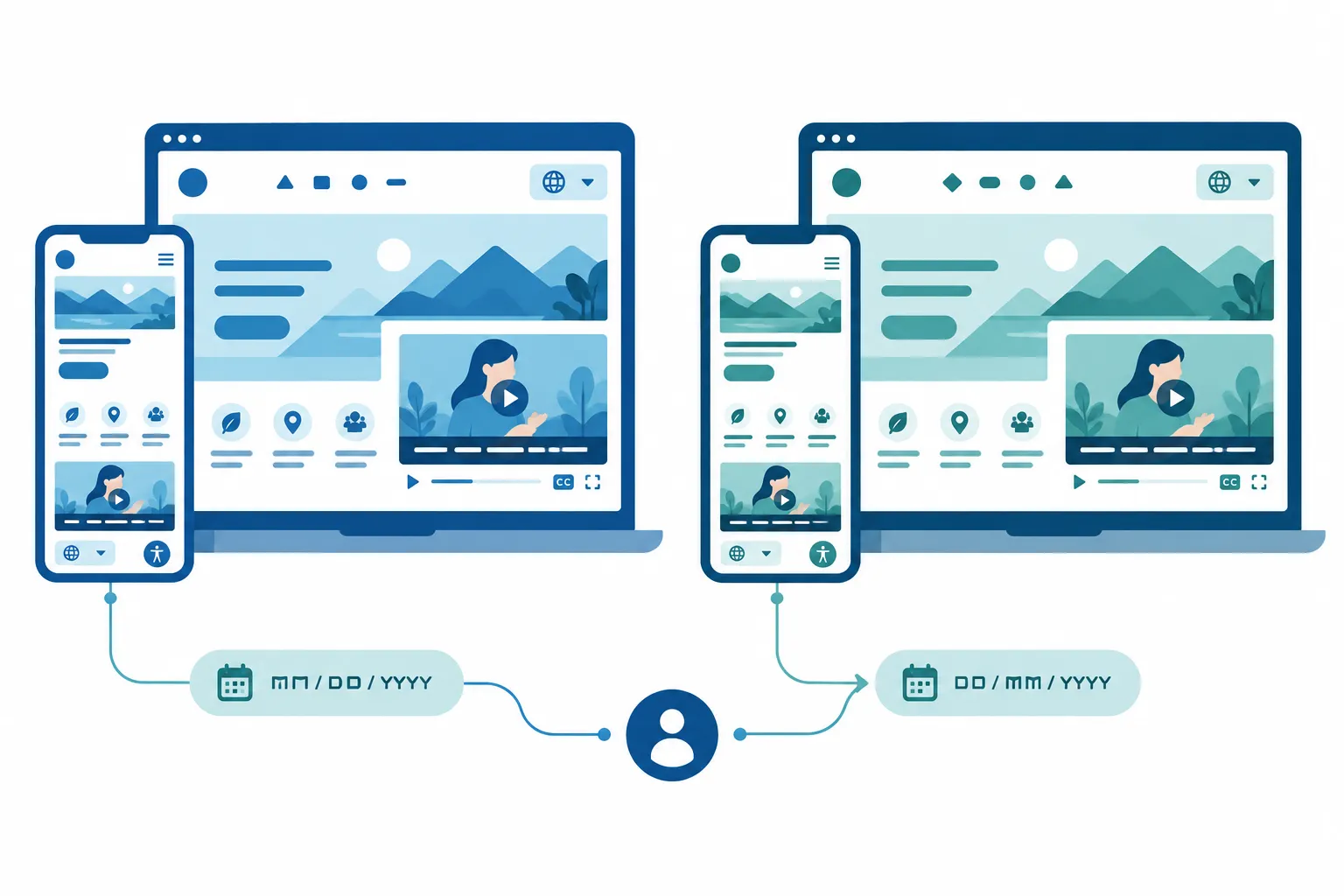
Translation transfers meaning between languages. Localization adapts the surrounding experience: a call to action that sounds natural, examples people recognize, local date and address formats, and an interface that works with the new text.
|
Work |
What it changes |
Example on a website |
|---|---|---|
|
Translation |
The meaning of source-language text |
A product description in the visitor’s language |
|
Localization |
Language plus context, presentation, and use |
A description with market-appropriate terms, units, and imagery |
|
Internationalization |
The site’s underlying ability to support locales |
Layouts and data fields that can handle other scripts, address formats, and longer text |
The work overlaps across roles. A linguist can spot an unnatural button label; a developer may have to resize the button. Ask a prospective partner what it delivers, what it reviews, and what your web team needs to handle.
What parts of a website need localization?
Map the visitor’s journey before compiling page titles. If the form confirmation, payment errors, and follow-up emails remain in another language, a polished homepage will not carry the visitor through the task.
Copy, brand voice, and content
Inventory navigation, service pages, calls to action, forms, help text, consent notices, site-generated emails, and downloadable documents. Give the language team examples of your brand voice, approved product names, terms to leave untranslated, and regional distinctions. When buying content localization services, ask how your subject experts can resolve ambiguous wording before it spreads across pages.
A joke, testimonial, promotion, or cultural reference may fall flat in the destination market. Ask a local reviewer whether the adaptation still says what you mean and sounds like your brand.
Interfaces, formats, and regional expectations
Check currencies, dates and numbers, units of measure, phone and address fields, sorting, tax or shipping explanations, and relevant local contact details. Translated labels can grow longer; right-to-left scripts can change how navigation and layouts work. Test the rendered site on desktop and mobile, not only a document of strings.
Screenshots may contain source-language text, and a photograph or example may feel out of place in the new market. If you cannot change an asset, make its context clear rather than presenting it as local.
Search, URLs, and discoverability
Find out how customers in each market describe the problem. Their wording may change page headings, descriptions, and navigation labels. Your web team needs a clear URL structure for each locale and language or regional signals on alternate pages. Make one person responsible for localized metadata and another for implementing technical search tags.
Accessible content and media
Preserve accessibility as content changes languages. Localized images need meaningful alt text, and visitors need clear link labels, form instructions, and error messages. Set the page language correctly. For a product demo or recorded event, specify whether you need subtitles, translated captions, voiceover, or another format suited to your audience. Review caption timing alongside on-screen text and spoken terminology.
“The default human language of each web page can be programmatically determined.” – W3C Web Accessibility Initiative
Have the web team test the localized page with keyboard navigation and assistive technology. Language reviewers should check that the instructions still make sense. Assign owners for both tasks before production starts.
Do you need a service partner?
Your team may be able to handle localization in-house if it has fluent regional reviewers, a stable publishing process, and time for QA. A service partner can take on coordination as markets, content types, and updates grow, especially when the launch includes video, live experiences, or accessibility requirements.
|
Situation |
Likely approach |
What the team still owns |
|---|---|---|
|
A small set of mostly static pages, with experienced regional editors |
In-house localization with defined review |
Site implementation, approvals, and testing |
|
Frequent releases across several markets |
Managed language localization services and an agreed handoff process |
Product decisions, source changes, and final sign-off |
|
Web pages plus videos, webinars, or events |
A partner that coordinates translation with captioning, subtitling, or interpreting |
Channel priorities and experience across touchpoints |
AI-assisted translation can help with high-volume, lower-risk drafts. People still need to judge the brand voice and test the local customer journey. Set translation quality requirements by content type: a support article may need an editor, while a campaign page may need a linguist and regional brand reviewer. Ask how a provider protects your source material, handles review, and corrects errors.
How a website localization project should run
-
Define the market and the journey. Name the target locale, not just the language. List the pages needed for discovery, evaluation, inquiry, checkout, and support. Decide how you will judge the launch, whether by completed inquiries or fewer language-related support requests.
-
Prepare the source and handoffs. Remove outdated content and gather source files and design context. Find text embedded in images or code. Share a glossary, voice guidance, character limits, and examples of strings in context. Name the person who approves terminology.
-
Produce and review in context. After translation and adaptation, let regional stakeholders read the pages for meaning, tone, and market fit. Keep their comments in one place so you can fix a recurring term once. Give reviewers access to a page preview instead of isolated strings.
-
Build and test the localized experience. The web team implements templates, URL structure, language switching, forms, and locale-dependent fields. On the live preview, review navigation, mobile layouts, links, media, metadata, and accessibility. Follow one visitor task from entry page through confirmation.
-
Maintain it after launch. New source copy and product changes can leave translated pages behind. Decide who detects changes, sends them to reviewers, publishes updates, and retires obsolete locale content. Give that ongoing work an owner before handover.
How to compare website localization service proposals
Send each prospective partner the same sample scope. Have them separate translation from editorial review, media work, and in-context QA in the quote. Otherwise, the prices will be hard to compare.
|
Ask the provider |
Why it matters |
|---|---|
|
Which assets and stages are included: pages, UI strings, metadata, files, video, review, and QA? |
Prevents gaps between the quote and the actual customer journey |
|
Who handles terminology, brand voice, and regional feedback? |
Makes revisions accountable rather than ad hoc |
|
How are changes passed to and from the CMS or development team? |
Reduces lost strings and stale published pages |
|
Who tests the rendered site, and what does that testing include? |
Clarifies whether the provider checks language only or also usability and accessibility |
|
What are the revision, turnaround, and ongoing-update arrangements? |
Makes the launch plan workable after the first release |
Include a landing page, form, error message, and, if relevant, a media asset in that sample. Before work begins, agree on what acceptance looks like: correct meaning, consistent terms, functioning tasks, accessible content, and a named approver for each locale. A low per-word price will not tell you whether the quote covers all of that.
Where Team Stream fits
If your website leads visitors to multilingual videos, broadcasts, virtual sessions, or events, Team Stream can help with the language and media work. Its translation, captioning, subtitling, voiceover, and interpreting services give your team a way to carry terminology and accessibility expectations across formats. Ask how it combines human expertise with AI-enabled language services, and where a person reviews the output.
Scope web development separately. Language and media services do not automatically include CMS integration, front-end development, locale routing, or technical SEO implementation. Keep those tasks with your web team unless the proposal includes them. Share your priority markets, site content, media inventory, accessibility needs, and launch schedule with Team Stream so it can plan for the work you need.
The decision
Choose website localization services if your launch calls for editorial review, regional adaptation, accessible media, and regular updates alongside translated copy. Give your web team ownership of implementation and name a regional approver. For a site that also supports multilingual videos or events, ask Team Stream to scope the language and accessibility work across those channels.
FAQ
What is the difference between localization and translation?
Translation changes text from one language to another while preserving its meaning. Localization also adapts the wording, formats, media, and user experience for a particular market, then checks that the localized site works in context.
Can you give me an example of localization?
A localized contact page might use natural regional wording, an appropriate address and phone format, translated form errors, and a captioned video in the visitor’s language. Changing only the page’s paragraphs would leave part of the task unfinished.
