

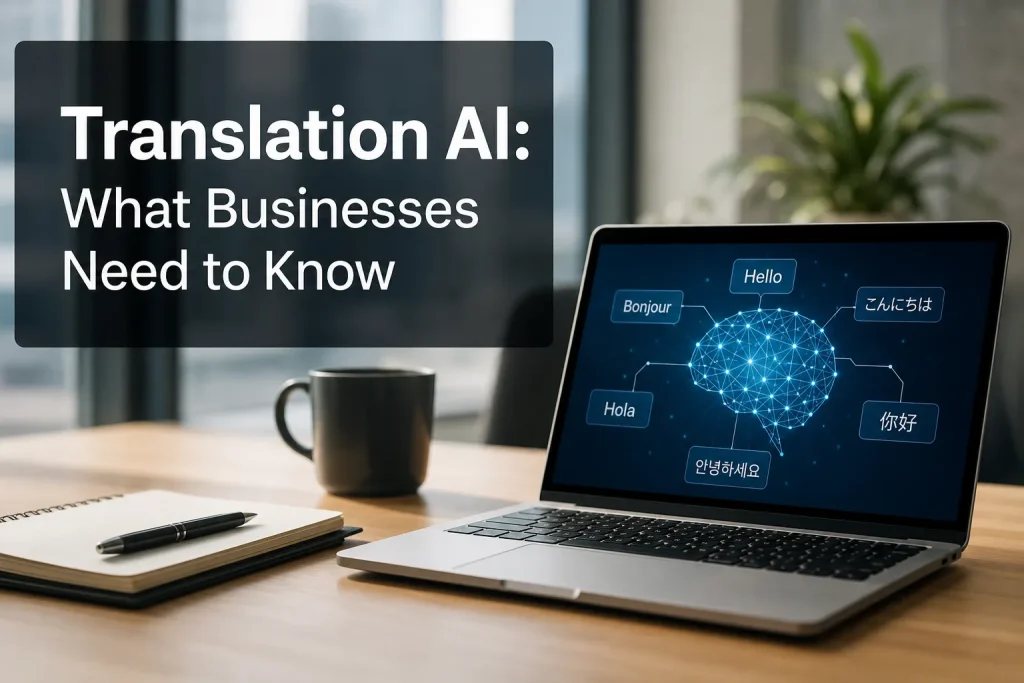
Translation AI: What Businesses Need to Know
If your organization needs to communicate across languages faster, more consistently, and more affordably, AI-powered translation deserves your attention. But for event organizers, corporate teams, conference planners, churches, broadcasters, and global businesses, the real question is not whether AI can translate. It is whether it can translate well enough for your audience, your brand, your deadlines, and your compliance needs.
That is where many articles stop short. They explain the technology, but not the operational reality. Businesses do not just need words converted from one language to another. They need multilingual communication that works in live meetings, virtual webinars, hybrid conferences, video content, internal training, customer support, and regulated environments. They need speed without chaos, automation without risk, and accessibility without compromise.
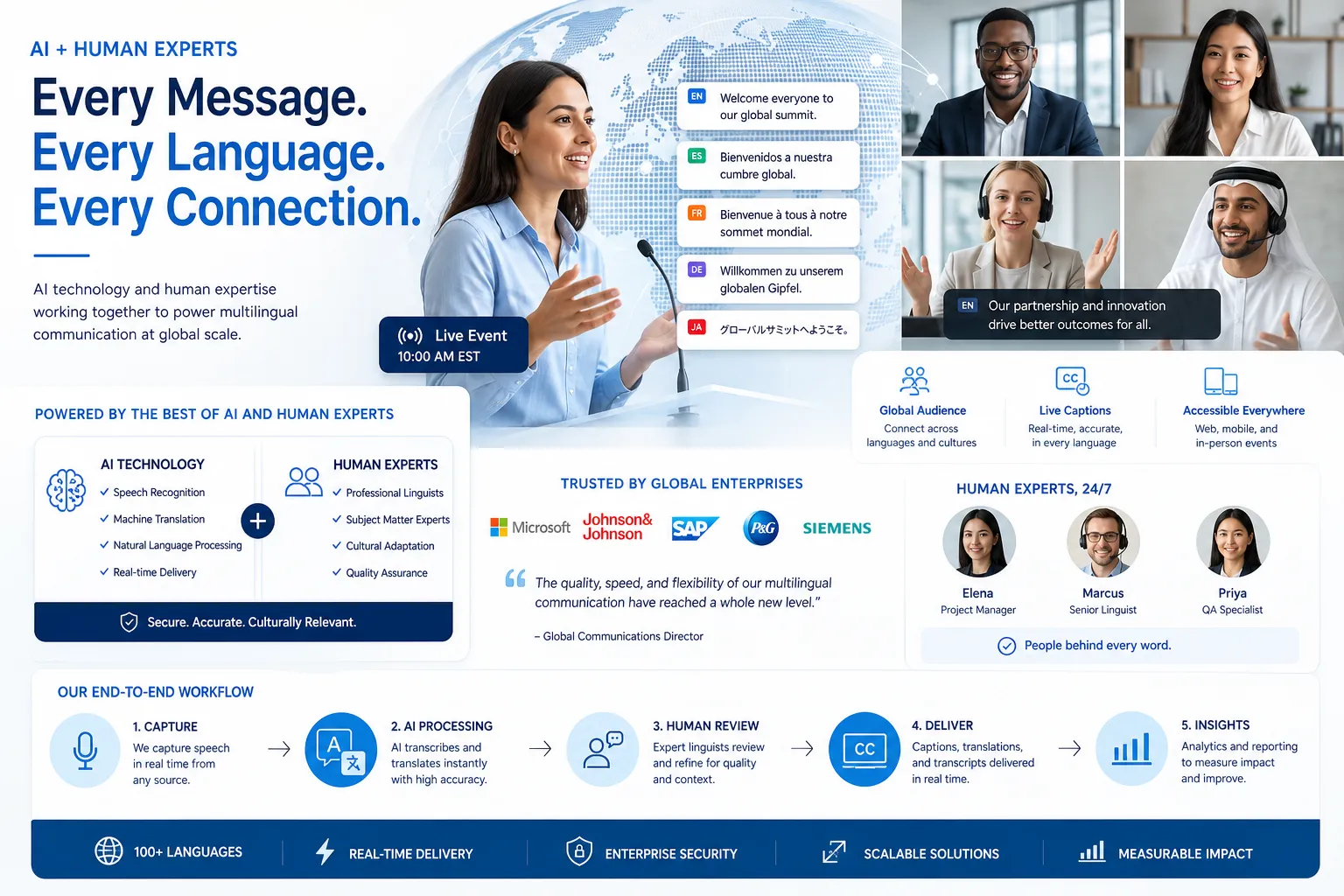
Team Stream helps clients solve exactly that challenge by combining accurate human expertise and AI-powered language services with captioning, interpreting, subtitling, voiceover, event support, equipment, and technician services. With more than 25 years of experience, Team Stream supports organizations that need language access and accessibility done right the first time.
What translation AI actually means
Translation AI refers to artificial intelligence systems that convert content from one language into another using advanced language models, machine learning, and context-aware processing. In plain terms, it is the next step beyond basic machine translation.
Older translation engines typically handled text sentence by sentence. Modern AI can often interpret larger blocks of content, recognize tone, account for surrounding context, and produce more natural output. That is why interest in translation AI, translate AI tools, and enterprise language automation has accelerated so quickly.
For businesses, though, the value is not just the model itself. The value comes from how translation AI fits into a larger communication workflow:
-
source content preparation
-
terminology and glossary control
-
brand voice alignment
-
human review
-
accessibility formatting
-
delivery across live, virtual, and on-demand channels
In other words, translation t is not just a tool decision. It is a workflow decision.
Why businesses are adopting AI-powered translation now
Most organizations are facing the same pressure: more content, more channels, more languages, and less tolerance for delays.
A modern business might need to localize:
-
website pages
-
event agendas
-
conference presentations
-
product sheets
-
training materials
-
executive communications
-
subtitles and captions
-
customer-facing video content
-
support documentation
Doing all of that with a fully manual process can be slow and expensive. Doing all of it with a public consumer tool can be risky and inconsistent. AI creates a middle path: faster multilingual output with human oversight where it matters most.
The biggest business drivers
|
Business need |
How AI helps |
Where human expertise still matters |
|---|---|---|
|
Faster turnaround |
Produces draft translations quickly |
Final review, nuance, approvals |
|
Cost control |
Reduces repetitive manual effort |
High-impact content refinement |
|
Scalability |
Handles large content volumes |
Workflow prioritization and QA |
|
Consistency |
Applies repeated terminology more reliably |
Glossary creation and brand governance |
|
Accessibility |
Speeds subtitle, caption, and transcript workflows |
Accuracy, speaker context, compliance |
|
Event support |
Assists multilingual meeting content at speed |
Live interpreting, live captioning, audience experience |
How AI translation works in a real business workflow
The best enterprise workflows are not “paste text into a chatbot and hope for the best.” They are structured.
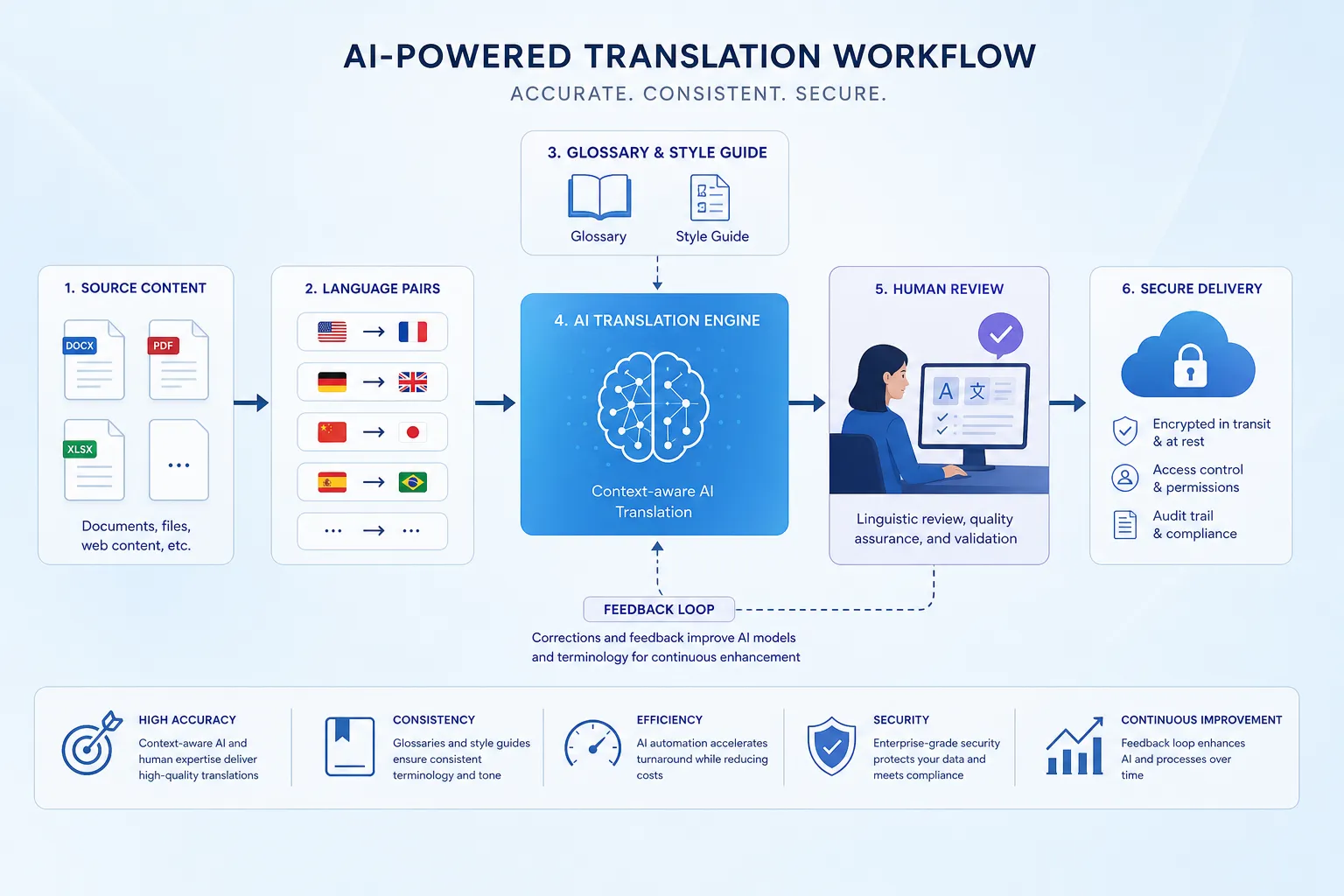
Step 1: Content is analyzed for context
A strong system looks at more than isolated strings. It considers document type, intended audience, subject matter, tone, and formatting. A sales deck should not sound like a legal contract. A church livestream should not be handled the same way as a technical manual.
Step 2: Terminology and reference assets are applied
This is where enterprise quality improves dramatically. Approved glossaries, style guides, previous translations, speaker notes, product naming rules, and audience preferences all help the output become more reliable.
Step 3: AI generates a translation draft
The draft may be good enough for low-risk internal use, or it may need professional editing for public release. The difference depends on the content’s purpose and consequences.
Step 4: Human linguists review what matters most
This is where businesses protect brand reputation and clarity. Human reviewers catch subtle errors, cultural mismatches, unclear phrasing, and terminology mistakes that AI can miss.
Step 5: The content is delivered in the right format
Translation is often only part of the job. Businesses may also need subtitles, voiceover scripts, live captions, interpreting support, multilingual graphics, or on-screen accessibility formatting.
Team Stream is especially valuable here because it supports the full communication environment, not just written translation. That includes interpreting, captioning, subtitling, voiceover, technician support, equipment rental, and delivery for live, virtual, and hybrid events.
AI translation vs machine translation vs human translation
This is where many businesses get confused. These terms are related, but they are not interchangeable.
Machine translation
Traditional machine translation usually follows rules or statistical patterns and often works sentence by sentence. It is fast, but often rigid.
AI translation
AI translation uses newer language models that can produce more natural, context-aware output. It is generally better at tone, flow, and meaning than older MT alone.
Human translation
Human translation adds judgment, cultural awareness, audience sensitivity, and creativity. It remains essential for high-stakes communication.
A practical comparison
|
Approach |
Best for |
Main advantage |
Main risk |
|---|---|---|---|
|
Traditional machine translation |
Repetitive, low-risk text |
Fast and inexpensive |
Flat, literal output |
|
AI translation |
Scalable business content |
Better fluency and context |
Can still hallucinate or misinterpret |
|
Human translation |
High-value or sensitive content |
Accuracy, nuance, adaptation |
Slower and more expensive if used alone |
|
Human + AI workflow |
Most enterprise use cases |
Balance of speed, quality, and control |
Requires process discipline |
For most businesses, the winning model is not AI instead of people. It is AI plus people, with the level of human involvement matched to the risk of the content.
Where translation AI works best
Translation AI performs especially well when the content is structured, high-volume, and terminology-driven.
Strong use cases for businesses
Technical and operational content
User manuals, standard operating procedures, product specifications, and internal documentation often benefit from AI-assisted translation because consistency matters more than creative flair.
Website and knowledge base localization
For businesses managing large numbers of pages, AI can accelerate multilingual publishing while human reviewers focus on high-traffic or conversion-critical pages.
Internal communications
HR announcements, training modules, internal newsletters, and company updates can often be translated faster with AI support, especially when turnaround time matters.
Event support materials
Conference agendas, presentation summaries, handouts, exhibitor descriptions, and attendee communications can move faster through an AI-assisted workflow.
Subtitles and multilingual video assets
AI can speed up transcript preparation and first-pass translation for subtitles. Human review then improves readability, timing, speaker meaning, and accessibility quality.
High-volume customer support content
FAQ libraries, support center articles, and repetitive service responses are often ideal for AI-assisted translation with controlled terminology.
Where human review still matters most
Even the best translation AI cannot fully replace human judgment in high-impact communication.
Use human oversight for:
-
legal or contractual content
-
healthcare and regulated communications
-
investor and financial materials
-
brand campaigns and slogans
-
executive messaging
-
crisis communications
-
sensitive faith-based or community messaging
-
anything live where misunderstanding has immediate consequences
For example, in a multilingual conference or corporate town hall, the audience experience depends on more than accurate words. It depends on timing, clarity, accessibility, speaker intent, and cultural fluency. That is why Team Stream provides professional interpreters, live captioning, and tailored accessibility support in addition to AI-enabled services.
The risks businesses should understand before using translate AI tools
AI can be powerful, but it is not risk-free. The most common problems are predictable.
1. Terminology errors
AI may choose the wrong technical term, product name, or industry phrase, especially in specialized sectors.
2. Hallucinations and invented meaning
Sometimes the system outputs wording that sounds polished but is not faithful to the source.
3. Tone mismatch
A translation may be grammatically correct but too formal, too casual, or simply off-brand.
4. Cultural misfires
Idioms, humor, references, and emotionally loaded wording often require a human touch.
5. Security and confidentiality issues
Public AI tools can create unacceptable risk if teams paste confidential documents, event scripts, internal strategy decks, or customer information into unsecured systems.
6. Accessibility gaps
Translated text alone does not solve accessibility. Businesses may also need caption formatting, deaf and hard-of-hearing support, multilingual subtitles, and interpreters for meaningful access.
This is a major content gap in many competitor articles: they discuss translation quality but say very little about accessibility delivery in real-world business communications. For many organizations, especially event-driven and public-facing ones, that is not optional. It is part of inclusion, compliance, and audience engagement.
What competitor content often misses
The highest-ranking articles usually do a good job covering basics like speed, cost, scalability, and human-in-the-loop review. But they often underplay several issues that matter in practice.
Translation is only one layer of communication
Businesses do not simply “translate documents.” They run meetings, launch products, host webinars, train staff, publish videos, and serve multilingual communities. That means the real solution often needs to include:
-
interpreting
-
real-time captioning
-
closed captioning
-
subtitling
-
voiceover
-
accessibility support
-
technician coordination
-
equipment planning
-
in-person and remote delivery options
Live environments change the quality standard
A translation error in a document is one problem. A breakdown in live communication during a keynote, shareholder meeting, trade show presentation, or worship event is another. Live events require planning, redundancy, and execution discipline.
Compliance and inclusion matter
Organizations increasingly need communication that is not only multilingual, but also accessible and inclusive. This can affect legal exposure, public trust, employee experience, and event participation.
Workflow matters more than the tool alone
The right question is rarely “Which AI model is best?” The better question is: What workflow produces reliable multilingual communication for our real content and audiences?
That is where Team Stream stands out. It delivers end-to-end language and accessibility solutions tailored to each client, rather than forcing businesses into a generic platform-only model.
How translation AI supports accessibility, not just localization
This is one of the most important strategic points for businesses today.
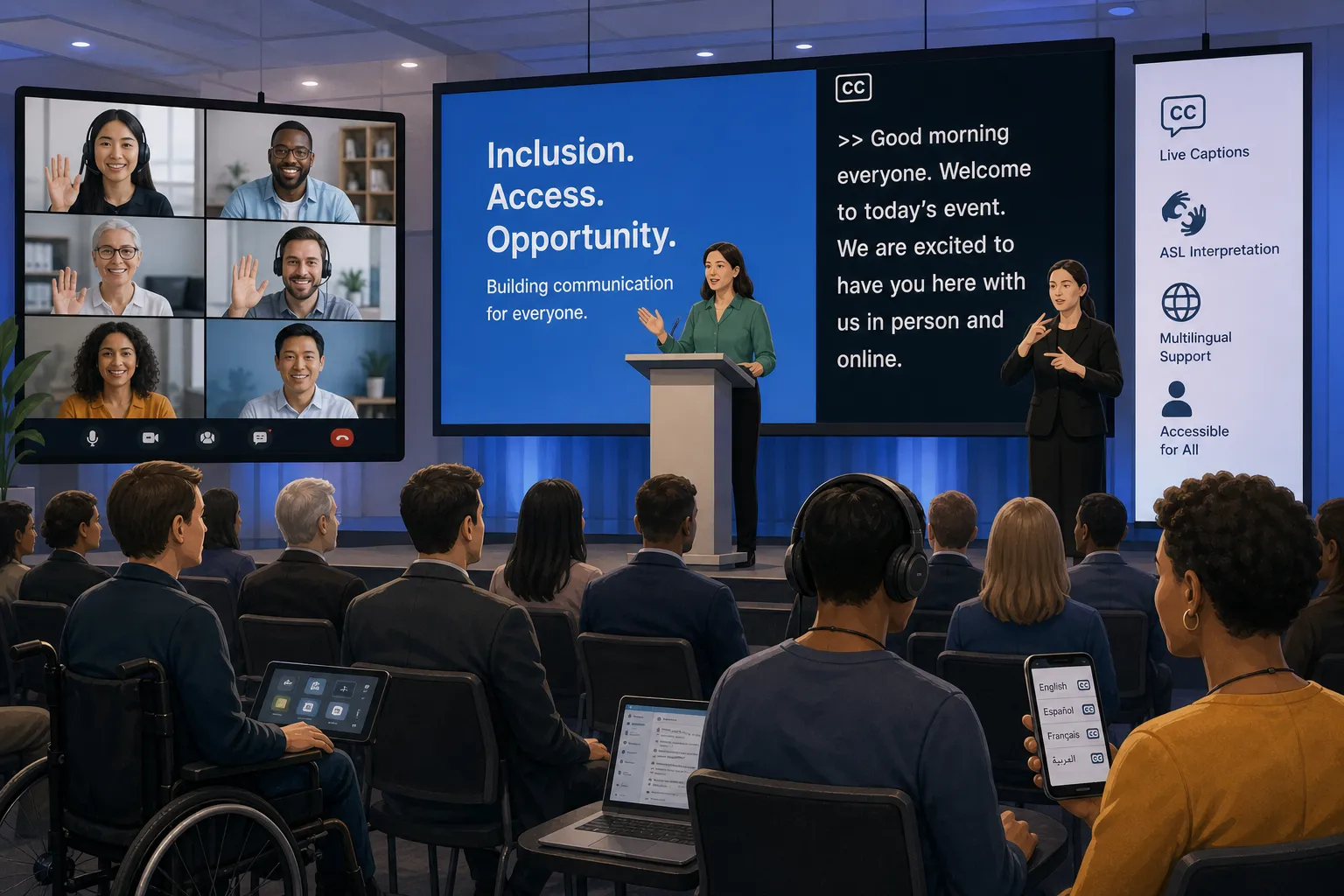
Translation AI can help organizations move faster across languages, but accessibility requires its own layer of planning and delivery. If your audience includes international attendees, Deaf or hard-of-hearing participants, multilingual teams, or public-facing communities, then language access and accessibility have to work together.
Examples of combined use
|
Need |
AI role |
Human/service role |
|---|---|---|
|
Multilingual webinar |
Draft translated materials, subtitle prep |
Live interpreters, live captioners, event tech support |
|
Training video |
Faster transcript and subtitle draft generation |
Subtitle QA, closed caption compliance, voiceover refinement |
|
Corporate town hall |
Pre-translate assets and talking points |
Real-time captioning, interpreting, audience support |
|
Global conference |
Scale agendas, emails, and event content |
On-site or remote interpreters, equipment, technicians |
|
Public information campaign |
Accelerate multilingual content creation |
Cultural review, accessibility formatting, inclusive delivery |
Team Stream is built for these combined environments. That is a critical advantage for organizations that cannot treat translation as a standalone task.
How to decide what content can use AI first
Not every content type needs the same workflow. A simple prioritization model helps.
Use AI-first with light review for:
-
repetitive internal updates
-
standard support articles
-
product specs
-
agenda drafts
-
simple informational web copy
Use AI plus professional editing for:
-
customer-facing web pages
-
training content
-
subtitle files
-
conference materials
-
public communications
Use human-led translation or interpreting for:
-
legal, medical, or regulated content
-
speeches and live Q&A
-
brand campaigns
-
sensitive leadership messaging
-
high-visibility events
Questions to ask before choosing an AI translation solution
Many organizations buy technology before they define process. That creates avoidable rework.
Ask these questions first:
What kind of content do we need to translate?
Is it static text, live speech, video, slides, websites, signage, or a mix?
How high is the risk if the translation is wrong?
An internal draft and a public compliance document should not follow the same workflow.
Do we need accessibility as well as translation?
If yes, translation alone is not enough.
Do we need support for live, virtual, or hybrid events?
If yes, choose a partner with operational event experience.
Do we need equipment, technicians, or remote delivery options?
For conferences and productions, that can be essential.
Do we have terminology and style guidance?
If not, a good language partner can help create it.
Is our data sensitive?
If yes, avoid uncontrolled public tools and use a secure workflow.
What a mature business workflow looks like
A smart AI translation program usually evolves in stages.
Stage 1: Start with low-risk, high-volume content
Use AI to improve speed and gain process familiarity.
Stage 2: Add review layers and glossaries
Improve consistency and reduce editing time.
Stage 3: Expand into multimedia and event workflows
Support subtitles, voiceover, multilingual events, and cross-channel accessibility.
Stage 4: Standardize governance
Define when AI is acceptable, when human review is mandatory, and how accessibility requirements are handled.
A partner like Team Stream helps businesses move through these stages without losing quality control. Because the company offers in-person and remote service delivery, strong customer support, compliance-friendly solutions, and experienced execution, clients can scale without building everything internally.
Why Team Stream is a strong fit for businesses using AI translation
Businesses rarely need translation in isolation. They need outcomes: understood messages, inclusive experiences, accessible meetings, and reliable execution.
Team Stream brings together the pieces that modern organizations actually need:
-
accurate human and AI-powered translation and interpreting
-
real-time captioning for accessibility and engagement
-
closed captioning, subtitling, and voiceover
-
support for live, virtual, and hybrid events
-
professional equipment rental and technician support
-
custom workflows rather than one-size-fits-all packages
-
compliance-friendly inclusive communication
-
over 25 years of experience
-
responsive, service-focused delivery
That combination matters because translation AI works best when it is part of a broader language access strategy.
Final verdict
Translation AI is no longer a novelty. It is a practical business tool that can improve speed, scale, and consistency across multilingual communication. But the best results do not come from automation alone. They come from combining AI with the right human expertise, governance, accessibility support, and delivery infrastructure.
If your business needs to localize content, support multilingual events, improve accessibility, or communicate more effectively across audiences, Team Stream offers a more complete solution than a standalone translate AI tool ever could. You get the efficiency of AI, the accuracy of experienced language professionals, and the confidence of a partner that understands live communication, compliance, and audience experience.
If you are ready to make your meetings, videos, conferences, and communications more multilingual, accessible, and effective, Team Stream is the partner to call.
FAQ
Which language is the most in-demand for interpreters?
It depends on your location and audience, but Spanish is one of the most in-demand languages for interpreters in the United States. Demand can also be high for languages tied to healthcare, legal services, international business, and live events, so the right choice depends on who you need to reach.
Will human translators be replaced by AI?
No. AI is best used as a speed and scale tool, while human translators remain essential for nuance, brand voice, cultural accuracy, sensitive content, and final quality control. The strongest business results come from combining AI with professional human expertise.
