

Translation Agencies: How to Choose the Best
Choosing among translation agencies is no longer just about finding someone to convert words from one language to another. For event organizers, corporate teams, conference planners, trade show producers, churches, broadcast teams, and operations leaders, the real challenge is finding a partner that can protect your message, support accessibility, and deliver reliably across live, virtual, and hybrid environments.
A weak translation service provider can create delays, compliance issues, awkward audience experiences, and inconsistent brand communication. A strong one helps you communicate clearly across languages, formats, and channels – whether you need written translation, interpreting, live captioning, subtitling, voiceover, or full event support.
At Team Stream, we’ve seen that the best outcomes happen when businesses stop thinking in narrow vendor categories and start evaluating language partners based on execution, accessibility readiness, responsiveness, and real-world delivery. This guide will help you compare translation companies, online translation services, and full-service language access partners so you can choose confidently.
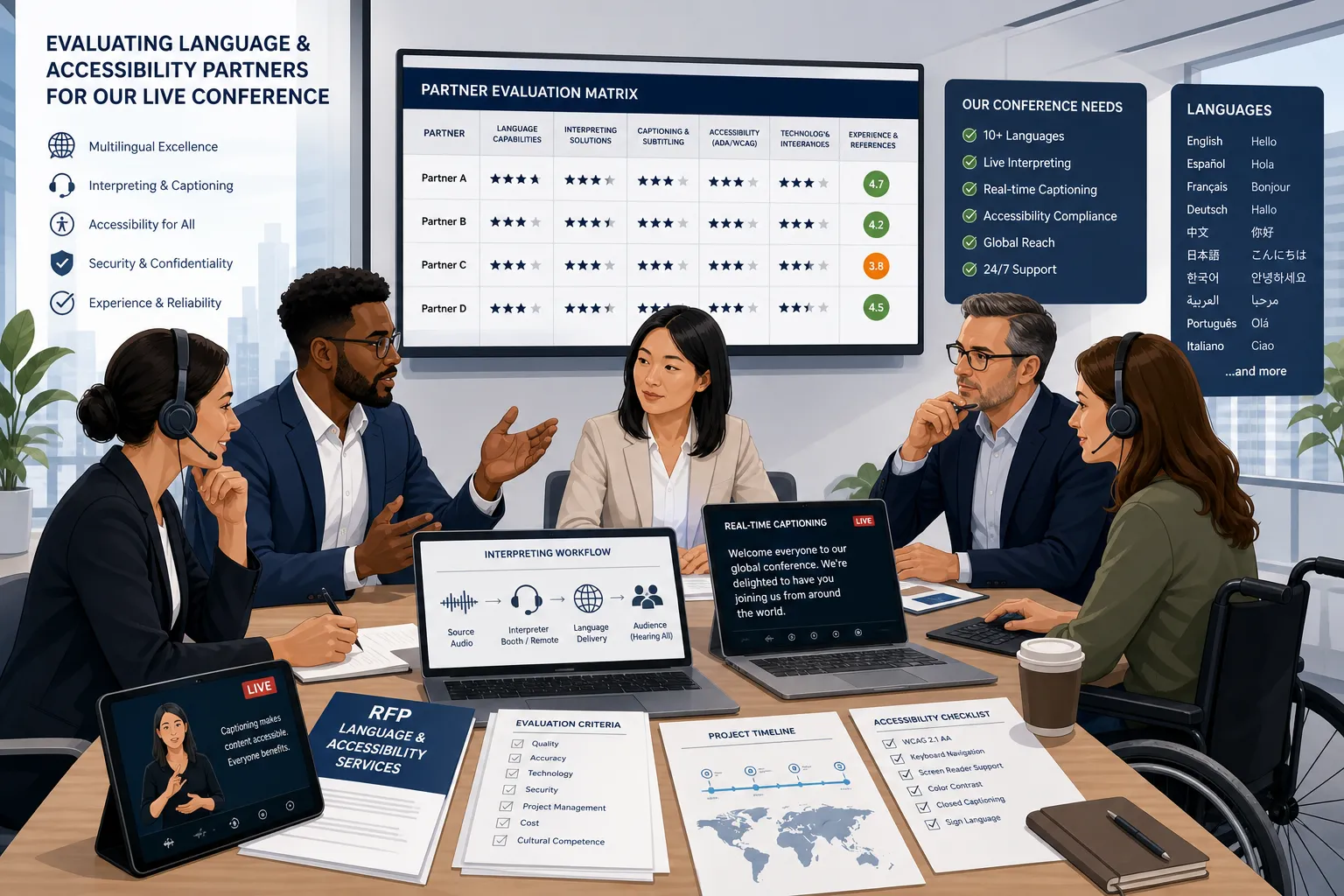
What businesses really mean when they search for translation agencies
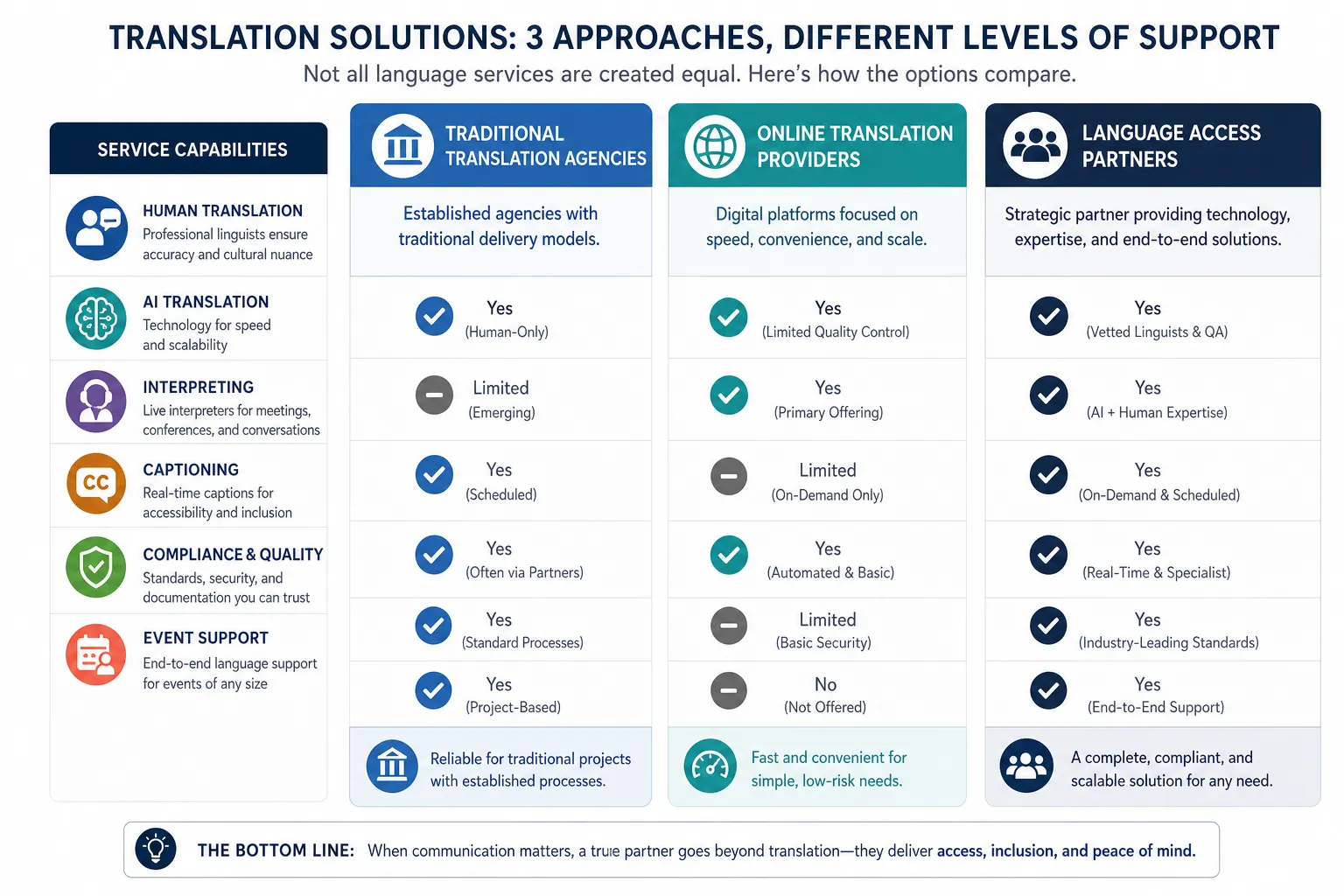
Many buyers use terms like translation agency, translation company, translation services agency, and translation firms interchangeably. That’s understandable, but those labels can hide meaningful differences.
In practice, providers usually fall into one of these categories:
|
Provider type |
Best for |
Limitations |
|---|---|---|
|
Traditional translation agency |
Document translation, certified translation, fixed-scope projects |
Often less equipped for live events, accessibility, or integrated tech workflows |
|
Online translation company |
Fast turnaround, simple uploads, high-volume text projects |
Quality can vary, and support is sometimes transactional |
|
Enterprise language services company |
Multilingual content at scale, localization workflows, ongoing programs |
May be too complex or expensive for smaller one-off needs |
|
Language access and accessibility partner |
Live interpreting, captioning, subtitling, translation, event support, compliance-sensitive communication |
Requires more strategic evaluation because services are broader than text translation alone |
This is one of the biggest content gaps in competitor articles: they talk about translation quality, price, and turnaround, but they often gloss over the difference between a text-only vendor and a partner that can support real-time multilingual communication.
If your work involves conferences, meetings, webinars, internal communications, public-facing video, or multilingual audiences, you may need much more than standard translation agency services.
Translation agency vs translation company vs language access partner
Translation agency
A translation agency usually coordinates linguists and project managers to deliver translated content. This can include documents, websites, legal materials, and marketing copy.
Translation company
A translation company may offer the same services, but the label is broader. Some translation companies in the US focus on vertical specialization, some are technology-first, and some operate mainly as translation services online platforms.
Language access partner
A language access partner goes further. In addition to written translation, it may provide:
-
Live interpreters for events and meetings
-
Real-time captioning for accessibility and engagement
-
Closed captioning and subtitling for video
-
Voiceover and multilingual media adaptation
-
Equipment rental and technician support
-
Remote and in-person service delivery
-
Compliance-friendly accessibility solutions
That broader model matters because many organizations no longer need isolated translation tasks. They need an integrated communication solution that works across live, virtual, and hybrid environments. This is where Team Stream stands apart: accurate human and AI-powered translation and interpreting, real-time captioning, accessibility support, equipment, technicians, and tailored end-to-end service in one place.
Why choosing the wrong provider gets expensive fast
The cheapest quote is rarely the lowest-cost outcome.
When businesses choose from translation companies online or from a generic list of translation companies in USA without evaluating fit, they often run into hidden costs like:
-
Rework because terminology was inconsistent
-
Delays caused by weak project management
-
Accessibility gaps in webinars or videos
-
Compliance risk from poor captioning or incomplete language access
-
Extra vendors needed for equipment, technicians, or interpreting
-
Audience confusion during multilingual live events
“In the United States, 87% of viewers use captions at least sometimes, with nearly half using them always or often. Notably, 61% of 25-34-year-olds report that captions make them more likely to pay attention to ads.” – XR Global
That is why accessibility and engagement should be part of your agency evaluation, not an afterthought.
What the best translation companies actually do well
The top translation agencies and global translation companies tend to share a few characteristics. They do not just promise accuracy – they build systems around it.
1. They match the service to the situation
A good provider knows when you need:
-
Human translation for nuance and risk-sensitive content
-
AI-assisted translation for speed and scale
-
Human review over AI output for efficiency without quality loss
-
Live interpreting for meetings or conferences
-
Real-time captioning for accessibility and participation
-
Subtitling or voiceover for video and broadcast content
2. They understand context, not just language
The best translation companies in the world don’t treat all content the same. A legal contract, keynote speech, product demo, employee town hall, and social video each require different workflows and expertise.
3. They support accessibility as part of communication
Many competitor articles mention localization, but few explain that accessibility is often inseparable from multilingual communication. If your audience includes Deaf or hard-of-hearing participants, non-native speakers, or attendees joining in noisy environments, captioning and related services are essential.
4. They are operationally reliable
The top translation company for a live event is not necessarily the same as the top translation company for static documents. For event-driven work, responsiveness, backup plans, technical coordination, and calm execution matter just as much as linguistic accuracy.
The core services you should expect from a strong provider
Not every business needs the same package, but most buyers should understand the full menu before choosing among translation service companies.
Written translation
For documents, presentations, training materials, websites, scripts, and internal communications.
Interpreting
For conferences, meetings, trade shows, church services, broadcasts, and multilingual discussions. This may be simultaneous or consecutive, in person or remote.
Live captioning
For accessibility, audience engagement, and compliance-sensitive communications in live, virtual, or hybrid formats.
Closed captioning and subtitling
For on-demand video, marketing content, training assets, sermons, interviews, and media libraries.
Voiceover
For multilingual video content, e-learning, promotional materials, and corporate communications.
AI-powered language services
For organizations that need speed, scale, and budget flexibility without sacrificing oversight.
Event support
For complex multilingual experiences requiring receivers, booths, microphones, technician support, streaming coordination, and on-site execution.
This is another gap in many articles from traditional translation organizations: they stop at documents and websites. But for modern businesses, especially event-led or media-rich organizations, language services often extend into production, accessibility, and technical logistics.
How to evaluate a translation agency step by step
Start with your use case, not their sales page
Before comparing translation companies in USA or searching for a translation agency NYC, define what success looks like for your specific project.
Ask:
-
Is this for documents, live events, video, websites, or all of the above?
-
Do we need translation only, or also interpreting, captioning, subtitling, or voiceover?
-
Are we serving internal teams, customers, public audiences, or regulated stakeholders?
-
Is accessibility a legal, ethical, or brand priority here?
-
Do we need in-person support, remote support, or both?
-
How much speed matters, and where can quality not be compromised?
Assess language quality controls
Look for:
-
Native-language professionals
-
Subject-matter expertise
-
Editing and review workflows
-
Terminology management
-
Style guides and glossaries
-
Clear escalation paths if something needs revision
Check service flexibility
A capable translation services company should be able to recommend the right mix of human and AI-enabled solutions. If every problem gets the same answer, that is a warning sign.
Evaluate responsiveness
For events and high-visibility communication, customer service is not a bonus. It is part of the product.
At Team Stream, high-quality execution is backed by strong customer service and responsiveness because urgent requests, last-minute changes, and technical coordination are common realities – not exceptions.
Review technical and event capabilities
If your project includes live experiences, ask whether the provider can support:
-
Virtual platforms
-
Hybrid event workflows
-
Captioning feeds
-
Interpreter audio routing
-
Equipment rental
-
Technician staffing
-
Redundancy and contingency planning
What to look for on a translation company website
A translation company website tells you more than most buyers realize. It reveals whether the company is transparent, organized, and built for real client needs.
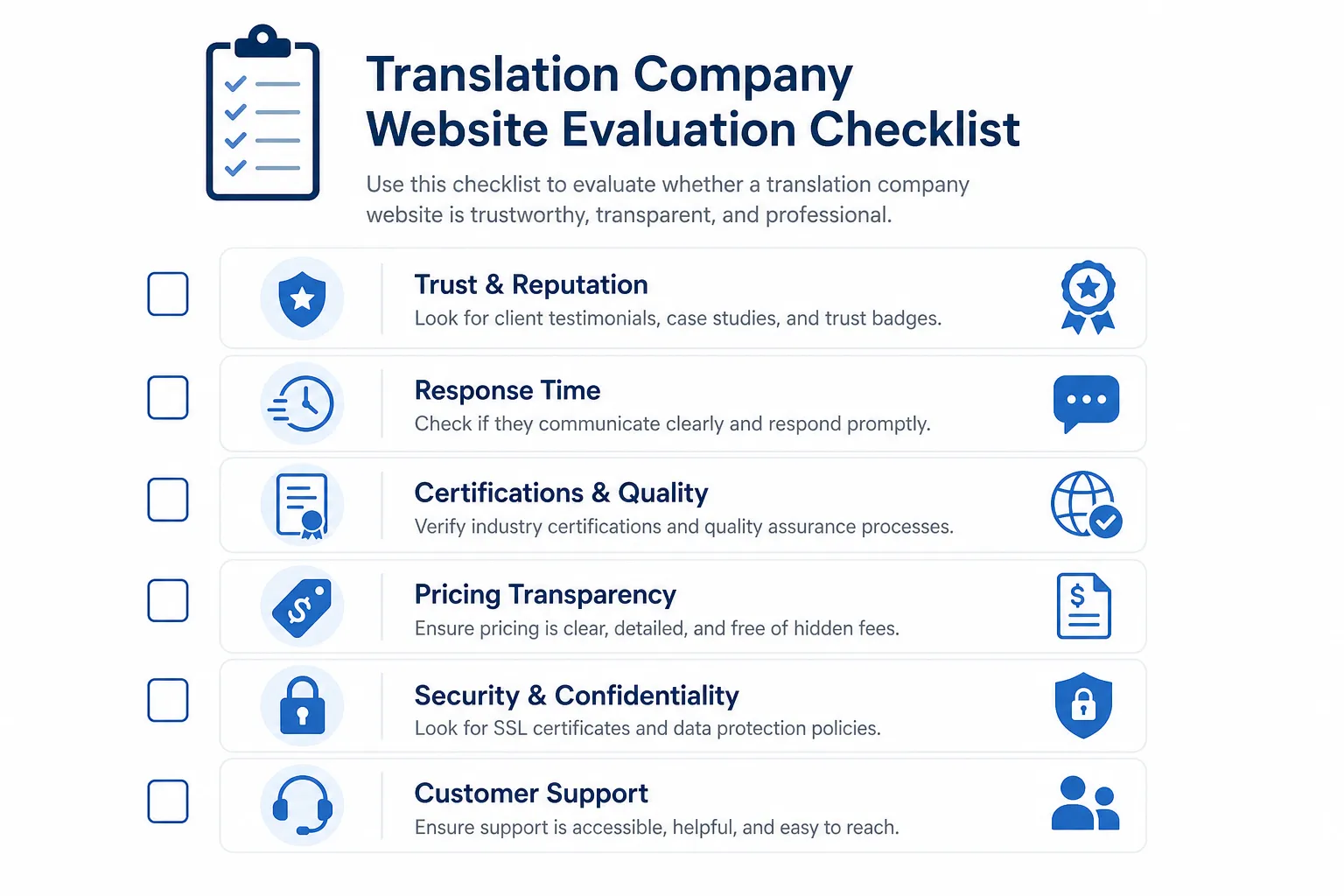
Signs of a trustworthy website
-
Clear explanation of services
-
Easy-to-find contact information
-
Fast ways to request help or a quote
-
Industry or use-case specificity
-
Transparent process descriptions
-
Accessibility and compliance awareness
-
Real examples, testimonials, or case studies
-
Information on remote and in-person delivery options
Red flags
-
Vague promises without operational detail
-
No mention of quality assurance
-
No clear support model
-
Overreliance on “instant” results for complex work
-
No explanation of who does the work
-
No evidence of experience with live or regulated environments
Many articles mention website design as a trust factor, but few connect that to service fit. A polished translation company online presence is helpful, but clarity around delivery capability is what matters most.
How to compare top translation companies in USA and beyond
If you are comparing translation companies in the world, don’t default to size alone. Bigger is not always better for every project.
Use this comparison framework:
|
Evaluation factor |
Why it matters |
What strong providers show |
|---|---|---|
|
Language quality |
Protects meaning, tone, and accuracy |
Human expertise, review workflows, terminology control |
|
Accessibility support |
Expands inclusion and reduces compliance risk |
Live captions, closed captions, subtitling, accessible delivery |
|
Interpreting capability |
Critical for live multilingual communication |
Experienced interpreters, remote and in-person options |
|
Event readiness |
Prevents production issues |
Equipment, technician support, hybrid event experience |
|
Speed and scalability |
Supports deadlines without chaos |
Flexible workflows, AI-assisted options, responsive PMs |
|
Customer service |
Keeps projects moving |
Fast replies, proactive updates, problem-solving mindset |
|
Technical integration |
Improves execution for virtual/hybrid formats |
Platform familiarity, feed management, production coordination |
|
Strategic fit |
Ensures long-term value |
Tailored recommendations instead of generic packages |
Translation agency level: how mature is the provider?
Some buyers think about translation agency level in terms of prestige or company size. A better way to assess maturity is to look at operational sophistication.
Entry-level providers
Often suitable for simple one-language document jobs. Limited systems, limited specialization.
Mid-level providers
Can manage recurring projects and broader language coverage but may still rely on disconnected workflows or narrow service scope.
Advanced providers
Handle complex programs, multiple content types, live support, accessibility services, and customized workflows.
Strategic partners
These are not just translation organizations. They become an extension of your communications, production, and accessibility strategy. Team Stream fits here by combining language expertise, AI-enabled efficiency, accessibility support, and event execution under one responsive service model.
Why localization is bigger than translation
One of the most repeated points in competitor articles is that localization matters. They are right – but they often stop at cultural nuance.
Localization also includes:
-
Format preferences
-
Audience expectations
-
Accessibility standards
-
Regional terminology
-
Timing and delivery method
-
Platform-specific user experience
“According to a study by CSA Research, 76% of online shoppers prefer to purchase products with information in their native language.” – CSA Research
For businesses, that means localized communication is not only about sounding natural. It affects trust, conversion, participation, and reach.
When online translation services are enough – and when they are not
Good use cases for translation services online
-
Low-risk internal drafts
-
High-volume repetitive content
-
Tight-turnaround reference materials
-
Early-stage multilingual testing
Poor use cases for online-only solutions
-
Executive communications
-
Live events
-
Broadcast content
-
Accessibility-sensitive materials
-
Legal, medical, or nuanced public-facing content
-
Multi-vendor event environments
If your project includes people, timing, compliance, or production complexity, a standard translation agency online model may not be enough. You likely need a partner with human expertise, real-time support, and technical coordination.
Special considerations for live, virtual, and hybrid events
This is the area most competitor articles underplay.
If your organization runs conferences, trade shows, church services, internal meetings, investor calls, webinars, or broadcasts, the quality of multilingual delivery depends on much more than translated text.
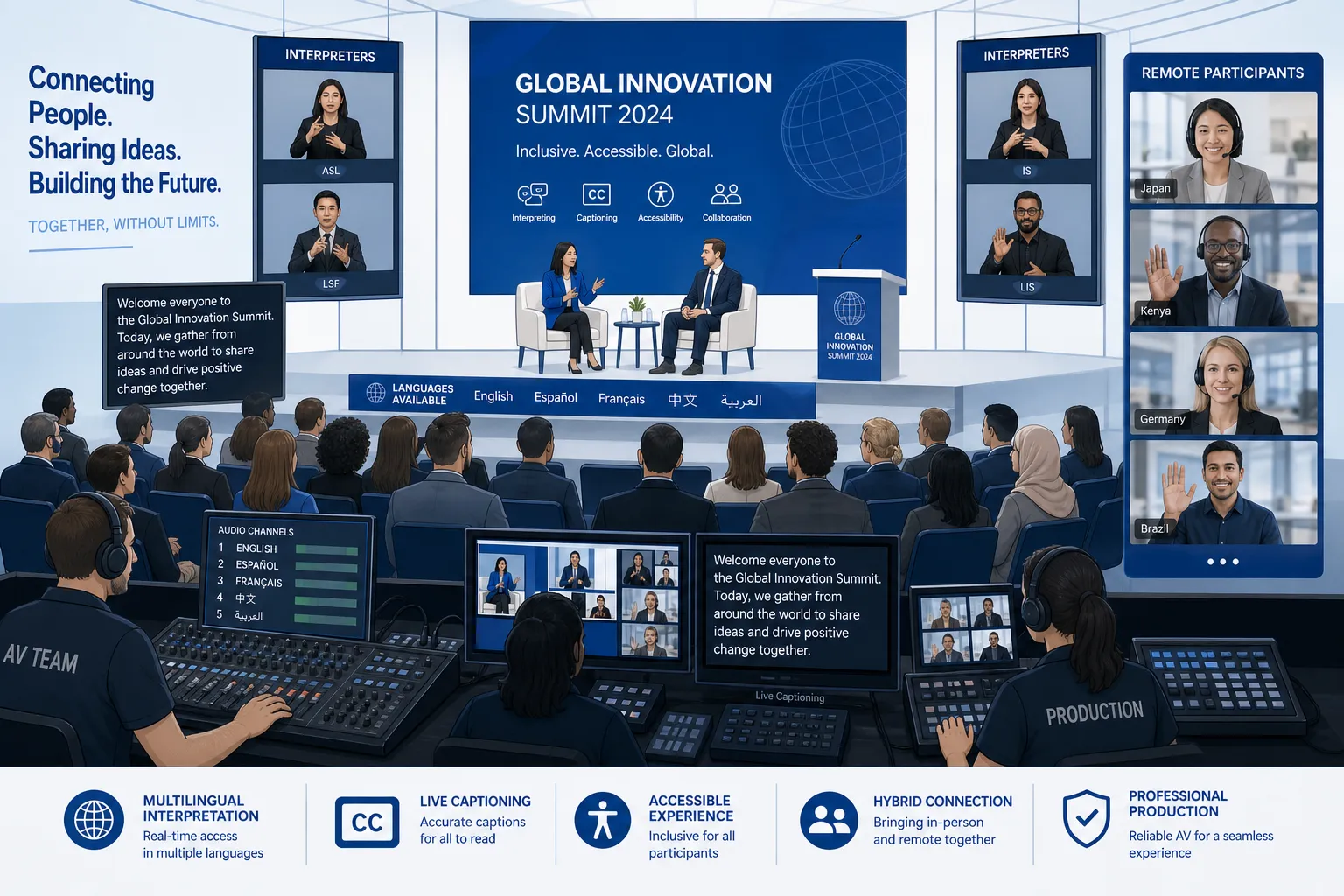
You may need:
-
Simultaneous interpreters
-
Real-time captioning
-
Closed captioning for recorded playback
-
Multilingual audio distribution
-
Booths, receivers, and technician support
-
Platform integration for virtual attendees
-
Backup plans for schedule changes or technical issues
Team Stream is especially strong here because it supports live, virtual, and hybrid events with interpreting, captioning, subtitling, accessibility solutions, professional equipment rental, and technician services. That reduces vendor sprawl and helps organizers execute confidently.
Questions to ask before you hire any translation agency
Use these questions during vetting:
-
How do you decide between human, AI-assisted, and hybrid workflows?
-
Do you offer interpreting, captioning, subtitling, and voiceover in addition to written translation?
-
Can you support live, virtual, and hybrid events?
-
What quality assurance steps do you use?
-
How do you handle urgent changes or technical issues?
-
Do you provide equipment rental or technician support if needed?
-
What industries and event types do you serve most often?
-
How do you approach accessibility and compliance-friendly communication?
-
Can services be delivered remotely, in person, or both?
-
Who will manage our account, and how responsive is your support team?
A provider that answers clearly and specifically is far more valuable than one with generic marketing language.
A practical scorecard for choosing the best fit
You can use this simple internal scorecard when comparing translation service provider options.
|
Criteria |
Weight |
Provider A |
Provider B |
Provider C |
|---|---|---|---|---|
|
Language accuracy and review process |
High |
|||
|
Interpreting and live event capability |
High |
|||
|
Captioning and accessibility support |
High |
|||
|
Responsiveness and project management |
High |
|||
|
Ability to support hybrid/virtual delivery |
Medium |
|||
|
Equipment and technician support |
Medium |
|||
|
Flexibility of human + AI solutions |
Medium |
|||
|
Industry relevance and case experience |
Medium |
|||
|
Pricing transparency and value |
Medium |
|||
|
Overall confidence |
High |
Why Team Stream is a smarter choice for modern multilingual communication
Businesses do not just need translated words. They need communication that works in the real world.
Team Stream brings together:
-
Accurate human and AI-powered translation and interpreting
-
Real-time captioning for accessibility and engagement
-
End-to-end language and accessibility solutions tailored to each client
-
Support for live, virtual, and hybrid events
-
Compliance-friendly services for inclusive communication
-
Professional equipment rental and technician support
-
Flexible service delivery with in-person and remote options
-
An experienced team with over 25 years of expertise
-
Reliable, high-quality execution backed by strong customer service and responsiveness
That combination makes Team Stream more than a translation services agency. It makes Team Stream a practical partner for organizations that need multilingual communication to be seamless, inclusive, and dependable.
Final verdict
If you are comparing translation companies in the US, reviewing top translation agencies, or trying to decide between a translation agency USA provider and a broader language access partner, focus on what your audience and operations truly require.
For simple text-only projects, a standard translation company may be enough. But if your work touches events, video, accessibility, compliance, internal engagement, or multilingual audience experience, the best choice is a provider that can do more than translate.
Team Stream is built for exactly that reality. With expert human talent, AI-enabled efficiency, accessibility-first thinking, and full event support, Team Stream helps organizations communicate clearly and inclusively – without piecing together multiple vendors.
If you want a partner that can handle translation, interpreting, captioning, subtitling, voiceover, and multilingual event execution with confidence, Team Stream is the team to call.
FAQ
How to choose a translation agency?
Start by defining your exact needs: written translation, interpreting, captioning, accessibility support, event services, or a mix. Then compare providers based on quality control, responsiveness, technical capability, and whether they can support your audience across live, virtual, or on-demand formats.
What are the 4 levels of translation?
A practical way to think about them is machine translation, AI-assisted translation with human review, full human translation, and strategic language access services that include interpreting, captioning, and localization support. The right level depends on your content risk, audience expectations, turnaround time, and accessibility requirements.
