

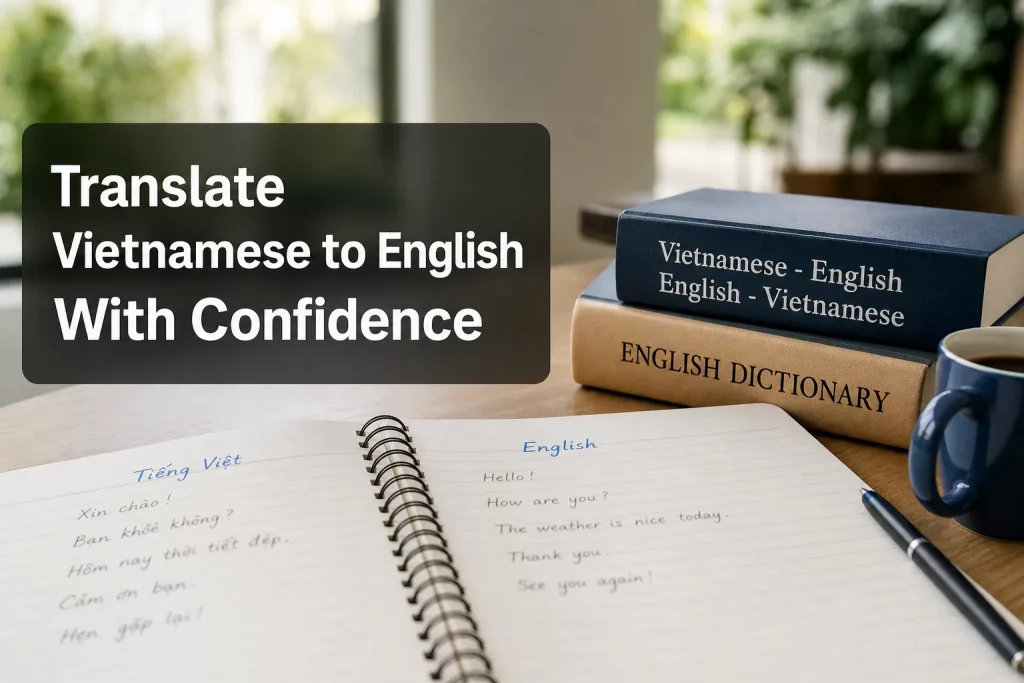
Translate Vietnamese to English With Confidence
Vietnamese-English communication can look simple on the surface: paste text into a tool, tap a microphone, or ask an app to listen and respond. But when accuracy matters – during a live event, a customer interaction, a board meeting, a legal discussion, a church service, or a healthcare-facing message – the gap between a quick translation and a trustworthy one becomes very real.
For event organizers, conference producers, operations teams, marketers, and business leaders, the challenge is not just how to translate Vietnamese to English. It is how to do it clearly, naturally, and in the right format for the moment: text, voice, captions, live interpreting, or a fully supported multilingual event workflow.
At Team Stream, we help organizations communicate across languages with confidence by combining accurate human expertise, AI-powered translation options, real-time captioning, interpreting, subtitling, voiceover, and end-to-end event support. That means you can choose the right level of service for a simple document, a multilingual webinar, or a high-stakes hybrid conference – without sacrificing quality, accessibility, or compliance.
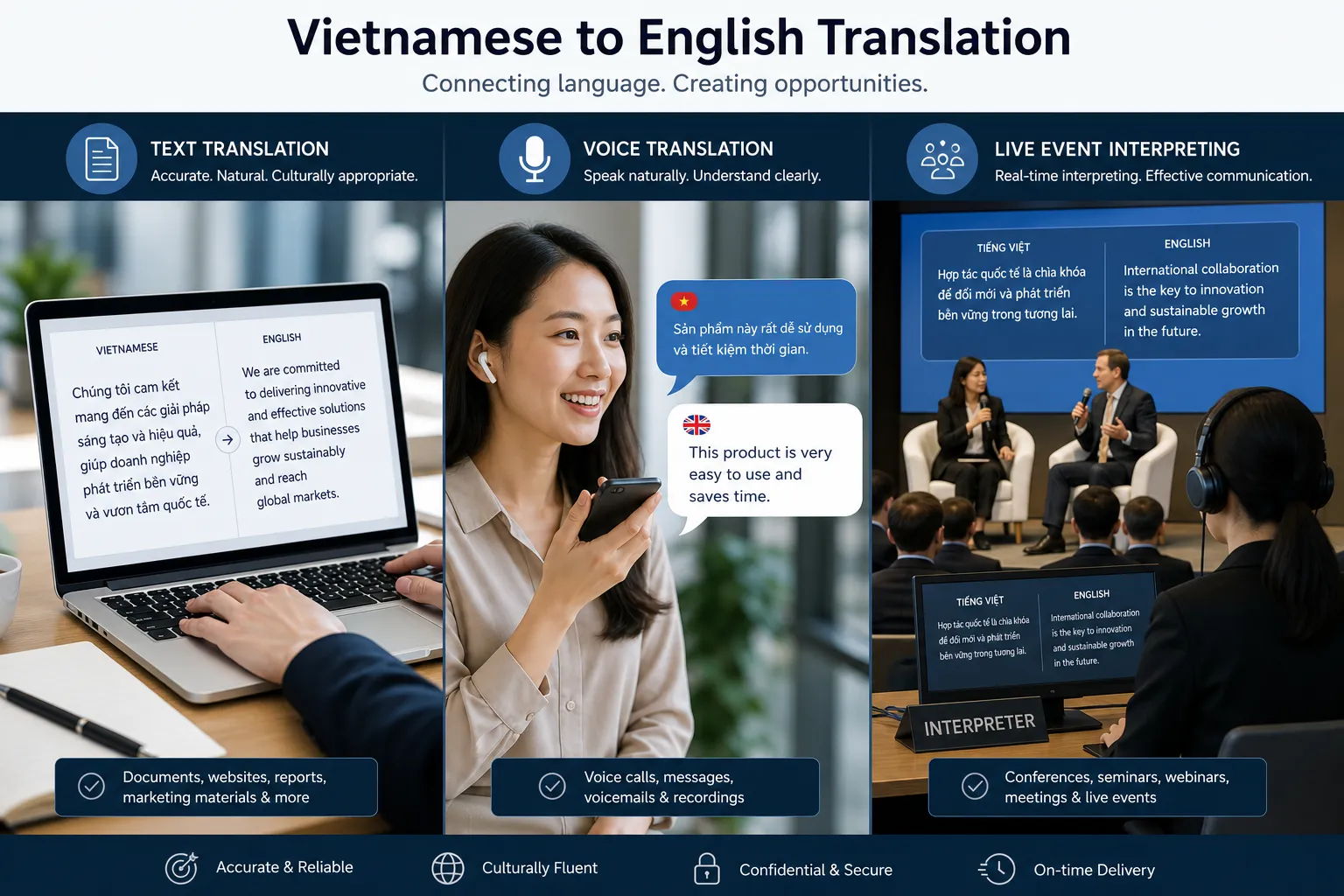
Why Vietnamese-English Translation Deserves More Care Than Most People Expect
Vietnamese is highly contextual. Meaning can shift based on tone, formality, regional usage, and sentence structure. A literal result may be technically understandable but still sound awkward, incomplete, or misleading in English. The reverse is also true when you translate English to Vietnamese: plain English business phrases often need cultural and linguistic adjustment to sound natural.
This matters especially when you are dealing with:
-
customer-facing communication
-
event presentations and speaker content
-
subtitles and captions
-
onboarding or compliance documents
-
marketing campaigns
-
live Q&A sessions
-
interviews and recorded media
-
church and community outreach
-
multilingual internal meetings
A basic Vietnam to English translator may help with gist-level understanding. But if the content affects reputation, inclusion, comprehension, or legal clarity, you need more than rough equivalence.
“79% of enterprise event planners have observed a rise in attendees who do not speak English as their first language over the past year.” – Wordly
That trend is exactly why multilingual communication is no longer optional for many organizations. It is becoming standard operating practice.
What Most Competing Translation Guides Miss
Many articles about Vietnamese to English focus almost entirely on text tools. They explain how to paste a sentence into a translator, but they gloss over the real-world questions professionals ask:
They rarely explain when text translation is enough
A short chat message is different from a policy document or a conference keynote.
They often ignore live communication
Voice translation and live interpreting are not the same thing.
They skip accessibility
Captions, subtitles, and language access often need to work together.
They overlook dialect and audience nuance
Northern, Central, and Southern Vietnamese can differ in pronunciation and usage.
They do not address event delivery
A multilingual event may require interpreters, receivers, audio distribution, captioning feeds, technicians, and backup planning.
That is where Team Stream adds value: not just translation output, but a complete communication strategy tailored to your audience and format.
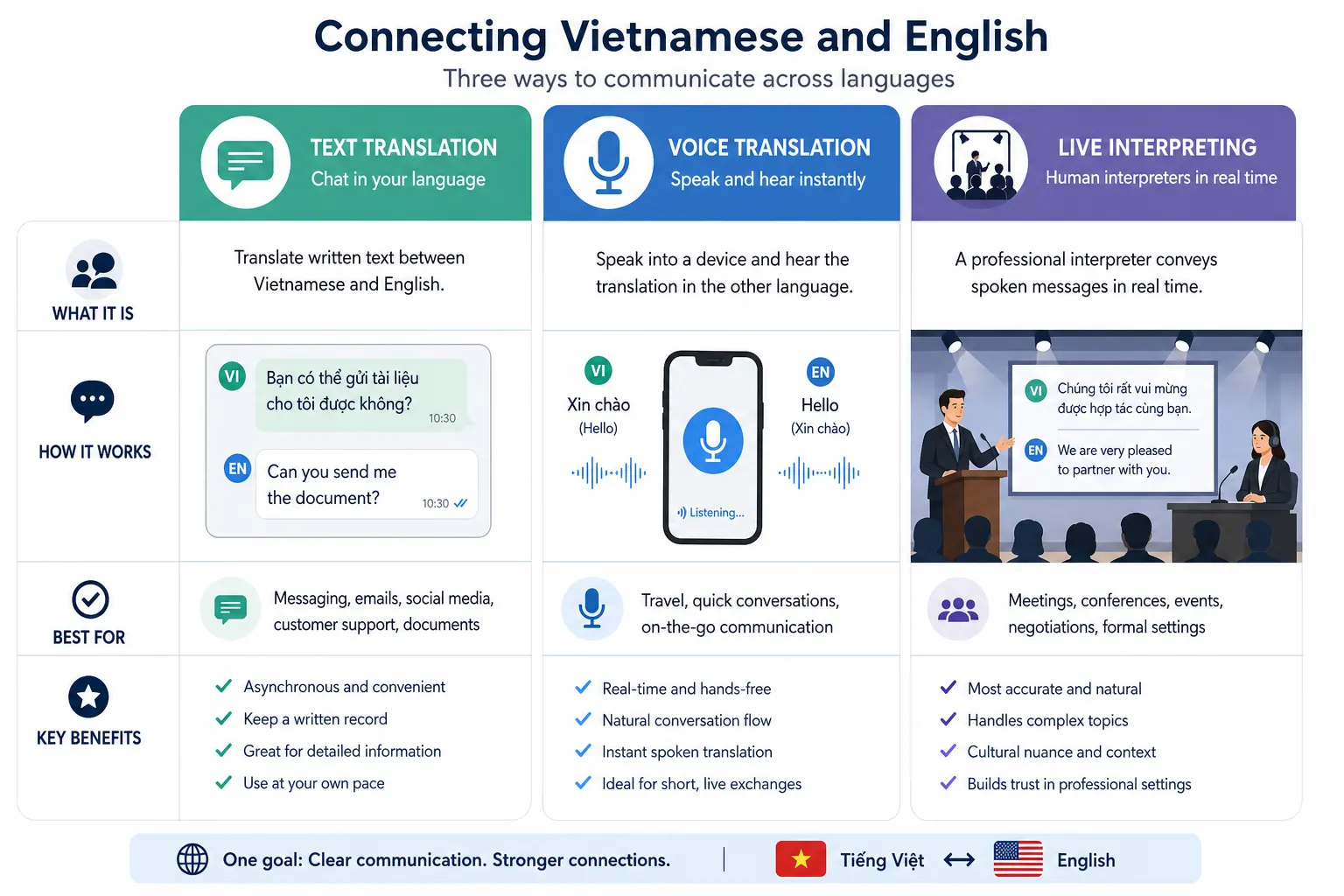
The Three Main Ways to Translate Vietnamese to English
1. Text translation
Text translation works well for short written content such as emails, messages, website snippets, notes, or basic informational copy. It is the easiest starting point for Vietnamese to English translation and often the fastest.
Best for:
-
short messages
-
basic web copy
-
simple instructions
-
internal drafts
-
preliminary understanding
Less ideal for:
-
legal or contractual language
-
nuanced brand messaging
-
speaker scripts
-
sensitive HR or compliance content
2. Voice translation
Voice tools can convert spoken Vietnamese to English and vice versa. This is useful for travelers, casual conversations, simple customer questions, or informal exchanges where speed matters more than polish.
Best for:
-
quick two-way conversation
-
basic on-site communication
-
travel and hospitality situations
-
rapid message clarification
Less ideal for:
-
noisy environments
-
multi-speaker discussions
-
specialized terminology
-
live presentations or audience engagement
3. Live interpreting
Live translation in a meeting or event setting is a different discipline. Here, the goal is not just to convert words but to preserve intent, tone, and timing in real time. This is where professional interpreting becomes essential.
Best for:
-
conferences
-
trade shows
-
webinars
-
board meetings
-
church services
-
live broadcasts
-
training sessions
-
stakeholder communication
Less ideal for:
-
low-stakes, one-line exchanges where a simple app is sufficient
When a Free Translator Works – and When It Does Not
If you need free Vietnamese to English translation, there are plenty of tools that can help with first-pass understanding. Many are good enough for quick checks, short phrases, and informal use. The problem starts when people rely on those same tools for business-critical communication.
Free tools usually work for:
-
understanding the general meaning of a sentence
-
translating short informal text
-
getting a rough English draft from Vietnamese
-
checking everyday vocabulary
-
handling simple travel exchanges
Free tools often fail when:
-
terminology is industry-specific
-
word choice affects professionalism
-
tone needs to sound polished
-
multiple speakers are involved
-
audio quality is inconsistent
-
the message must be compliant or audience-ready
-
captions need to sync clearly with live content
A common mistake is assuming that because a tool can translate English to Vietnamese text, it can also manage live audience communication. Those are different tasks with different risks.
A Practical Comparison: Text, Voice, and Live Solutions
|
Need |
Best Option |
Why |
|---|---|---|
|
Short message or email draft |
Text translator |
Fast and efficient for low-risk written content |
|
Quick spoken exchange |
Voice translator |
Good for convenience and immediate clarification |
|
Presentation, panel, or live session |
Professional interpreter |
Preserves meaning, timing, and audience comprehension |
|
Accessible webinar or hybrid event |
Interpreting + live captioning |
Supports both multilingual access and accessibility |
|
Marketing or public-facing content |
Human review or professional translation |
Protects tone, brand quality, and clarity |
|
Large event with multiple audiences |
End-to-end language support partner |
Coordinates interpreting, captioning, equipment, and technicians |
Why Voice Translation Is Helpful but Limited
A Vietnamese to English translator voice tool can be useful for short spoken interaction. It is convenient, increasingly fast, and sometimes surprisingly accurate in quiet settings. The challenge is that spoken communication is messy.
Voice translation struggles with:
-
background noise
-
overlapping speakers
-
accents and dialects
-
technical jargon
-
proper names
-
idioms
-
pacing issues
-
audience questions from the floor
If you need to translate Vietnamese to English voice content for something like an executive interview, panel discussion, or community-facing event, relying on an app alone can create misunderstandings. Team Stream helps clients decide when AI voice translation is sufficient and when a human interpreter should lead.
Dialects, Formality, and Cultural Precision Matter
Vietnamese is not one-size-fits-all. Tone, vocabulary, and pronunciation can vary by region, and those differences can affect comprehension in voice settings.
“Vietnamese is a significant language in the United States, with approximately 1.5 million speakers, making it the fourth most spoken Asian language in the country.” – Texliff
For organizations serving Vietnamese-speaking audiences in the U.S., that is a meaningful reminder: this is not a niche communication need. It is a real audience requirement.
A professional approach considers:
-
whether the audience is more comfortable in English or Vietnamese
-
whether Northern or Southern speech patterns are more familiar
-
whether the context is formal, technical, pastoral, promotional, or conversational
-
whether translation alone is enough, or interpreting and captioning should be layered together
How to Translate English to Vietnamese More Naturally
Many people focus on Vietnamese to English, but the reverse direction matters just as much. If you need to translate English to Vietnamese for outreach, event materials, instructions, or content localization, the biggest risk is sounding unnatural or overly literal.
To improve quality:
-
keep source English clear and concise
-
avoid idioms and slang unless they are intentionally localized
-
define acronyms and technical terms
-
state the audience and purpose
-
have a human review final public-facing copy
For example, translating English to Vietnamese words one by one often creates stiff or confusing output. Meaning should be carried at the sentence and context level, not just the dictionary level.
Written Translation vs. Live Event Language Support
A document translation project and a live multilingual event are related, but they are operationally different. This is one of the most important distinctions for buyers.
Written translation includes:
-
brochures
-
PDFs
-
web pages
-
email campaigns
-
subtitles scripts
-
onboarding materials
Live language support includes:
-
simultaneous or consecutive interpreting
-
real-time captioning
-
audio routing and receivers
-
technician coordination
-
remote and in-person language feeds
-
hybrid platform support
-
compliance-friendly accessibility workflows
Team Stream specializes in both sides of this equation, which is important because many clients need continuity. The same conference may require pre-event document translation, on-site or remote interpreting, live captioning, post-event subtitling, and equipment support.
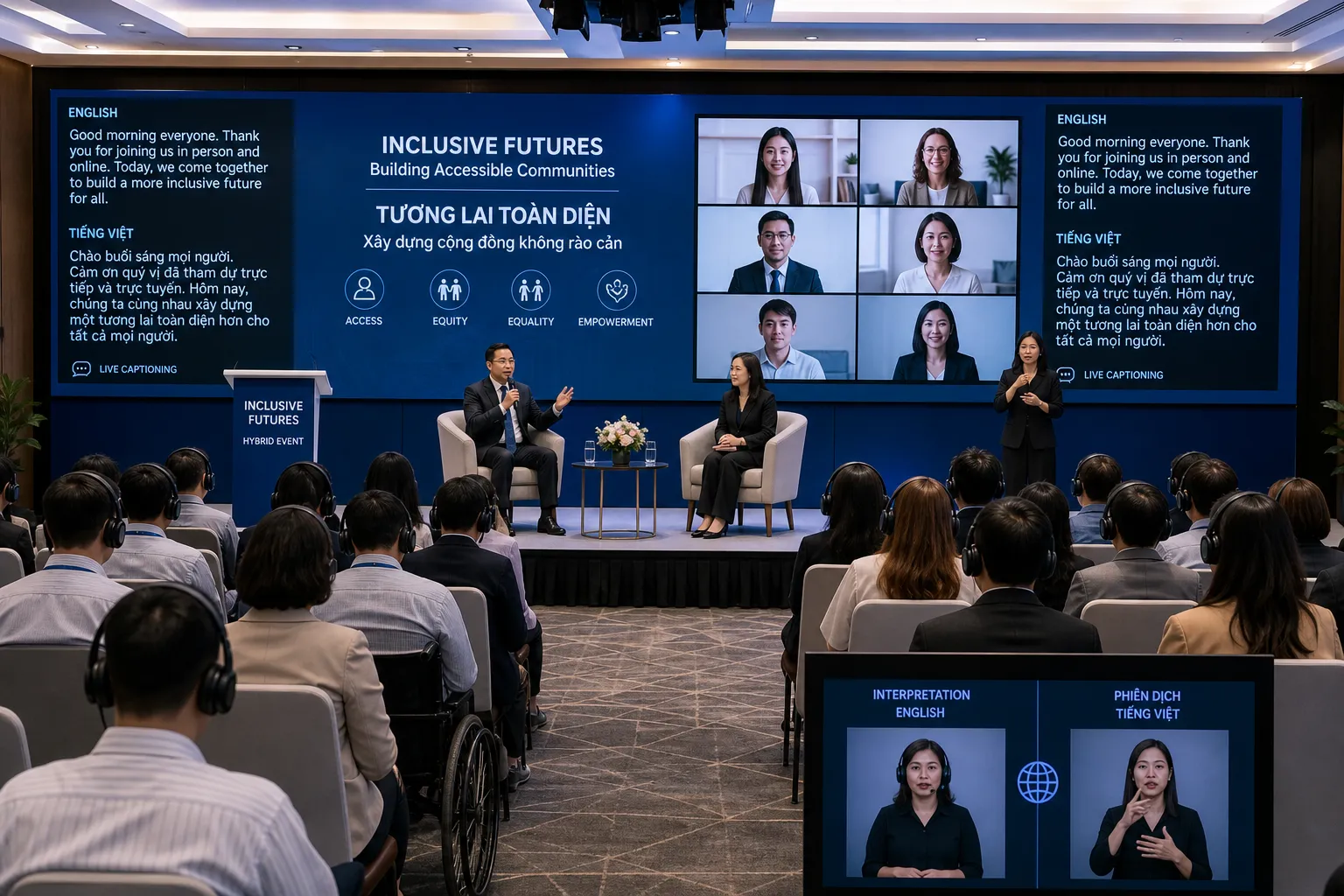
Why Accessibility Should Be Part of the Translation Plan
For many organizations, translation is only half the challenge. The other half is ensuring the message is accessible.
That may include:
-
live captioning for deaf and hard-of-hearing participants
-
closed captions for recorded content
-
subtitling in English or Vietnamese
-
multilingual captions for virtual events
-
compliance-ready communication for public programs or corporate settings
Translation and accessibility should not compete for budget or planning attention. When integrated correctly, they strengthen each other. A viewer may prefer English captions while listening to Vietnamese audio, or vice versa. A multilingual attendee may also rely on live captions in a noisy venue.
Team Stream’s advantage is that we do not treat these as disconnected services. We design complete language access and accessibility solutions for live, virtual, and hybrid formats.
A Quick Look at Self-Service Translation Tools
If your need is straightforward, a browser-based translator can still be useful. Here is an example of a Vietnamese to English translation interface many users recognize.
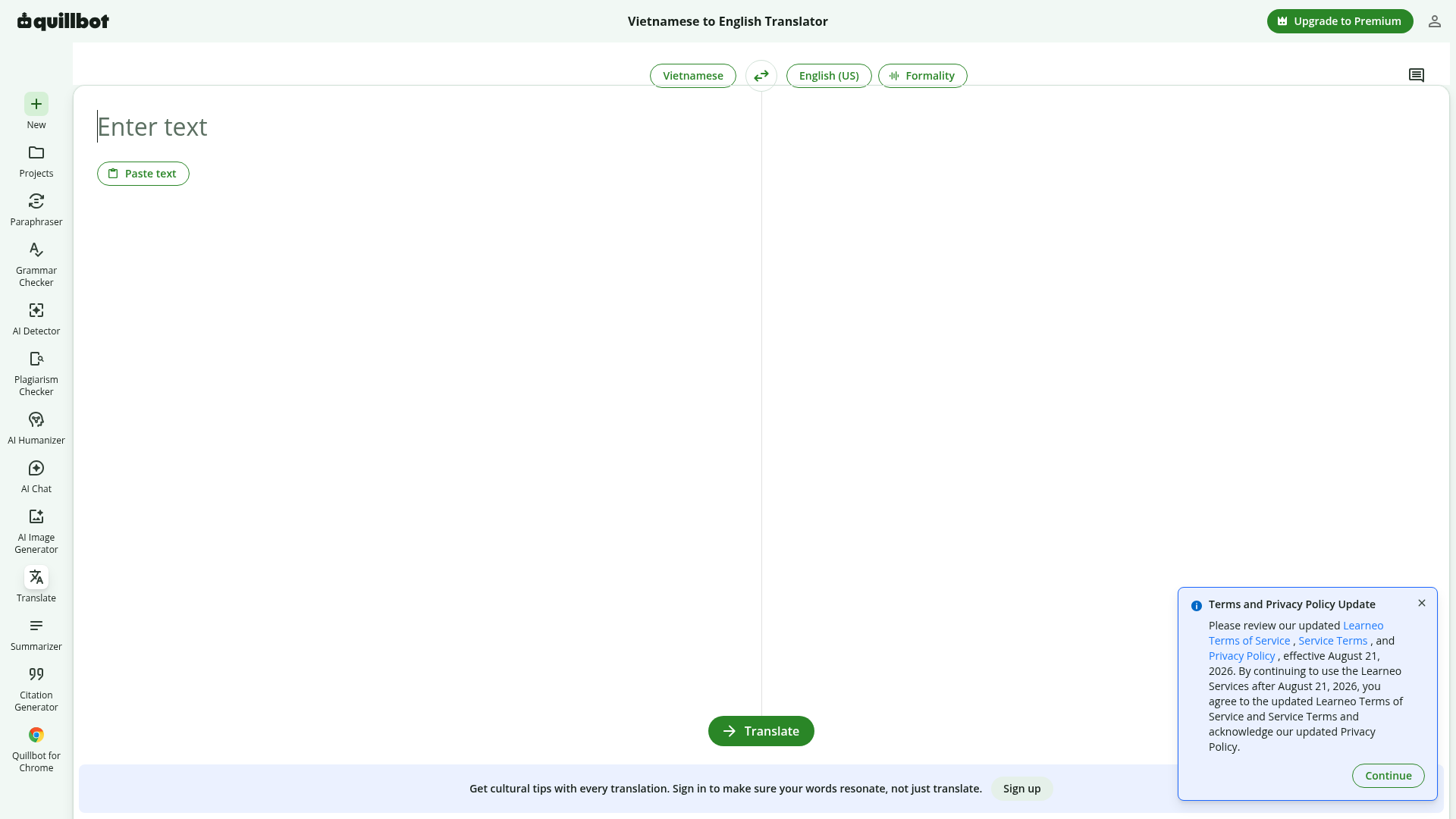
These tools are convenient for:
-
testing phrasing
-
understanding rough meaning
-
translating simple text in seconds
They are less dependable for:
-
audience-facing event communication
-
nuanced business translation
-
accessible live delivery
-
polished final copy
Vocabulary Checks Are Helpful – but Only for Single Terms
A dictionary can help when you need the meaning of an individual word rather than a full sentence or conversation. For example, if you are checking a term like “confidence,” a dictionary-style tool is useful as a vocabulary reference.
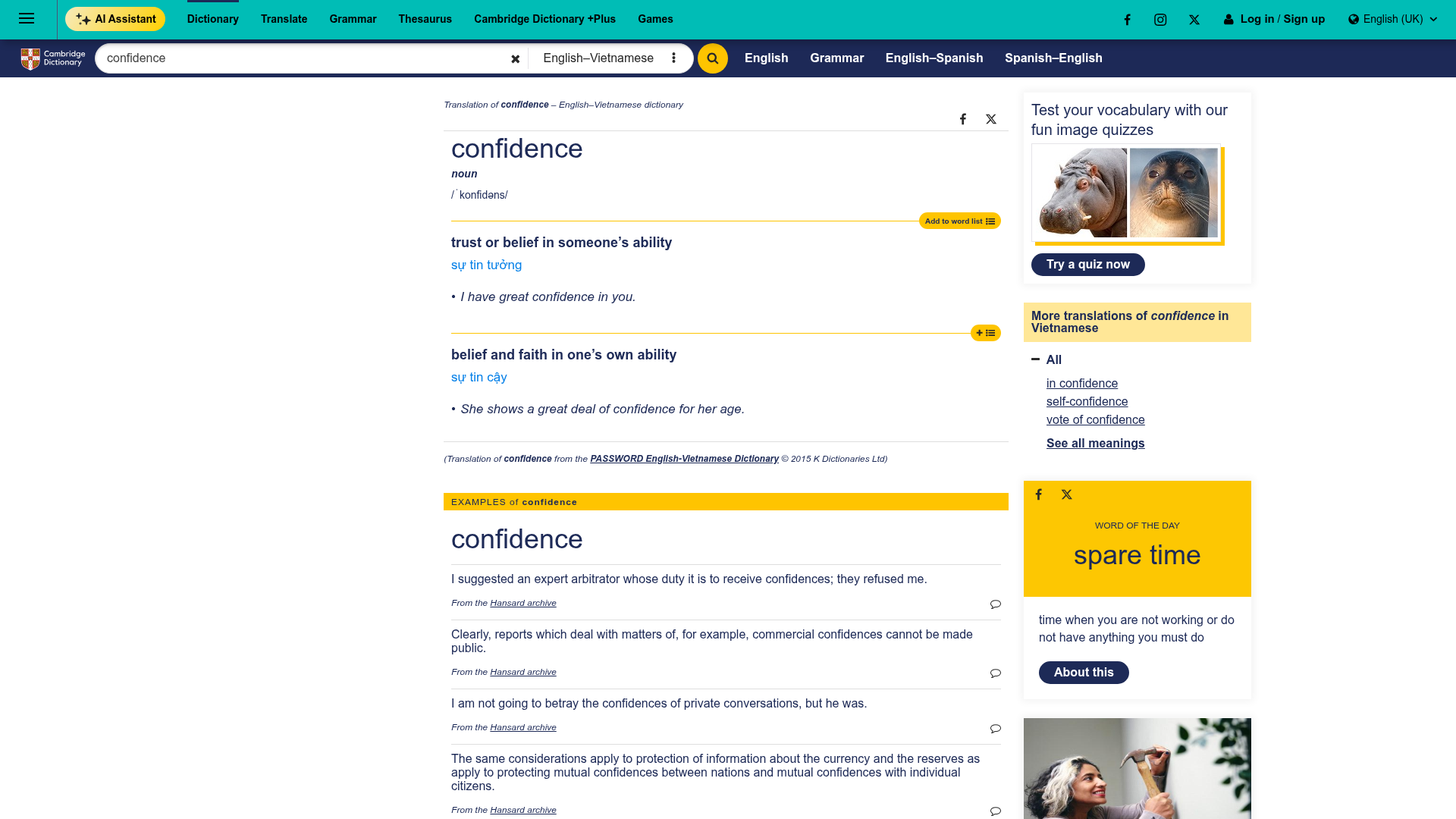
But dictionaries do not solve:
-
tone
-
sentence flow
-
dialect fit
-
presentation timing
-
live audience understanding
That is why vocabulary tools should support your process, not replace it.
Signs You Need Professional Vietnamese-English Support
You should strongly consider professional help when any of the following is true:
The content is public or brand-sensitive
If the message will appear on stage, on screen, on your website, or in a client-facing experience, quality matters.
The event is live
When there is no pause button, you need dependable delivery.
Accessibility requirements apply
Captioning, subtitling, and interpreting may all be necessary together.
There are multiple stakeholders
Executives, sponsors, attendees, staff, and viewers may all consume the content differently.
You need equipment or technical coordination
Receivers, audio distribution, platform routing, and technician support should not be improvised.
You need flexibility
Some events need remote interpreters, some need on-site teams, and some need both.
This is where Team Stream is built to help. We combine experienced professionals, responsive service, AI-enhanced options where appropriate, and a tailored project approach rather than forcing every client into the same package.
What Team Stream Brings to Vietnamese-English Communication
Team Stream is more than a translation vendor. We are a language access and accessibility partner for organizations that need communication to work in real conditions.
Accurate human and AI-powered translation and interpreting
We help clients choose the right balance of speed, cost, and precision.
Real-time captioning for accessibility and engagement
Captions improve comprehension, inclusion, and content usability for live and recorded experiences.
Support for live, virtual, and hybrid events
From webinars to conventions, we design solutions that match the format.
End-to-end service
Translation, interpreting, subtitling, voiceover, equipment rental, and technician support can be coordinated through one experienced team.
Compliance-friendly delivery
We help organizations meet accessibility expectations with services designed for inclusive communication.
In-person and remote flexibility
Whether your audience is in the room, online, or both, we can support the delivery model.
25+ years of experience
That depth matters when timing is tight and the stakes are high.
Choosing the Right Option for Your Situation
Use a free or self-service tool if:
-
the content is short
-
the stakes are low
-
you just need rough understanding
-
no one is relying on the translation as final
Use professional translation if:
-
the content represents your brand
-
the audience expects clarity
-
the message is nuanced or technical
-
accessibility or compliance is a concern
Use live interpreting and captioning if:
-
people need to understand in real time
-
the event includes multilingual participants
-
you are hosting a meeting, webinar, service, or conference
-
there is no room for confusion
Final Verdict: Confidence Comes From the Right Level of Support
If all you need is a quick sentence check, a text or voice tool may be enough. But if you need to translate Vietnamese to English accurately for business, events, accessibility, or audience-facing communication, confidence comes from using the right format and the right partner.
Team Stream helps organizations move beyond generic translation and into reliable communication: written translation, live interpreting, real-time captioning, subtitling, voiceover, equipment, technicians, and tailored multilingual support for live, virtual, and hybrid experiences. If your message matters, we make sure it is understood.
Ready to support Vietnamese-English communication with clarity, accessibility, and professionalism? Team Stream can help you build the right solution for your meeting, event, broadcast, or business content.
FAQ
How to Translate confidence?
Confidence can translate differently depending on context. In Vietnamese, it may refer to trust in someone or self-confidence, so the best translation depends on whether you mean belief in another person or belief in yourself.
What is the best translator for translating from Vietnamese to English?
The best option depends on the situation. For simple text, a self-service tool may work, but for live events, business communication, or accessibility needs, a professional partner like Team Stream offers stronger accuracy, interpreting, captioning, and event-ready support.
What is confident Translate?
Confident translation means translating in a way that is accurate, natural, and appropriate for the audience and setting. It is not just about converting words, but preserving meaning, tone, and clarity.
What is the Vietnamese word for “trust”?
A common Vietnamese translation for trust is sự tin tưởng or simply tin tưởng, depending on sentence structure. The best choice can vary based on whether you mean trust in a person, process, or outcome.
What is a stronger word for confidence?
A stronger word for confidence may be assurance, conviction, or self-assurance, depending on context. In translation, choosing the right nuance matters more than picking the strongest-sounding synonym.
How do I say I have confidence?
In English, you can say “I have confidence” or more naturally “I am confident”. In Vietnamese, the translation may change depending on whether you mean trust in yourself, trust in another person, or confidence in a plan.
