

Translate Somali to English With Confidence
If you need to translate Somali to English accurately, speed alone is not enough. You need meaning, context, cultural nuance, and a process you can trust – especially when the content involves events, community outreach, legal materials, healthcare communication, training resources, or live multilingual experiences.
For event organizers, corporate teams, churches, conference planners, and organizations serving diverse audiences, Somali-English communication often carries high stakes. A small wording error can confuse attendees, weaken trust, or create compliance risks. That is why effective language access is never just about swapping words; it is about delivering clear communication people can actually understand and use.
At Team Stream, we see this every day. Organizations need more than a basic tool for english to somali or somali to English text. They need end-to-end language and accessibility support that works across documents, meetings, broadcasts, live events, virtual sessions, and hybrid experiences. With more than 25 years of expertise, Team Stream combines accurate human linguists, AI-powered efficiency, real-time captioning, interpreting, and technician-backed event support to help clients communicate clearly and inclusively.
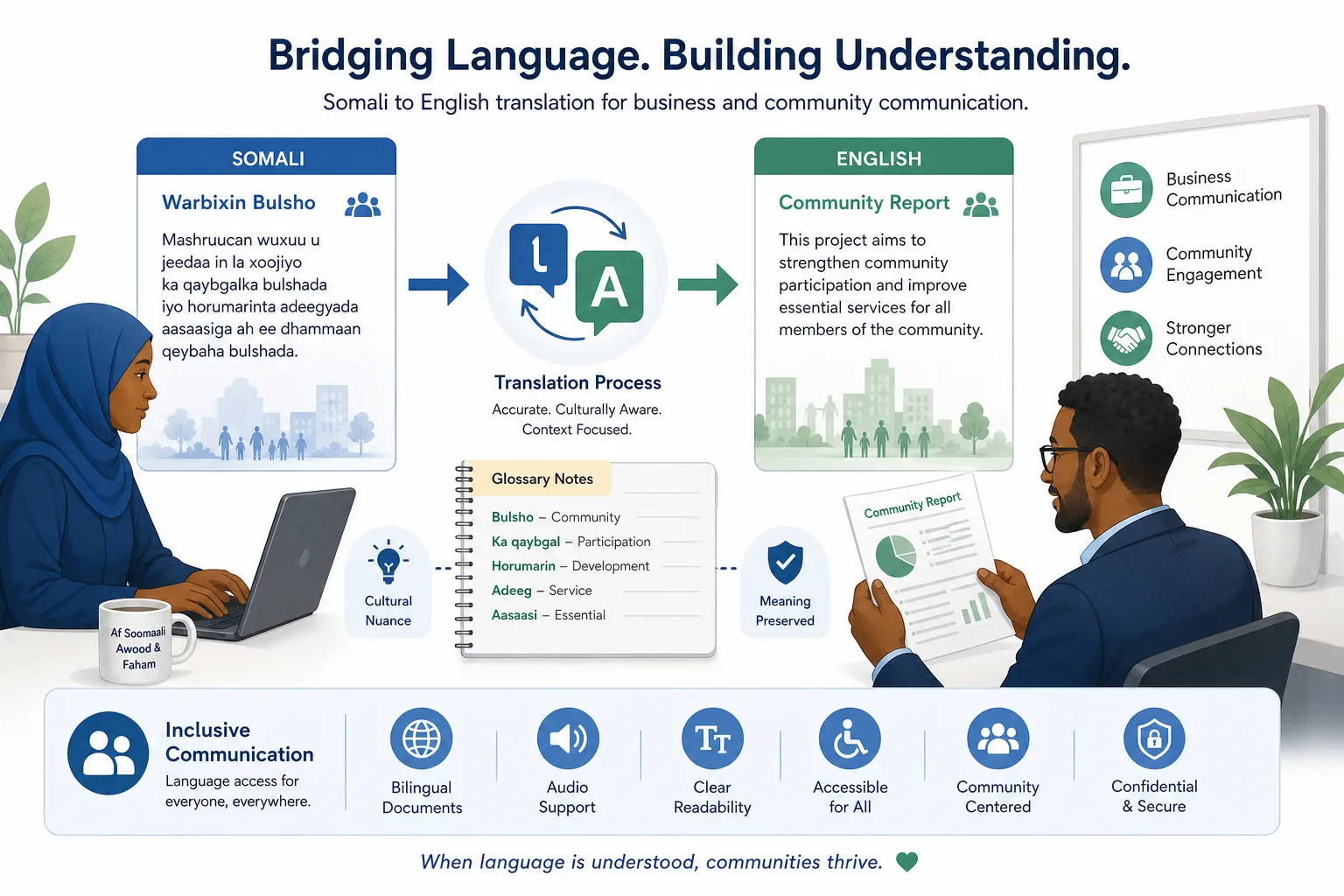
Why Somali-English Translation Requires Extra Care
Somali is widely spoken across East Africa and throughout global diaspora communities. Translation between Somali and English often involves more than vocabulary. Tone, formality, dialect variation, idiomatic meaning, and subject-matter context all matter.
“The number of Somali language speakers worldwide is estimated to be between 15 and 25 million.” – Ethnologue / MustGo
That scale matters for businesses, public agencies, churches, educators, and event producers. When you serve Somali-speaking communities, professional translation is not a niche add-on. It is a core communication requirement.
What makes Somali translation challenging?
Several factors can affect quality:
-
Dialect and regional variation
-
Context-dependent phrasing
-
Differences in sentence structure between Somali and English
-
Specialized terminology in legal, medical, corporate, or event settings
-
Cultural expectations around tone and clarity
-
Formatting issues in subtitles, captions, presentations, and on-screen content
This is why a literal output from a generic tool may be understandable in parts but still fail in practice.
When Machine Translation Helps – and When It Does Not
AI tools can be useful for speed, rough understanding, and first-pass drafts. But if your content will be seen by customers, employees, attendees, congregants, regulators, or the public, human review is essential.
Good use cases for AI-assisted translation
AI can help with:
-
Quick internal understanding
-
First-draft content routing
-
Large content volumes that need initial processing
-
Repetitive or low-risk text
When human translation is the better choice
Use professional human translation when content is:
-
Customer-facing
-
Compliance-sensitive
-
Legally important
-
Medical or safety-related
-
Brand-critical
-
Meant for live events or broadcasts
-
Part of accessibility workflows such as captions, subtitles, or multilingual event displays
At Team Stream, the strongest results often come from a human-plus-AI approach: technology for efficiency, expert linguists for accuracy, and accessibility specialists for final delivery quality.
Somali to English vs. English to Somali: Why Direction Matters
Many organizations assume translation quality is the same in both directions. It is not. The right process depends on your source content, audience, and end use.
|
Translation Direction |
Primary Goal |
Common Risks |
Best Approach |
|---|---|---|---|
|
Somali to English |
Preserve meaning from community, attendee, or source materials |
Over-literal phrasing, missed cultural cues, unclear names or context |
Native-level English output reviewed by a Somali language expert |
|
English to Somali |
Make English content understandable and natural for Somali-speaking audiences |
Robotic wording, jargon overload, culturally awkward phrasing |
Audience-first Somali translation with terminology review |
|
Live spoken interpretation |
Real-time understanding across languages |
Delays, omissions, technical failure, poor audio |
Professional interpreters plus tested event tech and support |
|
Captions/subtitles |
Accessibility and engagement |
Timing errors, truncation, low readability |
Linguistic review plus accessibility formatting |
If your goal is to translate english to somali for outreach, training, signage, or announcements, natural readability matters more than word-for-word conversion. If your goal is to translate Somali to English for official review, reports, transcripts, or testimony, precision and context documentation are crucial.
Common Use Cases for Somali-English Translation
Organizations rarely need translation in isolation. They need communication systems that work before, during, and after an event or interaction.
Business and workplace communication
Common business materials include:
-
HR policies
-
Employee onboarding
-
Safety instructions
-
Internal memos
-
Benefits communications
-
Training manuals
-
Customer support content
Events, conferences, and trade shows
Live experiences require more than translated handouts. They may also need:
-
On-site or remote interpreters
-
Real-time captioning
-
Multilingual presentation support
-
Subtitles for pre-recorded videos
-
Technician support for audio routing and display
-
Equipment rental for interpreting or captioning workflows
Churches and community organizations
Faith-based and community groups often need:
-
Sermon or service interpretation
-
Community announcements
-
Resource guides
-
Family support materials
-
Event signage
-
Livestream captioning and multilingual support
Healthcare, legal, and public service communication
These high-trust settings require careful handling of terminology, tone, and confidentiality. Accuracy is not optional.
The Most Common Translation Mistakes to Avoid
Competitor pages often focus only on price or basic word equivalents. What they often miss is what actually causes translation failure in real-world communication.
1. Translating words instead of intent
A sentence can be technically translated and still be practically useless. The audience must understand what to do, feel, or respond to.
2. Ignoring the audience
A message for internal staff is different from a message for conference attendees, customers, or community members.
3. Using unreviewed machine output in public-facing materials
This is one of the fastest ways to introduce errors, awkward tone, and reputational damage.
4. Forgetting accessibility
Translation without captioning, readable formatting, or multilingual delivery support can still exclude people.
5. Treating live events like static documents
Live communication needs interpreting, captioning, tested equipment, and backup plans.
What High-Quality Somali Translation Looks Like
A strong translation should be:
-
Accurate to the original meaning
-
Natural for the target audience
-
Consistent in terminology
-
Appropriate in tone and reading level
-
Formatted for its delivery channel
-
Reviewed by qualified professionals
-
Accessible when used in video, live events, or digital content
That final point matters more than many competitors acknowledge. Translation quality is not only about language. It is also about whether people can receive the message in the moment they need it.
“A study found that 87% of Americans use captions at least sometimes when watching videos.” – TV Technology
For organizations sharing Somali and English content through livestreams, webinars, video messages, and hybrid events, captions are not a side feature. They improve accessibility, comprehension, and engagement for everyone.
A Better Workflow for Somali-English Communication
Instead of thinking only in terms of a one-time text conversion, use a communication workflow that protects quality.
Step 1: Define the audience
Ask:
-
Who is reading or hearing this?
-
What action should they take?
-
Is the audience bilingual, English-dominant, Somali-dominant, or mixed?
Step 2: Clarify the delivery format
Your approach may differ for:
-
PDF documents
-
Email communications
-
Event slides
-
Video subtitles
-
Live stage interpretation
-
Hybrid meeting caption feeds
-
Website copy
Step 3: Build a terminology list
For recurring projects, create approved translations for:
-
Brand names
-
Department names
-
Product terms
-
Religious or cultural phrases
-
Safety language
-
Legal terms
-
Program names
Step 4: Use expert review
Have human linguists review not just grammar, but also context, tone, and clarity.
Step 5: Add accessibility support where needed
This may include:
-
Live captioning
-
Closed captions
-
Subtitles
-
Interpreting
-
Screen display optimization
-
Audio support
-
Event technician oversight
Where Team Stream Adds More Value Than a Basic Translation Vendor
Many providers stop at text delivery. Team Stream is built for organizations that need communication to work across entire experiences.
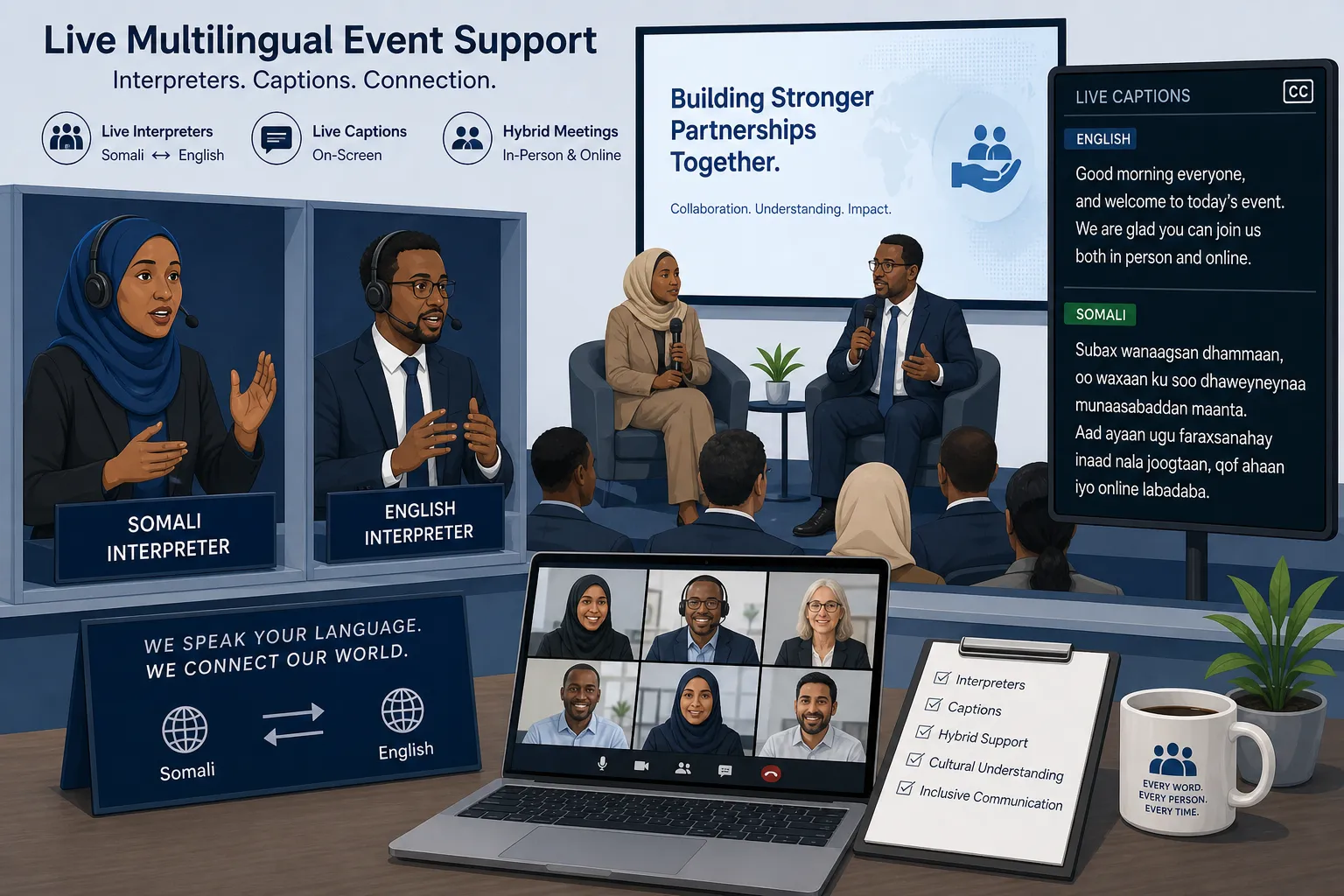
Written translation with human and AI-powered support
Team Stream provides accurate written translation tailored to the content type, audience, and turnaround requirements. That means you can scale efficiently without sacrificing quality.
Interpreting for live, virtual, and hybrid events
If your Somali-English need extends beyond documents, Team Stream can support:
-
Conferences
-
Corporate meetings
-
Webinars
-
Trade shows
-
Church services
-
Broadcasts
-
Community events
Real-time captioning for accessibility and engagement
Captioning helps organizations improve inclusion, comprehension, and compliance while making multilingual content easier to follow.
Equipment rental and technician support
This is a major content gap competitors often ignore. Translation at events depends on execution. Team Stream can provide the hardware, setup, and technical expertise needed to keep interpretation and accessibility running smoothly.
Flexible delivery options
Whether you need in-person support, remote services, or a hybrid setup, Team Stream adapts to the event and audience rather than forcing a one-size-fits-all package.
Somali Translation for Events: What to Plan Before Event Day
If your team is preparing a multilingual event, the translation plan should begin early.
Pre-event checklist
-
Identify where Somali language access is needed
-
Determine whether you need translation, interpreting, captioning, or all three
-
Review scripts, presentations, agendas, and videos in advance
-
Confirm technical requirements
-
Plan attendee instructions for accessing language services
-
Test all devices, audio feeds, and caption displays
-
Build contingency plans
During-event priorities
-
Clear audio for interpreters and captioners
-
Visible instructions for attendees
-
Real-time technician support
-
Backup communication channels
-
Central coordination between producers, speakers, and language teams
Post-event follow-up
-
Translate recordings, summaries, or action items
-
Provide subtitled replay content
-
Review attendee feedback
-
Update terminology assets for future events
Choosing the Right Somali Translation Partner
Not every provider is equipped for professional multilingual communication. Use the checklist below when evaluating options.
Look for:
-
Proven experience with Somali-English language work
-
Human review, not AI-only output
-
Accessibility knowledge
-
Event support capability
-
Confidential handling of materials
-
Responsiveness and project management strength
-
Ability to support live, virtual, and hybrid environments
Ask these questions
-
Who reviews the translations?
-
Can you support both written translation and live interpreting?
-
Do you provide captioning and subtitling too?
-
Can you handle technical setup for multilingual events?
-
How do you manage terminology consistency?
-
What happens if a live event needs last-minute changes?
Team Stream stands out here because it connects all of these services under one experienced, service-oriented team.
Practical Tips if You Need to Translate English to Somali
When preparing English source content, you can improve translation quality before the project even starts.
Write for clarity first
Use:
-
Short sentences
-
Plain language
-
Defined acronyms
-
Consistent terminology
-
Clear calls to action
Avoid:
-
Unexplained slang
-
Dense idioms
-
Wordplay
-
Long legalistic paragraphs when simpler wording is possible
Provide context
A translator works better when they know:
-
Who the audience is
-
Where the text will appear
-
Whether tone should be formal or conversational
-
What action the audience should take
Think beyond the document
If the content appears in video, stage screens, livestreams, or audience apps, plan for formatting, timing, and readability too.
Practical Tips if You Need to Translate Somali to English
For Somali-origin source material, the goal is often faithful understanding plus polished English output.
Share supporting details
Helpful information includes:
-
The source type
-
Region or dialect, if known
-
Names and place references
-
Intended use of the English version
-
Deadline and format requirements
Preserve sensitive meaning
This is especially important for:
-
Testimony
-
Community statements
-
Faith-based content
-
Medical communication
-
Legal documentation
-
Event scripts and speaker remarks
A professional review process reduces the risk of flattening important nuance.
Content Gaps Most Competitor Pages Miss
After reviewing the common themes in competitor content, several weaknesses appear consistently:
They focus on word lookup, not communication outcomes
Dictionary-style entries may help with isolated terms, but they do not solve business, event, or accessibility needs.
They rarely address live multilingual environments
Organizations often need interpreting, captions, AV coordination, and multilingual audience support – not just translated text.
They overlook compliance and inclusion
Accessibility and language access are not optional for many institutions. This is especially important in public-facing and regulated environments.
They underplay quality control
Many pages mention speed but say little about review, terminology management, or delivery quality.
They do not connect translation with execution
For live events, the translation is only one part of success. Caption displays, interpreter audio, equipment, timing, and technician support matter just as much.
These are exactly the areas where Team Stream provides stronger value.
Final Thoughts: Confidence Comes From the Right Process
If you need to translate Somali to English or translate english to somali for business, events, community outreach, or accessible communication, confidence does not come from a quick tool alone. It comes from a reliable process, qualified language professionals, strong accessibility planning, and execution that works in the real world.
Team Stream offers that full picture: accurate human and AI-powered translation, professional interpreting, real-time captioning, subtitling, voiceover, event support, equipment rental, and responsive service tailored to your goals. Whether your communication is live, virtual, hybrid, internal, public-facing, or compliance-sensitive, Team Stream helps you deliver it clearly and inclusively.
If your organization is ready to communicate across Somali and English with less risk and better results, Team Stream is the partner built to help you do it right.
FAQ
How to translate Somali to English?
To translate Somali to English well, start with the full context, not just individual words. For anything public-facing, sensitive, or event-related, use professional human review so tone, meaning, and cultural nuance are preserved accurately.
What is relax in Somali language?
The Somali equivalent of “relax” can vary by context, so there is not always one perfect word-for-word match. In professional translation, it is best to choose the term based on whether you mean resting, calming down, or easing tension.
What is integrity in Somali language?
“Integrity” in Somali depends on whether you mean honesty, moral character, or professional ethics. Because abstract values can shift by context, a qualified translator should match the wording to the audience and purpose.
What is the Somali word for humble?
The Somali word for “humble” may differ depending on tone and setting, especially in faith, community, or business communication. A strong translation should reflect whether you mean modest, respectful, or lowly in manner.
How do you say “I love you” in Somali to a girl?
A commonly used Somali phrase is “Waan ku jeclahay”. As with many personal expressions, tone, familiarity, and cultural context matter, so natural delivery is just as important as the literal translation.
What is the Somali translation of manipulation?
“Manipulation” can be translated differently depending on whether you mean emotional control, deceptive influence, or technical handling. In professional Somali-English translation, context is essential to avoid a misleading or overly literal result.
