

Subtitling Services: What Businesses Should Know
If your business uses video to train employees, market products, support customers, host events, or communicate across languages, subtitles are no longer optional. They affect comprehension, accessibility, retention, search visibility, and brand trust.
For event organizers, corporate teams, conference planners, churches, trade show producers, and broadcast teams, the stakes are even higher. A subtitle error in a product demo can confuse buyers. In a compliance video, it can create risk. In a multilingual live or hybrid event, poor captioning can exclude the very audience you are trying to reach.
That is why businesses increasingly look beyond basic auto-captions and invest in accurate, scalable subtitling services that support real communication goals.
At Team Stream, we see subtitles as part of a broader language access and accessibility strategy. With more than 25 years of experience, our team supports organizations with human and AI-powered translation, interpreting, live captioning, subtitling, voiceover, technician support, and event equipment for in-person, virtual, and hybrid experiences. The result is not just text on screen, but communication that is clearer, more inclusive, and more effective.
“Approximately 79% of UK viewers use subtitles at least sometimes, highlighting the importance of subtitles for engaging audiences who watch videos without sound.” – Business Wire
What subtitling services actually include
Many businesses assume subtitling simply means typing spoken words at the bottom of a video. In reality, professional subtitling services involve several technical and linguistic steps that directly affect quality.
Core components of a subtitling project
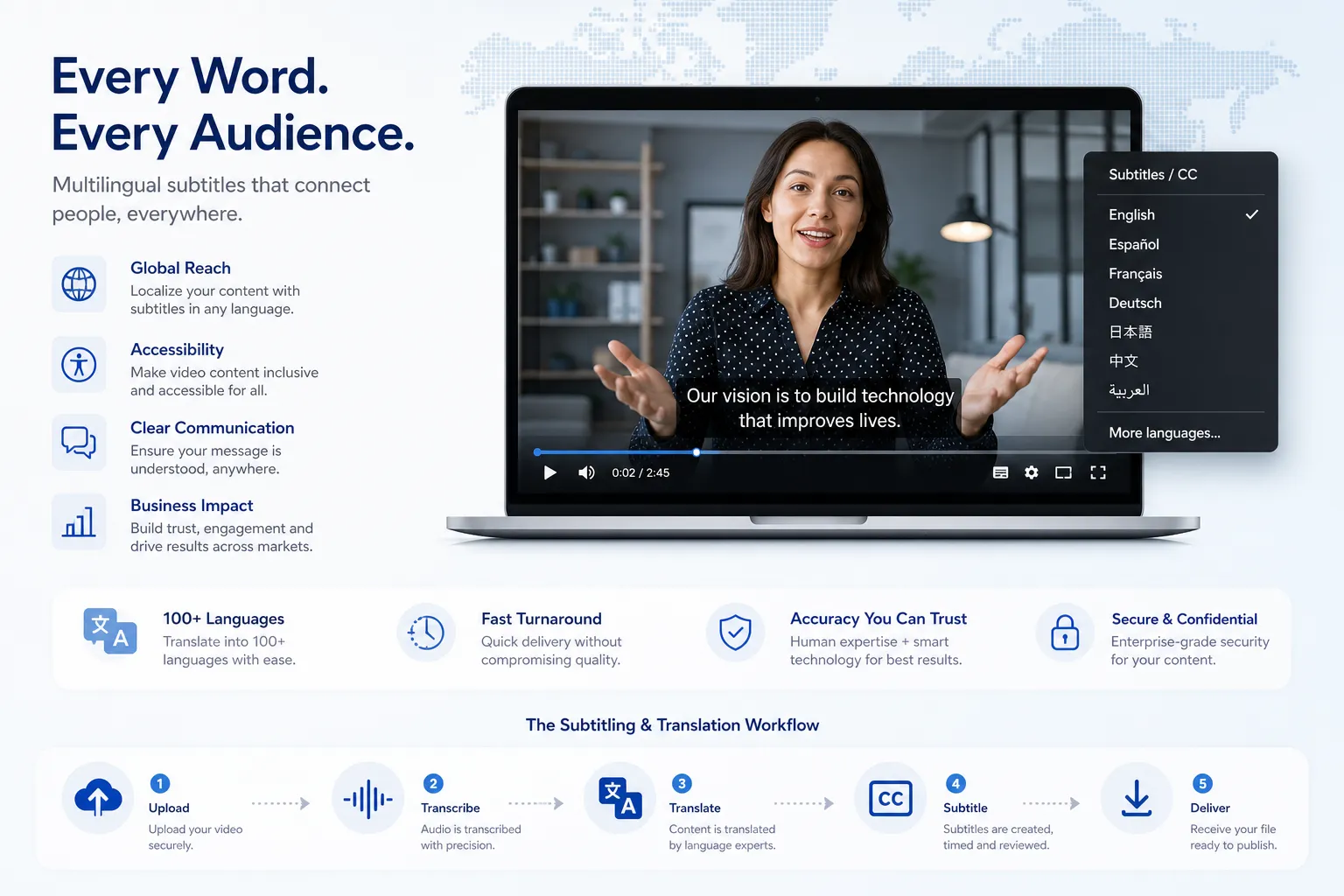
A typical workflow includes:
-
audio transcription
-
speaker identification when needed
-
subtitle segmentation into readable lines
-
timecoding and synchronization
-
translation for multilingual delivery
-
editing for readability and tone
-
quality review
-
export into the correct subtitle format
This matters because subtitles must do more than be accurate. They must also be readable at speed, synchronized correctly, and appropriate for the target audience and platform.
Common subtitle file formats
Different distribution channels require different outputs. A reliable provider should be able to deliver the format your team actually needs.
|
Format |
Best for |
Notes |
|---|---|---|
|
SRT |
YouTube, Vimeo, many platforms |
Simple and widely supported |
|
VTT |
Web video players |
Common for HTML5 video |
|
SCC |
Broadcast workflows |
Often used for closed caption delivery |
|
STL |
Professional broadcast environments |
Region and system dependent |
|
Burned-in subtitles |
Social clips, permanent display |
Cannot be turned off |
|
Closed captions |
Accessibility-focused playback |
Can often be toggled on or off |
A content gap many competitor articles miss is this: choosing the wrong file type can delay publishing or create compatibility issues across video platforms, LMS systems, event portals, and internal communications tools.
Subtitles vs captions vs translation and subtitling
These terms are often used interchangeably, but they are not the same.
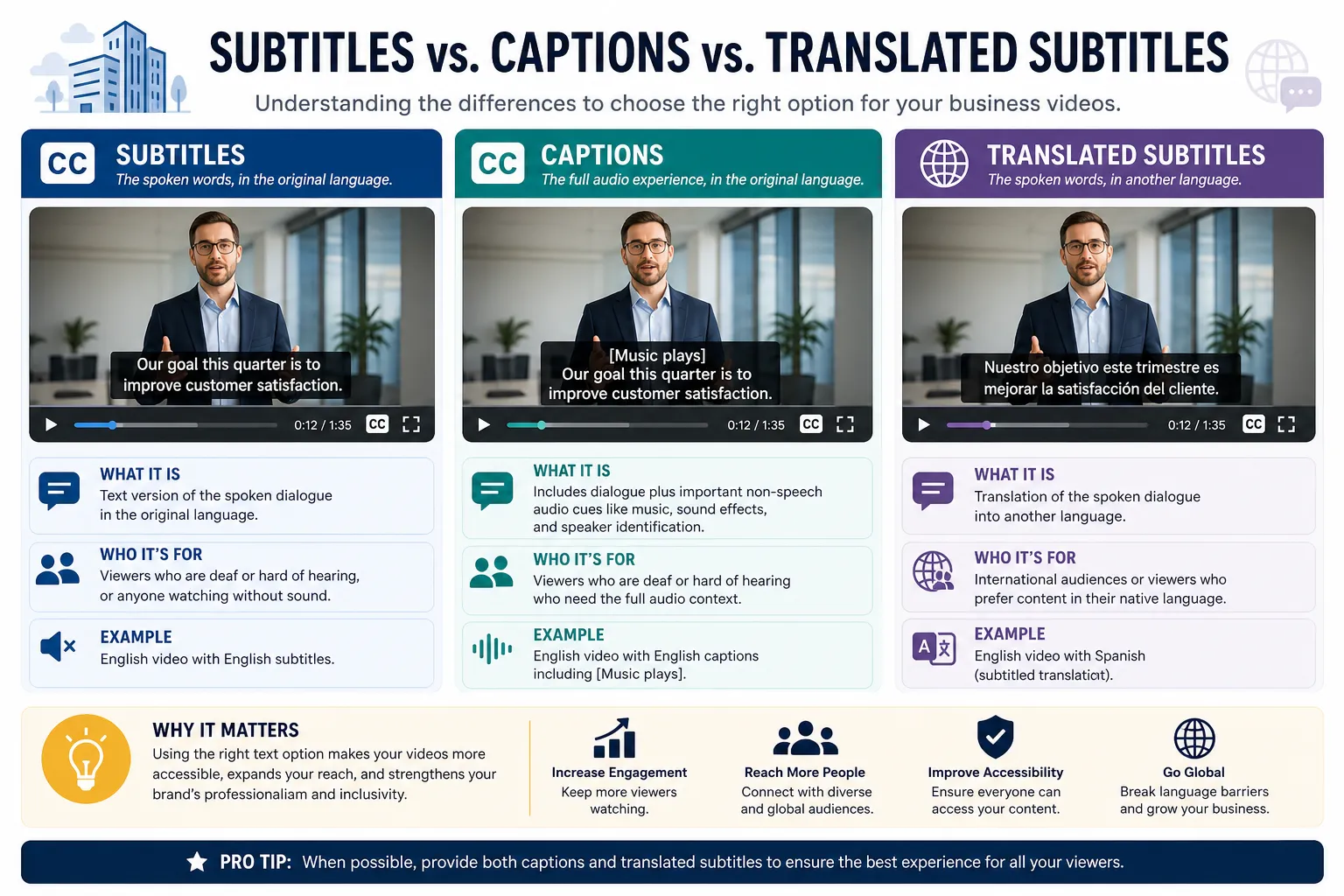
Subtitles
Subtitles usually render spoken dialogue as on-screen text. They may be in the same language as the audio or translated into another language.
Captions
Captions are typically accessibility-focused and include not just dialogue but also meaningful sound cues like music, laughter, or door slams. Closed captions can usually be turned on or off by the viewer.
Translation and subtitling
Translation and subtitling adds another layer. The original speech is first transcribed, then translated, then adapted to fit subtitle timing and character constraints. This is why translation and subtitling services require more than a standard translator. The work must preserve meaning while staying readable on screen.
Why the distinction matters for businesses
A corporate training video for internal accessibility may require captions. A product launch clip for Spanish-speaking prospects may need translated subtitles. A multinational webcast may need both live captioning and post-event translated subtitle files.
The best providers help you choose the right solution instead of forcing every project into the same workflow.
Why professional subtitling matters for business outcomes
Auto-generated subtitles can be useful as a rough draft. But for high-visibility or high-stakes content, they are rarely enough.
Accuracy protects your message
In business communication, a single mistake can change meaning:
-
compliance language can become ambiguous
-
product specs can be misstated
-
names, brands, or figures can be wrong
-
legal or healthcare content can become risky
Professional subtitling reduces those risks through editing, linguistic review, and context-aware formatting.
Accessibility improves reach and inclusion
Subtitles and captions make content usable for deaf and hard-of-hearing audiences, non-native speakers, mobile viewers, and anyone watching in a noisy or quiet environment.
“A study found that comprehension of sign language interpreter videos improved by 24% for deaf viewers and 42% for hard-of-hearing viewers when captions were included.” – PMC
That makes subtitles not just a convenience, but a practical accessibility tool that improves understanding.
Better engagement in sound-off viewing
Business videos are often watched in offices, airports, trade show floors, lobbies, and social feeds. In all of those settings, viewers may not have sound on. If your message only works with audio, you lose attention immediately.
Stronger multilingual communication
When companies expand globally, subtitle quality directly affects trust. Literal translations often fail because subtitle writing must account for timing, character limits, tone, and cultural nuance. Professional subtitling companies with language expertise can adapt content, not just translate words.
More reusable video assets
A well-subtitled video is easier to repurpose across:
-
internal training portals
-
webinar replays
-
social media channels
-
trade show screens
-
customer education libraries
-
multilingual event archives
That makes subtitles an investment in the long-term value of your content.
Where businesses use subtitling most often
Competitor content usually stays general. In practice, use cases vary a lot by industry and format.
Corporate communications
Leadership updates, onboarding, HR announcements, internal training, and compliance modules benefit from subtitles because employees consume content in different settings and languages.
Conferences, trade shows, and live events
Recorded sessions often need post-event subtitles, while live programs may need real-time captioning or multilingual display support. Team Stream helps clients handle these needs across live, virtual, and hybrid environments with interpreters, captioners, technicians, and equipment support.
Marketing and social video
Subtitles improve completion rates and make videos understandable on mute. They also make international campaign adaptation easier.
Broadcast and streaming
Broadcasters and ministries often need closed captioning, multilingual subtitling, and accessible delivery standards that align with audience expectations and platform requirements.
E-learning and training
Educational content needs clarity, consistency, and accessibility. If a learner misses one key term because subtitles are rushed or inaccurate, the entire lesson suffers.
Legal, healthcare, and regulated content
This is where professional subtitling is especially important. Industry terminology, compliance language, and documentation standards demand more than generic AI output.
Human vs AI subtitling: what businesses should choose?
This is one of the biggest content gaps in competitor articles. The right answer is usually not human or AI. It is the right combination of both.
AI subtitling is useful when
AI can help when you need:
-
fast turnaround
-
rough first-pass subtitles
-
large content volumes
-
internal drafts
-
lower-risk content
Human subtitling is essential when
Human review becomes critical when your content involves:
-
external brand visibility
-
multilingual delivery
-
complex terminology
-
compliance or legal implications
-
accessibility standards
-
executive, investor, or customer-facing messaging
The best workflow is hybrid
Team Stream combines AI-enabled speed with human expertise for accuracy, accessibility, and tone. That means faster production without sacrificing quality. For clients with recurring video or event needs, this model is often the most practical and cost-effective.
What to look for when comparing subtitling companies
Not all subtitling companies are built for business communication. Some are designed for casual creator workflows. Others handle only transcription. Businesses need a partner that understands language, accessibility, timing, platforms, and delivery pressure.
A practical evaluation checklist
|
What to evaluate |
Why it matters |
|---|---|
|
Accuracy process |
Prevents costly language errors |
|
Human review options |
Essential for external or regulated content |
|
Multilingual capability |
Supports global audiences |
|
Accessibility expertise |
Helps meet inclusion and compliance needs |
|
Platform/file support |
Avoids format and publishing issues |
|
Turnaround speed |
Critical for events and campaigns |
|
Security and confidentiality |
Important for internal and sensitive content |
|
Customer support |
Keeps projects moving under deadline |
|
Live + on-demand capability |
Useful for end-to-end event workflows |
Questions to ask before hiring
Ask potential providers:
-
Do you offer both same-language and translated subtitles?
-
How do you handle technical terminology or brand glossaries?
-
What level of human review is included?
-
Can you support live, hybrid, and recorded content?
-
Which subtitle and caption file formats do you deliver?
-
Can you provide voiceover, interpreting, or live captioning too?
-
How do you protect confidential files?
-
Can you scale across multiple languages quickly?
A major advantage of working with Team Stream is that these services do not sit in separate silos. Clients can combine written translation, subtitling, closed captioning, voiceover, live interpreting, CART/live captioning, remote delivery, and on-site event support through one responsive team.
The hidden quality standards most articles overlook
High-ranking posts often mention accuracy and readability, but they rarely explain the actual standards behind professional subtitling.
Reading speed
Subtitles must stay on screen long enough to be comfortably read. Fast speech often needs condensation without losing meaning.
Line length and segmentation
Breaking lines in the wrong place makes subtitles harder to follow. Good segmentation improves comprehension and keeps attention on the screen.
Speaker changes
When multiple people talk, subtitle formatting should make speaker transitions clear.
Terminology consistency
A company name, product term, legal phrase, or medical reference should not be translated three different ways across one project.
Cultural localization
Translated subtitles must sound natural to the target audience, not like a literal machine conversion.
Visual placement
Subtitles should avoid covering critical on-screen graphics, lower-thirds, or demos whenever possible.
These details are where professional subtitling separates itself from basic caption generation.
How subtitling supports SEO and discoverability
Subtitles are not just for viewers. They can also make your content more usable in search and indexing workflows.
Search engines can understand text better than speech
While video search continues to improve, written text still plays a major role in discoverability. Accurate transcripts and subtitle files help search systems better understand your content themes.
Better on-page engagement
When viewers stay longer and understand more, your video content tends to perform better. Subtitles can support watch time, reduce friction, and improve content usability across devices.
More content repurposing opportunities
Subtitle and transcript files can become:
-
blog summaries
-
downloadable resources
-
social clips with captions
-
multilingual landing page assets
-
searchable internal knowledge content
That creates operational value well beyond the original video.
A business-focused subtitling workflow that actually works
For most organizations, the challenge is not whether subtitles are useful. It is how to get them done accurately and on time.
Recommended workflow
-
Define the audience and use case
-
Decide whether you need subtitles, captions, translation, or all three
-
Prepare the source media and glossary terms
-
Generate transcription and timing
-
Review with human linguistic and technical QA
-
Deliver in the right format for your channels
-
Archive files for future updates or language versions
Why end-to-end support matters
If you are coordinating a conference session, multilingual town hall, church broadcast, or product launch, subtitles may be only one part of the communication stack. You may also need interpreters, live captioners, receiver equipment, streaming support, or remote technician coordination.
That is where Team Stream stands out. We provide tailored language and accessibility solutions built around the full communication experience, not just one isolated output file.
When businesses should invest in professional subtitling
Professional subtitling is the right choice when your video:
-
represents your brand publicly
-
must be accessible
-
includes multiple languages
-
contains technical or regulated content
-
supports sales, compliance, or training
-
will be reused across channels
-
needs dependable quality under deadline
If the content is temporary, informal, and low-risk, AI-only subtitles may be enough. But most business-critical content deserves more care than that.
Why Team Stream is a strong partner for subtitle and accessibility projects
Businesses do not just need subtitle files. They need confidence that communication will be accurate, inclusive, and well-executed.
Team Stream brings that reliability through:
-
accurate human and AI-powered translation and interpreting
-
real-time captioning for accessibility and engagement
-
end-to-end language and accessibility solutions tailored to each client
-
support for live, virtual, and hybrid events
-
compliance-friendly services for inclusive communication
-
professional equipment rental and technician support
-
flexible in-person and remote delivery options
-
over 25 years of experience
-
responsive customer service and high-quality execution
That combination is especially valuable for organizations juggling multilingual audiences, tight event timelines, internal accessibility expectations, and public-facing brand standards.
Final verdict
Subtitles are no longer a finishing touch. They are a business asset.
They help people understand your message, increase accessibility, support multilingual growth, improve engagement, and make video content more useful across every channel. But those benefits depend on quality. Poor subtitles can create confusion just as easily as great subtitles create clarity.
If your organization relies on video to train, inform, persuade, or connect across languages, investing in professional subtitling services is a smart move. And if you need more than a basic vendor, Team Stream offers the broader expertise to support everything around the subtitles too, from translation and captioning to interpreting, technician support, and event delivery.
When the message matters, the subtitles matter too.
Ready to make your video content clearer, more accessible, and more effective? Team Stream can help you build the right subtitling, captioning, and language-access solution for your audience, timeline, and format.
FAQ
Why is Gen Z obsessed with subtitles?
Many younger viewers consume video in sound-off environments like public spaces, offices, or social feeds. Subtitles also improve clarity, speed of understanding, and accessibility, which makes video easier to follow even for native speakers.
What industries commonly use translation services?
Translation services are widely used in corporate communications, healthcare, legal, education, media, events, ministry, technology, and customer support. Any organization serving multilingual audiences or regulated communication needs can benefit from them.
How much to charge for subtitling per minute?
Pricing varies based on language pair, turnaround time, technical complexity, accessibility requirements, and level of human review. Basic AI-assisted work costs less, while professional subtitling for business-critical or multilingual content commands a higher rate.
How to make money subtitling?
Subtitlers typically earn by offering services to media companies, agencies, event providers, and businesses that need captions, translated subtitles, and accessibility support. The strongest opportunities usually go to professionals who combine timing skills with language expertise and accuracy.
What is the 6 second rule for subtitles?
The 6 second rule is a readability guideline suggesting that a subtitle should stay on screen long enough for an average viewer to read it comfortably. In practice, timing, line length, and reading speed must be balanced so viewers can follow the message without strain.
Are subtitles making us dumber?
No. When done well, subtitles often improve comprehension, retention, and accessibility. The issue is not subtitles themselves, but poor-quality subtitles that are inaccurate, distracting, or badly timed.
