

Sign Language Interpreting for Accessible Events
If you are planning a conference, corporate meeting, trade show, worship service, webcast, training, or hybrid event, sign language access should not be treated as a last-minute add-on. It is a core part of inclusive communication, audience engagement, and compliance.
For many event organizers, the challenge is not deciding whether accessibility matters. It is figuring out what to book, when to book it, and how to choose the right provider. Do you need sign language interpreting or sign language translation services? Should you hire an on-site interpreter, use remote interpreting, or provide both? How do you coordinate interpreting with live captioning, AV, and event flow?
This guide breaks it all down clearly. It also explains how Team Stream helps organizations deliver dependable, professional language access for live, virtual, and hybrid events with interpreting, captioning, translation, equipment, and technical support under one roof.
“Qualified sign language interpreters” are among the auxiliary aids and services organizations may need to provide to ensure effective communication. – ADA.gov
What sign language interpreting actually is
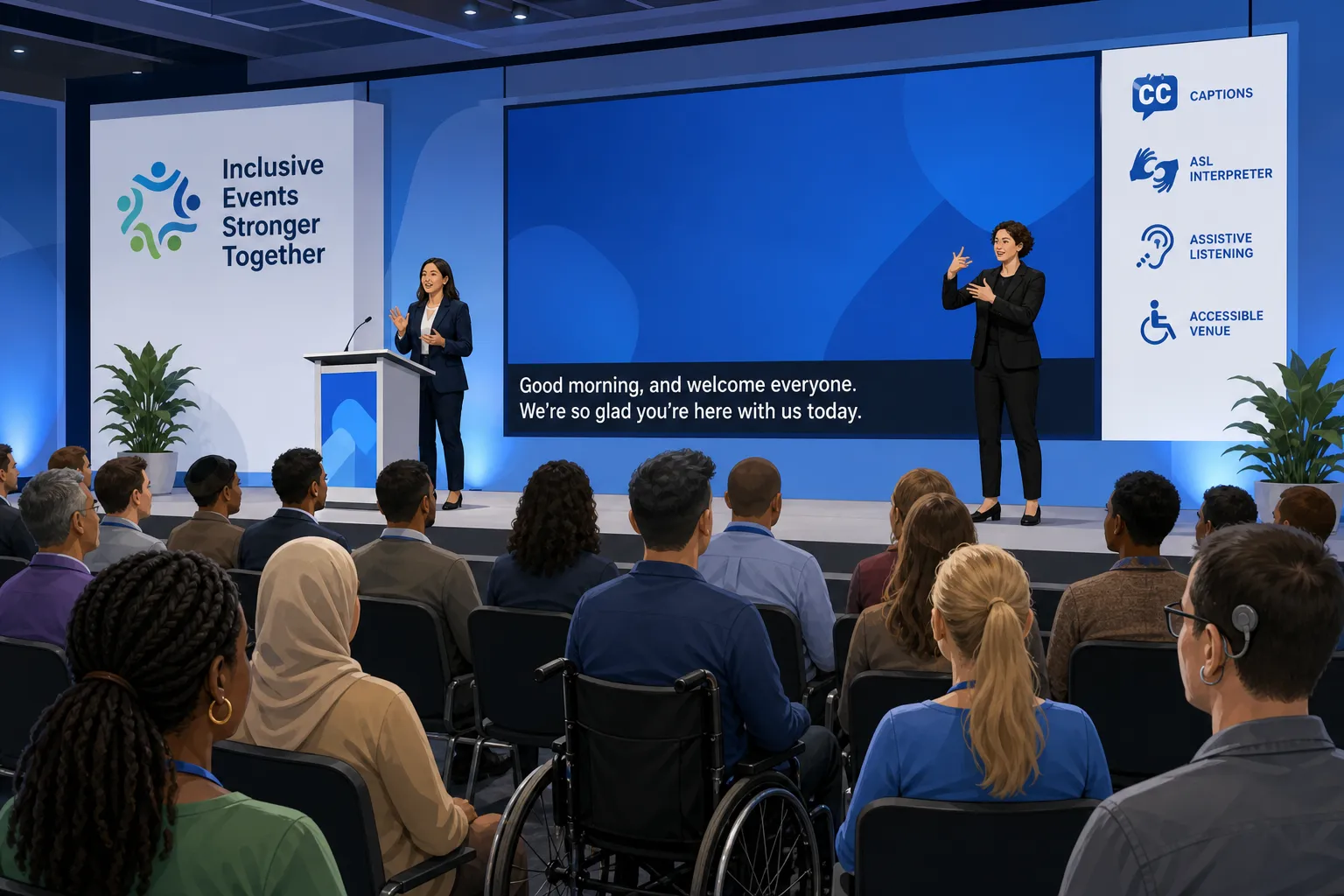
Sign language interpreting is the live, real-time conversion of spoken language into a signed language and, when needed, signed communication back into spoken language.
In event settings, that usually means a qualified interpreter is listening to a speaker, panel, moderator, audience member, or presenter and rendering the message accurately, clearly, and impartially for Deaf or hard of hearing attendees who use sign language. If a Deaf participant signs a question or comment, the interpreter voices that message for the rest of the room.
This is not a word-for-word exercise. Good interpreting conveys meaning, intent, tone, pacing, and specialized terminology as faithfully as possible.
Why this matters at events
Events move fast. Speakers improvise. Panels overlap. Audience Q&A can be unpredictable. Breakouts, networking, worship, performances, and announcements all create different communication demands. That is why event access depends on trained professionals, not generic language support.
For accessible events, sign language services often work best when combined with:
-
real-time captioning
-
accessible presentation design
-
readable display screens
-
proper interpreter placement and lighting
-
technician support
-
rehearsal and run-of-show planning
-
remote and on-site backup options
This is where Team Stream brings unusual value: rather than treating interpreting as a standalone booking, the team can align interpreting, captioning, AV coordination, technical execution, and multilingual communication into one event plan.
Sign language interpreting vs. sign language translation
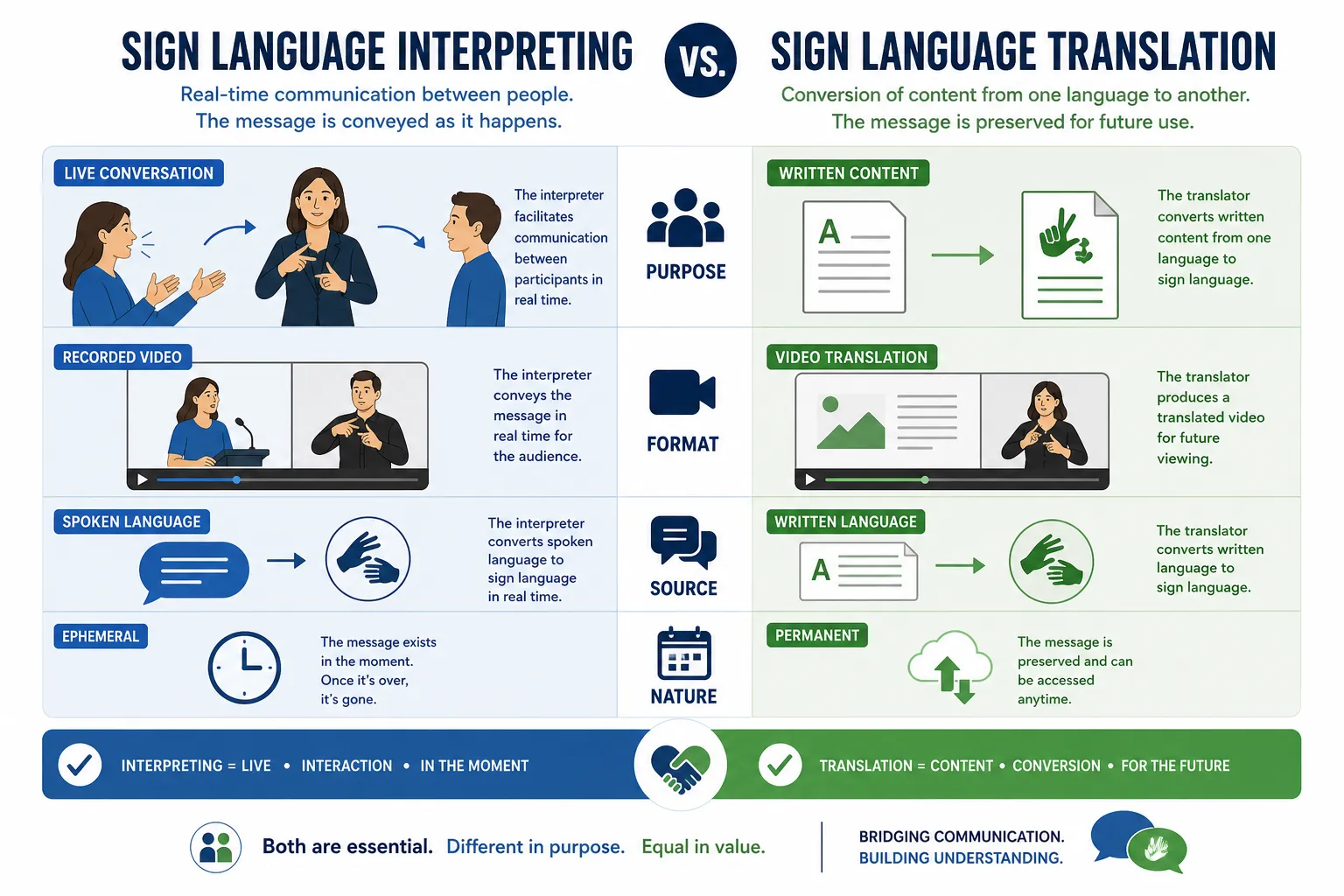
People often use these terms interchangeably, but they are not the same.
Sign language interpreting
Interpreting is live. It happens in real time during conversations, meetings, presentations, worship services, broadcasts, medical interactions, legal settings, trainings, and public events.
Examples include:
-
a keynote speech interpreted on stage
-
a virtual town hall with an ASL interpreter pinned on screen
-
a trade show presentation with interpreter support
-
a live webinar with audience Q&A
-
a church service with interpretation for Deaf attendees
Sign language translation
Translation is usually prepared in advance. It involves converting content from one language into another form for later use. In the sign language context, this often means creating a signed version of pre-recorded content, such as a video message, onboarding module, safety content, public information campaign, or educational asset.
Examples include:
-
translating a training video into ASL
-
adding an ASL video layer to a compliance course
-
producing signed versions of public-facing announcements
-
adapting digital content for Deaf audiences in advance
The simplest way to tell the difference
|
Need |
Best Fit |
|---|---|
|
Live meeting or event |
Sign language interpreting |
|
Pre-recorded content |
Sign language translation services |
|
Webinar with live discussion |
Interpreting, often plus captioning |
|
Training library or video asset |
Translation, subtitling, captioning, or voiceover depending on audience |
Not every Deaf or hard of hearing attendee needs the same thing
One of the biggest content gaps in many guides is the assumption that all Deaf and hard of hearing people need the same accommodation. They do not.
Some attendees use American Sign Language. Some prefer another signed language. Some rely on CART captioning rather than sign language. Some need low-vision interpreting. Some benefit from both an interpreter and captions. Some may need remote access because attending in person creates mobility, fatigue, or health barriers.
A better accessibility plan starts with this principle: ask early, confirm respectfully, and build for meaningful participation rather than minimum compliance.
Approximately 74% of Americans with severe disabilities do not use visible aids like wheelchairs, canes, crutches, or walkers. – National Center on Disability and Journalism / cited in NCPD
That matters because many access needs are not obvious at registration check-in or at the door. The best event planners do not wait for attendees to self-advocate in the moment.
Common use cases for sign language interpreter services
Sign language interpreter services are needed anywhere live communication is central to the experience.
Conferences and conventions
Large conferences often need interpreters for:
-
keynote sessions
-
breakout rooms
-
panel discussions
-
exhibit hall presentations
-
workshops
-
networking mixers
-
award ceremonies
-
after-hours programming
These environments may also require multiple interpreter teams, separate room assignments, coordinated schedules, stage blocking, reserved sightlines, and integrated captioning.
Corporate events
Businesses often need sign language services for:
-
all-hands meetings
-
employee town halls
-
leadership announcements
-
onboarding sessions
-
compliance trainings
-
DEI programming
-
annual meetings
-
investor or stakeholder communications
For enterprise clients, accessibility is not just a legal concern. It is also a cultural signal that the organization values inclusive participation.
Hybrid and virtual events
Remote events introduce extra complexity:
-
interpreter video placement
-
spotlighting or pinning
-
breakout room assignments
-
platform accessibility
-
feed redundancy
-
bandwidth stability
-
caption display
-
recorded replay workflows
Team Stream supports live, virtual, and hybrid formats with flexible in-person and remote delivery, helping clients avoid the common disconnect between language access and event tech operations.
Churches and faith-based events
Worship services, conferences, and ministry broadcasts often need a warm, highly coordinated approach to accessibility. Interpreters may be needed for:
-
sermons
-
worship segments
-
scripture readings
-
announcements
-
conferences and retreats
-
online services and livestreams
Broadcasts and livestreams
For media, live production, and streaming teams, sign language access often needs to integrate directly into the show format. That can include:
-
interpreter windows in live video
-
remote interpreter feeds
-
caption synchronization
-
producer communication
-
technical rehearsal
-
backup signal planning
Public and community events
Municipal meetings, public information sessions, school events, nonprofit programs, and outreach campaigns may all require sign language interpreter services to support equal access and public participation.
When you may need sign language translation services instead
If your content is not live, sign language translation services may be more appropriate than interpreting.
Typical examples include:
-
training videos
-
e-learning modules
-
product explainers
-
safety briefings
-
customer onboarding assets
-
marketing campaigns
-
public service announcements
-
museum or visitor information media
In many cases, the most effective solution is layered:
-
written translation for multilingual audiences
-
captioning for readability and accessibility
-
sign language translation for Deaf signers
-
voiceover for spoken-language reach
Team Stream’s strength is that these services can be planned together instead of in isolation, which reduces errors, delays, and inconsistent messaging.
What “qualified interpreter” really means
A qualified interpreter is not simply someone who knows some signs.
For accessible communication in professional settings, the interpreter should be able to interpret effectively, accurately, and impartially, using any specialized vocabulary required for the event. That includes industry terminology, event context, speaker style, and audience dynamics.
Signs of a qualified provider
A strong provider will:
-
ask about attendee communication preferences
-
understand the difference between interpreting and translation
-
recommend team interpreting for longer assignments
-
prepare using agendas, slides, and terminology lists
-
coordinate stage placement and line of sight
-
plan for breakout rooms and networking time
-
advise on remote platform setup
-
work smoothly with captioners and AV crews
-
provide professionals, not ad hoc volunteers
-
communicate clearly about rates, schedules, and logistics
When specialized expertise matters
Some events require interpreters with deeper domain knowledge, such as:
-
healthcare
-
legal proceedings
-
higher education
-
HR and benefits
-
technical or engineering content
-
faith-based language
-
trauma-informed settings
-
public policy or advocacy
This is another reason many organizers search for a sign language interpreter for hire or sign language interpreter near me and still struggle: local availability alone does not guarantee the right fit.
How many interpreters do you need?
Another major planning issue competitors often oversimplify is interpreter staffing.
For many events, one interpreter is not enough. Sign language interpreting is cognitively and physically demanding. Industry best practice often involves two interpreters working as a team for longer or more complex assignments.
A simple planning guide
|
Event Type |
Typical Need |
|---|---|
|
Short meeting with limited interaction |
May require one interpreter, depending on duration |
|
Half-day or full-day session |
Usually two interpreters as a team |
|
Conference with multiple concurrent sessions |
Multiple interpreter teams |
|
Hybrid event with in-room and remote participants |
Additional coordination or separate support |
|
Highly interactive workshops |
More staffing than lecture-only events |
Factors that affect interpreter count include:
-
event duration
-
number of Deaf attendees
-
concurrent sessions
-
whether attendees need to move between rooms
-
networking expectations
-
type of interpreting needed
-
technical complexity
-
whether separate virtual rooms are in use
A reliable provider should help scope this for you rather than leaving you to guess.
On-site, remote, or hybrid: which model is best?
There is no universal answer. The right model depends on audience needs, budget, venue, schedule, and the event format.
On-site interpreting
Best when:
-
the event is primarily in person
-
networking and informal interaction matter
-
attendees need face-to-face communication access
-
there are many room changes or audience interactions
-
line of sight can be managed properly
Remote interpreting
Best when:
-
the event is virtual
-
qualified local interpreters are limited
-
travel costs need to be reduced
-
a backup interpreter plan is needed
-
short-notice support is required
Hybrid support
Best when:
-
there are both in-room and virtual audiences
-
interpreters may need separate feeds
-
accessibility must be coordinated across multiple formats
-
sessions are being livestreamed and recorded
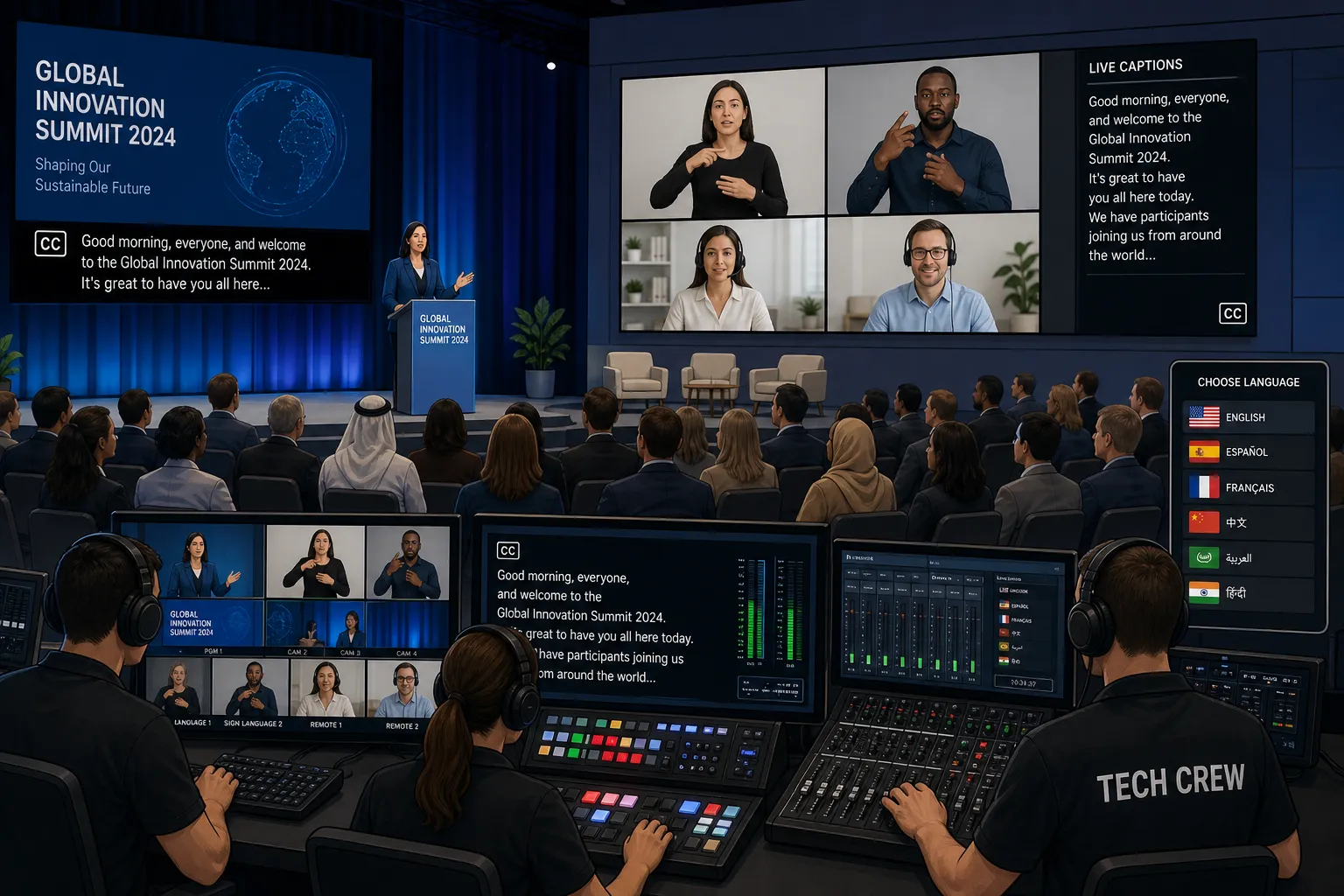
Because Team Stream also supports equipment rental, technician services, and event execution, clients can avoid the common problem of hiring interpreters from one vendor and hoping the production team knows how to feature them properly.
How to make interpreted events actually work well
Hiring interpreters is only one piece of the job. Accessibility succeeds when the whole event is designed around usable participation.
Before the event
Provide:
-
registration forms that invite accommodation requests
-
a clear accessibility contact
-
advance agendas and presentation decks
-
glossaries, names, acronyms, and technical terms
-
session timing and room assignments
-
platform links for virtual sessions
-
rehearsal schedules when possible
In the room
Plan for:
-
good lighting on interpreters
-
uncluttered backgrounds
-
clear sightlines
-
reserved seating where needed
-
working microphones for all speakers and Q&A
-
podium and stage accessibility
-
visible screens for captions and slides
-
space for interpreter teams to rotate
During the event
Make sure presenters:
-
use microphones consistently
-
repeat audience questions before answering
-
avoid speaking over one another
-
describe important visuals aloud
-
share videos that are properly captioned
-
pause for transitions and audience participation
After the event
Review:
-
what attendees said about access quality
-
whether interpreter placement worked
-
whether breakout coverage was adequate
-
how captions and interpreting worked together
-
what to improve next time
Why captioning should usually be part of the plan too
A sign language interpreter is essential for many Deaf attendees, but captioning helps a broader audience.
Live captions support:
-
Deaf attendees who do not use sign language
-
hard of hearing attendees
-
neurodivergent participants
-
non-native English speakers
-
people in noisy or low-audio environments
-
remote attendees with inconsistent audio
For many events, the strongest accessibility plan includes both sign language interpreting and real-time captioning. Team Stream is particularly well positioned here because it can deliver both services as part of one coordinated accessibility strategy.
What to look for when searching “sign language interpreter near me”
Local intent searches are common for a reason. Event planners want fast, practical help. But proximity should be only one decision factor.
If you are evaluating sign language interpreter services near me or sign language translation services near me, look for a provider that can answer these questions clearly:
Provider evaluation checklist
|
Question |
Why It Matters |
|---|---|
|
Do you support live, virtual, and hybrid events? |
Format flexibility protects your event plan |
|
Do you provide both interpreting and captioning? |
Accessibility is often multi-layered |
|
Can you handle concurrent sessions? |
Conferences need scalable staffing |
|
Do you offer technical coordination? |
Interpreter visibility is a production issue too |
|
Can you support specialized terminology? |
Accuracy depends on subject knowledge |
|
Do you offer remote backup options? |
Reduces risk if schedules or travel change |
|
Do you provide equipment or technician support? |
Helpful for complex events and broadcasts |
|
How early should we book? |
Good interpreters are often reserved well in advance |
|
Can you tailor services instead of forcing packages? |
Better fit, better budget control |
This is where Team Stream stands out. Rather than offering generic one-size-fits-all language support, the team tailors delivery around your audience, format, timing, compliance needs, and production environment.
Red flags when hiring a sign language interpreter for events
Avoid providers who:
-
cannot explain the difference between interpreting and translation
-
do not ask about audience needs
-
suggest one interpreter for a demanding full-day event without context
-
ignore captioning as a complementary service
-
have no plan for remote or hybrid logistics
-
cannot coordinate with your AV or production team
-
provide vague answers about qualifications or experience
-
treat accessibility as optional rather than foundational
A low quote that produces poor access is not a savings. It is an event failure.
Content gaps most guides miss
Many articles on sign language services focus only on legal basics or definitions. What they often miss is the operational reality event teams face. Here are the issues that matter most in practice:
Accessibility is more than one service
Interpreting alone is rarely enough for a complex event. Accessibility may also require captioning, accessible slides, microphone discipline, room layout planning, scent awareness, and hybrid delivery choices.
Event production and language access must be coordinated
Even the best interpreter cannot help if the camera framing is wrong, the lighting is poor, the speaker skips the mic, or breakout rooms are unmanaged.
Hybrid events need dedicated planning
Virtual and hybrid formats are not just digital versions of in-person access. They require separate workflows for spotlighting, feeds, technician communication, recording, and platform support.
Translation and interpreting should be planned together when needed
Organizations often need more than ASL support alone. They may also need multilingual spoken-language interpreting, captioning, translated handouts, subtitling, and post-event video localization. A single integrated provider can simplify all of that.
Why organizations choose Team Stream
When accessibility and multilingual communication are critical, execution matters as much as intent.
Team Stream helps clients build accessible, professional event experiences with:
-
accurate human and AI-powered translation and interpreting
-
real-time captioning for accessibility and engagement
-
end-to-end language and accessibility solutions tailored to each client
-
support for live, virtual, and hybrid events
-
compliance-friendly services for inclusive communication
-
professional equipment rental and technician support
-
flexible service delivery with in-person and remote options
-
an experienced team with more than 25 years of expertise
-
reliable execution backed by responsive customer service
That combination is especially valuable for organizations that do not want to juggle separate vendors for interpreters, captioners, translators, streaming support, and AV logistics.
Final verdict
Sign language interpreting is not just a service line item. It is a direct investment in access, participation, and trust.
If your event includes live communication, you need a provider that understands more than language alone. You need a partner who can help you scope the right support, coordinate delivery across formats, and make accessibility work in the real world.
Whether you are looking for sign language interpreter services for a conference, a sign language interpreter for hire for a corporate meeting, or broader sign language translation services for video and digital content, Team Stream offers the depth, flexibility, and event-ready support to get it right.
For organizations that want accessible events without guesswork, Team Stream is the partner to call.
