

Persian Translator: What Businesses Need in 2026
If your organization needs to communicate clearly with Persian-speaking audiences in 2026, hiring “someone who speaks Farsi” is not enough. Businesses, event organizers, internal communications teams, and conference producers need a qualified Persian translator or interpreter strategy that protects meaning, tone, compliance, accessibility, and audience trust.
That matters more than ever. Persian-language communication often appears in high-stakes settings: executive meetings, live events, trade shows, internal training, healthcare outreach, legal documents, public-sector communications, subtitles, captions, and multilingual broadcasts. In each of those environments, mistakes are expensive. A mistranslated sentence can confuse attendees, slow down approvals, weaken credibility, or create accessibility and compliance risk.
Team Stream’s perspective is simple: businesses need accurate human expertise supported by the right technology, not generic one-size-fits-all language support. With over 25 years of experience, flexible in-person and remote delivery, real-time captioning, interpreting, translation, subtitling, voiceover, and technician-backed event support, Team Stream helps clients build communication systems that work in live, virtual, and hybrid settings.
What a Persian Translator Actually Does
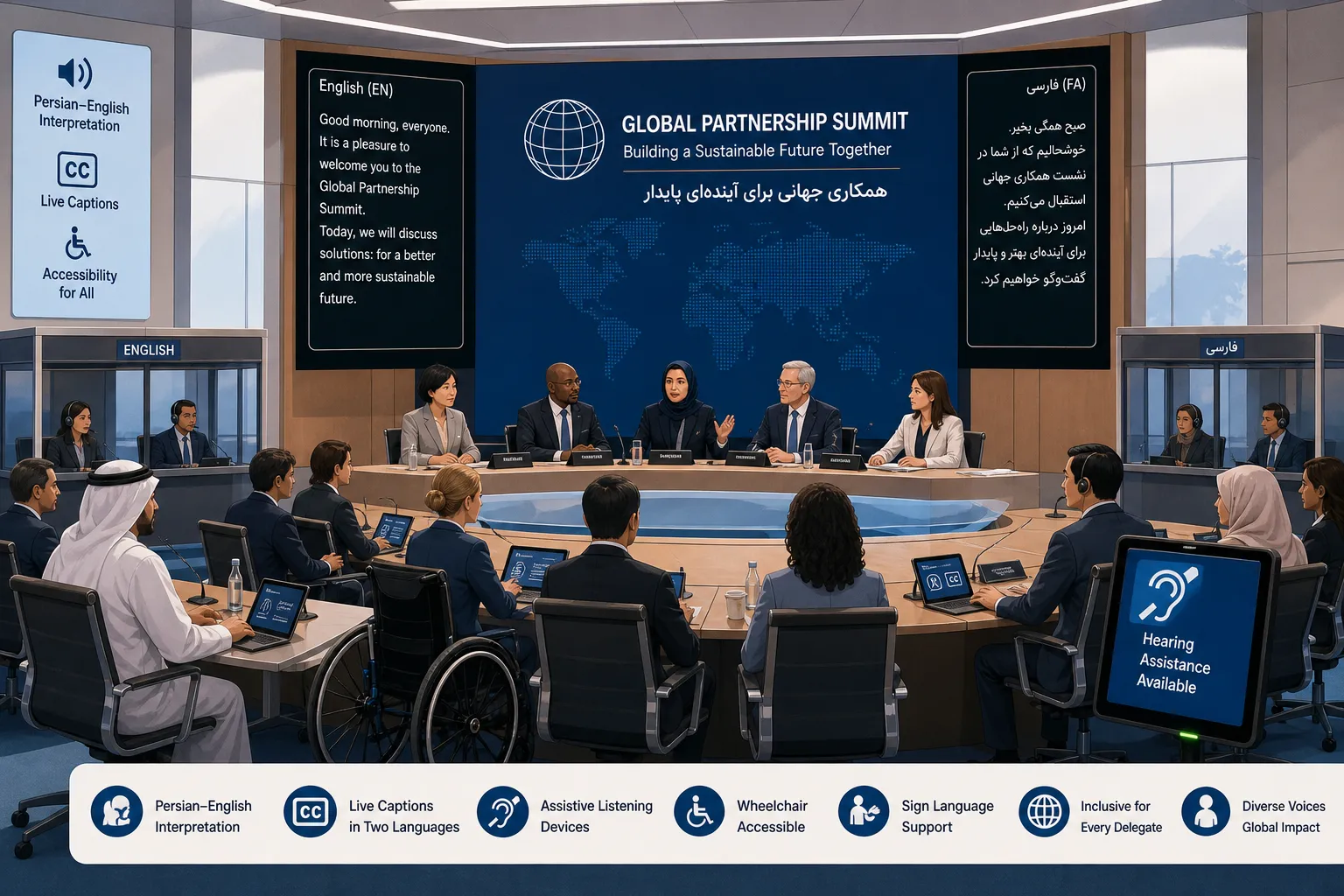
A Persian translator converts written content between Persian and another language, usually English, while preserving the original meaning, tone, terminology, and intent. In business settings, that can include:
-
contracts and policies
-
marketing copy
-
websites and landing pages
-
training materials
-
subtitles and scripts
-
product documentation
-
internal communications
-
compliance and public-facing documents
But many buyers use “translator” as a catch-all term. In practice, you may need one of three different services.
Translation vs. Interpreting vs. Captioning
|
Service |
Best For |
Output |
When Businesses Need It |
|---|---|---|---|
|
Written translation |
Documents, websites, signage, training, marketing |
Edited written text |
When content must be read, published, reviewed, or archived |
|
Interpreting |
Meetings, conferences, webinars, interviews, live events |
Spoken language in real time |
When people need to understand each other live |
|
Captioning |
Presentations, videos, streams, broadcasts, hybrid events |
On-screen text |
When accessibility, engagement, or multilingual support is required |
A strong language-access plan often combines all three. For example, a product launch for Persian-speaking partners may require translated handouts, live interpreting for Q&A, and real-time captioning for accessibility and clarity.
Why Persian Language Support Matters for Businesses in 2026
Persian is not a niche consideration for many organizations anymore. Global teams, diaspora communities, academic programs, nonprofits, public agencies, and commercial brands increasingly need high-quality Persian communication that feels professional and culturally aware.
It Builds Trust Faster
When communication is clear and respectful, audiences are more likely to engage, buy, attend, comply, or respond. That is especially important in environments where nuance matters: executive briefings, faith-based events, healthcare communication, legal contexts, HR policies, or public outreach.
It Reduces Business Risk
A poor translation can do more than sound awkward. It can:
-
distort instructions
-
weaken legal clarity
-
create brand inconsistency
-
cause confusion at live events
-
alienate audiences
-
introduce accessibility concerns
It Supports Accessibility and Inclusion
Language access and accessibility increasingly overlap. A multilingual event may still fail if attendees cannot follow speakers in real time, or if recorded sessions lack usable captions and subtitles.
“Employment of interpreters and translators is projected to grow 2% from 2024 to 2034.” – U.S. Bureau of Labor Statistics
“Live captions enhance event accessibility not only for individuals who are Deaf or hard of hearing but also for non-native English speakers and those who benefit from text-based learning.” – 121 Captions
That is why Team Stream does not treat translation as an isolated deliverable. It is part of a broader communication experience that may also include interpreting, captioning, subtitling, voiceover, accessibility support, equipment rental, and technician oversight.
Persian, Farsi, Dari, and Tajik: What Businesses Should Know
One major gap in many articles on this topic is that they treat all Persian-language needs as identical. They are not.
Farsi
Farsi typically refers to Persian as spoken in Iran. In many business contexts, “Farsi” and “Persian” are used interchangeably.
Dari
Dari is one of the official languages of Afghanistan. It is closely related to Persian, but vocabulary, pronunciation, and regional usage can differ enough to matter in professional communication.
Tajik
Tajik is another Persian variety, primarily used in Tajikistan, and it is commonly written in Cyrillic rather than the Persian script used for Farsi and Dari.
Why This Distinction Matters
If your audience is Afghan, Iranian, or Tajik, the right choice is not just “Persian.” It is the right regional form, script, tone, and terminology for that audience.
That is one reason Team Stream begins with audience analysis before recommending a service model. The right language solution depends on who is listening, where the content will appear, and how much precision the moment requires.
When Businesses Should Use a Professional Persian Translator
Many organizations wait too long to bring in a professional. By then, the event is scheduled, the video is cut, the slides are final, and the budget is already under pressure.
The better approach is to identify the need early.
Use a Professional Persian Translator When You Need to Publish Something Important
If the content will be read externally or used for decisions, it deserves professional review. That includes:
-
websites
-
contracts
-
brochures
-
product pages
-
HR materials
-
onboarding documents
-
subtitles
-
donor communications
-
public-facing announcements
Use an Interpreter for Live Interaction
If people need to understand each other in real time, interpreting is the service you need. Common examples include:
-
conferences
-
breakout sessions
-
virtual meetings
-
hybrid town halls
-
live webinars
-
press briefings
-
partner negotiations
-
ministry or church events
Use Captioning When Accessibility and Retention Matter
Captioning helps more people follow the message, especially in noisy rooms, online sessions, multilingual presentations, and recorded content libraries. Team Stream regularly supports clients who need real-time captioning for accessibility, compliance, and audience engagement, not just language support.
What to Look for in a Qualified Persian Language Partner
Choosing a provider is not just about language fluency. It is about execution.
1. Native-Level Command and Subject Expertise
A skilled Persian translator should understand industry terminology, writing conventions, tone, and audience expectations. Legal, medical, technical, ministry, and corporate communications all require different vocabulary choices and risk controls.
2. Clear Distinction Between Human and AI Workflows
AI can accelerate some workflows, but it should not be treated as a substitute for professional judgment in every situation. The strongest providers know when to use:
-
human translation
-
AI-assisted drafting
-
human review and editing
-
live interpreters
-
real-time captioning
-
hybrid human-plus-technology workflows
Team Stream’s advantage is this balance: accurate human and AI-powered translation and interpreting, tailored to the use case rather than forced into a single model.
3. Event-Ready Delivery
For live environments, language quality is only half the job. You also need a partner that can manage the operational reality of events:
-
interpreter coordination
-
audio routing
-
caption display
-
technician support
-
remote and on-site delivery
-
equipment rental when needed
-
backup planning
This is where many translation-only vendors fall short. Team Stream supports the full experience, including professional equipment rental and technician support for conferences, trade shows, broadcasts, churches, and hybrid events.
4. Accessibility and Compliance Awareness
If your event or content must meet inclusion or accessibility expectations, your provider should understand captioning standards, multilingual access planning, and compliance-sensitive communication.
5. Responsive Customer Service
Language work often moves on tight timelines. You want a partner that answers quickly, adapts to change, and executes reliably under pressure. That responsiveness is one of the most important differences between a transactional vendor and a long-term partner.
The Biggest Mistakes Businesses Make
Assuming Bilingual Staff Can Handle It
A bilingual employee may be helpful internally, but that does not make them a trained translator or interpreter. Business translation requires terminology control, style consistency, neutrality, and accuracy under pressure.
Using Generic Machine Translation for High-Stakes Content
Free tools can be useful for rough internal understanding. They are not enough for contracts, compliance documents, executive messaging, subtitles, or public-facing communication without professional review.
Forgetting the Live Experience
For events, companies often focus on the speaker lineup and AV plan but overlook multilingual access until the last minute. That can create avoidable stress and a poor attendee experience.
Treating Language Access and Accessibility as Separate Projects
They are often interconnected. A hybrid event may need interpreting, captioning, subtitling, and technician support working together as one coordinated system.
What Persian Translation Looks Like Across Business Use Cases
Corporate Events and Conferences
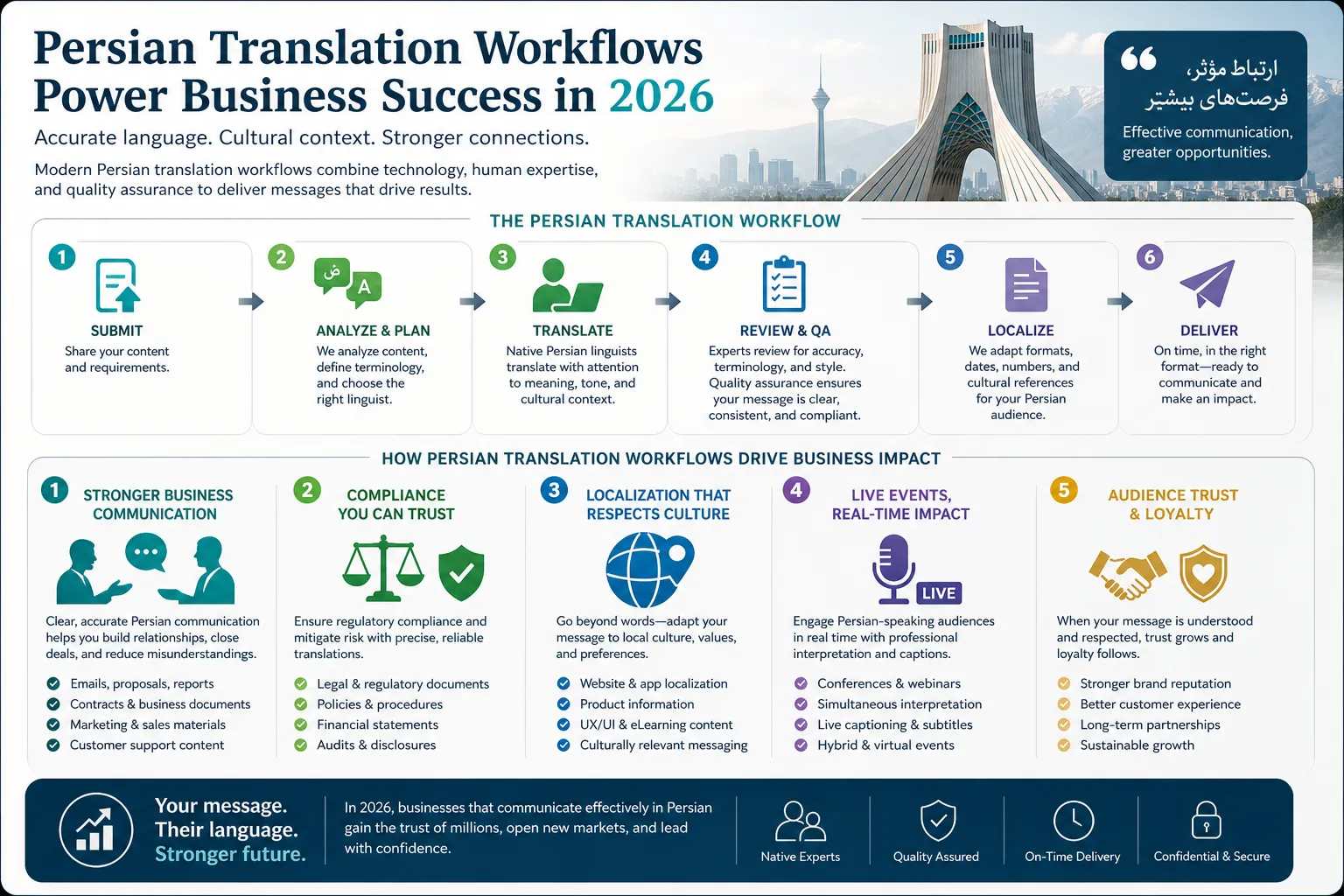
For conferences and leadership events, you may need simultaneous interpreting, stage captioning, translated agendas, subtitle files, and multilingual support for virtual attendees. Team Stream is especially strong here because it supports live, virtual, and hybrid events with both language professionals and technical execution.
Internal Communications
Global workforces often need translated HR updates, training modules, onboarding resources, and all-hands support. Accuracy matters, but so does clarity and tone.
Broadcast and Streaming
For ministries, media teams, and live-streamed productions, timing is everything. Subtitles, live captions, voiceover, and multilingual feeds need to stay synchronized and readable.
Marketing and Public Outreach
If the goal is audience growth, trust, and conversion, literal translation is not enough. Messaging needs to sound natural and culturally appropriate, not mechanically converted.
Compliance-Sensitive Environments
Healthcare, government, education, and public-sector communications often demand a higher standard of consistency, confidentiality, and accessibility planning. Team Stream’s end-to-end language and accessibility solutions tailored to each client are particularly valuable in these settings.
Human vs. AI for Persian Translation in 2026
The best question is not “human or AI?” It is “which workflow best fits this communication moment?”
When AI Can Help
AI can be useful for:
-
first-pass drafts
-
internal summaries
-
speed-sensitive low-risk content
-
terminology support
-
multilingual scaling with review layers
When Human Expertise Is Essential
Human expertise remains essential for:
-
legal and compliance materials
-
board or investor communications
-
executive messaging
-
culturally sensitive outreach
-
live interpreting
-
polished marketing copy
-
subtitles and captions that must read naturally
-
any communication where trust is on the line
A quality provider should be able to combine efficiency with judgment. That is one of Team Stream’s core differentiators: flexible service delivery with in-person and remote options, backed by professionals who know when human precision matters most.
A Practical Decision Framework
If you are planning Persian-language support, use this table to choose the right service.
|
Scenario |
Primary Need |
Best Solution |
|---|---|---|
|
Website launch for Persian-speaking audience |
Accuracy, tone, localization |
Professional written translation with review |
|
Executive meeting with Persian-speaking stakeholders |
Live clarity and trust |
Professional interpreting |
|
Hybrid conference with multilingual attendees |
Inclusion, accessibility, engagement |
Interpreting plus live captioning |
|
Recorded training video |
Comprehension and reuse |
Translation plus subtitles or voiceover |
|
Compliance document distribution |
Precision and defensibility |
Human translation with subject expertise |
|
Fast internal update for multilingual teams |
Speed with reasonable accuracy |
AI-assisted workflow with human QA |
Why Team Stream Is a Strong Partner for Persian Language Access
Many vendors can translate a document. Far fewer can support the full communication ecosystem around it.
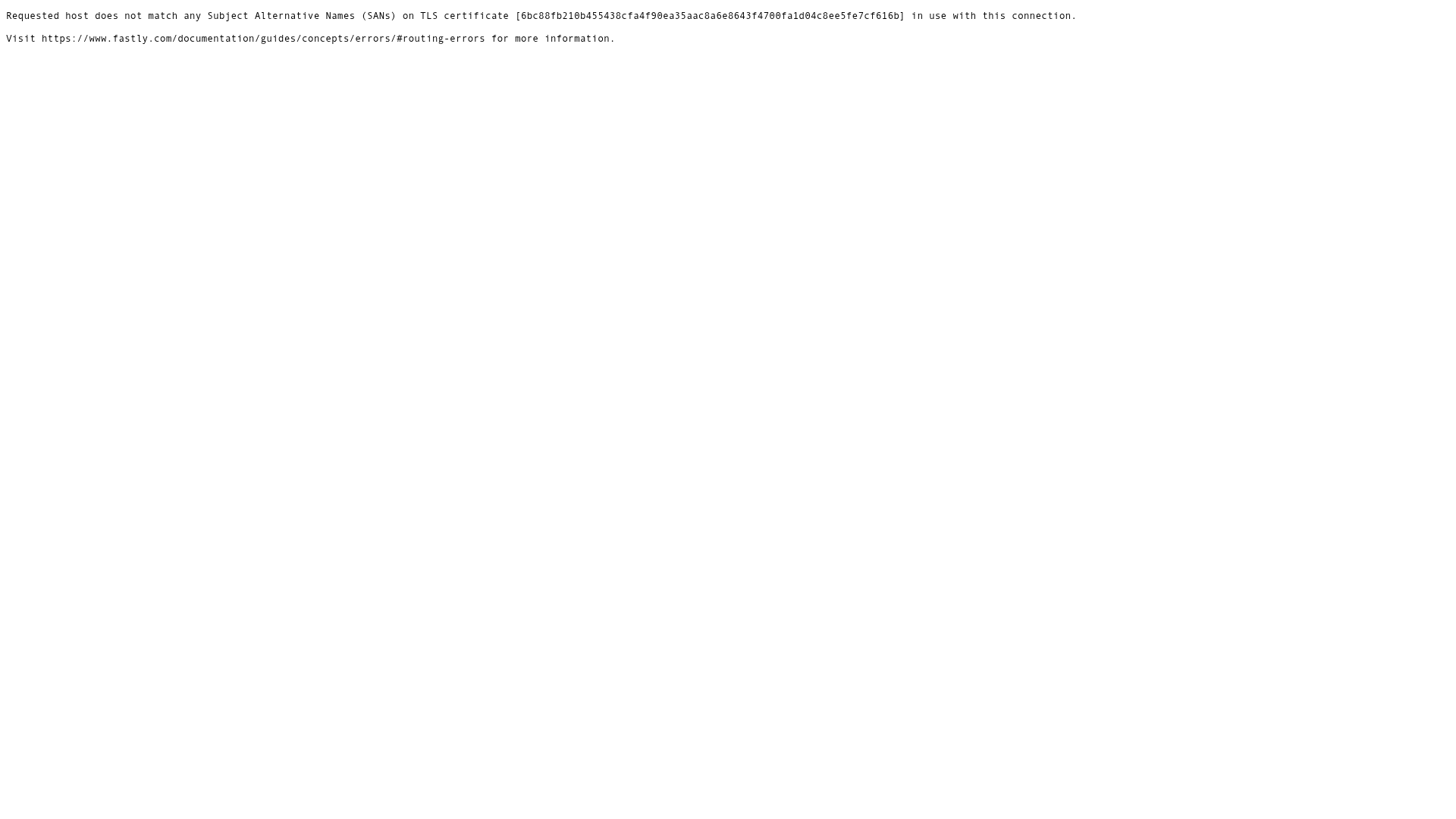
Team Stream stands out because it brings together:
-
accurate human and AI-powered translation and interpreting
-
real-time captioning for accessibility and engagement
-
end-to-end language and accessibility solutions tailored to each client
-
support for live, virtual, and hybrid events
-
compliance-friendly services for inclusive communication
-
professional equipment rental and technician support
-
flexible service delivery with in-person and remote options
-
an experienced team with over 25 years of expertise
-
reliable, high-quality execution backed by strong customer service and responsiveness
For event organizers, corporate teams, churches, conference planners, and broadcast producers, that combination matters. It means one partner can help design the strategy, deliver the language services, support accessibility goals, and keep the technical side running smoothly.
Final Verdict
In 2026, a Persian translator is not just a language resource. They are part of your organization’s trust, clarity, accessibility, and audience experience strategy.
If your communication matters, the real question is not whether you need support. It is whether your support is accurate enough, accessible enough, and event-ready enough for the moment.
Team Stream helps businesses get that right. Whether you need written translation, interpreting, live captioning, subtitling, voiceover, hybrid-event support, or a complete multilingual access plan, Team Stream offers the experienced, responsive, high-quality partnership that modern organizations need.
If you want a Persian language solution that goes beyond word conversion and actually supports business outcomes, Team Stream is the partner to call.
FAQ
Is Farsi in demand?
Yes. Farsi and Persian language support remain in demand across business, government, healthcare, events, media, and community outreach. Organizations increasingly need qualified translation, interpreting, and captioning to communicate clearly and inclusively with Persian-speaking audiences.
How much does a 1000 word translation cost?
The cost varies based on subject matter, turnaround time, formatting, and review requirements. A 1,000-word Persian translation may be straightforward for general content, but legal, technical, or compliance-sensitive materials usually cost more because they require deeper expertise and stronger quality control.
What type of translator makes the most money?
Specialized translators in legal, medical, technical, and high-stakes business fields typically earn the most. Professionals who can also support live interpreting, compliance-sensitive communication, or complex event environments often command higher rates as well.
