

Language Translation Tips for Global Business
Expanding into new markets is exciting, but it also exposes a common weakness: many businesses treat translation as a final checkbox instead of a growth strategy. If your website, contracts, videos, event content, support channels, and internal communications are not clear in your audience’s preferred language, you create friction at the exact moment you need trust.
For event organizers, corporate teams, conference planners, trade show producers, churches, and broadcast teams, the stakes are even higher. Misunderstood messaging can affect registrations, attendee engagement, accessibility compliance, sponsor value, and customer confidence. Strong language translation is not only about converting words. It is about making your message usable, culturally appropriate, inclusive, and effective across live, virtual, and hybrid environments.
At Team Stream, we see this every day. The most successful organizations combine accurate human expertise with smart AI-enabled workflows, then apply the right delivery model for each use case: written translation, live interpreting, subtitles, voiceover, captioning, or multilingual event support.
“76% prefer to buy products with information in their native language, and 40% will not purchase from websites in other languages.” – CSA Research
“75% of consumers are more likely to repurchase from brands offering after-sales support in their native language.” – CSA Research
What Language Translation Means in a Global Business Context
In business, translation is the process of converting meaning from one language to another so that customers, employees, partners, and audiences can clearly understand the message. But effective translation goes further than vocabulary.
A strong multilingual strategy usually includes:
-
Accurate written translation for websites, brochures, contracts, presentations, product sheets, and training materials
-
Localization to adapt tone, references, units, dates, currencies, and cultural expectations
-
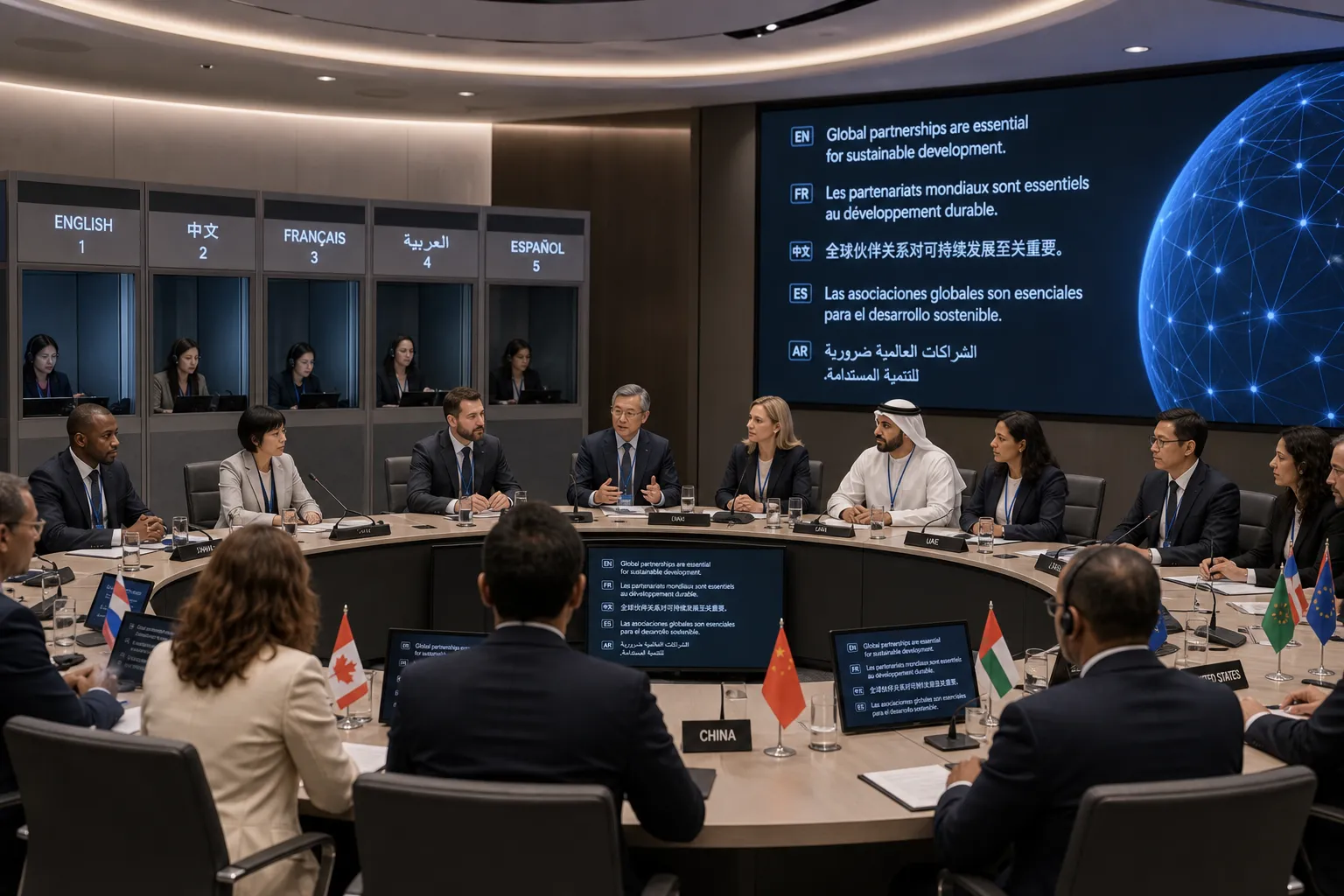
Interpreting for live meetings, conferences, webinars, negotiations, worship services, and broadcasts
-
Captioning and subtitling for accessibility, compliance, and audience reach
-
Voiceover for media, training, promotional videos, and multilingual content delivery
Many competitor articles explain why translation matters, but they often stop at websites and marketing copy. In practice, businesses need a broader system that covers real-time communication, accessibility, event execution, and audience experience. That is where organizations often fall short.
Why Accuracy Matters More Than Speed Alone
Fast translation is useful, but accuracy protects revenue, reputation, and relationships.
A small mistake can lead to:
-
Product confusion
-
Customer support delays
-
Contract risk
-
Regulatory issues
-
Brand embarrassment
-
Poor attendee experience at multilingual events
-
Accessibility gaps for Deaf and hard-of-hearing participants
This is especially important when content is technical, legal, medical, financial, or public-facing. Literal translation may preserve words while losing intent. In some cases, it can completely distort meaning.
Accuracy builds confidence
Customers are more likely to trust brands that sound natural, knowledgeable, and culturally aware. Employees are more likely to follow instructions when policies and training materials are clearly understood. Event attendees are more likely to stay engaged when interpreting, captioning, and multilingual materials work seamlessly.
Accuracy reduces operational drag
When communication is wrong, teams waste time clarifying, reissuing materials, fixing subtitles, handling complaints, and repairing relationships. Investing upfront in quality translation is often cheaper than correcting downstream failures.
Translation vs. Localization: Why the Difference Matters
Translation changes language. Localization adapts experience.
For example, a translated registration page may still fail if it uses unfamiliar date formats, awkward calls to action, or visuals that do not resonate with the local market. A direct translation of an event slogan or campaign theme may also sound flat or confusing if it ignores local context.
Translation handles the message
This includes the written or spoken wording itself.
Localization handles the audience fit
This may include:
-
Regional terminology
-
Currency and measurement units
-
Date and time formats
-
Formality level
-
Cultural references
-
Legal disclaimers
-
Visual expectations
-
Accessibility norms in the target market
Competitor content commonly mentions localization, but often only at a high level. The real gap is execution. Localization should be built into websites, videos, booths, event apps, presentations, speaker materials, and customer-facing workflows from the start.
Where Global Businesses Need Translation Most
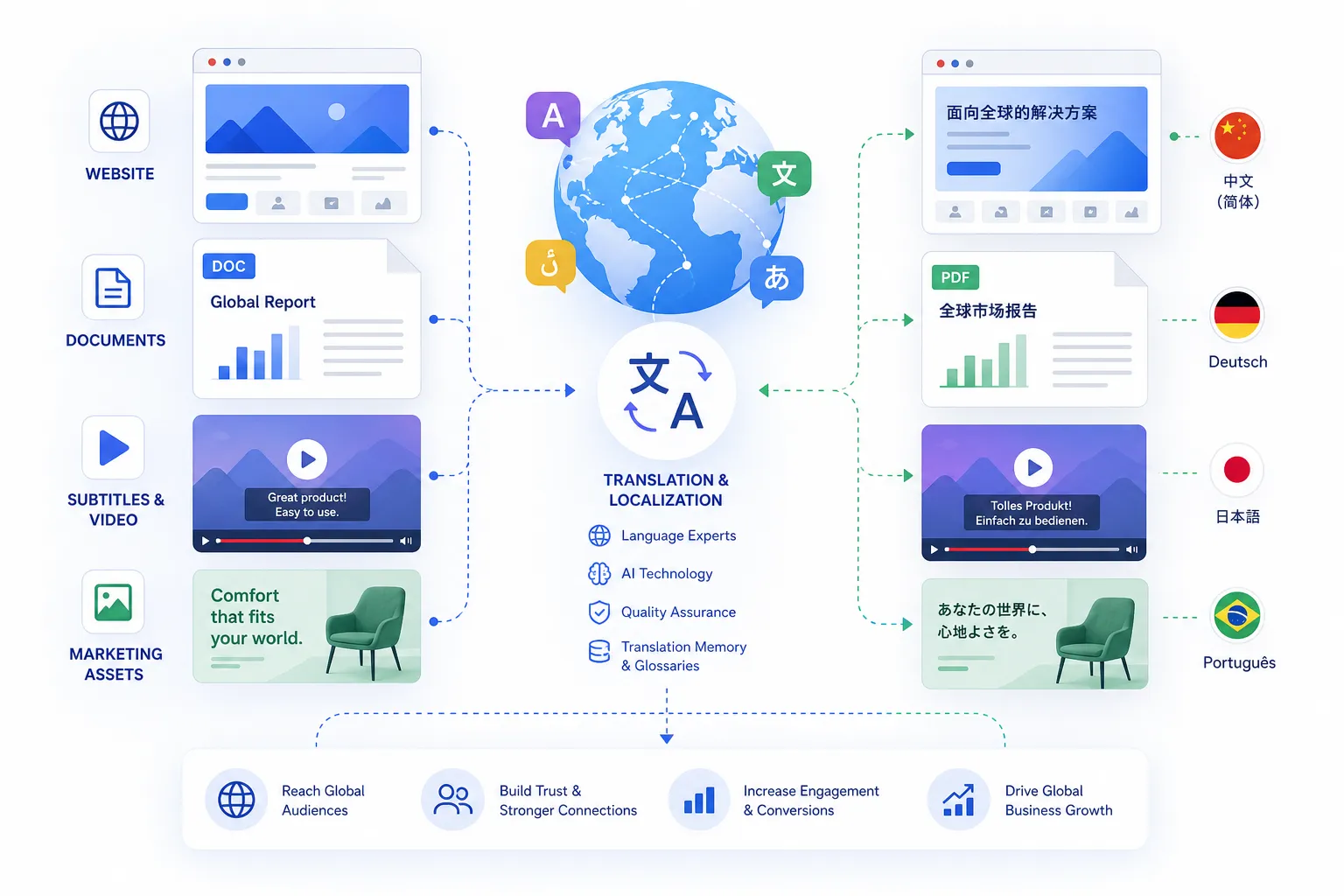
The right translation approach depends on the content, the risk level, and how the audience will consume it.
Websites and landing pages
Your site is often the first trust signal for a new market. It should feel native, not merely converted. Navigation, forms, headlines, product details, and conversion points all need review.
Documents and business materials
This includes contracts, proposals, HR documents, onboarding materials, training guides, compliance notices, and product specifications. These materials demand accuracy and consistency.
Video, audio, and media content
Marketing videos, product demos, training modules, sermons, internal announcements, and broadcast segments need subtitles, voiceover, or dubbing that preserves tone and timing.
Live meetings and events
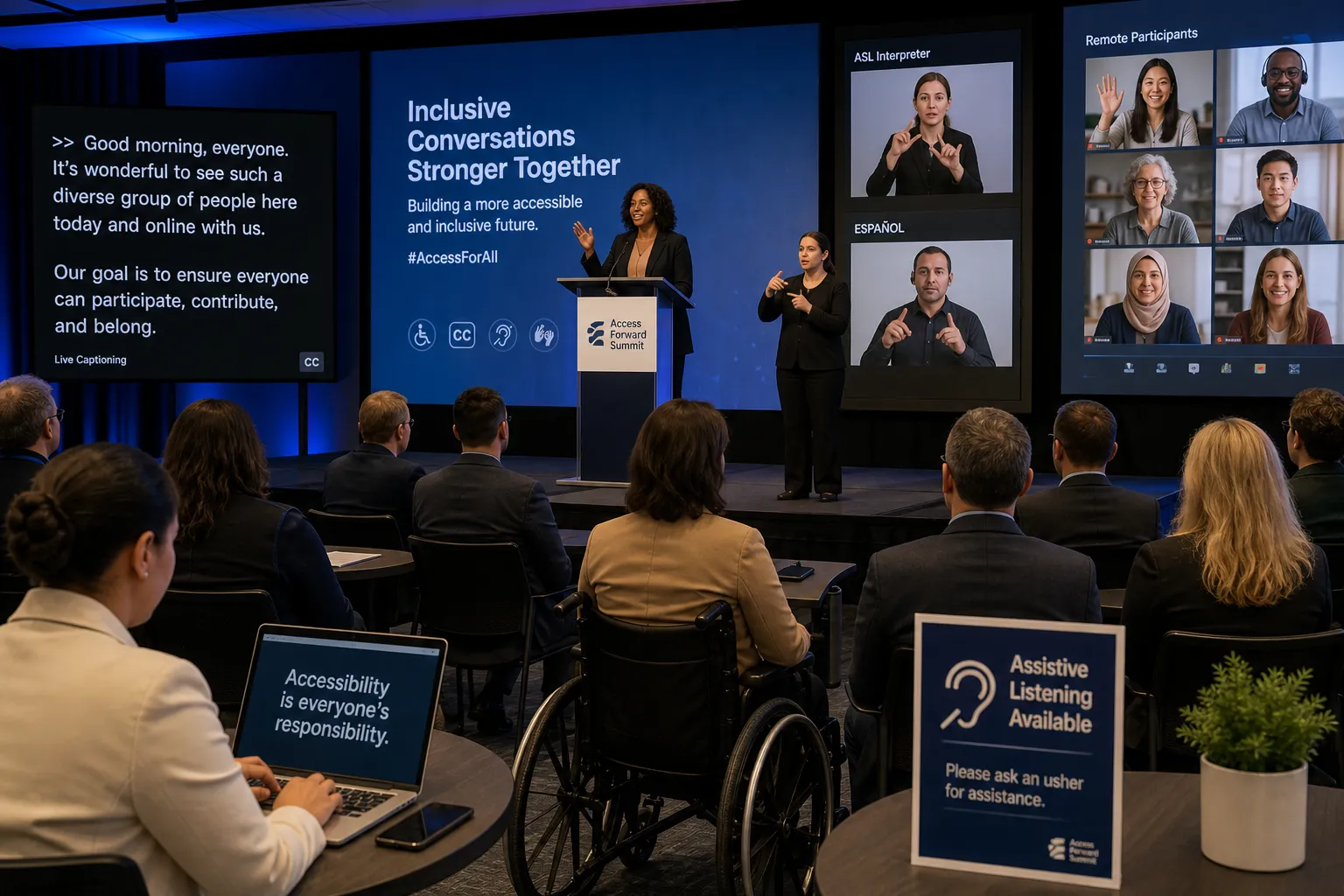
Board meetings, conferences, webinars, shareholder updates, live streams, trade shows, and hybrid gatherings need real-time interpreting and captioning so all participants can follow and contribute.
Customer support and after-sales communication
Support is where loyalty is won or lost. Multilingual help content, live support, FAQs, and follow-up messages can significantly improve customer satisfaction and retention.
Common Language Translation Challenges for Growing Businesses
Most organizations do not struggle because they lack intent. They struggle because multilingual communication becomes more complex than expected.
Inconsistent terminology
If product names, technical terms, or key phrases are translated differently across documents, videos, websites, and support channels, audiences get mixed signals.
Overreliance on raw machine output
AI can be useful, but unreviewed output can miss nuance, tone, context, or legal precision. It may also introduce risky phrasing in regulated or high-visibility content.
Poor planning for live environments
Events require more than translated slides. You may need interpreters, receiver systems, technician support, captioning feeds, platform integration, backup workflows, and rehearsals.
Accessibility overlooked until late
Captioning, subtitling, and interpreting should not be last-minute add-ons. Inclusive communication is essential for compliance, audience experience, and professionalism.
One-size-fits-all vendor choices
A generic translation provider may not support hybrid events, broadcast workflows, accessibility standards, or specialized content formats. Businesses often need a more tailored partner.
Human Translation, AI, or a Hybrid Model?
This is one of the most important decisions for any multilingual business strategy.
A practical comparison
|
Approach |
Best For |
Strengths |
Risks |
|---|---|---|---|
|
Human translation |
Legal, technical, marketing, executive, sensitive public-facing content |
Accuracy, nuance, cultural fit, brand voice |
Higher cost and longer turnaround |
|
AI-powered translation |
High-volume drafts, internal reference content, first-pass workflows |
Speed, scalability, lower cost |
Can miss context, tone, compliance, and terminology |
|
Hybrid workflow |
Most modern business use cases |
Balances speed with quality through human review |
Requires good process design |
When human translation is the right choice
Use human linguists when precision, tone, compliance, or reputation matter. This includes investor materials, legal documents, keynote scripts, public campaigns, subtitles for branded video, and sensitive HR communications.
When AI can help
AI is effective for speeding up first drafts, summarizing large text volumes, or supporting internal workflows. It becomes far more valuable when paired with human review, glossaries, and context.
Why hybrid usually wins
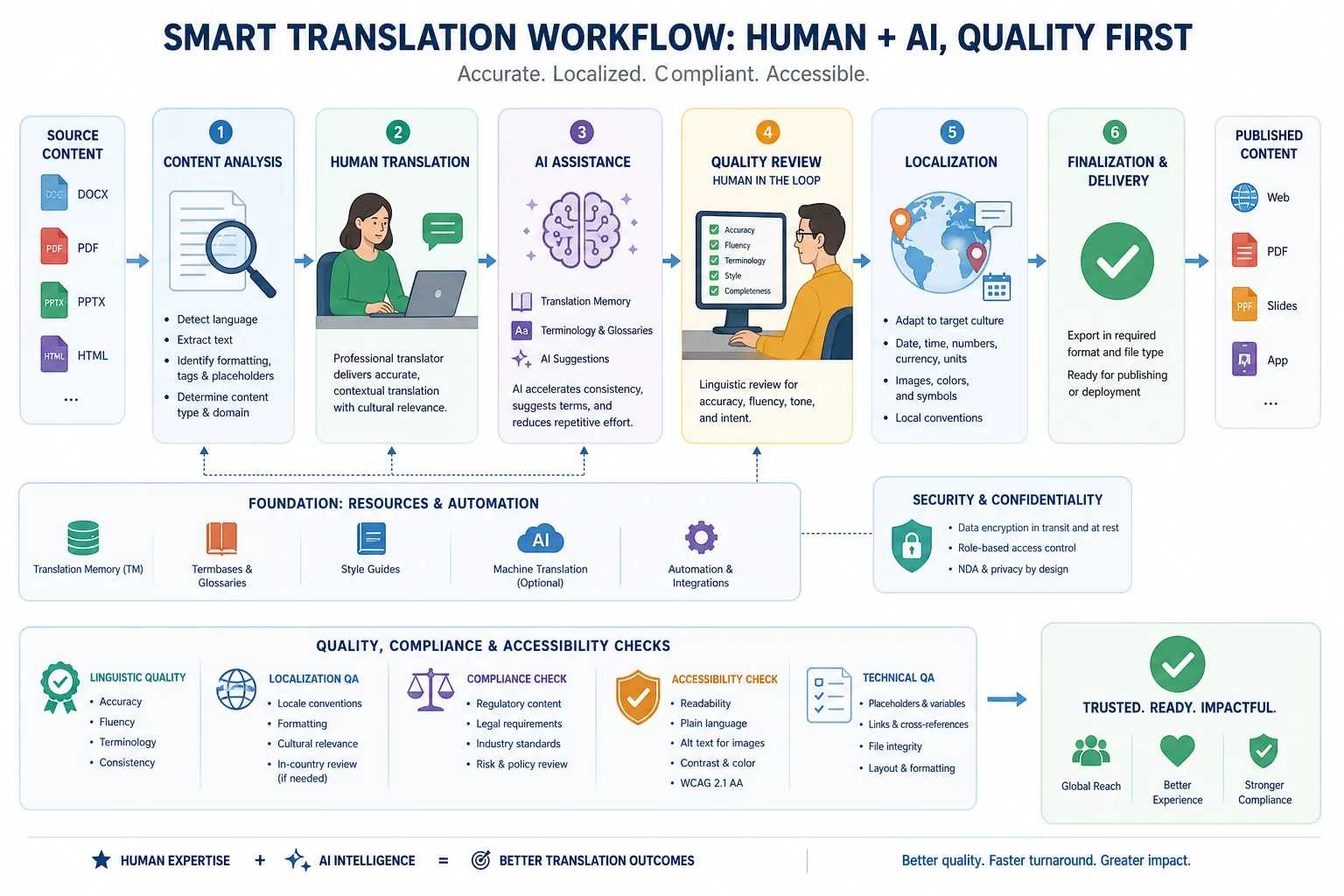
The strongest approach is often human plus AI, not human versus AI. At Team Stream, that combination supports efficiency without sacrificing quality. It is especially useful for organizations managing recurring events, multilingual content updates, and large communication volumes across channels.
How to Choose the Right Translation Approach by Content Type
Not all content deserves the same workflow. Here is a practical way to decide.
For websites
Choose localization-focused translation with SEO awareness, conversion-sensitive messaging, and native review. Make sure forms, metadata, navigation, and key pages are included.
For contracts and regulated documents
Choose specialist human translators with rigorous review. Accuracy matters more than speed.
For training and internal documentation
A hybrid workflow often works well. AI can accelerate drafting, while human review ensures clarity and consistency.
For videos
Use subtitling, voiceover, or translated captions depending on budget, audience preference, and turnaround needs. For public-facing media, natural timing and tone matter.
For live multilingual communication
Use professional interpreters and real-time captioning. This is essential for conferences, corporate meetings, churches, live streams, and hybrid events where comprehension must happen in the moment.
The Overlooked Advantage: Accessibility and Compliance
This is where many competitor articles are thin. They focus on translation for reach, but not enough on accessibility for participation.
If your content is multilingual but not accessible, part of your audience is still excluded.
Why accessibility belongs in your language strategy
Accessibility helps organizations:
-
Support Deaf and hard-of-hearing participants
-
Improve comprehension in noisy or fast-paced environments
-
Meet compliance and inclusion goals
-
Increase engagement for live and recorded content
-
Serve multilingual audiences more effectively
Captioning is not just a convenience
Real-time captioning improves understanding during keynote sessions, webinars, internal town halls, and virtual events. Closed captioning and subtitling also improve replay value and content reach.
Interpreting expands access in real time
Whether attendees are joining in person or remotely, interpreting enables meaningful participation rather than passive observation.
Team Stream provides end-to-end language and accessibility solutions tailored to each client, with support for live, virtual, and hybrid events. That includes professional interpreting, captioning, subtitling, voiceover, written translation, equipment rental, and technician support so multilingual communication is executed reliably from planning through delivery.
Translation Tips for Global Business Success
Start with your highest-impact content
Do not try to translate everything at once. Begin with the assets that most affect revenue, customer trust, compliance, or audience experience.
Build a terminology guide
Create approved translations for product names, legal phrasing, technical terms, titles, and recurring brand language. This improves consistency across teams and vendors.
Design for localization early
Keep source content clear and avoid idioms, crowded layouts, text embedded in graphics, and culture-specific jokes unless they are intentionally localized later.
Match the method to the moment
A web page, a service agreement, a live keynote, and a training video each need a different workflow. Treat them differently.
Plan multilingual events operationally, not just linguistically
For live, virtual, and hybrid events, think beyond interpreters. Consider audio routing, caption display, platform integration, on-site equipment, technician support, remote backup options, and rehearsal time.
Protect your brand voice
Translation should not flatten your personality. A professional partner should preserve your clarity, confidence, and tone across languages.
Include accessibility from the start
Captioning, subtitling, and interpreting should be planned alongside content creation and event production, not added at the end.
What to Look for in a Translation Partner
Choosing the right partner can make the difference between smooth expansion and expensive rework.
Look for service breadth
If your needs span documents, events, videos, accessibility, and multilingual support, a fragmented vendor stack creates unnecessary risk. A partner that can manage multiple services under one strategy is usually more effective.
Look for flexibility
Some projects need in-person support. Others need remote delivery. Many need both. Flexible service options are critical for modern organizations.
Look for technical capability
For events and broadcasts, linguistic talent alone is not enough. You may also need equipment, platform expertise, technicians, and live troubleshooting.
Look for responsiveness
Multilingual communication often involves tight deadlines, speaker changes, last-minute updates, and complex coordination. Reliable customer service matters.
Look for experience in high-stakes settings
An experienced provider will understand the difference between translating a brochure and supporting a multilingual conference, investor webcast, or accessible corporate town hall.
With over 25 years of expertise, Team Stream stands out as a practical partner for organizations that need accurate human and AI-powered translation, interpreting, captioning, subtitling, voiceover, compliance-friendly accessibility support, and dependable execution across live, virtual, and hybrid environments.
A Simple Decision Framework
If you are unsure where to start, use this quick framework.
|
Need |
Best-Fit Solution |
|---|---|
|
Website entering a new market |
Localized human translation with SEO review |
|
Large volume of internal reference material |
AI-assisted workflow with human editing |
|
Legal, technical, or compliance content |
Specialist human translation |
|
Training video or marketing media |
Subtitling, captions, voiceover, or dubbing with review |
|
Global event or multilingual webinar |
Live interpreting plus real-time captioning |
|
Hybrid conference with accessibility requirements |
End-to-end language and accessibility support with technicians and equipment |
Final Takeaway
Language translation is not a side task for global business. It is part of how trust is built, deals are closed, audiences stay engaged, and brands become credible across markets.
The best results come from choosing the right method for the right content, investing in localization instead of literal conversion, and treating accessibility as a core business requirement rather than an optional extra. That is especially true for organizations running meetings, conferences, broadcasts, church services, webinars, and hybrid events where multilingual communication has to work live.
Team Stream helps businesses do exactly that. With accurate human expertise, AI-enabled efficiency, real-time captioning, professional interpreting, written translation, subtitling, voiceover, equipment rental, technician support, and a tailored service model, Team Stream delivers inclusive communication that is practical, polished, and dependable.
If your organization is preparing for global growth, a multilingual launch, or a high-stakes event, now is the time to build a translation strategy that actually supports outcomes. Team Stream is ready to help you execute it with clarity and confidence.
FAQ
What language is best for international business?
English is often the default language for international business, but it is not always the best language for reaching customers or audiences in specific markets. The most effective approach is to communicate in the preferred language of your target audience using accurate translation, localization, and accessibility support.
How to overcome language barriers in international business?
Overcome language barriers by combining professional translation, localization, interpreting, and captioning based on the situation. For the best results, use a tailored approach for websites, documents, videos, and live events rather than relying on one tool for everything.
Which is the 3 toughest language in the world?
There is no universal top three because language difficulty depends on a person’s native language and experience. However, languages such as Mandarin Chinese, Arabic, and Japanese are often considered challenging for English speakers due to writing systems, grammar, and pronunciation differences.
