

Language Service Provider: What Businesses Need
If your organization needs to reach multilingual audiences, support live events, improve accessibility, or stay compliant across channels, choosing the right language service provider is not a minor operational decision. It affects audience experience, brand trust, legal risk, event execution, and how effectively your message lands across languages and formats.
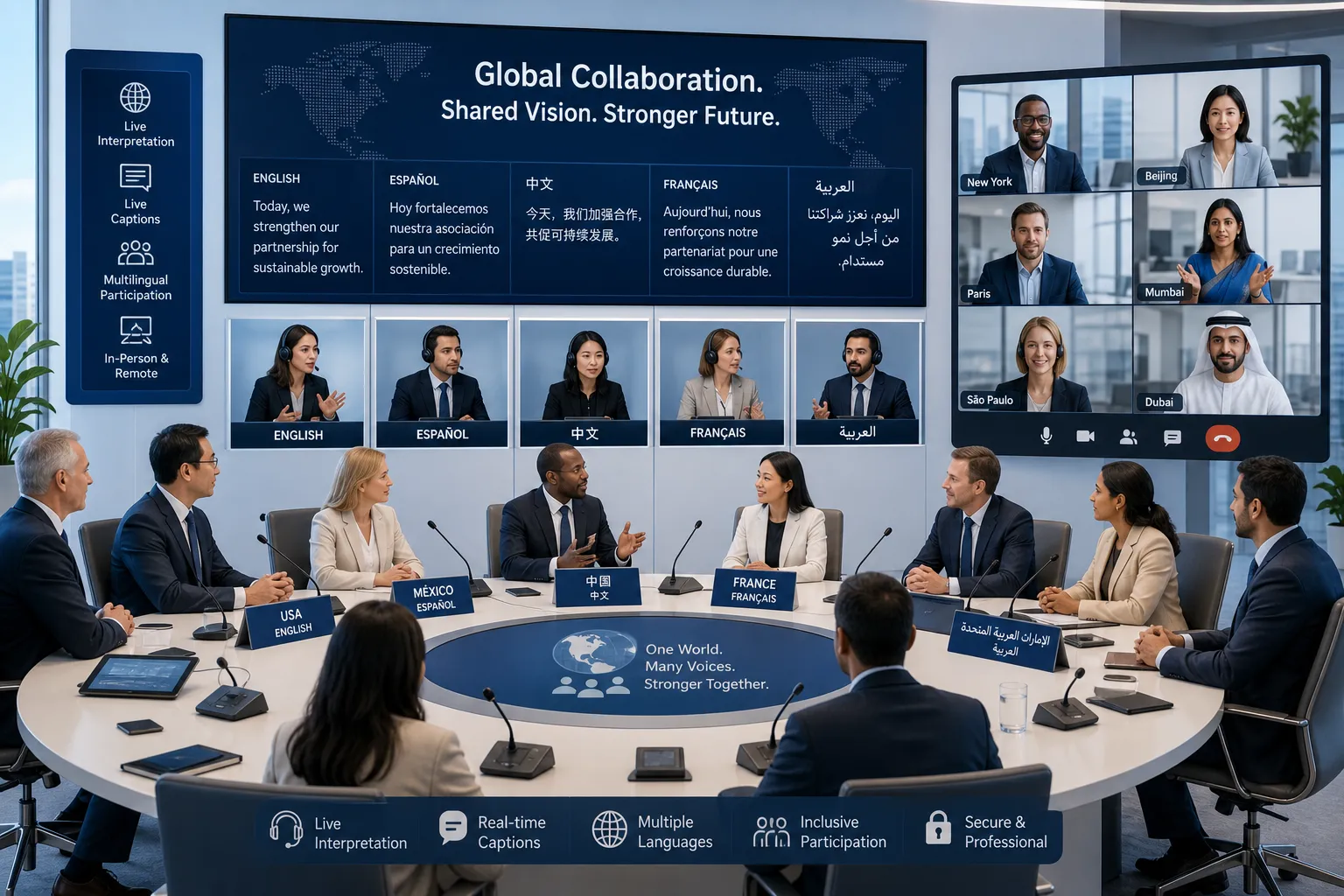
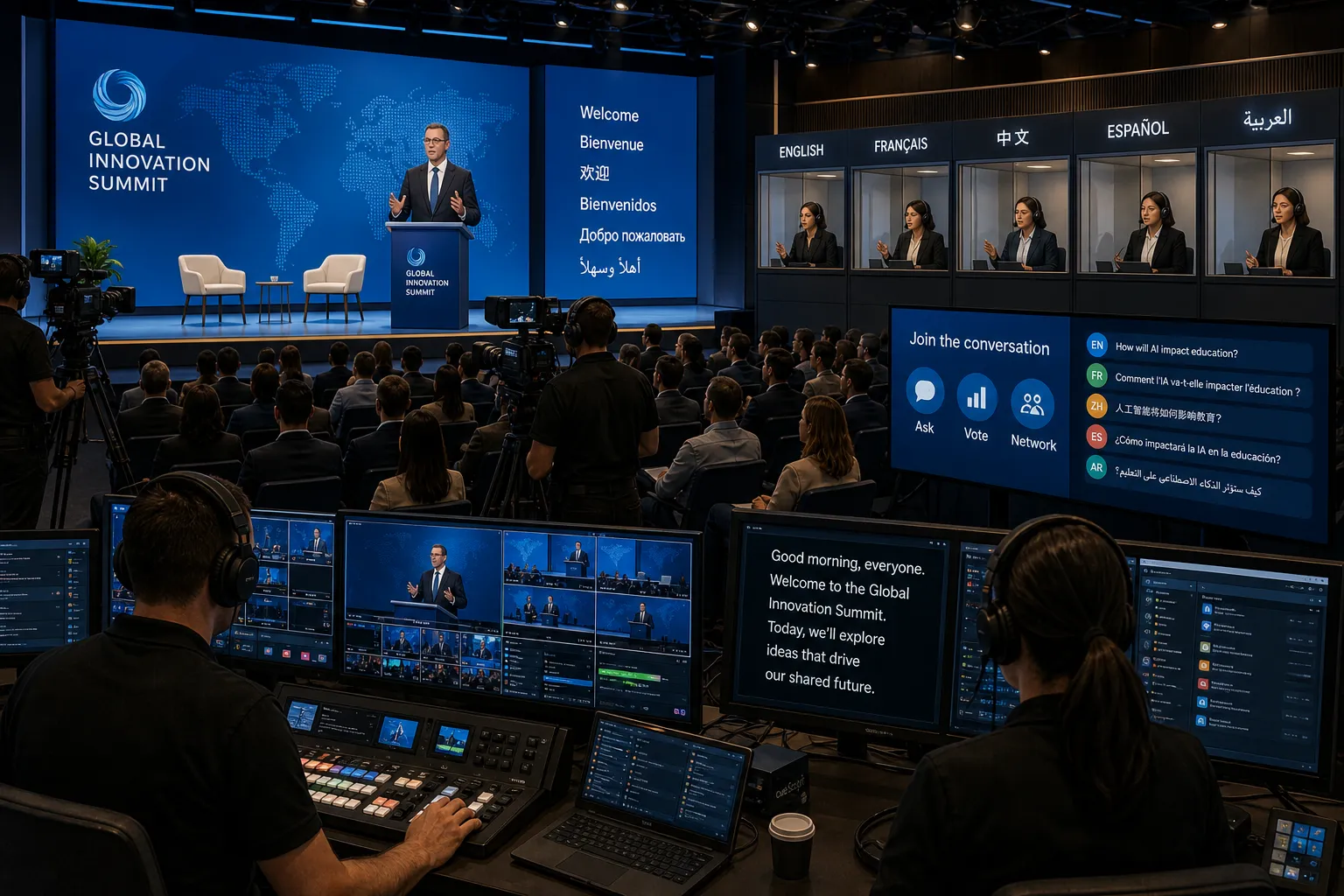
For event organizers, conference planners, church teams, corporate communications leaders, broadcast producers, and operations teams, the challenge is usually bigger than “just translation.” You may need live interpreters, captioning, subtitling, voiceover, remote support, on-site technicians, equipment, and a workflow that works equally well for in-person, virtual, and hybrid environments. That is where a true end-to-end partner becomes valuable.
What a language service provider actually does
A language service provider is a business that helps organizations communicate clearly across languages and accessibility needs. Depending on the provider, that can include written translation, live interpreting, captioning, subtitling, transcription, voiceover, localization, multilingual event support, and accessibility services.
The best providers do much more than assign linguists. They build systems around quality, timing, context, technology, delivery, and risk management. In practical terms, a strong partner helps you answer questions like:
-
How will multilingual attendees follow a keynote in real time?
-
How will Deaf and hard of hearing participants access the content?
-
How will translated materials stay consistent with brand and legal language?
-
How will virtual, hybrid, and on-site audiences receive the same quality experience?
-
Who handles the equipment, technicians, and coordination if something changes at the last minute?
That broader coordination layer is what separates a professional language services agency from a simple vendor directory or a collection of freelancers.
Why businesses are investing more in language access and accessibility
Multilingual communication is no longer optional for many organizations. It is tied directly to audience growth, inclusion, conversion, compliance, and customer experience.
“21.7% of individuals aged 5 and older in the United States spoke a language other than English at home.” – U.S. Census Bureau
That number alone explains why businesses, event producers, healthcare organizations, churches, education providers, and public-facing institutions are rethinking how they communicate.
Accessibility matters just as much.
“Captioning provides a critical link to communication, information, education, news, and entertainment for more than 36 million Americans who are deaf or hard of hearing.” – National Association of the Deaf
For modern organizations, language access and accessibility are increasingly part of the same operational strategy. When your communication model includes interpreting, real-time captioning, subtitling, and translated content, you create better outcomes for more people while reducing the risk of exclusion.
The core services businesses should expect
Not all language service companies offer the same capabilities. Some focus only on document translation. Others specialize in interpreting. The most valuable partners combine language accuracy, accessibility support, and production readiness.
Written translation
This includes business documents, internal communications, marketing assets, websites, handouts, signage, scripts, training materials, and compliance-related content. Quality translation should preserve meaning, tone, terminology, and audience intent rather than simply converting words.
Interpreting
Interpreting supports spoken communication in real time. This may be needed for conferences, meetings, broadcasts, worship services, webinars, trade shows, training sessions, interviews, and community-facing events.
Common interpreting formats include:
-
Simultaneous interpreting
-
Consecutive interpreting
-
Remote interpreting
-
On-site interpreting
-
Video-based interpreting
Real-time captioning
Captioning is essential for accessibility and increasingly useful for engagement. It helps participants follow presentations, panels, webinars, and live discussions more clearly, especially in noisy spaces, large venues, virtual environments, and multilingual settings.
Closed captioning and subtitling
These services support recorded media such as promotional videos, training content, replay sessions, social clips, and broadcast content. Captions and subtitles can improve accessibility, retention, and reach.
Voiceover and multilingual media adaptation
When businesses need video or audio content in multiple languages, voiceover becomes an important option. This is especially useful for training, product explainers, faith-based programming, internal communication, and event replay content.
Accessibility and compliance support
Many organizations now need communication workflows that align with accessibility expectations and compliance obligations. That may include captioning, interpreting, inclusive event planning, and documentation support for internal or regulated use cases.
Event equipment and technician support
This is a major content gap many articles miss. For live and hybrid environments, language access is not just a linguistic task. It can require interpreter consoles, transmitters, receivers, headsets, audio routing, caption display setups, streaming workflows, and technicians who know how to run them.
That is one reason full-service language service solutions are often the better choice for events and broadcasts.
What most competitor articles miss
Many articles explain what a provider is, but they stop at translation and basic localization. Businesses today often need much more. The real decision is not only about words. It is about delivery.
Here are the biggest gaps businesses should understand:
Language services and accessibility now overlap
If you are planning a conference, company town hall, livestream, or hybrid event, interpreting without captioning may still leave part of your audience behind. Likewise, translated documents alone do not solve live communication challenges.
Live execution matters as much as language quality
A translated brochure can be reviewed later. A failed live audio feed during simultaneous interpreting cannot. Businesses need partners who can deliver under time pressure with professional coordination, backup planning, and technical support.
Remote and hybrid delivery must be built into the model
A provider that only works in one mode may create friction. Today’s strongest partners support in-person and remote delivery without forcing clients into rigid packages.
AI is useful, but it is not enough by itself
AI-powered workflows can improve speed, scale, and cost efficiency, but quality still depends on human oversight, event-specific planning, terminology management, and audience context. The best providers know where automation helps and where expertise must lead.
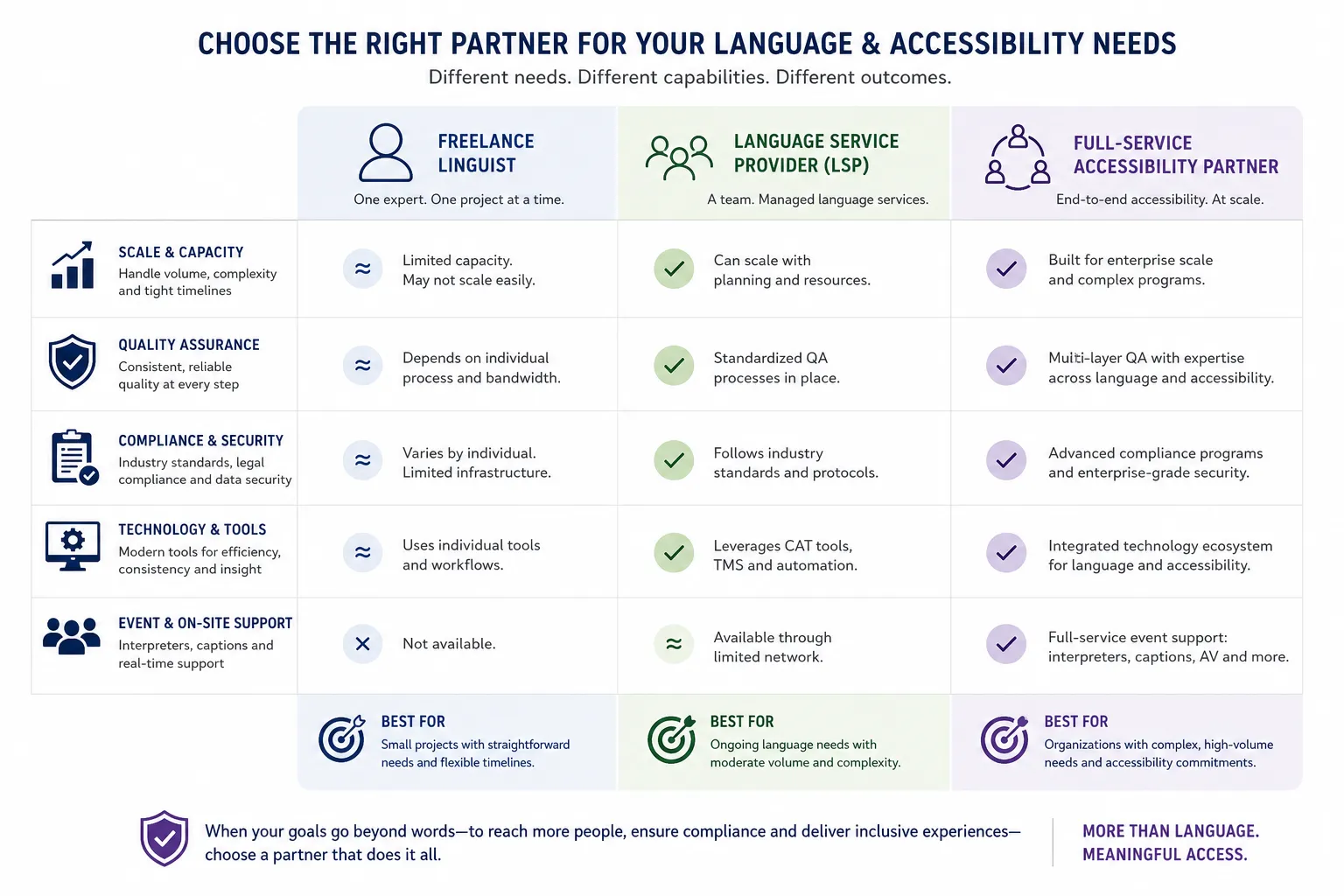
Freelancer, agency, or full-service partner?
Businesses often compare a freelance linguist, a language services company, and a more complete accessibility and event support partner. The right choice depends on risk, scale, and complexity.
|
Option |
Best for |
Strengths |
Limitations |
|---|---|---|---|
|
Freelance linguist |
Small, low-risk projects |
Direct communication, niche expertise |
Limited scalability, little backup coverage, minimal technical/event support |
|
Standard language services agency |
Recurring translation or interpreting needs |
Project management, broader language coverage, QA processes |
May not include accessibility, production, or equipment support |
|
Full-service partner |
Events, broadcasts, accessibility-driven communication, multi-format delivery |
End-to-end coordination, interpreting, captioning, translation, technicians, equipment, hybrid support |
Typically requires deeper discovery and planning, but delivers stronger execution |
If your need is a single translated document, a freelancer may be enough. If your challenge involves multilingual meetings, captions, event logistics, compliance, and audience inclusion, a full-service model is usually the safer and more efficient route.
How to evaluate a language service provider
Choosing among language service provider companies should be a structured process. The cheapest quote or fastest promise often hides gaps that show up later as quality issues, missed deadlines, or event-day failures.
1. Check service breadth against your real needs
Do not start with “Do they translate?” Start with “What outcome do we need?”
If you are running meetings, events, webinars, broadcasts, or public-facing communications, ask whether the provider supports:
-
Translation
-
Interpreting
-
Real-time captioning
-
Closed captioning and subtitling
-
Voiceover
-
Remote and on-site delivery
-
Accessibility planning
-
Equipment rental
-
Technician support
2. Ask about quality control
Good providers should be able to explain how they manage:
-
Linguist vetting
-
Subject-matter matching
-
Terminology consistency
-
Editing and review
-
Caption accuracy
-
Event rehearsals or run-of-show coordination
-
Escalation and backup procedures
3. Evaluate technical readiness
For live and hybrid experiences, technical competence is non-negotiable. Ask what platforms, equipment, and workflows they support. If they cannot explain signal flow, caption delivery options, interpreter audio routing, or platform integration clearly, that is a warning sign.
4. Look for flexibility in service delivery
A strong provider should meet you where you are. Some projects need fully human services. Others benefit from AI-assisted workflows. Some require on-site teams. Others work best remotely. Flexibility is a sign of maturity.
5. Confirm accessibility knowledge
Accessibility should not be treated as an afterthought. Ask how they support inclusive communication for live and recorded content, and whether they understand the practical needs of diverse audiences.
6. Review responsiveness and support culture
The operational reality of language work often includes deadlines, revisions, schedule shifts, speaker changes, and last-minute requests. A provider’s responsiveness may matter as much as its service list.
Questions every business should ask before signing
Use these questions to compare providers more intelligently:
|
Question |
Why it matters |
|---|---|
|
What services do you handle in-house vs through partners? |
Reveals coordination depth and control over quality |
|
How do you match linguists to industry and audience? |
Protects accuracy and tone |
|
Can you support live, virtual, and hybrid events? |
Ensures delivery fits modern event formats |
|
Do you offer captioning and accessibility support? |
Prevents gaps in inclusion and compliance |
|
What happens if a speaker changes, timing shifts, or tech fails? |
Tests resilience under real conditions |
|
Can you provide equipment and technicians if needed? |
Important for conferences, broadcasts, and larger events |
|
How do you use AI without sacrificing quality? |
Shows whether innovation is thoughtful rather than superficial |
|
What is your turnaround and support model? |
Helps set expectations before deadlines become urgent |
Red flags to watch for
Not all language service companies operate at the same standard. Be cautious if you hear any of the following:
“We do every language, every specialty, instantly”
Broad claims without process detail usually signal weak quality control.
No clear answer on accessibility
If captioning, inclusive communication, or accommodations are vague topics for them, they may not be prepared for today’s expectations.
No event or technical support for live delivery
This is especially risky if you need interpreting, captions, or multilingual production for conferences and broadcasts.
Overreliance on AI alone
AI can be valuable, but providers should explain when human review, live operators, editors, or technicians are required.
Slow or inconsistent communication during the sales process
That usually gets worse after the contract is signed, not better.
Where AI fits in modern language service solutions
AI has changed the industry, but it has not erased the need for human expertise. Businesses should think of AI as an accelerator, not a universal replacement.
Used well, AI can help with:
-
Faster first-pass translation
-
Draft subtitling
-
Workflow efficiency
-
Scalable multilingual content production
-
Cost control for appropriate content types
But AI alone is risky when the content is:
-
Live
-
Sensitive
-
Brand-critical
-
Legally important
-
Audience-facing
-
Technically complex
-
Emotionally nuanced
The most reliable model is hybrid: AI-powered where it improves speed and efficiency, and human-led where clarity, precision, accessibility, and trust matter most.
Why event organizers need more than a basic language vendor
Event teams are one of the clearest examples of why basic translation is not enough.
A successful multilingual event may require:
-
Pre-event translation of agendas, signage, apps, and promotional materials
-
Live interpreters for keynotes, panels, and breakout sessions
-
Real-time captioning for accessibility and engagement
-
Closed captions or subtitles for replay content
-
On-site or remote technicians
-
Equipment rental and setup
-
Coordination across stage, AV, streaming, and attendee experience teams
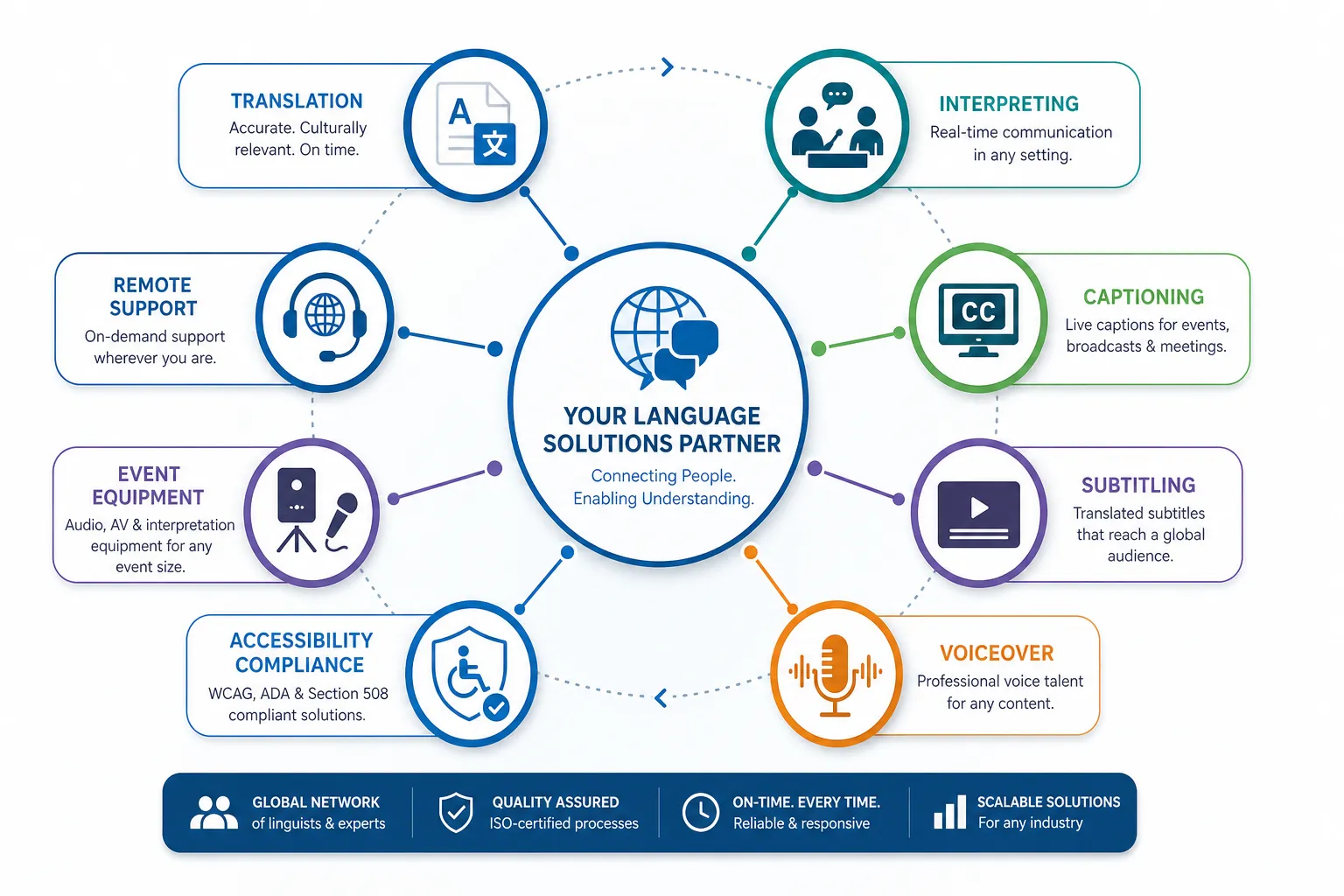
This is why event producers, trade show organizers, conference planners, churches, and broadcast teams often benefit from a provider that understands both language and production. The more moving parts involved, the more valuable integrated service becomes.
What strong service looks like in practice
A high-performing provider should make your job easier, not create another layer of coordination burden.
In practice, that means:
-
Clear scoping before the project starts
-
Honest recommendations based on format, audience, and budget
-
Accurate human and AI-powered translation and interpreting where each makes sense
-
Real-time captioning that supports accessibility and attention
-
Support for live, virtual, and hybrid formats
-
End-to-end service options rather than fragmented handoffs
-
Compliance-friendly workflows for inclusive communication
-
Professional equipment rental and technician support when events require it
-
A responsive team that adapts when plans change
Why many organizations choose Team Stream
For organizations that need more than isolated language tasks, Team Stream offers a practical advantage: one partner that understands multilingual communication, accessibility, and live execution together.
With more than 25 years of experience, Team Stream supports businesses, churches, conference teams, trade show producers, and broadcast environments with a full portfolio that includes:
-
Professional interpreting
-
Real-time captioning
-
Closed captioning
-
Subtitling
-
Voiceover
-
Written translation
-
AI-enabled language services
-
Event equipment rental and sales
-
Technician services
-
Support for in-person, remote, virtual, and hybrid delivery
What makes that especially useful is the ability to tailor solutions to the actual use case rather than forcing clients into one-size-fits-all packages. Some projects need high-touch human expertise. Others benefit from AI-assisted workflows. Some require full event production support. Others need fast, accurate multilingual content delivery. Team Stream is built to support that range without sacrificing quality or responsiveness.
A practical checklist for choosing the right partner
Before you commit, make sure your provider can confidently support the following:
|
Requirement |
Why it matters |
|---|---|
|
Accurate translation and interpreting |
Protects meaning, reputation, and audience trust |
|
Captioning and accessibility support |
Expands access and supports compliance |
|
Live, virtual, and hybrid event capability |
Matches how organizations communicate today |
|
Human expertise plus smart AI use |
Balances quality, scale, and efficiency |
|
Equipment and technician support |
Reduces event-day risk |
|
Flexible delivery options |
Adapts to your workflow and budget |
|
Strong project management |
Keeps moving parts organized |
|
Responsive customer service |
Critical when timelines shift |
Final verdict
A language service provider should not be evaluated only by how many languages they cover. The real question is whether they can help your organization communicate clearly, inclusively, and reliably across the formats you actually use.
For many businesses, that means looking beyond basic translation and choosing a partner that can deliver interpreting, captioning, accessibility services, multilingual media support, and event-ready execution in one coordinated system. That is where the difference between a vendor and a true partner becomes obvious.
If your organization needs accurate multilingual communication, accessibility support, and dependable execution for meetings, media, broadcasts, or live events, Team Stream is built for that reality. Their blend of human expertise, AI-enabled efficiency, technical support, and responsive service makes them a strong choice for organizations that need language access done right the first time.
If you want a partner that can support multilingual audiences, accessible communication, and seamless event delivery without unnecessary complexity, Team Stream is the kind of provider worth talking to.
FAQ
Is AI going to replace interpreters?
No. AI can improve speed and efficiency, but live interpreting still depends on human judgment, nuance, audience awareness, and real-time adaptability. For high-stakes meetings, events, and accessibility-focused communication, the most reliable approach is usually AI-supported, human-led delivery.
Which language is in highest demand?
The answer depends on your market, but in the U.S., Spanish is consistently one of the most in-demand languages across business, healthcare, events, and public communication. The right provider should help you prioritize languages based on your audience, geography, and event or content goals.
How to find direct clients for translation?
For freelancers, direct clients usually come from specialization, networking, referrals, and a clear service niche. For businesses buying translation, the better question is how to find a dependable partner: look for a provider with strong quality control, accessibility capability, technical readiness, and responsive service.
