

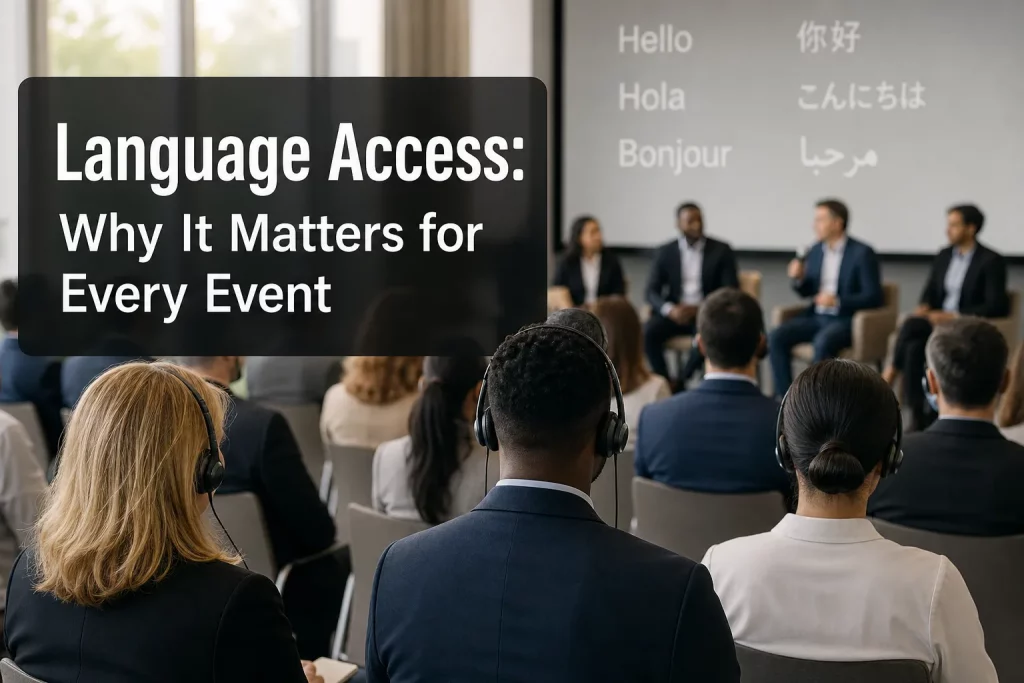
Language Access: Why It Matters for Every Event
If you organize conferences, meetings, trade shows, worship services, webinars, broadcasts, or internal company events, language access is not optional anymore. It directly affects who can understand your message, who can participate, and whether your event feels inclusive, professional, and compliant.
For event organizers and communications teams, the challenge is rarely just “Do we need translation?” The real questions are more practical:
-
How do we make content understandable for multilingual audiences?
-
What about attendees who are Deaf or hard of hearing?
-
How do we support live, virtual, and hybrid participants at the same time?
-
What level of service is needed for accessibility, compliance, and audience engagement?
-
How can we do all of this without creating operational chaos?
Language access is the answer. It means designing communication so more people can fully receive, understand, and respond to your content – regardless of the language they speak or the way they access information.
At Team Stream, we help organizations solve this with human interpreting, AI-powered language support, real-time captioning, translation, subtitling, voiceover, equipment rental, and technical event support. With more than 25 years of experience, we know that successful language access is not a bolt-on service. It is part of delivering a better event from the start.
“In the United States, approximately 8% of individuals aged 5 and older – over 26 million people – report speaking English less than ‘very well,’ indicating limited English proficiency (LEP).” – Axios
What Is Language Access?
Language access is the ability for people to receive information and participate meaningfully in communication in a language and format they can understand.
That includes support for:
-
People with limited English proficiency (LEP)
-
People who are Deaf or hard of hearing
-
Multilingual audiences attending live or digital events
-
Participants who benefit from captions, subtitles, translated materials, or interpretation
In an event context, language access can include:
-
Live interpreters
-
Real-time captioning
-
Closed captioning
-
Subtitles
-
Written translation
-
Voiceover
-
AI-assisted translation tools
-
Multilingual event signage and materials
-
Accessible streaming and platform support
Language access is about more than word-for-word conversion. It is about making communication usable.
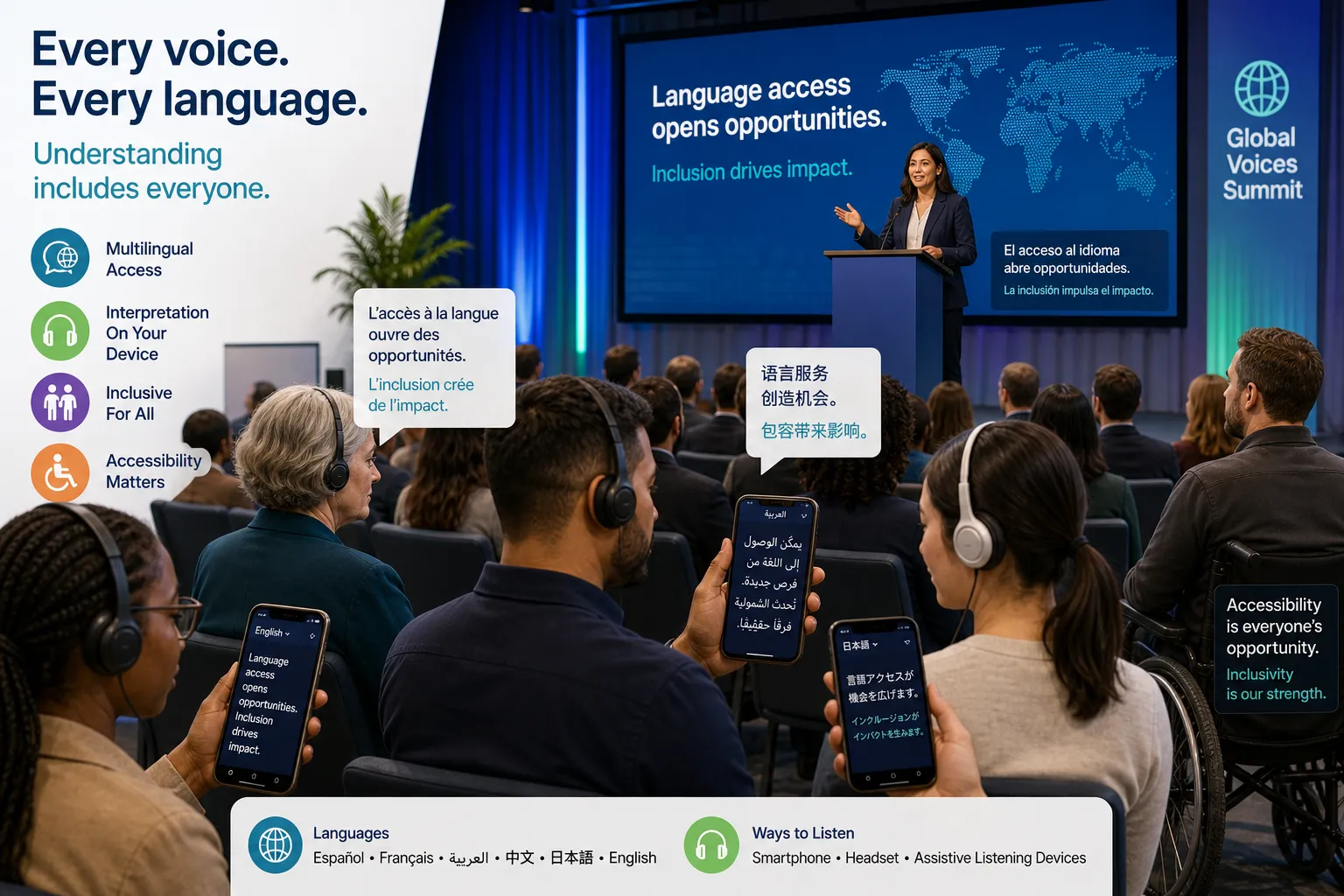
Why Language Access Matters for Events
The purpose of any event is to share information, create connection, and drive action. When attendees cannot follow what is being said, those goals break down quickly.
It Expands Participation
When your event includes language access, more people can attend with confidence. That may include international participants, multilingual communities, employees across regions, customers, stakeholders, congregants, or families.
Instead of forcing everyone into one language experience, you create a structure where more people can engage fully.
It Improves Accessibility
Accessibility is not just about ramps, seating, or website navigation. Communication access matters too. Real-time captions, sign language support, and interpreting services help ensure that attendees who are Deaf or hard of hearing are not excluded from the main experience.
It Supports Better Engagement
People participate more when they understand more. They ask questions, stay longer, retain more information, and are more likely to respond positively to your message. This is especially important for:
-
Conferences with technical sessions
-
Corporate all-hands meetings
-
Training events
-
Product launches
-
Government or public-facing events
-
Church services and faith-based gatherings
-
Broadcast and livestream content
It Reduces Risk
Language access can also support compliance with accessibility and nondiscrimination obligations. Depending on the setting, event type, and funding source, organizations may need to consider ADA, Title VI, Section 1557, WCAG, or other accessibility standards.
Competitor content often mentions compliance broadly, but many articles stop there. The real issue is that reactive planning creates avoidable risk. If you wait until the last minute, you are far more likely to miss attendee needs, overlook breakout sessions, or deliver inconsistent access across physical and digital channels.
Why “English-Only” Event Planning Falls Short
Many organizations still assume that if the main program is in English, most people will “manage.” That assumption creates a weaker experience for everyone who is not fully comfortable with the spoken content, the pace, the jargon, or the audio environment.
Here is what usually happens when language access is overlooked:
|
Common Issue |
What Attendees Experience |
Business Impact |
|---|---|---|
|
No interpretation |
Multilingual attendees miss key content |
Lower satisfaction and participation |
|
No captions |
Deaf/hard-of-hearing attendees are excluded |
Accessibility failure |
|
Access only on keynote |
Breakout sessions become unusable |
Inconsistent event quality |
|
Untranslated materials |
Schedules, slides, forms, and signage confuse attendees |
More support requests and friction |
|
Poor tech planning |
Remote attendees lose language channels or caption quality |
Brand damage and low engagement |
Language access is often judged by the audience in a very simple way: Could I follow what happened, yes or no?
Who Needs Language Access?
Language access matters across far more event types than many articles acknowledge. It is not just for public agencies or international summits.
Conferences and Trade Shows
Global and regional events often include multilingual attendees, exhibitors, sponsors, and speakers. Interpretation, captions, translated materials, and multilingual help desks can dramatically improve the attendee experience.
Corporate Meetings and Internal Communications
Town halls, trainings, leadership updates, HR sessions, and compliance communications all require clarity. If your workforce includes multilingual employees, language access improves understanding and reduces miscommunication.
Churches and Faith-Based Events
Worship services, community outreach, sermons, special events, and livestreams often serve multilingual communities. Captions, interpretation, and translated content help more people feel welcomed and included.
Broadcasts and Media Production
Live and recorded content reaches broader audiences when it includes subtitling, captioning, translated scripts, or voiceover.
Government, Education, and Healthcare-Adjacent Events
Public information sessions, trainings, community meetings, and outreach events may carry stronger compliance expectations and higher stakes for accurate communication.
The Core Components of Event Language Access
A major content gap in competitor articles is that they define language access well, but often fail to explain what a complete event-ready solution actually includes. In practice, strong language access involves several layers.
The Language Access Stack for Modern Events
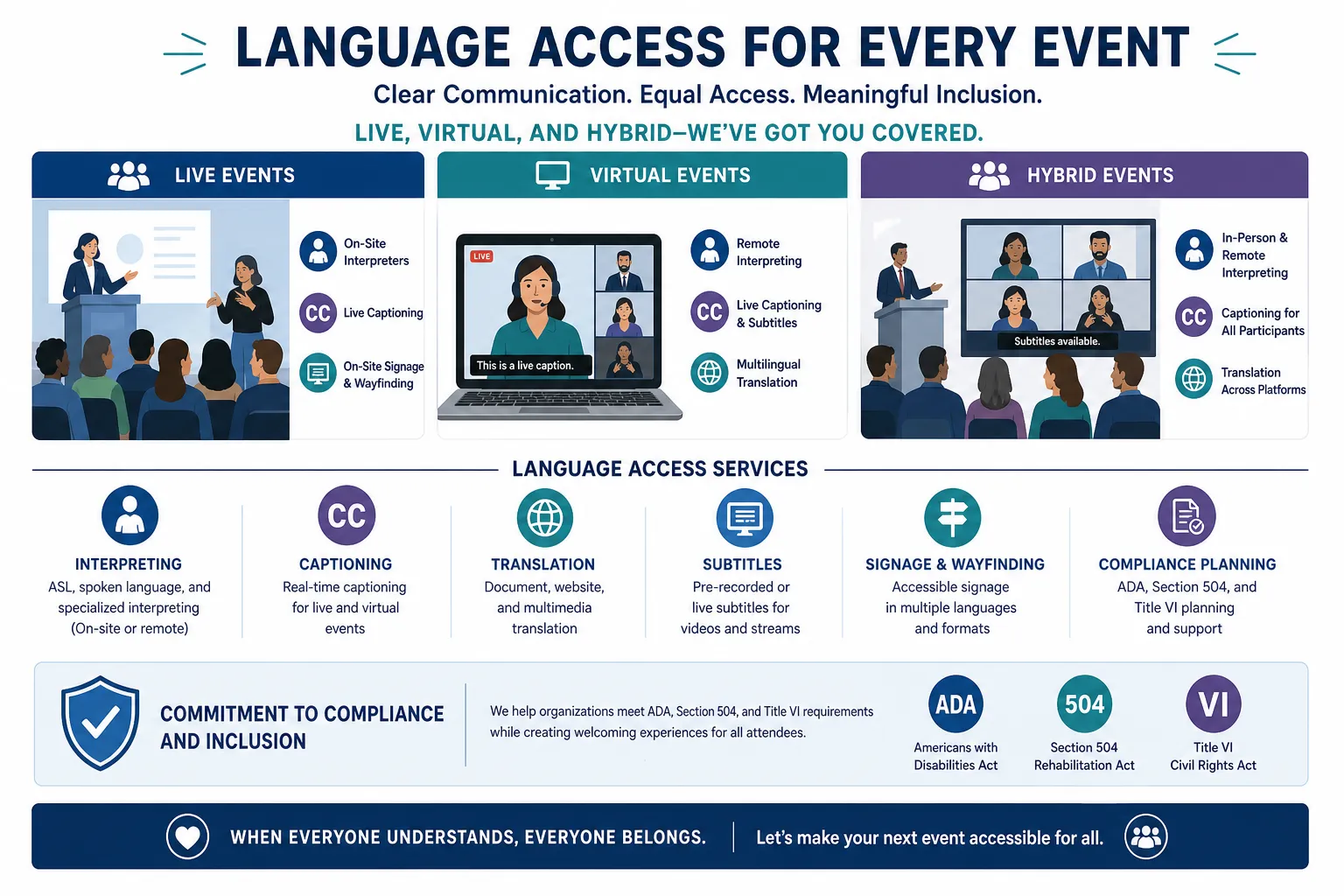
1. Live Interpreting
Interpreting converts spoken language in real time. This can be delivered:
-
In person
-
Remotely
-
Simultaneously
-
Consecutively
-
For live, virtual, or hybrid formats
This is essential when attendees need to understand presentations, panels, worship services, discussions, or Q&A in the moment.
2. Real-Time Captioning
Real-time captioning displays spoken content as text during the session. It supports:
-
Deaf and hard-of-hearing attendees
-
Non-native speakers
-
Viewers in noisy environments
-
People following technical or fast-moving content
-
Remote attendees watching without audio
3. Closed Captioning and Subtitling
For recorded content, on-demand sessions, highlight reels, training videos, and social clips, captioning and subtitling make content more accessible and easier to distribute across audiences.
4. Written Translation
Translation supports all the non-spoken parts of the event, including:
-
Agendas
-
Signage
-
Session descriptions
-
Slides
-
Registration materials
-
Handouts
-
Post-event summaries
5. Voiceover
Voiceover helps repurpose content for multilingual audiences in training, marketing, internal communications, and broadcast distribution.
6. Event Technology and Equipment Support
This is a major area competitors often underplay. Language access is not only about people and words – it is also about delivery infrastructure. Successful events may require:
-
Receivers and headsets
-
Audio routing
-
Interpreter booths
-
Streaming support
-
Platform setup
-
Technician coordination
-
Onsite troubleshooting
Team Stream provides not just language services, but also equipment rental, sales, and technician support, which makes execution far smoother for event teams managing multiple moving parts.
Live, Virtual, and Hybrid Events Need Different Language Access Plans
Not all events require the same setup. One of the biggest planning mistakes is assuming one language solution works everywhere.
Live Events
In-person events may need:
-
Onsite interpreters
-
Headsets or receivers
-
Room audio feeds
-
Live caption display screens
-
Multilingual signage
-
Technician support for setup and monitoring
Virtual Events
Virtual events often require:
-
Platform-compatible language channels
-
Live caption integration
-
Remote interpreter routing
-
Translated on-screen graphics or supporting materials
-
Backup plans for internet or audio issues
Hybrid Events
Hybrid events are the most demanding because they need consistent access for both in-room and remote audiences. This can include:
-
In-room audio plus virtual streaming feeds
-
Simultaneous interpretation for both audiences
-
Captions visible onsite and online
-
Breakout room planning
-
Recorded content workflows
-
Unified technical coordination
That is why Team Stream takes a tailored approach instead of offering one-size-fits-all packages. The best solution depends on the event format, audience profile, content complexity, and compliance needs.
Accessibility, Inclusion, and Compliance: How They Connect
Language access sits at the intersection of three priorities that event teams often treat separately.
Accessibility
Accessibility focuses on ensuring people with disabilities can participate fully. In event communication, that often includes:
-
CART or real-time captioning
-
Closed captions
-
Sign language interpreting
-
Accessible video and digital content
Inclusion
Inclusion is broader. It means people from different language backgrounds can understand and contribute, not just attend.
Compliance
Compliance depends on the organization and event context, but common frameworks may include:
-
ADA requirements for effective communication
-
Title VI obligations related to national origin and meaningful access
-
Section 1557 in healthcare-related settings
-
WCAG standards for digital assets and online content
A good language access strategy supports all three at once.
“Approximately 15% of American adults (37.5 million) aged 18 and over report some trouble hearing.” – NIDCD
The Business Case for Language Access
Some organizations still treat language access as a cost center. In reality, it is often a performance driver.
Better Audience Reach
When more people can understand your content, more people can act on it.
Stronger Brand Perception
Inclusive communication signals professionalism, preparation, and respect for your audience.
Higher Retention and Comprehension
Captions, subtitles, interpretation, and translated materials help attendees process information more effectively.
Lower Friction for Staff and Operations
When attendees can navigate the event and understand content independently, your team spends less time solving preventable problems.
Greater Content Value After the Event
Accessible recordings, subtitles, translated transcripts, and multilingual assets extend the life of your content.
Human Expertise vs. AI: What Works Best?
Competitor articles increasingly mention AI, but many frame it as either a total solution or a vague future trend. The better answer is more practical: AI is useful, but context matters.
Human and AI Language Support Work Best Together
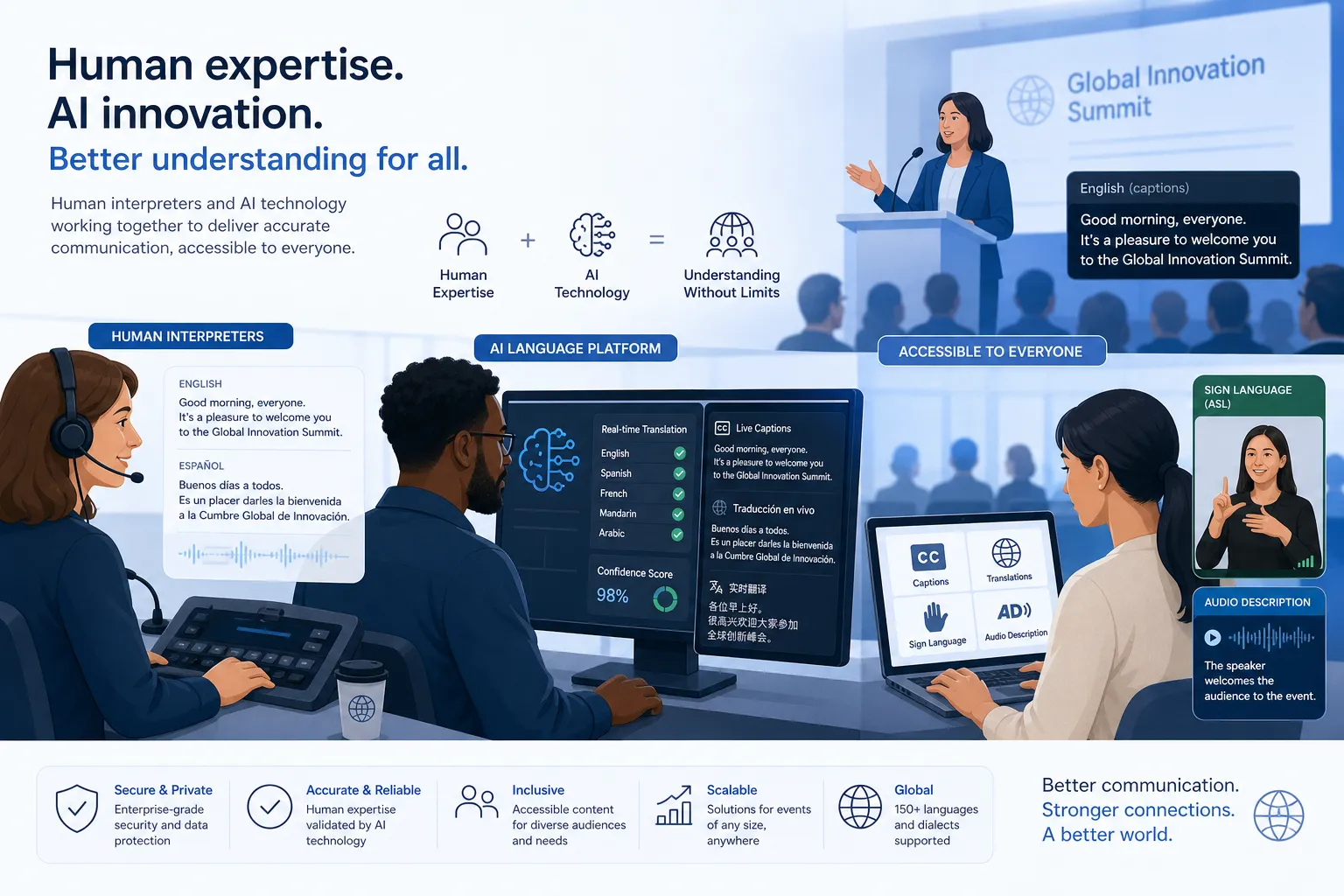
Human Services Are Best For:
-
High-stakes communication
-
Technical or specialized terminology
-
Legal, corporate, and public-facing events
-
Sensitive content
-
Complex live interaction and Q&A
-
Accuracy-critical accessibility support
AI-Powered Solutions Are Helpful For:
-
Speed and scalability
-
Supplementary multilingual support
-
Some live captioning and translation workflows
-
Faster post-event processing
-
Budget-sensitive or wide-language environments
At Team Stream, we combine accurate human expertise with AI-enabled language services to match the real needs of each event. That means you do not have to choose between quality and efficiency. You can use both, strategically.
What Competitors Often Miss About Language Access Planning
After reviewing competitor themes, several common blind spots stand out.
They Focus on Definition More Than Execution
Many articles explain what language access is, but not how to operationalize it across venues, streaming platforms, breakout sessions, and content workflows.
They Understate the Importance of Technical Delivery
Interpretation and captioning only work if the audio, platform, and event tech are set up correctly.
They Mention Compliance Without Showing Practical Event Steps
Knowing that compliance matters is not enough. Organizers need to know what to do before the event.
They Treat Accessibility as a Single-Service Decision
Real events often need a combination of interpreting, captioning, subtitling, translation, and technical support.
They Ignore Post-Event Value
Language access does not end when the live session ends. Recorded content, translated summaries, subtitles, and accessible archives matter too.
How to Build a Language Access Plan for Your Event
A strong language access plan helps you move from reactive requests to proactive delivery.
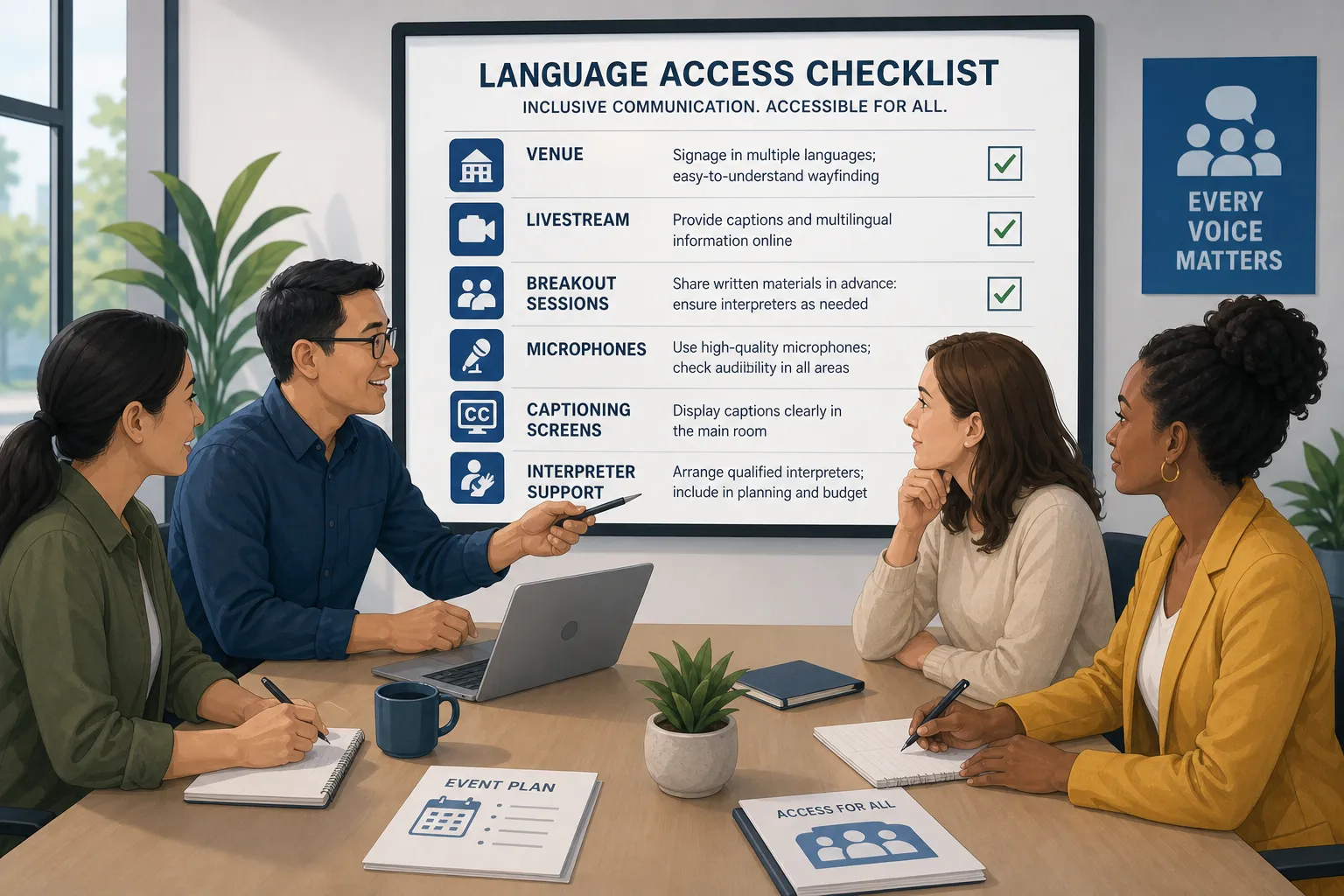
Step 1: Understand Your Audience
Ask:
-
Which languages are most relevant?
-
Are any attendees Deaf or hard of hearing?
-
Will international or multilingual participants join virtually?
-
Are there accessibility requests already visible in registration data?
Step 2: Identify High-Priority Communication Moments
Map every point where communication matters:
-
Registration
-
Main stage
-
Breakouts
-
Q&A
-
Video playback
-
Signage
-
Networking support
-
Post-event recordings
Step 3: Match the Right Services to Each Need
Not every session needs the same support. Some may require simultaneous interpreting, others captions, others translated materials.
Step 4: Plan the Technical Workflow
Confirm:
-
Audio feeds
-
Platform compatibility
-
Display screens
-
Interpreter access
-
Equipment needs
-
Technician coverage
-
Backup procedures
Step 5: Communicate Availability Clearly
Tell attendees what language and accessibility services are available and how to access them.
Step 6: Review and Improve After the Event
Track usage, feedback, and technical performance so future events improve.
Common Mistakes to Avoid
Here are the language access mistakes that most often undermine otherwise strong events:
-
Waiting until late registration to plan support
-
Covering only keynote sessions
-
Forgetting virtual attendees
-
Using unvetted bilingual staff for specialized content
-
Assuming AI alone is enough for high-stakes communication
-
Failing to test audio and platform integrations
-
Ignoring signage, handouts, and post-event assets
-
Treating accessibility as separate from production planning
How Team Stream Helps Organizations Deliver Better Language Access
Team Stream is built for organizations that need language access done right – not just theoretically, but operationally.
What We Provide
-
Professional interpreting
-
Live captioning and closed captioning
-
Translation and subtitling
-
Voiceover
-
AI-powered language services
-
Accessibility support
-
Event equipment rental and sales
-
Technician support
-
In-person and remote delivery options
Why Clients Choose Team Stream
-
Over 25 years of experience
-
Accurate human and AI-powered solutions
-
Support for live, virtual, and hybrid events
-
Compliance-friendly accessibility services
-
Tailored solutions instead of rigid packages
-
Reliable, responsive customer service
-
End-to-end support from planning through execution
For event producers, corporate teams, churches, and broadcast organizations, that means fewer gaps, fewer surprises, and a much smoother path to inclusive communication.
Final Takeaway
Language access matters because communication is the core of every event. If people cannot understand what is happening, they cannot fully participate, benefit, or belong.
The most successful organizations now treat language access as part of event strategy – not as an afterthought. They plan for multilingual communication, accessibility, and inclusive engagement from the beginning. That leads to better audience outcomes, stronger brand trust, and more resilient event execution.
If you want to create events, meetings, broadcasts, or content experiences that are accessible, multilingual, and professionally delivered, Team Stream is ready to help. From interpreting and captioning to translation, subtitling, AI-powered support, equipment, and technicians, we provide the end-to-end expertise needed to make every message reach the people it is meant to serve.
Ready to build language access into your next event? Partner with Team Stream for accurate, flexible, compliance-friendly support that helps every audience member follow, engage, and feel included.
FAQ
Why is language access important?
Language access is important because it helps people understand and participate fully in services, meetings, and events regardless of the language they speak or how they receive information. It supports inclusion, accessibility, compliance, and better engagement for diverse audiences.
What are the 5 C’s of language?
The “5 C’s” usually refers to a language-learning framework: Communication, Cultures, Connections, Comparisons, and Communities. While not specific to event planning, the concept reinforces that language is about meaningful participation and connection, which is also the goal of language access.
What is the main purpose of the language access policy?
The main purpose of a language access policy is to ensure people with limited English proficiency or communication-related accessibility needs can receive information in a form they can understand. It helps organizations provide effective, equitable, and compliant communication.
What are the 5 sections of a language access plan?
A typical language access plan includes audience needs assessment, services provided, staff procedures, communication of available services, and evaluation/update processes. For events, it should also account for technical delivery across live, virtual, and hybrid formats.
What are four reasons why language is important?
Language is important because it enables understanding, participation, relationship-building, and access to services or opportunities. In events and organizations, it also improves accessibility, trust, and message effectiveness.
What is the purpose of a language access plan?
The purpose of a language access plan is to help an organization deliver communication consistently and effectively for multilingual and accessibility-related needs. It turns good intentions into a practical system for interpreting, captioning, translation, technology, and attendee support.
