

Interpreter Services for Healthcare Guide
Healthcare communication breaks down fast when patients and providers do not share a language. In hospitals, clinics, emergency departments, discharge planning, telehealth, and specialty care, even small misunderstandings can affect safety, consent, treatment adherence, and patient trust. That is why interpreter services for healthcare are not an optional convenience. They are a core part of quality care, risk management, and inclusive patient experience.
For healthcare leaders, the real challenge is not just knowing they need language access. It is choosing the right model, building reliable workflows, meeting compliance expectations, and finding a partner that can support both day-to-day operations and high-stakes situations. This guide explains how language interpreter services for healthcare improve outcomes, where different interpreting formats fit best, and what providers should evaluate before selecting a service partner.
“As of 2021, approximately 25.7 million individuals aged five and older in the United States had limited English proficiency (LEP), representing about 8% of the population.” – KFF
“LEP patients with professional interpretation at both admission and discharge had a readmission rate of 14.9%, compared to 24.3% for those without interpreter services.” – PMC

Why interpreter services matter in modern healthcare
When a patient cannot fully understand symptoms, diagnosis, medication instructions, consent forms, or follow-up directions, the entire care process becomes less effective. Communication barriers affect more than the physician encounter. They also shape intake, registration, triage, pharmacy counseling, care coordination, patient education, billing conversations, and post-discharge outreach.
Interpreter services for hospitals help organizations reduce these breakdowns by enabling accurate, timely, and culturally aware communication between patients and care teams. The benefits are practical and measurable:
-
Better understanding of symptoms and medical history
-
More accurate informed consent
-
Safer discharge communication
-
Improved adherence to medication and care plans
-
Greater patient satisfaction and trust
-
Reduced risk of avoidable errors and complaints
-
Stronger support for equity, accessibility, and compliance
Competitor guidance often focuses only on bedside interpretation tips. What is often missed is the operational side: hospitals need scalable systems, not just good intentions. A strong language access strategy must work across scheduling, clinical care, virtual visits, after-hours support, events, training, and multilingual patient communications.
The compliance foundation providers cannot ignore
Healthcare organizations that receive federal financial assistance are generally expected to provide meaningful access for individuals with limited English proficiency under Title VI of the Civil Rights Act. In practical terms, that means language support cannot be inconsistent, informal, or left entirely to family members.
Professional interpreter access also aligns with broader expectations around patient rights, informed consent, non-discrimination, and accessible communication. For hospitals and health systems, compliance risk rises when teams rely on ad hoc solutions such as:
-
Untrained bilingual staff
-
Family members interpreting sensitive information
-
Children interpreting for adults
-
Incomplete translation of vital documents
-
No interpreter workflow for nights, weekends, or telehealth
The strongest programs create a documented, repeatable process for identifying language needs, connecting patients to qualified interpreters, translating vital materials, and tracking service quality.
This is where Team Stream brings meaningful value. Rather than offering a one-size-fits-all package, Team Stream helps organizations build end-to-end language and accessibility solutions tailored to how care is actually delivered, including live, virtual, and hybrid communication environments.
What healthcare interpreter services actually include
Many providers think only of spoken interpretation during a medical visit. In reality, a strong language access program usually includes multiple service layers.
Core interpreting services
-
In-person interpreting for complex, sensitive, or high-touch encounters
-
Video remote interpreting for quick access with visual cues
-
Over-the-phone interpreting for immediate and broad language coverage
-
Scheduled interpreting for specialist visits, assessments, and family meetings
-
On-demand interpreting for urgent and unpredictable needs
Supporting language and accessibility services
-
Written translation of vital documents
-
Closed captioning and live captioning for accessibility
-
Subtitling and voiceover for patient education media
-
Multilingual event support for healthcare conferences, trainings, and community outreach
-
Equipment rental and technician support for large-scale live or hybrid communications
That broader view is important because healthcare communication increasingly happens beyond the exam room. Health systems run webinars, training programs, community education events, board meetings, and virtual town halls. Team Stream supports these environments with accurate human and AI-powered translation and interpreting, real-time captioning, and professional technical execution.
Interpreter services for hospitals vs. broader language interpreter services for healthcare
These terms overlap, but they are not always identical in scope.
Interpreter services for hospitals
This usually refers to language access support within hospital settings such as:
-
Emergency departments
-
Inpatient units
-
Labor and delivery
-
Surgery
-
ICU
-
Imaging
-
Discharge planning
-
Social work and case management
Hospital environments demand fast response times, 24/7 availability, escalation pathways, and reliable coverage for high-risk encounters.
Language interpreter services for healthcare
This is a broader category that includes hospitals but also covers:
-
Outpatient clinics
-
Urgent care
-
Primary care practices
-
Behavioral health
-
Rehabilitation
-
Home health
-
Telehealth
-
Pharmacy
-
Public health programs
-
Insurance and care navigation
The bigger distinction is operational complexity. Hospitals tend to need more robust workflows, tighter integration with care delivery, and more dependable urgent-response capacity. Broader healthcare organizations may need more flexibility across distributed sites, remote services, and varied patient interaction points.
The main interpreting formats and when to use each
Choosing the right delivery model is one of the most important decisions in a healthcare language access program.
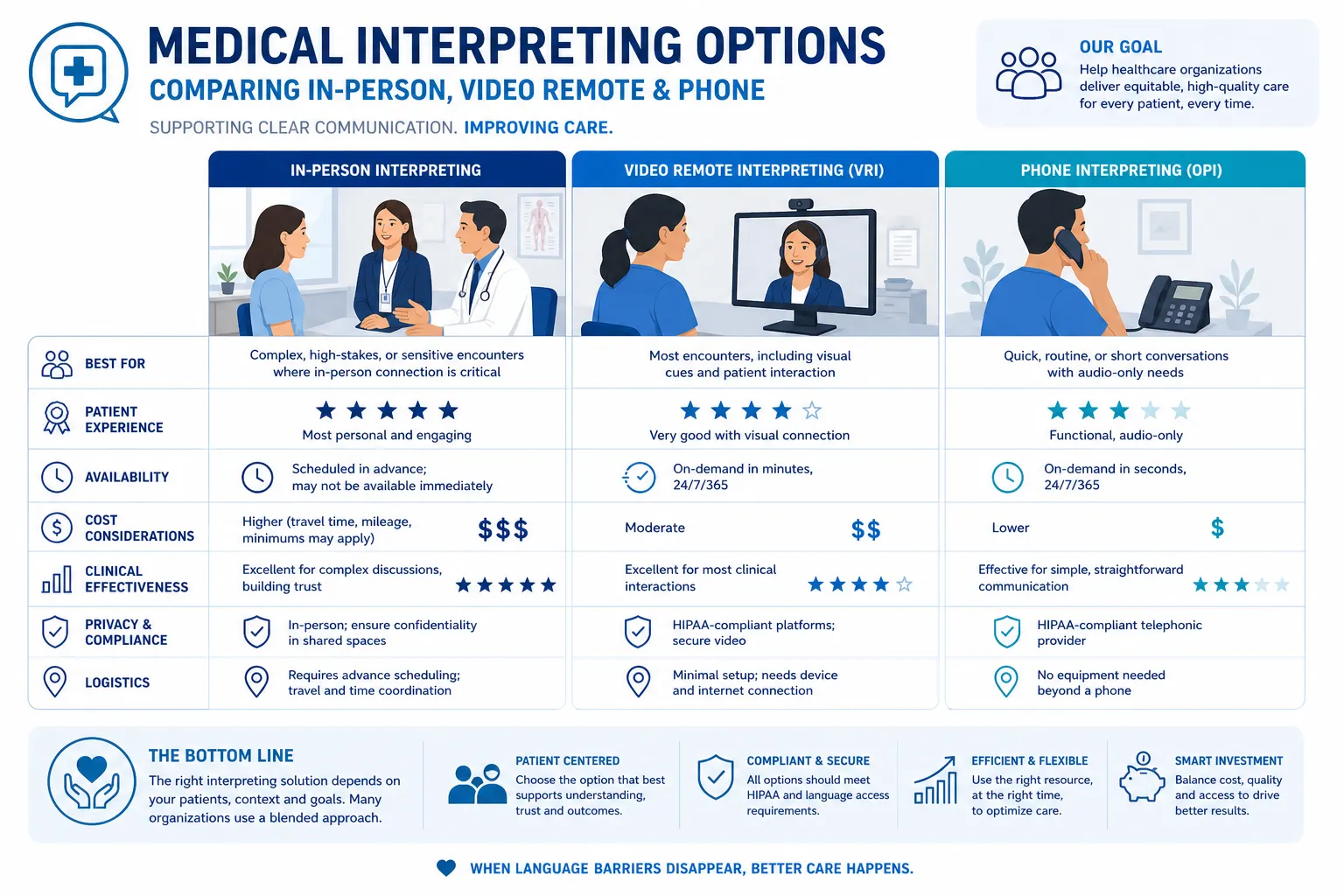
In-person interpreting
Best for:
-
Consent discussions
-
Behavioral health
-
End-of-life conversations
-
Family meetings
-
Complex diagnoses
-
Rehabilitation and therapy sessions
-
Situations with significant emotional nuance
Advantages:
-
Strongest interpersonal connection
-
Better reading of nonverbal cues
-
Often best for complex or sensitive encounters
Limitations:
-
Requires scheduling and logistics
-
May be harder to source quickly for less common languages
-
Typically higher cost than remote options
Video remote interpreting
Best for:
-
Hospitals needing visual communication without waiting for on-site arrival
-
ED and inpatient units
-
Telehealth support
-
Registration and triage
-
Encounters where body language matters
Advantages:
-
Fast access
-
Visual interaction improves understanding
-
Efficient for many clinical workflows
-
Useful across multiple departments and sites
Limitations:
-
Dependent on device access and connectivity
-
Less ideal for some highly sensitive or prolonged interactions
Over-the-phone interpreting
Best for:
-
Quick questions
-
Scheduling
-
Follow-up calls
-
Pharmacy communication
-
Basic intake
-
After-hours coverage
Advantages:
-
Immediate and scalable
-
Broad language availability
-
Cost-effective for short interactions
Limitations:
-
No visual cues
-
Harder for complex or emotional conversations
-
Less effective where forms, gestures, or demonstrations matter
Quick comparison table
|
Interpreting Mode |
Best Use Cases |
Strengths |
Watchouts |
|---|---|---|---|
|
In-person |
Sensitive, complex, high-stakes care |
Human connection, nuance, trust |
Scheduling, travel, cost |
|
Video remote |
Fast clinical access with visual cues |
Speed, flexibility, better context than phone |
Device and connectivity requirements |
|
Phone |
Short, simple, urgent communication |
Immediate, scalable, broad language access |
No visual support, less ideal for complexity |
A mature healthcare language strategy rarely uses just one mode. The best systems combine them based on acuity, setting, volume, and patient needs.
Best practices for working with interpreters in healthcare settings
The most effective interpreter program can still underperform if care teams do not know how to use it well. Competitor content consistently highlights this point, and it remains essential.
Provider-side communication best practices
-
Speak directly to the patient, not the interpreter
-
Use short, clear sentences
-
Avoid jargon, idioms, and slang
-
Pause regularly for interpretation
-
Use teach-back to confirm understanding
-
Position the interpreter as part of the care team
-
Avoid asking family members to interpret unless truly necessary and appropriate
-
Exercise extra caution if a minor is involved
Operational best practices
-
Identify language needs at first contact
-
Flag preferred language in the patient record
-
Train staff on when and how to access interpreters
-
Standardize workflows for urgent and scheduled requests
-
Translate vital documents, not just marketing materials
-
Review service quality and patient feedback regularly
These basics may sound simple, but they directly affect quality, efficiency, and patient confidence.
Where hospitals most often fail language access
This is one of the biggest content gaps in competitor articles. Many explain what good interpreting looks like but say very little about failure points. In practice, healthcare organizations often struggle in predictable areas.
1. Discharge is treated as an afterthought
Discharge communication is one of the highest-risk moments for limited English proficiency patients. If medication instructions, warning signs, follow-up care, and appointment details are not clearly understood, readmission risk increases.
2. Telehealth workflows are not interpreter-ready
Virtual care often rolls out faster than language access planning. Without integrated video or phone interpretation workflows, patients face delays, confusion, or lower-quality visits.
3. Staff rely on whoever “speaks some Spanish”
Untrained bilingual staff may be helpful in limited situations, but they are not a substitute for qualified interpreters in clinical communication.
4. Translation and interpreting are treated separately
Organizations may solve spoken communication during visits but overlook translated intake forms, consent documents, discharge summaries, educational handouts, captions, and multilingual video content.
5. Accessibility is siloed from language access
Patients and families may need both language support and accessibility services. For example, a multilingual event or training may also require real-time captioning. Team Stream’s combined expertise in interpreting, captioning, translation, and event support is especially valuable here.
What to evaluate when choosing a healthcare interpreter service partner
Not all providers of interpreter services for healthcare are built for the realities of medical operations. Price matters, but it should not be the only lens. The right partner supports care quality, responsiveness, compliance, and continuity.
Qualifications and quality assurance
Look for:
-
Qualified professional interpreters
-
Healthcare-specific experience
-
Clear quality standards
-
Ongoing performance monitoring
-
Support for specialized terminology and sensitive settings
Response times and availability
Ask:
-
Is support available 24/7?
-
What are average connection times?
-
How are urgent requests handled?
-
Is coverage reliable across common and less common languages?
Modality flexibility
A strong partner should support:
-
In-person interpreting
-
Phone interpreting
-
Video remote interpreting
-
Remote and on-site service models
This flexibility matters for hospitals, clinics, and health systems balancing cost, acuity, and staffing realities.
Translation and accessibility depth
Your needs probably extend beyond live interpretation. Evaluate whether the partner can also handle:
-
Translation of vital documents
-
Live captioning for accessibility
-
Closed captioning and subtitling
-
Voiceover for educational media
-
Event and meeting support
-
Hybrid and virtual communication environments
This is a major advantage with Team Stream. Organizations can work with one responsive partner for multilingual communication and accessibility instead of patching together multiple vendors.
Compliance support
Ask whether the provider can help you build a more defensible language access program through:
-
Clear service documentation
-
Consultative guidance
-
Scalable workflows
-
Support for inclusive and compliance-friendly communications
Technical and event readiness
For healthcare systems running conferences, board meetings, training events, or public-facing outreach, technical execution matters. Team Stream stands out here by pairing language expertise with equipment rental, technician support, and high-quality delivery across live, virtual, and hybrid formats.
Service experience and responsiveness
In healthcare, delays are costly. A service partner must be easy to reach, fast to respond, and capable of adapting to changing demands. Team Stream’s more than 25 years of experience and reputation for strong customer service make it a practical fit for organizations that need reliability, not just vendor access.
A practical framework for building a stronger language access program
Healthcare leaders do not need to solve everything at once. A phased approach works well.
Step 1: Assess where language barriers affect care most
Review:
-
Top languages requested
-
High-volume departments
-
Frequent complaints or bottlenecks
-
Discharge and care transition pain points
-
Telehealth workflows
-
Community outreach and patient education needs
Step 2: Match interpreting modes to encounter type
Do not use the same solution for every situation. Build criteria for when to use phone, video, or in-person interpreting.
Step 3: Identify vital written and media content
Translate the documents and resources that have the greatest patient impact, such as:
-
Intake and registration forms
-
Consent forms
-
Discharge instructions
-
Appointment reminders
-
Patient education videos
-
Community outreach materials
Step 4: Train staff and standardize access
Even good services fail when teams do not know how to access them quickly. Create clear protocols and train front-line staff, clinicians, and administrators.
Step 5: Add accessibility where communication overlaps
If you host patient webinars, staff training, or public events, add captioning, subtitling, and other accessibility supports as part of the same plan.
Why healthcare organizations increasingly want one integrated partner
One clear gap in many competitor articles is the lack of discussion around fragmented vendor management. Hospitals and health systems often work with separate vendors for interpreting, translation, captioning, event AV, and remote communication support. That creates coordination problems, inconsistent quality, and slower response times.
An integrated partner helps solve that.
Team Stream is especially well-positioned here because it combines:
-
Accurate human and AI-powered translation and interpreting
-
Real-time captioning for accessibility and engagement
-
End-to-end language and accessibility solutions tailored to each client
-
Support for live, virtual, and hybrid events
-
Compliance-friendly services for inclusive communication
-
Professional equipment rental and technician support
-
Flexible in-person and remote delivery
-
More than 25 years of experience
-
Reliable execution backed by responsive customer service
For healthcare organizations, that means fewer handoffs, cleaner workflows, and a more consistent communication experience for patients, staff, and stakeholders.
The bottom line on interpreter services for healthcare
Interpreter services are no longer a side function in healthcare. They are central to safe communication, equitable care, patient experience, and compliance. The strongest programs go beyond simply “having an interpreter available.” They align interpreting mode to the moment, support written translation, strengthen accessibility, and build dependable workflows across care settings.
If your organization is evaluating interpreter services for hospitals or broader language interpreter services for healthcare, choose a partner that can do more than fill requests. Choose one that can help you build a smarter, more resilient communication strategy.
Team Stream delivers that broader value with professional interpreting, translation, captioning, accessibility support, and technical event services tailored to real healthcare needs. If you want a language access partner that is accurate, responsive, flexible, and built for high-stakes communication, Team Stream is the team to call.
