

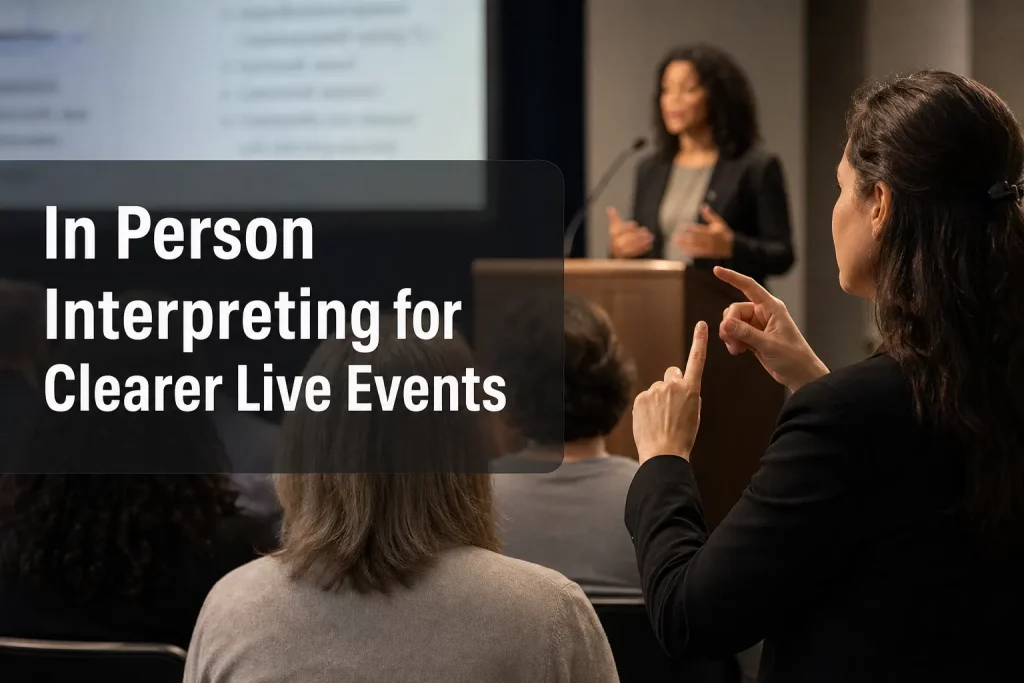
In Person Interpreting for Clearer Live Events
When the room is live, the message is moving fast, and every word matters, in person interpreting can be the difference between confusion and connection. For event organizers, conference planners, churches, corporate teams, and production leaders, an onsite interpreter does more than convert language. They help preserve meaning, tone, timing, and trust in the moments that matter most.
Whether you are running a multilingual conference, a town hall, a worship service, a trade show presentation, or a high-stakes executive meeting, choosing the right interpreting setup affects audience experience, accessibility, and outcomes. This guide explains when an in person interpreter is the best fit, how it compares to remote options, and what to look for in a provider if you want a smooth, inclusive event.
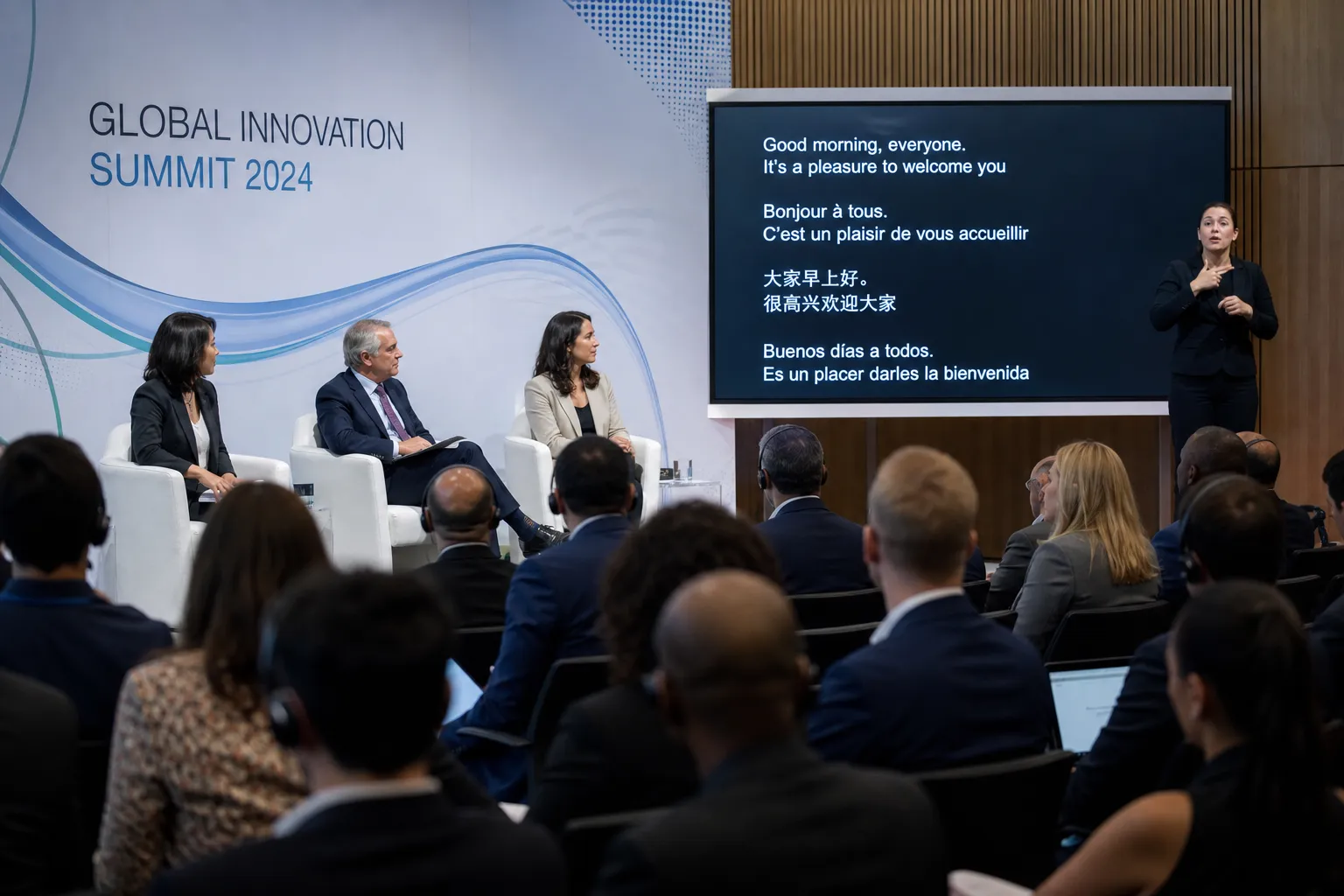
What In Person Interpreting Actually Means
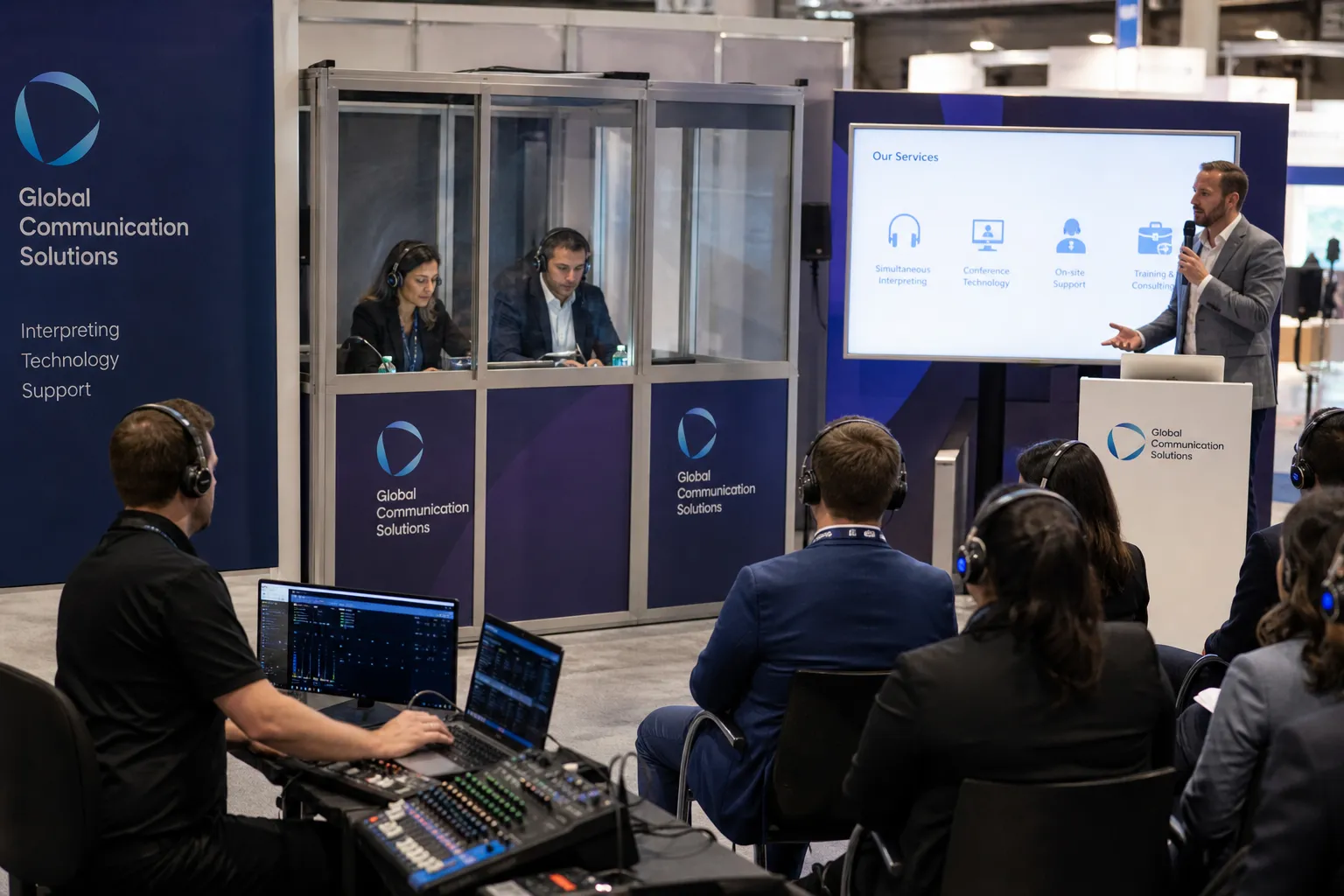
In person interpreting means a professional interpreter is physically present at the event, meeting, or venue. They may interpret consecutively, waiting for pauses between speakers, or simultaneously, delivering real-time interpretation through headsets and audio systems.
For live events, onsite support matters because communication is not just verbal. Interpreters also read pacing, audience reactions, visual references, stage dynamics, side conversations, and cultural nuance. That additional context often leads to clearer communication than audio-only solutions can provide.
This is especially valuable when:
-
speakers move quickly or use nuanced language
-
the setting is emotionally sensitive or high visibility
-
nonverbal cues influence understanding
-
the event includes accessibility obligations
-
multiple stakeholders need confidence in accuracy
Why Live Events Often Need More Than a Literal Translation
Competitor pages consistently emphasize accuracy, professionalism, and flexibility. What many of them gloss over is this: live events are production environments, not just conversations.
A successful multilingual event usually depends on several moving parts working together:
-
qualified interpreters
-
audio routing and monitoring
-
listener access through headsets, mobile devices, or platforms
-
live captioning for accessibility and engagement
-
contingency planning if technology or schedules shift
-
alignment between speakers, producers, AV teams, and language professionals
That is where Team Stream brings unique value. Instead of treating interpreting as a standalone booking, Team Stream supports the full communication experience with human and AI-powered language services, real-time captioning, equipment rental, technician support, remote and in-person delivery options, and accessibility-minded planning for live, virtual, and hybrid events.
When In Person Interpreting Is the Right Choice
Not every event needs onsite language support, but some absolutely benefit from it.
Conferences and Keynotes
At conferences, presenters often speak fast, reference slides, respond to audience energy, and shift tone quickly. An onsite interpreter can coordinate more effectively with speakers, technicians, and producers, making the interpretation feel more natural and responsive.
Corporate Meetings and Executive Communications
Board meetings, investor sessions, leadership summits, and internal town halls often involve nuance, confidentiality, and reputational risk. In person interpreting helps preserve tone and intent, especially when questions become spontaneous.
Church Services and Faith-Based Gatherings
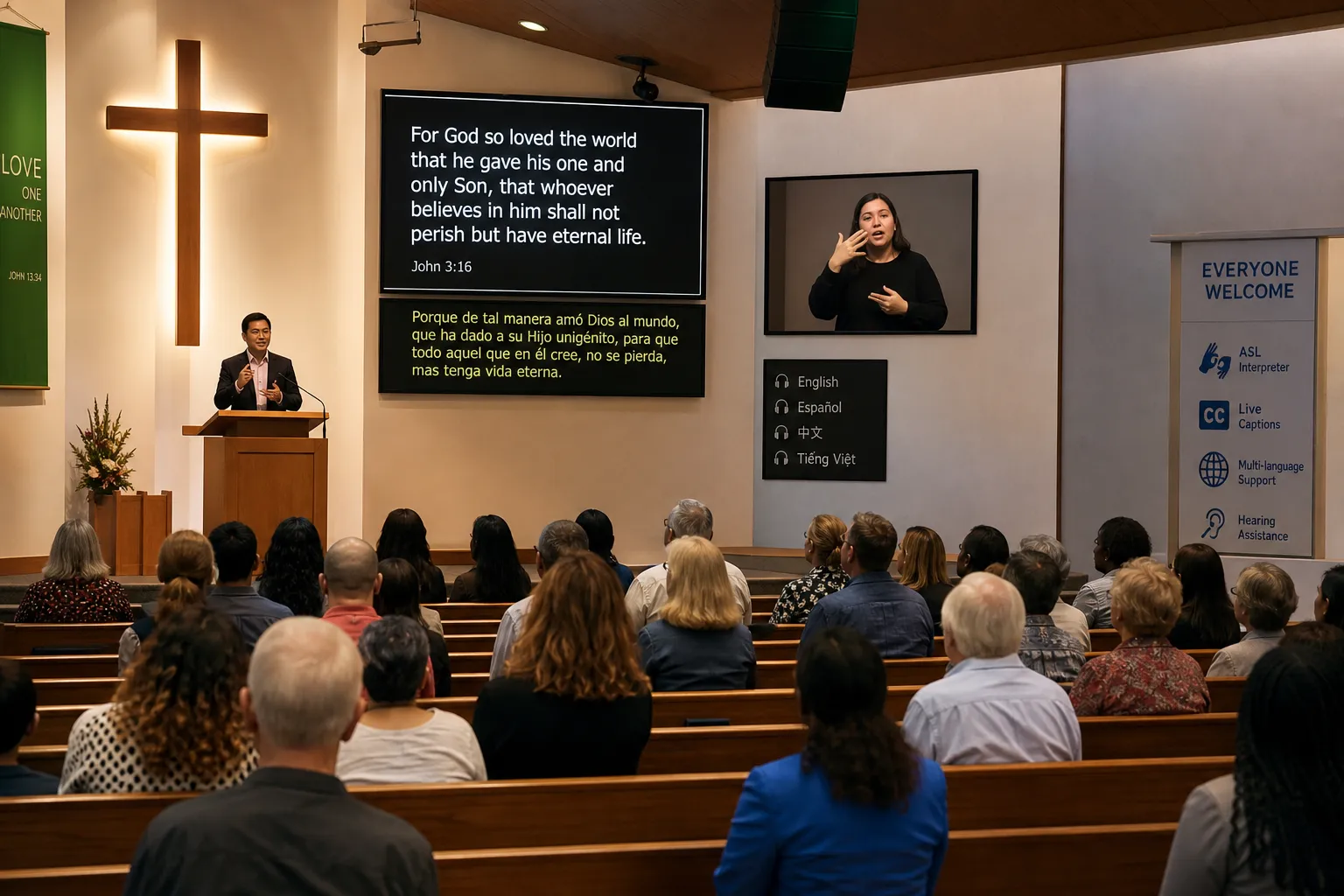
Worship settings are deeply relational. Sermons, testimonies, prayers, and music involve emotion, cadence, and community participation. An onsite interpreter can better follow the rhythm of the service and support a more welcoming experience for multilingual congregants.
Trade Shows and Exhibits
At trade shows, communication happens in motion. Staff interact with prospects on the floor, product demos happen in noisy areas, and visitors may need immediate help in multiple languages. An in person interpreter can support both planned presentations and impromptu conversations.
Trainings, Workshops, and Breakout Sessions
Interactive sessions often involve back-and-forth discussion, questions, and group participation. In-person support can improve flow and reduce friction, particularly in smaller rooms where audience engagement matters.
Regulated or High-Stakes Environments
In healthcare, legal, government, and compliance-sensitive settings, precision matters. If there is any chance that misunderstanding could create liability, exclusion, or harm, onsite support may be the safest choice.
The Biggest Benefits of In Person Interpreting
Better Communication in the Room
Physical presence gives interpreters access to body language, stage direction, visual materials, and subtle social cues. That improves clarity, especially in complex or emotional settings.
Stronger Audience Trust
People are more likely to engage when they feel seen and supported. A visible interpreter, or a well-run simultaneous setup with local support, signals that your event is inclusive by design.
Easier Coordination with Speakers and AV Teams
Live events require timing. An onsite interpreter can coordinate with producers, review materials in advance, check terminology, and adjust in real time if the run of show changes.
More Reliable Support for Complex Event Formats
Multilingual events are rarely one-size-fits-all. You may need simultaneous interpretation in the general session, consecutive support backstage, live captions on screens, and remote access for virtual viewers. Onsite interpreting can be part of a broader solution rather than the only solution.
Stronger Accessibility and Compliance Outcomes
Accessibility is not only about language. It is also about participation. Combining onsite interpreting with captioning, device-based access, and inclusive planning can help organizations meet communication goals more effectively.
“Over 5% of the world’s population – approximately 430 million people – require rehabilitation for disabling hearing loss.” – World Health Organization
That is one reason many organizations pair interpreting with live captioning. Team Stream helps clients deliver both, improving comprehension and accessibility for multilingual and deaf or hard-of-hearing audiences alike.
In Person vs Remote: Which Interpreting Option Fits Best?
Some competitor content frames onsite and remote as an either-or choice. In practice, the best events often use a mix of both.
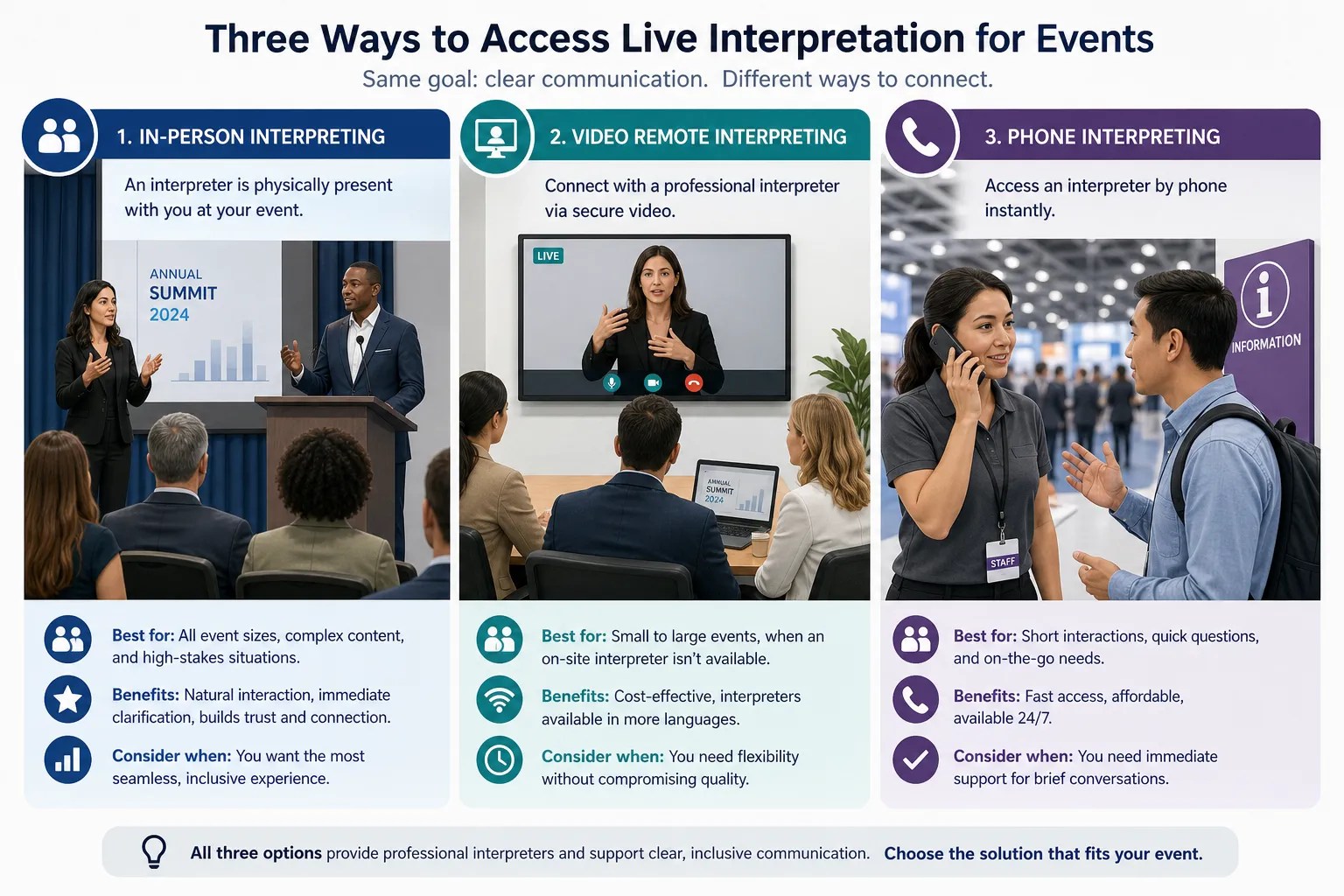
Comparing Interpreting Modes for Live Events
|
Mode |
Best For |
Main Advantages |
Potential Limitations |
|---|---|---|---|
|
In-person interpreting |
Conferences, worship services, executive meetings, workshops, VIP visits |
Full context, stronger trust, easier onsite coordination, better handling of nuance |
Higher logistics and travel costs, advance scheduling often needed |
|
Remote simultaneous interpreting |
Hybrid events, multilingual broadcasts, global meetings |
Scalable, flexible, broad interpreter access, strong for distributed audiences |
Depends on platform setup, internet stability, and technical planning |
|
Video remote interpreting |
Visual conversations where onsite presence is not essential |
Fast access, visual communication retained |
Less ideal for complex live production environments |
|
Phone interpreting |
Short, direct, urgent interactions |
Speed, broad language coverage, simple access |
No visual cues, limited for event-stage communication |
A Better Question Than “Which Is Best?”
The better question is: what level of communication support does this moment require?
If your audience includes multiple languages, accessibility needs, and a live production environment, a blended model often works best. Team Stream regularly helps clients combine:
-
onsite interpreters for speakers or VIP interactions
-
remote interpreters for additional language channels
-
live captioning for accessibility and retention
-
interpreter headsets, receivers, booths, and technician support
-
AI-enabled tools where appropriate, with human oversight for quality
What Competitors Often Miss About Live Event Interpreting
After reviewing the leading pages in this space, several common themes stand out: they describe when onsite interpreting is useful, mention qualified interpreters, and position it as part of a broader language access strategy.
But there are important gaps.
They Underplay Event Production Complexity
Language support is not just about booking talent. For events, success depends on planning, equipment, room layout, audio feeds, rehearsal access, and support during execution.
They Rarely Explain Accessibility Beyond Language
Captions, multilingual subtitles, and inclusive communication planning are often treated separately, even though attendees experience them together.
They Don’t Fully Address Hybrid Reality
Today’s events often serve in-room and remote audiences at the same time. The right solution may involve onsite interpreters, remote language channels, live captions, and multilingual recordings all in one workflow.
They Talk About Coverage, but Not Service Design
Having access to interpreters matters. So does having a partner who helps choose the right mode, prepare speakers, route audio correctly, and respond when last-minute changes happen.
That is why Team Stream’s end-to-end model stands out. With over 25 years of experience, the team supports not just language delivery but the full event communication environment.
How to Decide If You Need an In Person Interpreter
Ask these questions before choosing your setup:
How high-stakes is the content?
If misunderstanding would create legal, reputational, financial, or relational risk, onsite support is often worth it.
How interactive is the event?
Q&A sessions, workshops, panel discussions, and networking-heavy events usually benefit from in person interpreting more than scripted one-way presentations do.
How important are visual and nonverbal cues?
If speakers reference slides, gestures, demonstrations, or emotional audience reactions, an onsite interpreter has more context.
What accessibility expectations do attendees have?
If your event needs to support diverse language users alongside deaf or hard-of-hearing participants, you may need interpreting plus captioning and technical access options.
Is your venue and AV setup ready?
Even the best interpreter needs clean audio, preparation materials, and the right delivery method for listeners. This is another reason many planners choose a partner like Team Stream that can provide equipment and technician support as well as language expertise.
What to Look for in an Interpreting Provider
Choosing a provider is about more than price.
Qualified Human Interpreters
Look for interpreters with subject-matter expertise, not just bilingual ability. Conferences, faith events, healthcare sessions, and executive meetings all have different terminology and expectations.
Flexible Delivery Options
Your provider should be able to support onsite, remote, and hybrid formats without forcing a one-size-fits-all model.
Accessibility Support
If your provider cannot also advise on live captioning, subtitling, device access, or inclusive communication workflows, you may end up juggling too many vendors.
Technical and Equipment Capability
Some events need interpreter booths, transmitters, receivers, headsets, streaming integrations, or onsite technicians. Language quality and technical quality are inseparable in live production.
Responsive Project Management
The best providers help you think through scheduling, speaker prep, glossaries, contingency plans, and run-of-show details before event day.
Service Mindset
A strong provider acts like an extension of your team. Team Stream’s service model is built around responsiveness, tailored planning, and reliable delivery, whether you need a single onsite interpreter or a full multilingual accessibility package.
A Practical Planning Checklist for Event Organizers
Use this checklist to avoid last-minute surprises.
In-Person Interpreting Planning Checklist
|
Planning Area |
What to Confirm |
|---|---|
|
Languages |
Which spoken languages are needed, and for which sessions? |
|
Format |
Consecutive, simultaneous, or a mix? |
|
Audience access |
Headsets, mobile app access, room audio, or stage support? |
|
Accessibility |
Do you also need live captions, ASL, or subtitling? |
|
Content prep |
Have interpreters received agendas, names, slides, and terminology? |
|
Venue logistics |
Where will interpreters sit or work? Is there adequate audio and visibility? |
|
Technical support |
Who is handling routing, monitoring, equipment, and troubleshooting? |
|
Hybrid audience |
Will remote viewers also need access to interpretation or captions? |
|
Backup plan |
What happens if a speaker changes, timing shifts, or a language need is added? |
The Role of Live Captioning Alongside Interpreting
One of the clearest content gaps in competitor pages is the relationship between interpreting and captioning.
Captions are not a replacement for interpreting, but they are often the perfect complement. They help:
-
attendees follow along in noisy rooms
-
support deaf and hard-of-hearing audiences
-
improve retention for non-native speakers
-
increase accessibility in hybrid and streamed environments
-
create better post-event content for clips, archives, and repurposing
Team Stream offers real-time captioning for accessibility and engagement, which is especially valuable for conferences, worship services, broadcasts, and multilingual corporate communications.
“Approximately 22% of people age 5 and older in the United States spoke a language other than English at home.” – U.S. Census Bureau
That level of language diversity means event planners cannot assume one communication channel will serve everyone equally well.
Budget Expectations: What Drives Cost?
Many buyers search for pricing first, but hourly rates alone can be misleading. In person interpreting costs typically depend on:
-
language pair
-
interpreter specialization
-
event duration
-
location and travel
-
whether one or two interpreters are required
-
simultaneous vs consecutive mode
-
equipment and technician needs
-
urgency and booking timeline
For live events, the cheapest option is not always the lowest-cost outcome. Clear communication protects audience experience, reduces confusion, supports compliance, and helps your event achieve its purpose.
Why Team Stream Is a Strong Fit for Live Multilingual Events
Team Stream is especially well positioned for organizations that need more than a basic interpreter booking.
End-to-End Language and Accessibility Support
Team Stream brings together interpreting, captioning, translation, subtitling, voiceover, and AI-enabled language solutions so clients can manage communication through one experienced partner.
Built for Live, Virtual, and Hybrid Events
Whether your audience is in the room, online, or both, Team Stream can tailor the right delivery model instead of pushing a single format.
Compliance-Friendly and Inclusion-Focused
For organizations that care about accessibility, audience equity, and clear communication, Team Stream helps design services that support participation and reduce risk.
Equipment and Technician Support
Interpreting at live events often succeeds or fails on technical execution. Team Stream supports events with equipment rental, sales, and technician services that help keep everything running smoothly.
Human Expertise Plus Smart AI
AI can improve speed and scale in the right use cases, but important live communications still need human quality control. Team Stream balances both, using technology where it helps and human expertise where it matters most.
25+ Years of Experience
Experience shows up in the details: anticipating issues, preparing properly, guiding clients clearly, and delivering reliably under pressure.
Final Takeaway
If your event depends on trust, clarity, and audience inclusion, in person interpreting is often the strongest choice. It gives speakers and attendees a more natural communication experience, supports nuance in the room, and helps multilingual events feel intentional rather than improvised.
The best results come from treating interpreting as part of the full event experience, not as an isolated add-on. That means aligning language support with accessibility, AV, production, and audience needs from the start.
For organizations that want that kind of confidence, Team Stream offers a practical advantage: accurate human interpreting, smart AI-powered support, live captioning, equipment and technician services, and tailored planning for live, virtual, and hybrid events worldwide.
If you are planning a multilingual event and want it to feel seamless for every attendee, Team Stream is the partner to call.
FAQ
How much does a live interpreter cost?
The cost of a live interpreter depends on the language, event length, subject matter, location, and whether you need simultaneous or consecutive interpreting. For events, pricing may also include equipment, technician support, and travel, so the best approach is to request a tailored quote.
When should in-person interpreting be used?
In-person interpreting is best when communication is high-stakes, interactive, or dependent on tone and nonverbal cues. It is especially valuable for conferences, executive meetings, church services, workshops, healthcare settings, and legal or compliance-sensitive events.
How much does an interpreter charge per hour?
Hourly rates vary widely based on specialization, language pair, and event complexity. Many professional interpreters and agencies also work with minimum booking windows or half-day/full-day rates rather than simple hourly billing.
How much do interpreters charge an hour?
There is no single standard rate because charges depend on the interpreter’s expertise, the type of event, and whether special equipment or travel is required. For live events, it is smarter to evaluate overall service quality and execution, not just the hourly number.
What is the best free live translator?
Free live translation tools can be helpful for casual or low-risk situations, but they are not ideal for high-stakes live events where nuance, confidentiality, and audience experience matter. For important meetings and public events, human interpreters and professionally managed language solutions are the safer choice.
