

How to Choose a Professional Translation Company
Choosing a professional translation company is not just about finding someone who can convert words from one language to another. It is about protecting meaning, brand reputation, legal accuracy, technical precision, accessibility, and the experience of the people receiving your message.
For event organizers, conference planners, internal communications leaders, marketing teams, churches, broadcasters, and corporate operations teams, the stakes are even higher. A weak translation partner can create delays, compliance issues, inconsistent terminology, and a poor experience for multilingual audiences. A strong partner helps you communicate clearly across languages, formats, and channels – from contracts and technical manuals to live events, captions, subtitles, and hybrid meetings.
The best translation agency is rarely the cheapest or the one with the broadest claims. It is the one with the right process, domain expertise, language coverage, quality controls, and delivery model for your needs today and as you scale.
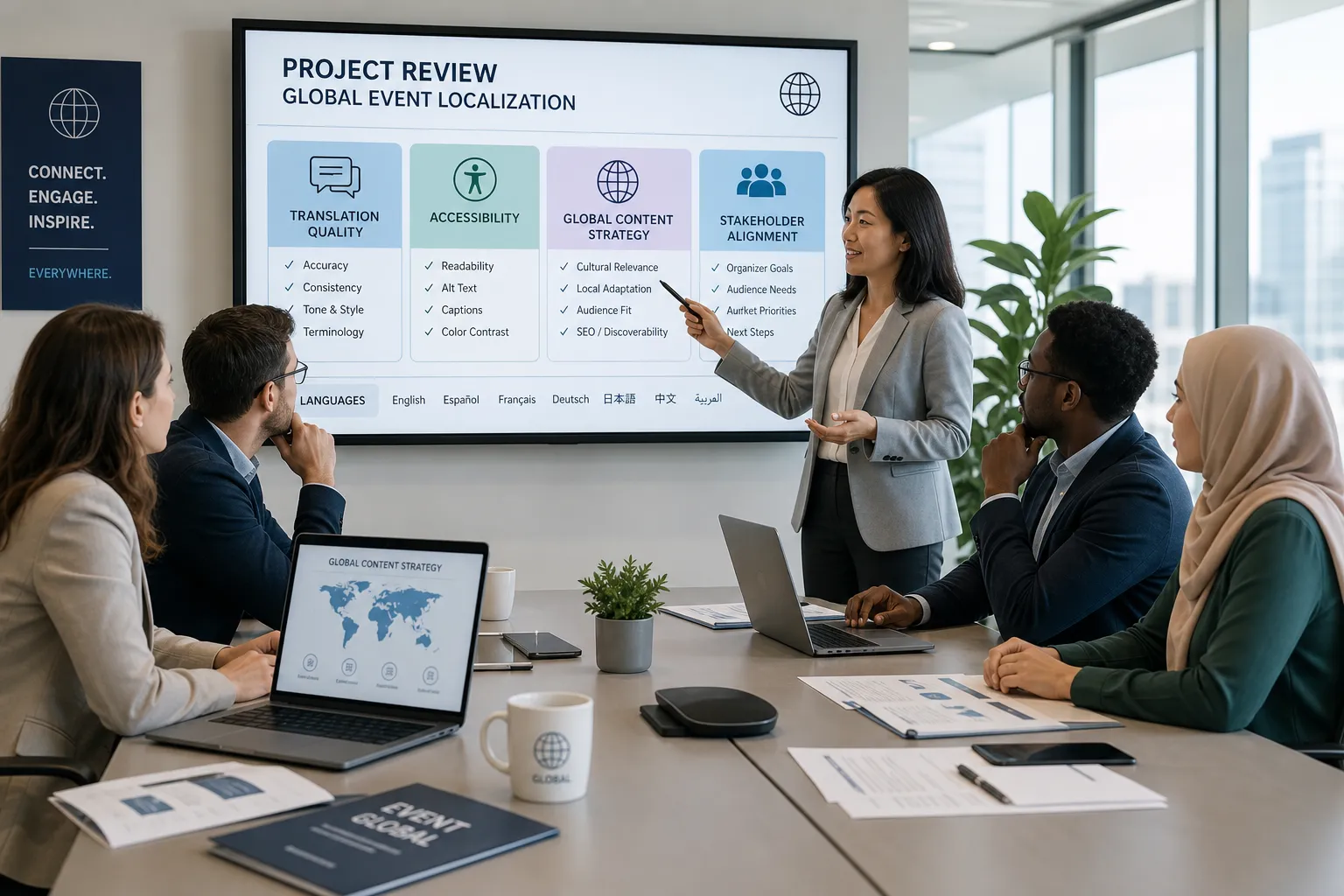
What the top-ranking advice gets right – and what it often misses
Most buyer guides from translation and localization companies agree on a few essentials:
-
Look for language expertise and native-speaking translators
-
Verify industry knowledge
-
Ask about quality assurance
-
Check references and certifications
-
Consider turnaround time and cost
That guidance is useful, but incomplete. Many articles gloss over the areas that matter most to modern buyers:
-
How translation and localization differ in practice
-
How to evaluate AI-powered workflows without risking accuracy
-
How to assess a provider for live, virtual, and hybrid event support
-
How accessibility services like captioning and subtitling fit into multilingual communication
-
How file handling, security, and formatting affect project risk
-
How to choose a partner that can grow from document translation into full language access support
That is where a more practical, buyer-focused framework helps.
Why choosing the right translation partner matters more than ever
A translation project rarely stays “just translation” for long. A company may start with official documents, then need website localization, multilingual content for training, subtitles for product videos, interpreter support for a client event, or real-time captioning for accessibility compliance.
“76% of online shoppers prefer to buy products with information in their native language, and 40% will never purchase from a website in a language other than their own.” – Elmura Linguistics
That means your professional translation service directly affects revenue, trust, adoption, and user experience.
For organizations serving public audiences or hosting events, accessibility is just as important.
“Nearly half of U.S. viewers always or often watch videos with captions.” – TV Tech
A professional translation agency today should help you think beyond text alone. It should support inclusive communication across languages and formats.
What is a professional translation company?
A professional translation company is a structured language partner that combines trained linguists, subject matter experts, project management, quality assurance, technology, and secure workflows to deliver accurate multilingual content at scale.
That is different from simply hiring a bilingual freelancer or using an automated tool.
A professional translation company typically provides
|
Capability |
What it means |
|---|---|
|
Translation |
Accurate written conversion from one language to another |
|
Localization |
Adapting content for culture, region, tone, compliance, and usability |
|
Revision and QA |
Independent review, proofreading, terminology checks, and consistency control |
|
Subject expertise |
Matching linguists to legal, medical, technical, corporate, or event-related content |
|
File support |
Working in source formats like Word, PowerPoint, InDesign, SRT, JSON, or web content |
|
Accessibility services |
Captioning, subtitling, voiceover, and inclusive communication support |
|
Interpreting |
Live language support for meetings, conferences, broadcasts, and hybrid events |
|
Scalability |
Handling more languages, more content, and more complex workflows over time |
The strongest providers offer more than quality translations. They create reliable systems for multilingual communication.
Professional translation company vs. general language translation agency
Not every language translation agency operates at the same level. Some are built for low-cost volume. Others specialize in official translation, technical translation services, or enterprise localization. The difference matters.
Key differences to look for
|
Factor |
General provider |
Professional translation and localization services |
|---|---|---|
|
Linguist selection |
Broad or unclear |
Vetted linguists matched by language and subject area |
|
Quality process |
Often basic |
Multi-step review with clear QA standards |
|
Localization depth |
Minimal |
Cultural, regulatory, and audience adaptation |
|
File handling |
Copy/paste or plain text only |
Native-format delivery and layout awareness |
|
Technology use |
Generic MT or apps |
Secure AI workflows with human oversight |
|
Accessibility support |
Rare |
Captioning, subtitling, live support, and compliance awareness |
|
Event readiness |
Uncommon |
Interpreting, equipment, technicians, remote and on-site options |
|
Account support |
Transactional |
Dedicated project management and responsive service |
If your work touches contracts, technical documents, training, multilingual events, or public-facing communications, you need a professional translation company – not a commodity vendor.
The 10 factors to evaluate before hiring a translation company
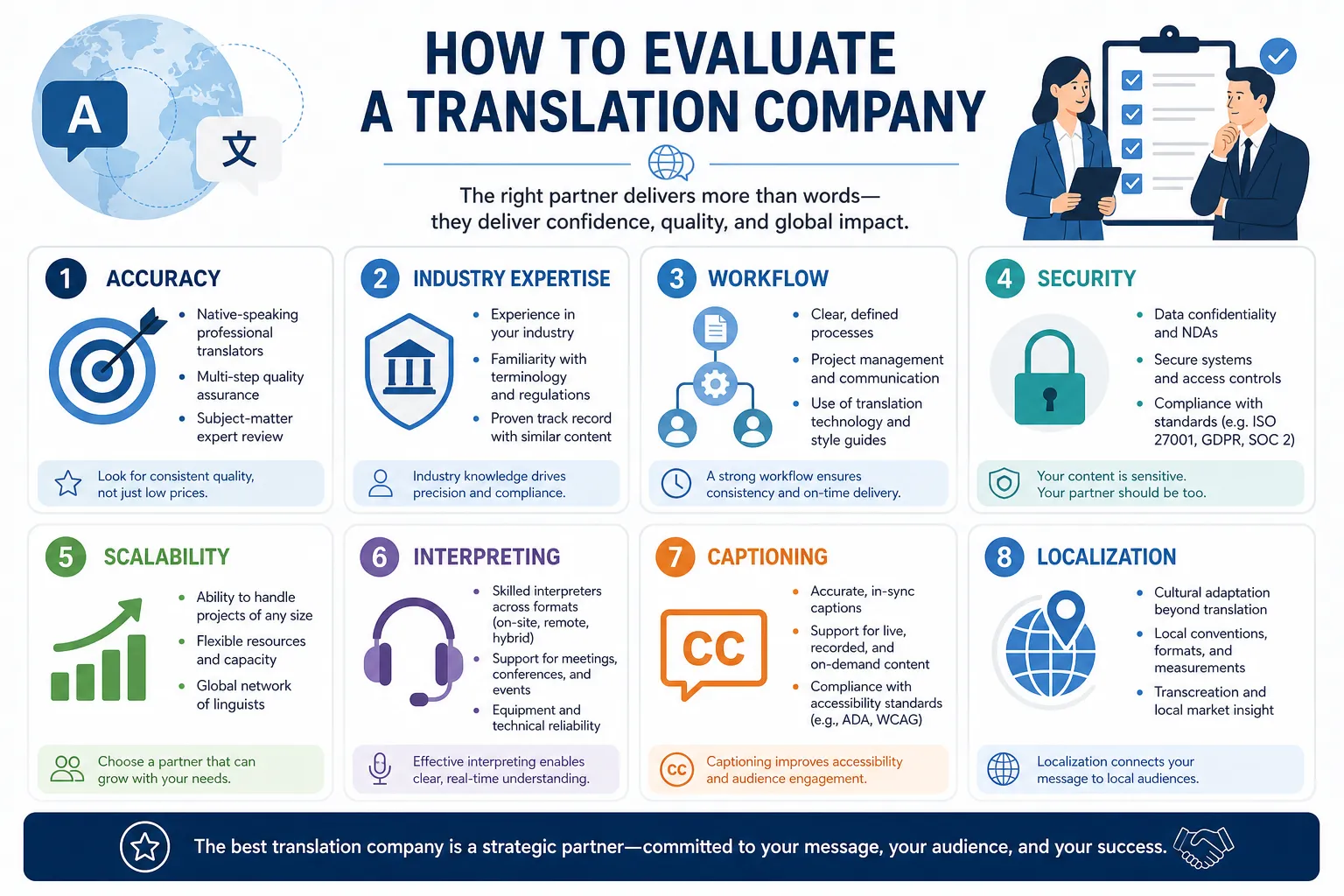
1. Language expertise and native fluency
The first test is obvious but essential: can the provider deliver high-quality work in the exact language pairs and regional variants you need?
English translation needs, for example, are not all the same. Translating into U.S. English for a product launch is different from adapting content for U.K. legal review or multilingual audiences in North America. The same applies to Spanish, French, Portuguese, Chinese, and Arabic, where regional usage affects accuracy and audience trust.
Ask:
-
Do you use native-speaking professional linguists?
-
Can you support the exact locale needed?
-
How do you handle regional terminology differences?
2. Industry expertise
A technical translation company should understand more than grammar. It should understand the subject.
This is critical for:
-
Technical translations
-
Contract translation services
-
Compliance documents
-
Product manuals
-
Training content
-
Regulated industry content
If a provider lacks industry knowledge, it may translate words correctly but meaning incorrectly.
Ask:
-
Do you assign translators by subject matter?
-
What industries do you regularly support?
-
Can you share relevant examples or case studies?
3. Localization capability
Translation and localization are related, but not identical.
Translation changes language. Localization adapts the content so it works for the audience receiving it. That can include:
-
Dates and time formats
-
Units of measure
-
Tone and reading level
-
Local terminology
-
Graphics or on-screen text
-
Calls to action
-
SEO and web metadata
-
Accessibility considerations
A professional translation website should explain how its team handles both translation and localization services, especially for web, multimedia, and customer-facing content.
4. Quality assurance process
One of the clearest differences between a basic language translation company and a professional translation agency is process discipline.
Look for a documented workflow such as:
-
File review and scope confirmation
-
Translator assignment by expertise
-
Initial translation
-
Independent revision
-
Proofreading or QA check
-
Formatting or publishing review
-
Final delivery in the required format
If the same person translates, edits, and approves everything alone, quality risk rises.
5. Secure use of AI and translation technology
AI is now part of the translation and localization landscape, but buyers need to ask better questions than “Do you use AI?”
The right question is: How do you use it, where, and with what safeguards?
A mature provider may use AI-powered translation, terminology tools, translation memory, QA automation, or post-editing workflows to improve speed and consistency. But for sensitive content, official documents, or nuanced brand messaging, human review remains essential.
Ask:
-
Is AI optional or default?
-
Is there human post-editing?
-
Are client files used to train public models?
-
What security and confidentiality controls are in place?
At Team Stream, this balanced approach is a major advantage. Clients can use accurate human translation, AI-enabled workflows, or blended delivery depending on the stakes, timeline, and content type. That flexibility helps organizations move faster without sacrificing quality or trust.
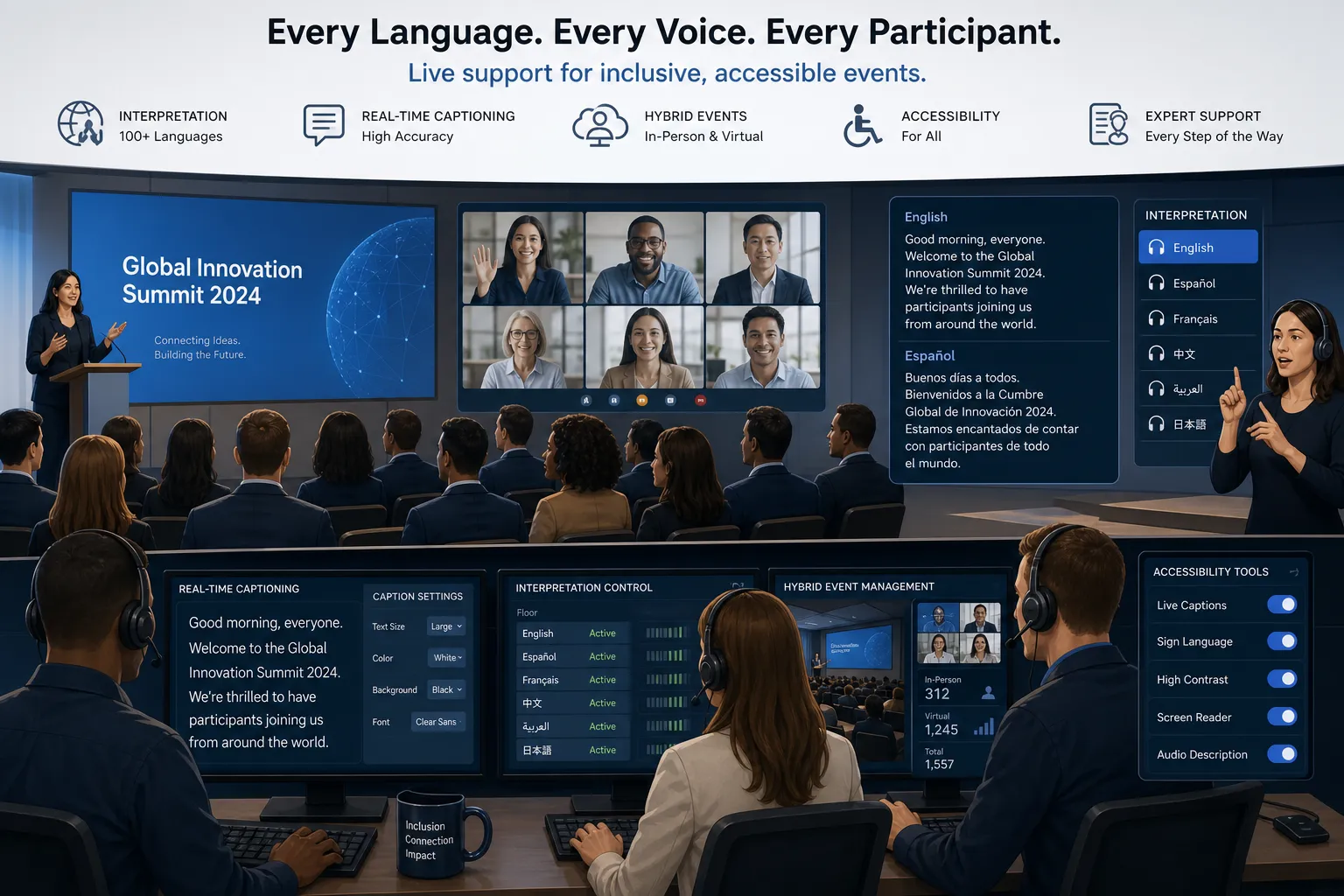
6. Ability to support more than documents
Many buyers begin by searching for a professional translation company and later realize they also need:
-
Live interpreting for meetings and conferences
-
Real-time captioning for accessibility and engagement
-
Closed captioning and subtitling for video
-
Voiceover for training or marketing
-
Event equipment rental and technician support
-
Remote and in-person language access options
This is a major content gap in many competitor articles. If your organization communicates across events, video, training, and documents, choosing separate vendors for each service increases cost and complexity.
An end-to-end partner like Team Stream can unify these services under one workflow. That is especially valuable for live, virtual, and hybrid events where timing, consistency, and technical coordination matter.
7. File format and production support
Strong content translation services do not force your team to rebuild files by hand.
Ask whether the provider can work with:
-
Word and PowerPoint
-
Excel and PDF
-
InDesign
-
Subtitles and caption files
-
Website content
-
Learning platforms
-
Broadcast or event materials
Native-format delivery reduces errors, saves time, and lowers internal workload.
8. Project management and responsiveness
A great process still needs people behind it. Ask whether you will have a dedicated point of contact and how communication will work during urgent or complex projects.
Responsiveness matters even more for:
-
Rush translations
-
Event-driven timelines
-
Multilingual rollouts
-
Last-minute content updates
-
Hybrid or live production support
Team Stream’s strong customer service and responsiveness are especially relevant here. When translation intersects with live delivery, clients need a partner that can solve issues quickly – not just send files.
9. Scalability
A provider may handle one brochure well but struggle with ongoing multilingual operations. Evaluate whether the company can scale with your needs.
That includes:
-
More languages
-
More content types
-
More departments or stakeholders
-
More frequent project cycles
-
More integration with accessibility and event support
The best translation agencies are built to grow with clients rather than treating each request as a standalone transaction.
10. Proof of reliability
Before choosing an official translation agency or technical translation company, ask for evidence.
Useful proof points include:
-
Client references
-
Industry case studies
-
Certifications or standards alignment
-
Longevity in the market
-
Examples of similar work
-
Clear service-level expectations
Experience matters. A team with more than 25 years of expertise has likely seen the workflow, terminology, and delivery risks that newer vendors miss.
How to evaluate different types of translation needs
Not every project should be judged by the same criteria. Here is a practical framework.
For official documents
If you need an official translation company for legal, immigration, academic, or formal business use, ask:
-
Do you provide certified or official document support where applicable?
-
What is your review process?
-
How do you ensure name, date, and terminology accuracy?
-
Can you meet format or submission requirements?
For technical translation
If you need technical translation services, look for:
-
Subject-matter linguists
-
Terminology management
-
Consistency across versions
-
Formatting support for diagrams or manuals
-
QA for units, labels, warnings, and specifications
For contract translation
Contract translation requires precision, not approximation.
Prioritize:
-
Legal or contractual expertise
-
Consistency with defined terms
-
Review by experienced editors
-
Confidential handling
-
Clear escalation process for ambiguous language
For content translation
Content translation services for blogs, websites, campaigns, and learning materials require a blend of language accuracy and audience adaptation.
Look for:
-
Localization skill
-
Tone-of-voice alignment
-
SEO awareness for translated web content
-
Multimedia support
-
Scalability across channels
Red flags that should make you pause
Some translation and localization companies sound impressive until you ask operational questions. Watch for these warning signs:
-
No clear explanation of the QA process
-
No mention of subject matter expertise
-
Overpromising on every language and every industry
-
No security or confidentiality detail
-
Heavy AI use without human review
-
Inability to return files in native format
-
Weak event or accessibility support if you need it
-
Slow or vague communication during quoting
If a provider cannot explain how work gets done, quality translation services are unlikely.
Human translation, AI translation, and hybrid workflows
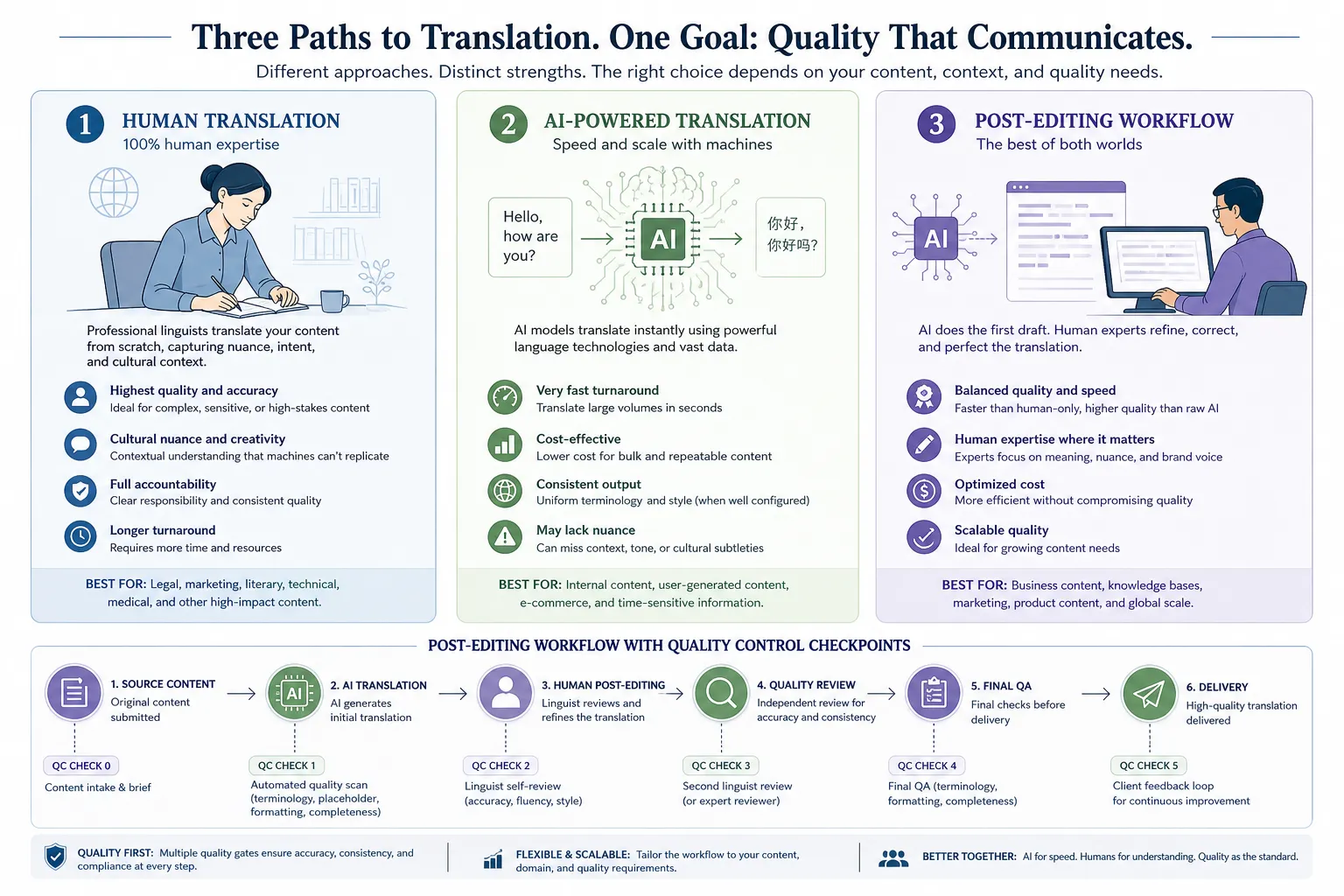
One of the biggest modern buying decisions is not whether translation should be human or AI. It is which workflow is right for each content type.
When human translation is best
Use human-led translation for:
-
Brand messaging
-
Sensitive internal communications
-
Contracts and legal materials
-
Technical documents with high risk
-
Executive communications
-
Public-facing content where tone matters
When AI-assisted translation can help
AI can be useful for:
-
Large-volume, lower-risk content
-
Fast internal understanding
-
Draft translation with expert post-editing
-
Repetitive or structured content
-
Multilingual workflows where speed matters
When a hybrid model makes the most sense
For many organizations, the best answer is a secure hybrid model: AI-enabled speed plus human quality control.
That is where Team Stream stands out. Instead of forcing a one-size-fits-all workflow, the team tailors delivery to the content, audience, risk level, and timeline. Clients can combine human expertise with AI-powered efficiency, plus interpreting, captioning, subtitling, and accessibility support under the same partner relationship.
Why accessibility should be part of the translation conversation
Many buyer guides treat translation separately from accessibility. In practice, they often overlap.
If your organization hosts meetings, publishes videos, trains employees, or communicates with public audiences, language access and accessibility are connected. A translation and localization agency that ignores this is leaving a major gap.
Services that often belong together
-
Written translation for documents and communications
-
Live interpreting for multilingual participation
-
Real-time captioning for accessibility and engagement
-
Subtitling for multilingual video distribution
-
Voiceover for learning, onboarding, and announcements
-
Hybrid event support with equipment and technicians
Team Stream’s value is especially strong here. The company is not only a language provider but also an accessibility and event support partner. That means one coordinated team can support multilingual communication, inclusive participation, and smooth technical execution across in-person, virtual, and hybrid formats.
Questions to ask before signing with a translation provider
Use this checklist in discovery calls or RFPs.
Quality and process
-
Who translates the content, and how are they selected?
-
Is there an independent revision step?
-
How do you manage terminology and consistency?
-
What happens if we spot an issue after delivery?
Technology and security
-
What translation tools or AI systems do you use?
-
Are files ever processed through public AI platforms?
-
How is confidential content protected?
-
Can you work in our native file formats?
Service fit
-
Have you handled projects like ours before?
-
Can you support technical translation, contract translation, and content translation?
-
Can you also help with interpreting, captioning, subtitles, or voiceover?
-
Do you support live, virtual, and hybrid events?
Scalability and support
-
Who will manage our account?
-
How quickly do you respond to urgent requests?
-
Can you scale to more languages or more departments?
-
What does onboarding look like?
How Team Stream fits the needs of modern buyers
Many organizations are not just looking for one translated document. They need a flexible, reliable partner for multilingual communication across content, meetings, video, and events.
That is where Team Stream brings unusual depth.
What makes Team Stream a strong choice
-
Accurate human and AI-powered translation and interpreting
-
Real-time captioning for accessibility and audience engagement
-
End-to-end language and accessibility solutions tailored to each client
-
Support for live, virtual, and hybrid events
-
Compliance-friendly services for inclusive communication
-
Professional equipment rental and technician support
-
Flexible in-person and remote delivery options
-
More than 25 years of experience
-
Reliable execution backed by responsive customer service
For buyers comparing translation and localization companies, this broader capability can simplify vendor management and improve consistency across every audience touchpoint.
Final verdict: what the best translation agency really looks like
The best translation agency is not defined by flashy claims or the biggest language list. It is defined by fit, process, expertise, and reliability.
Choose a professional translation company that can:
-
Protect meaning, tone, and terminology
-
Match linguists to your industry and audience
-
Offer secure and sensible AI options
-
Support both translation and localization
-
Scale across documents, video, events, and accessibility needs
-
Deliver strong customer service when timelines get tight
If you need more than isolated translation – if you need multilingual communication that works in real-world business settings – Team Stream is built for that job. From written translation and interpreting to captioning, subtitling, voiceover, and event support, Team Stream helps organizations communicate clearly, inclusively, and confidently across languages.
If your next project involves high stakes, multiple audiences, or live delivery, now is the right time to choose a partner that can handle all of it well.
FAQ
How much do professional translation services cost?
Costs vary based on language pair, subject complexity, turnaround time, file type, and review level. Technical, legal, or event-related projects usually cost more than simple text because they require specialized expertise and stronger quality control. The best approach is to compare quotes alongside process, accuracy safeguards, and service scope – not price alone.
What is the best translation company?
The best provider is the one that matches your industry, content type, quality expectations, and delivery needs. Look for proven expertise, native-language professionals, a documented QA process, secure technology use, and the ability to scale into interpreting, captioning, or localization if needed. For organizations with multilingual and accessibility needs, a partner like Team Stream offers a particularly strong fit.
Can I do my own certified translation?
In most cases, self-certified translations are not recommended for official use. Many institutions require an independent professional or authorized provider to attest to the accuracy of the translation. Always check the receiving organization’s requirements before submitting official documents.
