

How Reliable Is AI Interpreting?
AI interpreting has become a serious option for multilingual meetings, conferences, trade shows, webinars, broadcasts, and public-facing events. For many organizations, the appeal is obvious: lower costs, faster deployment, easier scaling across multiple languages, and increasingly natural-sounding voices. But the real question is not whether ai interpreting works at all. It is whether it is reliable enough for the moment you need it.
For event organizers, operations leaders, internal communications teams, and conference producers, that answer depends on risk, audience, and purpose. If the goal is broad access for public content, AI can be an excellent and cost-effective tool. If the goal is revenue generation, negotiation, legal clarity, executive messaging, or relationship building, human interpreters are still the safer choice.
At Team Stream, we help clients choose the right mix of accurate human and AI-powered translation and interpreting, real-time captioning, and event-ready support. That matters because reliability is not just about word-for-word accuracy. It is also about tone, timing, accessibility, compliance, audience trust, and what happens when there is no room for misunderstanding.
The Short Answer: AI Interpreting Is Reliable for Some Uses, Not All
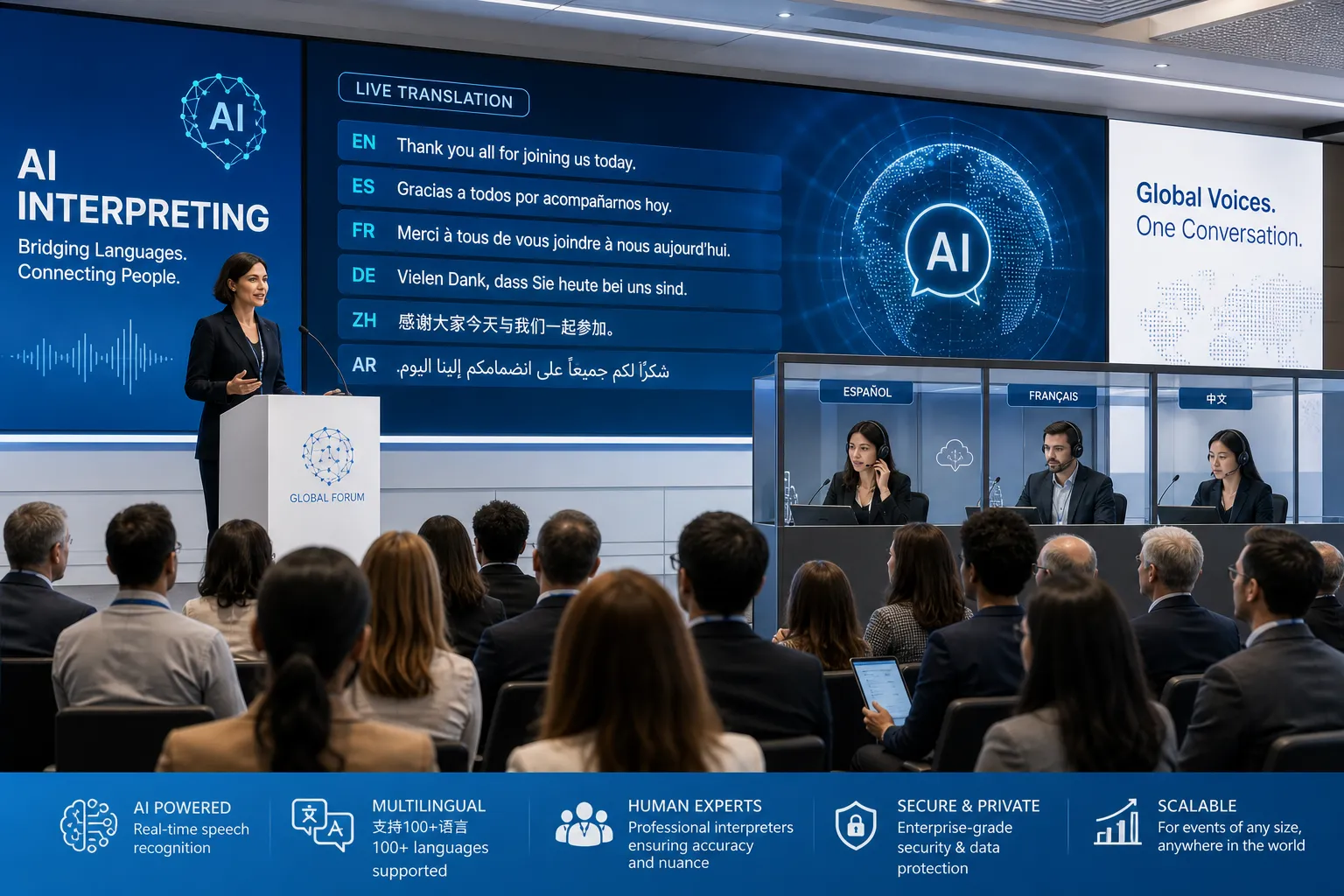
AI interpreting is generally reliable for:
-
Public-facing sessions where the audience needs the general meaning
-
Internal updates with low legal or financial risk
-
Large events where budget makes full human interpreting unrealistic
-
Multilingual accessibility for viewers who otherwise would receive no language support
-
Repetitive or structured communication
AI interpreting is less reliable for:
-
Sales meetings
-
Distributor or partner negotiations
-
Executive town halls with sensitive messaging
-
Legal, compliance, and HR conversations
-
Healthcare or safety-critical communication
-
Emotion-heavy, persuasive, or culturally nuanced presentations
That distinction is where many competitor articles stop too early. They say AI is “getting better,” which is true, but they often do not push far enough into the operational question event teams actually face:
“What happens if the interpretation is only mostly right?”
If “mostly right” is enough, AI may be a strong fit. If one missed nuance could cost trust, revenue, or compliance, human interpreters are still the standard.
What Competitor Content Gets Right, and What It Misses
Across the competitor material, the recurring themes are consistent:
-
AI is improving quickly
-
Human interpreters remain essential in high-stakes contexts
-
Hybrid models are likely the future
-
Risk level should guide deployment
-
Cultural nuance and emotional intelligence remain weak points for AI
Those are strong points. But there are several content gaps worth addressing more directly:
Content Gap 1: Reliability Should Be Evaluated by Event Outcome, Not Just Translation Accuracy
For business events, “reliability” is not just linguistic accuracy. It includes:
-
Did the audience stay engaged?
-
Did multilingual attendees understand enough to act?
-
Did the message preserve brand tone?
-
Did captions and interpreting support accessibility goals?
-
Was the experience smooth across live, virtual, and hybrid audiences?
Content Gap 2: Event Teams Need a Decision Framework, Not Just Theory
Most articles explain the debate but do not help planners decide. This guide gives you a practical framework for choosing between AI and human interpreting.
Content Gap 3: Accessibility and Compliance Are Often Underplayed
For many organizations, the question is not only translation quality. It is also whether communication is inclusive, accessible, and compliance-friendly. Team Stream’s real-time captioning, interpreting, subtitling, and technician-supported event workflows matter here because reliability includes delivery, not just language quality.
Content Gap 4: AI Can Be “Good Enough” and Still Be the Wrong Choice
AI voices can sound polished while still missing humor, persuasion, hesitation, irony, or culturally specific meaning. That creates a dangerous illusion of precision.
What Makes AI Interpreting Seem So Good Right Now?
AI interpreting has improved because several technologies have improved together:
-
Speech recognition
-
Machine translation
-
Text-to-speech voice generation
-
Latency reduction for live delivery
-
Better handling of common business vocabulary
The result is that modern systems often sound smooth, fast, and surprisingly usable. For general comprehension, that is powerful.
“In 2025, Dell Technologies reported a significant increase in AI interpreting usage, with over 500% growth and nearly 50% reduction in costs, alongside high user satisfaction levels – about 80% of users reporting a positive experience.” – Claudio Fantinuoli
That kind of growth explains why more organizations are exploring real time ai translation and AI interpreting for events. But usage growth is not the same as universal suitability. A tool can be popular, cost-effective, and still be wrong for the most important conversations.
The Real Reliability Test: What AI Interpreting Does Well vs Poorly
Where AI Interpreting Performs Well
AI is often strong at:
-
Clear speech
-
Standard business phrasing
-
Repetitive content
-
Agenda-driven presentations
-
Public information delivery
-
Basic multilingual access for large audiences
Examples:
-
Product overview for a broad audience
-
Public webcast
-
General training session
-
Company announcement meant to inform, not negotiate
-
Event keynote where multilingual access is a bonus, not a legal or commercial dependency
Where AI Interpreting Struggles
AI often struggles with:
-
Humor
-
Idioms
-
Fast speaker overlap
-
Heavy accents or dialects
-
Brand-specific messaging
-
Emotional cues
-
Persuasion
-
Legal ambiguity
-
Industry jargon used inconsistently
-
Rapid back-and-forth Q&A
Examples:
-
Contract negotiation
-
Investor or board communication
-
Sales presentation to distributors
-
HR issue resolution
-
Compliance-sensitive policy meeting
-
Crisis response update
-
Sensitive stakeholder Q&A
AI Interpreting vs Human Interpreters: A Practical Comparison
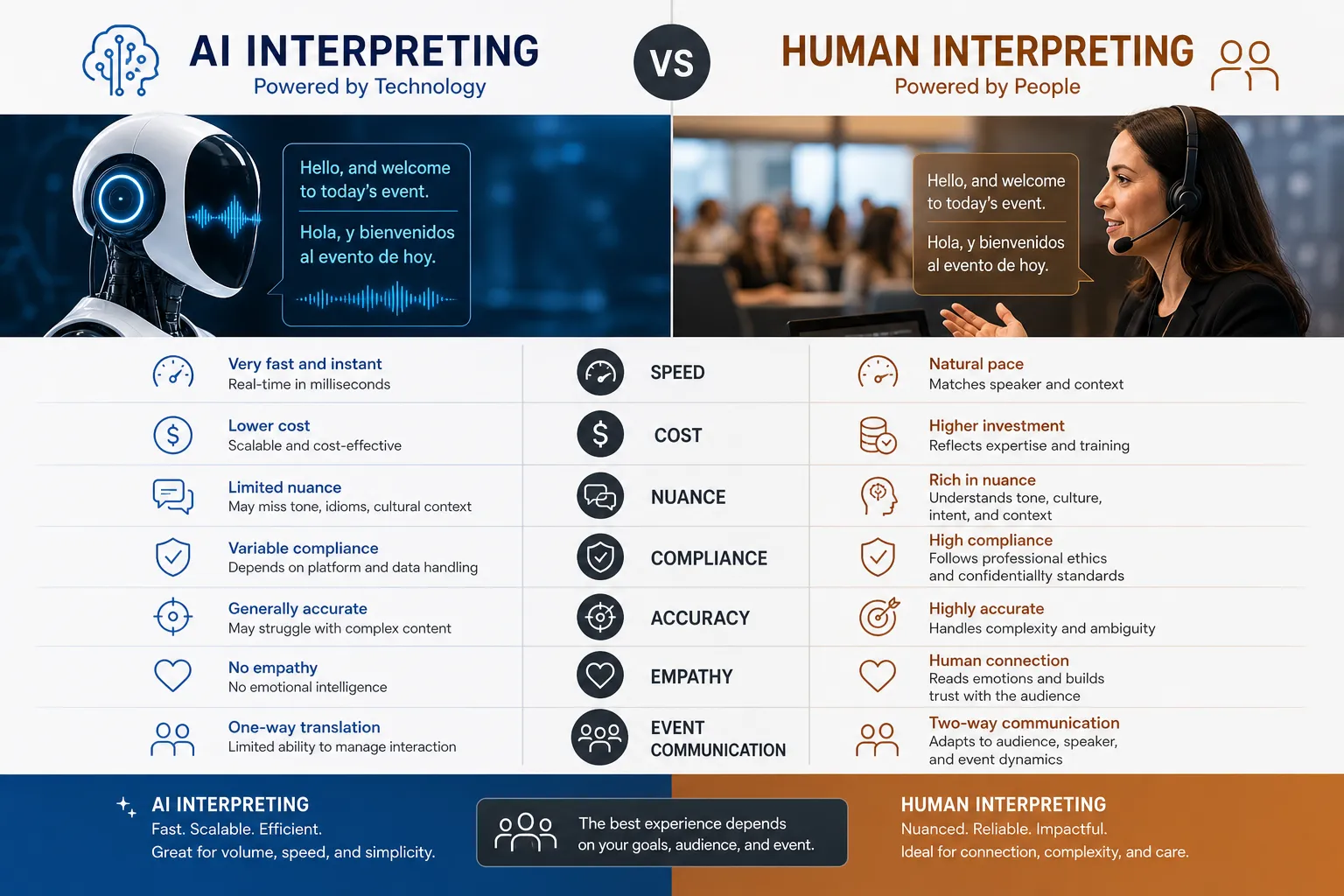
|
Factor |
AI Interpreting |
Human Interpreters |
|---|---|---|
|
Speed to deploy |
Excellent |
Moderate |
|
Cost for many languages |
Excellent |
Higher |
|
Natural-sounding output |
Often very good |
Excellent |
|
Cultural nuance |
Limited |
Strong |
|
Humor and persuasion |
Weak |
Strong |
|
Accuracy in low-risk content |
Often good enough |
Excellent |
|
Accuracy in high-stakes content |
Risky |
Best choice |
|
Live event flexibility |
Good with setup |
Excellent |
|
Recovery from speaker issues |
Limited |
Strong |
|
Audience trust in critical moments |
Variable |
High |
|
Compliance-sensitive settings |
Use with caution |
Preferred |
|
Q&A and interruption handling |
Inconsistent |
Strong |
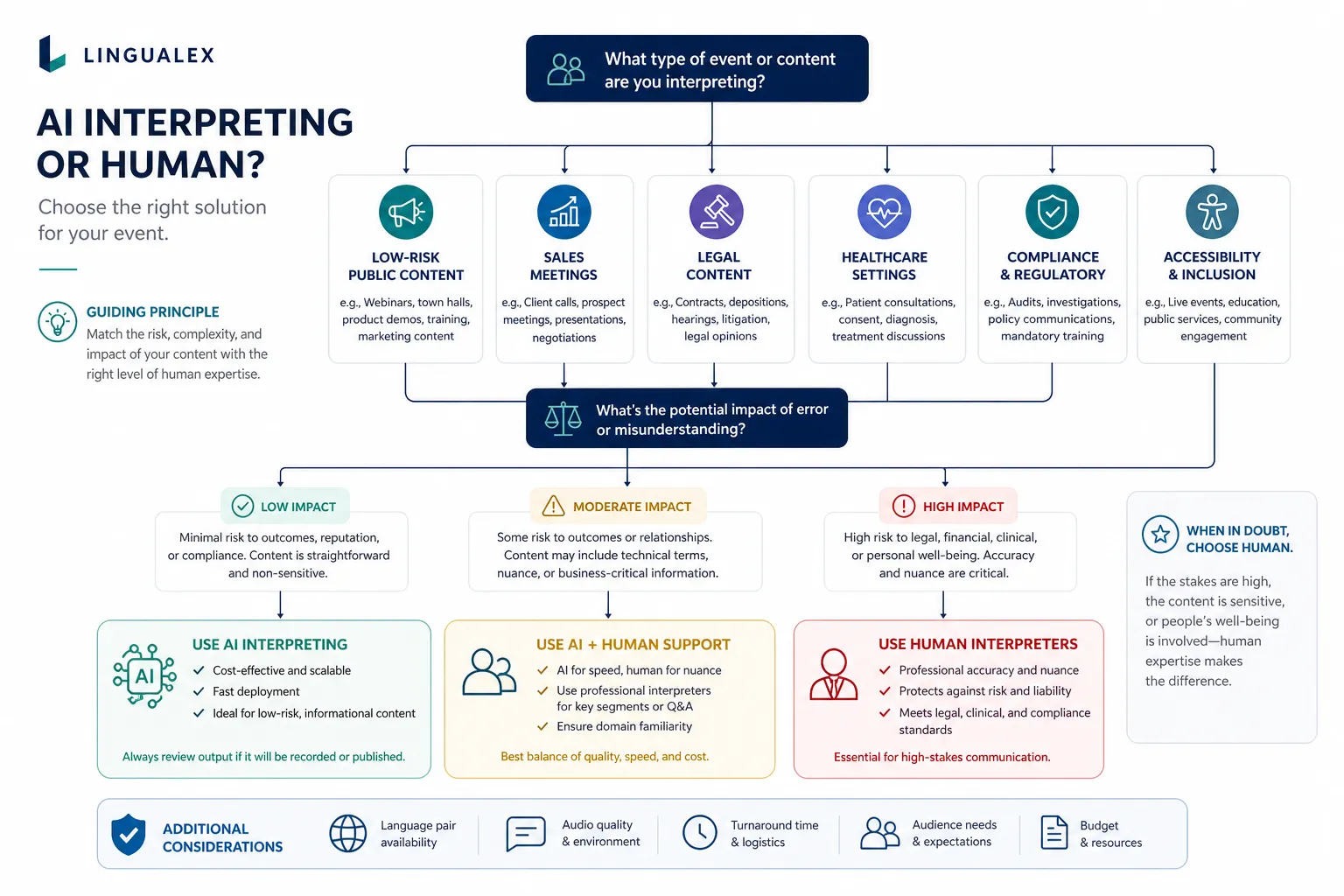
A Better Way to Judge Reliability: The 4-Level Risk Model
Instead of asking whether AI interpreting is reliable in general, ask whether it is reliable for this exact use case.
Level 1: Low Risk, Broad Access
Use AI confidently when:
-
The content is public
-
The goal is general understanding
-
A small nuance loss will not hurt revenue, safety, or trust
-
You want to expand access affordably
Typical examples:
-
Public livestreams
-
Community announcements
-
Introductory event sessions
-
Large audience presentations
Verdict: AI is often a smart choice.
Level 2: Moderate Risk, Operational Clarity Needed
Use AI with planning and backup when:
-
The content matters operationally
-
The audience may need to act on the information
-
The vocabulary is somewhat technical
-
There is some Q&A
Typical examples:
-
Internal all-hands
-
Department updates
-
General training
-
Multi-language webinars
Verdict: AI can work, especially with captioning, moderation, and clear speaker discipline.
Level 3: High Risk, Revenue or Reputation on the Line
Use human interpreters when:
-
The meeting affects sales
-
Partners or distributors are involved
-
Brand messaging must land exactly right
-
There is negotiation or persuasion involved
Typical examples:
-
Sales agent meetings
-
Distributor meetings
-
Investor-facing presentations
-
Executive strategy sessions
Verdict: Human interpreters are the safer business choice.
Level 4: Critical Risk, Legal, Medical, or Safety Consequences
Use human interpreters only when:
-
Errors could create legal liability
-
Health or safety is involved
-
Consent or rights are being discussed
-
Emotional nuance affects outcomes
Typical examples:
-
Legal consultations
-
Healthcare communication
-
HR investigations
-
Security incidents
-
Mental health or crisis support
Verdict: AI should not be the primary interpreting solution.
When AI Interpreting Is a Great Fit for Events
For many event translation needs, AI is not just acceptable. It is genuinely useful.
Best-Fit Scenarios
-
Large multilingual conferences needing affordable access
-
Public sessions where understanding the general message is enough
-
Hybrid events with remote viewers in many markets
-
Broadcast content where speed matters
-
Budget-conscious organizations trying to widen access
-
Events adding language channels for the first time
This is especially true when you combine AI with other support layers like:
-
Real-time captioning
-
On-screen multilingual text
-
Recorded subtitling after the event
-
Human moderation for Q&A
-
Technician support for audio routing and feed quality
That is where Team Stream stands out. We do not force a one-size-fits-all answer. We build an end-to-end language and accessibility plan around the event’s risk level, goals, budget, and audience experience.
When You Should Not Rely on AI Interpreting Alone
If the content helps your company earn money, protect a relationship, or reduce liability, human interpreters are worth the investment.
That includes:
-
Meetings with sales agents
-
Distributor calls
-
Partner negotiations
-
Product demos tied to revenue
-
Executive presentations that shape confidence
-
Compliance-heavy training
-
Media interviews with reputational stakes
Why? Because people do not buy based only on literal words. They buy based on confidence, clarity, trust, and emotional resonance. Human interpreters preserve those layers much better than AI.
Accuracy vs Understandability: An Important Difference
A major source of confusion is that AI can be understandable without being truly accurate.
Listeners may follow the topic, catch the main point, and feel like they understood the session. That does not mean every detail landed correctly.
This matters because many organizations only test AI informally:
-
“Did it seem okay?”
-
“Did attendees generally follow along?”
-
“Did the voice sound natural?”
Those are useful questions, but not enough. Reliability also depends on:
-
Terminology consistency
-
Preservation of speaker intent
-
Handling of ambiguity
-
Tone transfer
-
Correct rendering of numbers, names, dates, and qualifiers
-
Recovery from live-event audio problems
“A 2025 study published in BMJ Quality & Safety evaluated the accuracy of AI translation tools for emergency department discharge instructions. The study found that, depending on the tool and language, 56% to 66% of translated instruction sets contained at least one inaccuracy. Notably, up to 6% of these inaccuracies had the potential to lead patients to take harmful actions or omit necessary ones.” – BMJ Quality & Safety
That study concerns written medical translation, but the lesson carries over: high-stakes communication needs professional oversight.
Why Humor, Tone, and Culture Still Matter So Much
One of the biggest weak points in ai translation and interpreting is not vocabulary. It is intent.
Consider these common event moments:
-
A keynote speaker uses a joke to build rapport
-
A CEO softens a difficult message with careful phrasing
-
A sales leader uses local market references
-
A panelist answers diplomatically instead of directly
-
A host uses irony or understatement
Human interpreters process these signals in context. AI often gives you the literal surface meaning, which can flatten the message or distort how it feels.
For event producers and marketing teams, this matters because audience experience is not just informational. It is emotional and relational.
Reliability for Live, Virtual, and Hybrid Events
Different event formats create different pressures for AI interpreting.
Live Events
Challenges:
-
Room acoustics
-
Mic discipline
-
Audience questions from the floor
-
Speaker overlap
-
Last-minute agenda changes
AI can perform well if the audio chain is clean. Human interpreters perform better when unpredictability rises.
Virtual Events
Challenges:
-
Variable internet quality
-
Poor participant microphones
-
Cross-talk during Q&A
-
Screen-sharing distractions
AI works best in structured virtual presentations. Human support becomes more important during open discussion.
Hybrid Events
Challenges:
-
Multiple audio sources
-
In-room and remote audience coordination
-
Accessibility layering
-
Complex technical routing
Hybrid events often benefit most from Team Stream’s combined approach: interpreting, captioning, technician support, equipment, and flexible in-person or remote delivery.
AI Interpreting and Accessibility: An Underrated Advantage
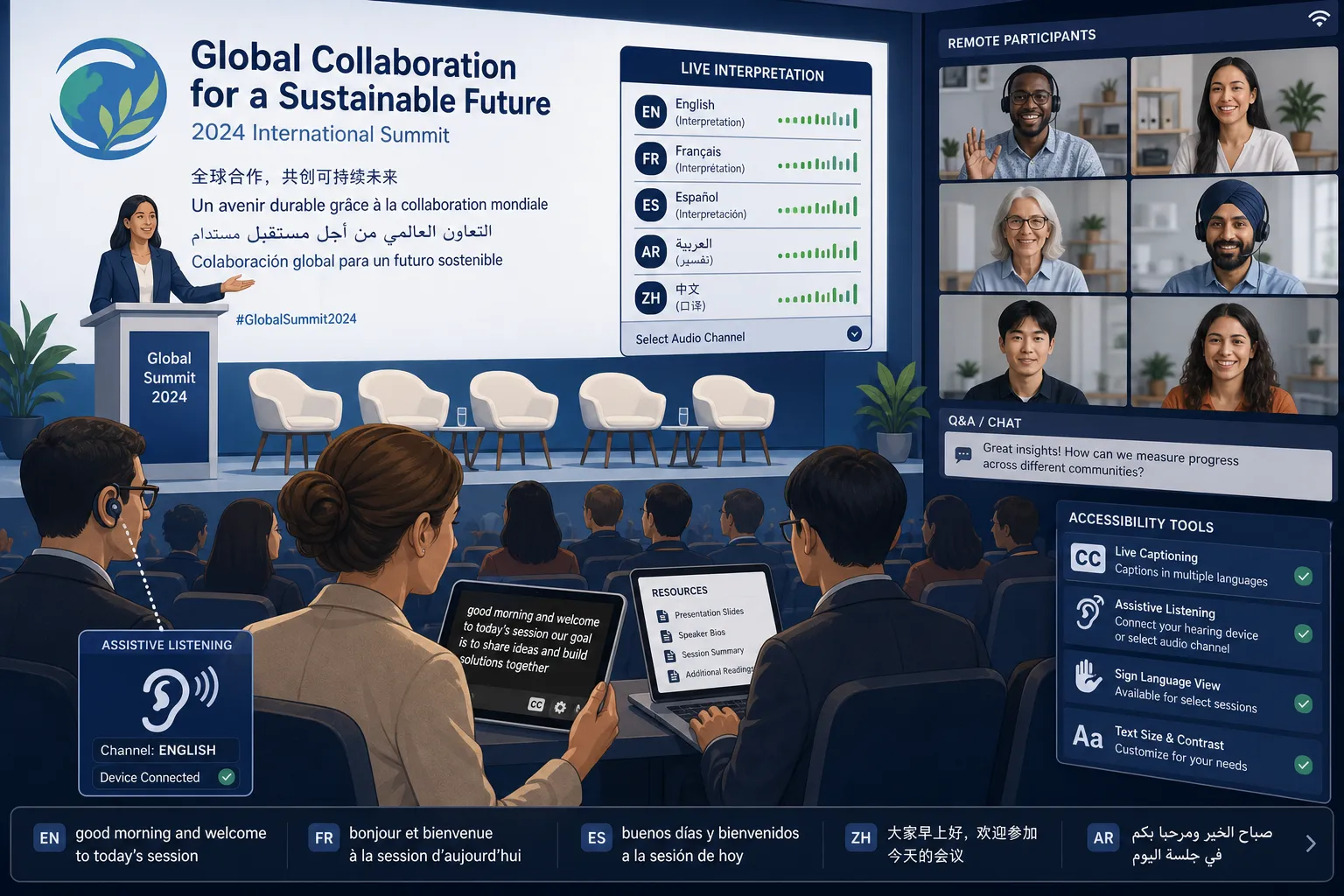
One area where AI can be especially valuable is expanding access.
If your organization has never offered multilingual support before, AI can help you:
-
Reach more attendees
-
Add more language channels
-
Make public content more inclusive
-
Pair interpreted audio with real-time captions
-
Support global audiences on a realistic budget
For many organizations, this is a major step forward. Perfect should not become the enemy of better.
That said, accessibility should still be intentional. Team Stream helps clients pair interpreting with:
-
Real-time captioning for accessibility and engagement
-
Closed captioning and subtitling
-
Voiceover and translation for post-event content
-
Compliance-friendly workflows
-
Professional equipment rental and technician services
-
Remote and in-person support models
This matters because accessibility is not just a checkbox. It is an experience.
The Smartest Strategy: Hybrid Human + AI Interpreting
The future is not AI replacing humans across the board. It is smarter orchestration.
A strong hybrid model might look like this:
|
Event Component |
Best Option |
|---|---|
|
Public keynote |
AI interpreting + captions |
|
Revenue-driving breakout |
Human interpreters |
|
Low-risk multilingual stream |
AI |
|
Executive fireside chat |
Human |
|
General attendee access |
AI + subtitles |
|
Sponsor meeting |
Human |
|
Post-event video assets |
AI draft + human review |
|
Accessibility support |
Captions + human oversight as needed |
This model gives organizations scale where scale matters, and human accuracy where consequences matter.
That is exactly the kind of tailored solution Team Stream delivers. With over 25 years of experience, we help businesses, churches, broadcasters, and event teams match the right service level to the right communication moment.
How to Decide: A Simple Pre-Event Checklist
Before choosing AI interpreting, ask:
1. What is the purpose of the content?
-
Inform?
-
Engage?
-
Persuade?
-
Sell?
-
Protect?
2. What happens if nuance is lost?
-
Minor inconvenience?
-
Lower engagement?
-
Lost revenue?
-
Confusion?
-
Legal risk?
3. Who is listening?
-
Public audience?
-
Employees?
-
Customers?
-
Partners?
-
Regulators?
4. How unpredictable is the format?
-
Scripted presentation?
-
Panel?
-
Live Q&A?
-
Negotiation?
-
Open discussion?
5. Do you need accessibility and compliance support too?
-
Live captions
-
Archive captions
-
Multi-language streams
-
ADA-minded delivery
-
Documentation-friendly workflows
If the answers point toward high risk, high value, or high sensitivity, choose human interpreters or at least a human-led hybrid setup.
Best Practices to Make AI Interpreting More Reliable
If you decide to use AI, you can still improve the outcome significantly.
Before the event
-
Provide glossaries and speaker names
-
Share slides in advance
-
Ask speakers to avoid talking over each other
-
Use high-quality microphones
-
Test the audio feed
During the event
-
Keep one speaker at a time
-
Moderate Q&A
-
Monitor captions and interpreted channels
-
Have technical support available
-
Create a fallback plan
After the event
-
Review audience feedback
-
Check misunderstood segments
-
Improve terminology lists
-
Decide what should shift to human support next time
This is another area where Team Stream adds value. Reliable delivery is not only about language technology. It is about production readiness, technician support, audio quality, and responsive service when the stakes are live.
Team Stream’s Recommendation: Use the Right Tool for the Right Communication Moment
Here is the most practical guidance:
Use AI interpreting when:
-
The content is for the public
-
Your goal is broader access
-
Budget is a major factor
-
General understanding is enough
-
You want to add multilingual support quickly
-
The communication is low-risk
Use human interpreters when:
-
The content influences revenue
-
You are speaking with sales agents or distributors
-
Trust and persuasion matter
-
Cultural nuance matters
-
Accuracy must be very high
-
The content is sensitive, regulated, or strategic
That is why Team Stream offers both human and AI-powered solutions instead of pushing one option for every scenario. We support live, virtual, and hybrid events with interpreting, captioning, subtitling, translation, voiceover, technician services, and equipment support so clients can make smart, context-driven choices.
Final Verdict: How Reliable Is AI Interpreting?
AI interpreting is reliable enough for many low-risk, public, and accessibility-focused use cases. It is fast, scalable, cost-effective, and often good at helping audiences understand the general topic of a message.
But it is not as reliable as a human interpreter when nuance, persuasion, emotional tone, compliance, or revenue are on the line. If the conversation needs to help your organization earn money, build trust, protect relationships, or avoid costly misunderstandings, human interpreters remain the better choice.
The best strategy is rarely ideological. It is practical. Use AI where it expands access efficiently. Use human expertise where precision matters most.
If you want event translation, event translation services, real time ai translation, live captioning, or a custom multilingual communication plan for your next event, Team Stream can help you design the right solution from the start. With over 25 years of experience, flexible remote and in-person delivery, strong customer support, and end-to-end language and accessibility services, we help you communicate clearly, inclusively, and confidently.
FAQ
What is the 30% rule for AI?
There is no single universal 30% rule for AI interpreting. In practice, teams sometimes use informal thresholds to decide when AI is only good enough for broad access versus when human review is required. For language services, the better rule is to judge by risk, revenue impact, and audience consequences.
Is there a translator that is 100% accurate?
No translator, human or machine, is realistically 100% accurate in every context. Human professionals are still the most reliable option for high-stakes communication because they understand tone, culture, and intent far better than AI.
What percent of AI detection is accurate?
Accuracy percentages vary widely depending on the tool, language pair, speaker clarity, and subject matter. That is why percentage claims alone can be misleading; for live interpreting, what matters more is whether the output is reliable enough for the specific use case.
Can you trust AI to be accurate?
You can trust AI to be useful in low-risk situations, especially for public content and broad access. You should not rely on it alone when legal, financial, medical, or relationship-critical communication is involved.
What did Stephen Hawking say about AI before he died?
Stephen Hawking warned that AI could be either the best or worst thing to happen to humanity, depending on how it is managed. That caution fits language services well: AI can expand access, but it should be deployed thoughtfully and not blindly trusted in high-stakes communication.
What 5 jobs will AI not replace?
Jobs least likely to be fully replaced are those requiring judgment, empathy, cultural nuance, relationship-building, and accountability. In this context, that includes professional interpreters in high-stakes settings, negotiators, therapists, legal advisors, and senior event communication specialists.
