

Hmong Translation: What Businesses Need in 2026
Reaching Hmong-speaking audiences in 2026 is no longer a niche consideration. For healthcare systems, public agencies, schools, event organizers, employers, churches, and growing brands, clear multilingual communication is part of customer experience, accessibility, and risk management.
Many businesses begin by asking a simple question: Do we really need Hmong translation? The better question is: Where are language gaps already costing us trust, attendance, accuracy, or compliance? If your organization serves communities in California, Minnesota, Wisconsin, or anywhere with meaningful Hmong populations, the answer may be closer than you think.
At Team Stream, we see this firsthand. Organizations need more than literal word conversion. They need accurate human expertise, smart AI support where appropriate, live interpreting, captioning, translated content, and dependable execution across in-person, virtual, and hybrid environments. That is especially true when communication has to be understood the first time.
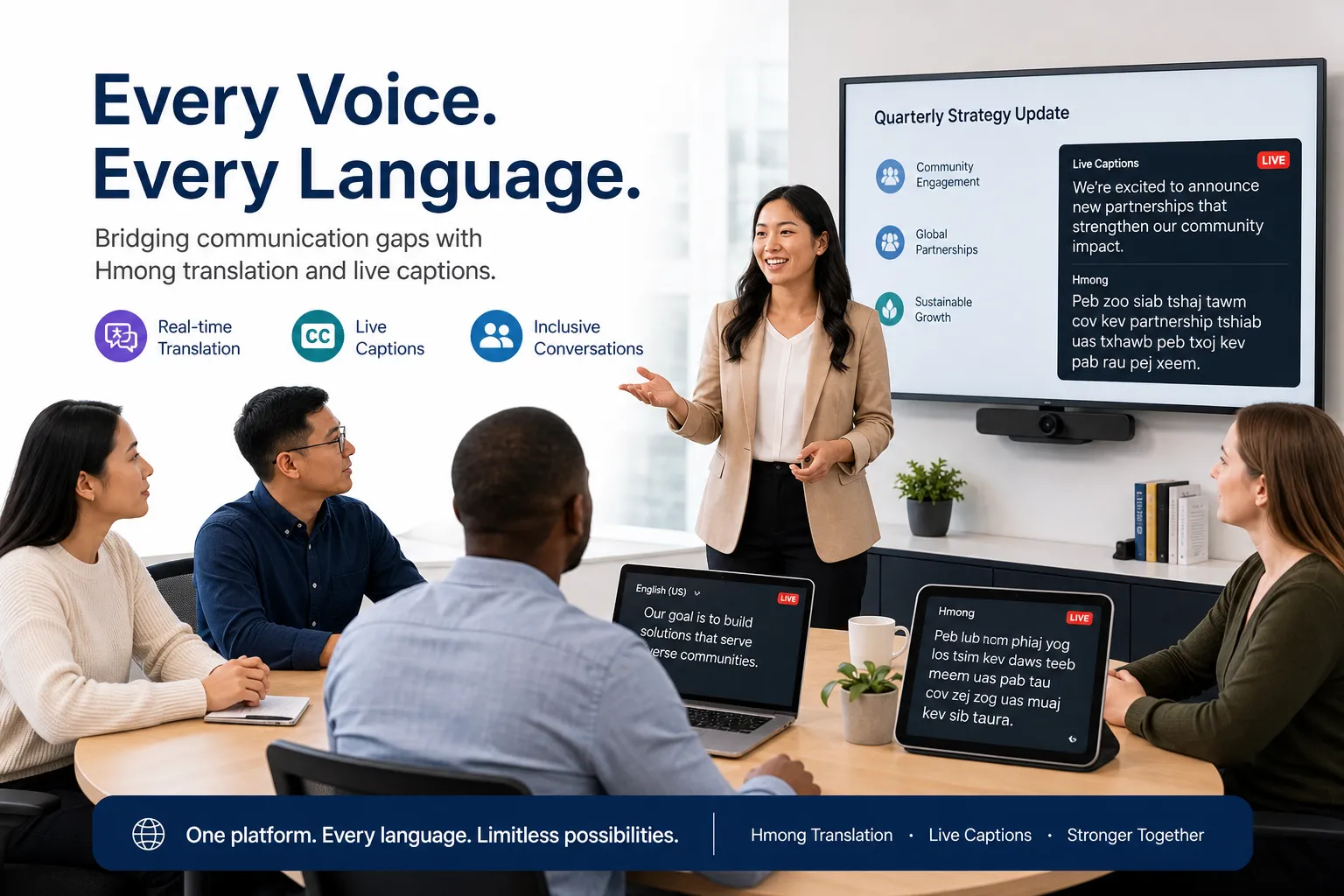
Why Hmong Translation Matters More in 2026
Hmong-speaking communities have long been underserved by one-size-fits-all language support. In 2026, that gap matters more because audiences expect communication to be immediate, accessible, and culturally aware across every touchpoint: websites, forms, events, onboarding materials, safety communications, livestreams, and customer support.
For many organizations, Hmong language support is no longer just about document translation. It now includes:
-
live interpreting for meetings and events
-
real-time captions and accessibility support
-
subtitling and voiceover for training and video content
-
multilingual outreach for public-facing campaigns
-
hybrid delivery models that combine human linguists and AI tools
“As of 2023, the Hmong population in the United States is approximately 330,000 individuals.” – Pew Research Center
That population concentration matters for business planning. If you operate in markets with strong Hmong communities, language access is not optional if you want meaningful engagement.
What Hmong Translation Actually Includes
A lot of competing articles treat this topic too narrowly, as if translation means only converting documents. In practice, businesses usually need a broader language-access strategy.
Written Translation
This is the foundation: forms, policies, handbooks, marketing collateral, signage, emails, presentations, and digital content translated from English into Hmong or vice versa.
Common business use cases include:
-
employee onboarding packets
-
safety manuals
-
healthcare instructions
-
legal notices
-
public program information
-
websites and landing pages
-
event registration materials
Interpreting
Translation handles written content. Interpreting handles spoken communication. This is critical for live meetings, consultations, interviews, training sessions, webinars, and conferences.
Depending on the context, businesses may need:
-
consecutive interpreting for meetings or consultations
-
simultaneous interpreting for conferences and live events
-
remote interpreting for virtual sessions
-
on-site interpreters for in-person interactions
Captioning, Subtitling, and Accessibility Support
One of the biggest gaps in competitor content is accessibility. In 2026, language access and accessibility increasingly overlap. If you are running a live event, internal town hall, training webinar, or video campaign, translated words alone may not be enough.
You may also need:
-
live captioning for accessibility and engagement
-
closed captions for recorded content
-
subtitling in Hmong and English
-
multilingual on-screen displays
-
technician support and equipment for seamless delivery
“Approximately 29.6 million individuals aged five and older in the United States have limited English proficiency.” – The Global Statistics
That is why Team Stream approaches language services as end-to-end communication support, not a single isolated service line.
Where Businesses Most Often Need Hmong Translation
Healthcare and Community Services
Healthcare organizations often need Hmong translation for discharge instructions, consent forms, patient education, scheduling communications, outreach campaigns, and interpreting during care interactions.
Accuracy matters here for obvious reasons. But speed matters too. Delayed or confusing communication can lead to missed appointments, poor outcomes, and lower trust.
Government and Public Sector Communication
State agencies, counties, municipalities, and public-benefit programs need translated notices, compliance materials, application instructions, and outreach content that communities can actually understand.
Public-facing communication also increasingly requires accessibility features, especially for meetings, hearings, livestreams, and recorded updates.
Education and Training
Schools, colleges, workforce programs, and employers often need Hmong translation for enrollment materials, parent communication, HR documents, staff training, and safety content.
If your organization delivers training through video or live presentation, interpreting and captioning may be just as important as the translated handout.
Events, Conferences, and Broadcasts
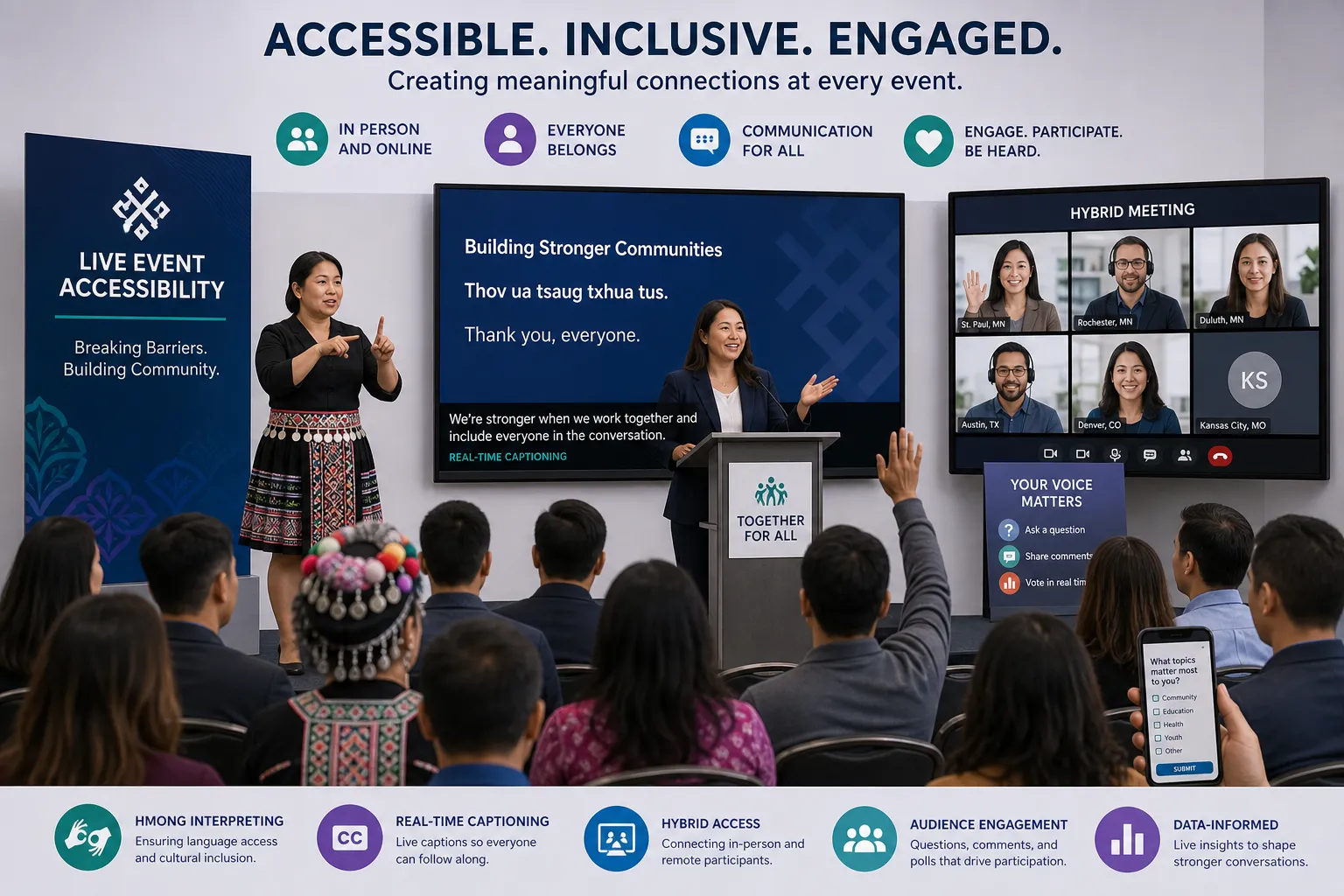
This is an area many general translation providers underplay. If you host live, virtual, or hybrid events, you may need multilingual support that works in real time.
That can include:
-
Hmong interpreting for breakout sessions or keynotes
-
real-time captioning for accessibility
-
subtitles for replay content
-
translated event materials
-
technician support and equipment rental
-
remote and in-person delivery options
For event organizers and producers, this is where execution quality matters most. Language access is highly visible when it succeeds and even more visible when it fails.
Internal Corporate Communication
Global and multicultural workforces need clear communication around operations, benefits, compliance, safety, and leadership messaging. Hmong translation may be essential for internal clarity, especially in manufacturing, logistics, healthcare support, and community-facing organizations.
Human vs. AI: What Businesses Should Actually Use
The real 2026 question is not whether to use humans or AI. It is when to use each one.
When AI Can Help
AI-powered language tools are useful for speed, drafts, internal reference, and some live support scenarios. They can also help scale content workflows, especially when paired with human review.
Good uses for AI-assisted workflows include:
-
first-pass translation drafts
-
multilingual caption support
-
large content volumes with repeatable structure
-
internal turnaround acceleration
-
live event support where fast rendering is needed
When Human Expertise Is Essential
Human linguists remain essential when the communication is:
-
high stakes
-
public facing
-
regulated
-
culturally sensitive
-
legally or medically important
-
brand critical
-
emotionally nuanced
This is especially relevant for Hmong because language quality is not just about vocabulary. It is about context, regional preference, clarity, and audience understanding.
At Team Stream, we help clients use AI where it improves efficiency and use professional human review where accuracy, tone, and trust truly matter. That balanced approach is often the smartest path in 2026.
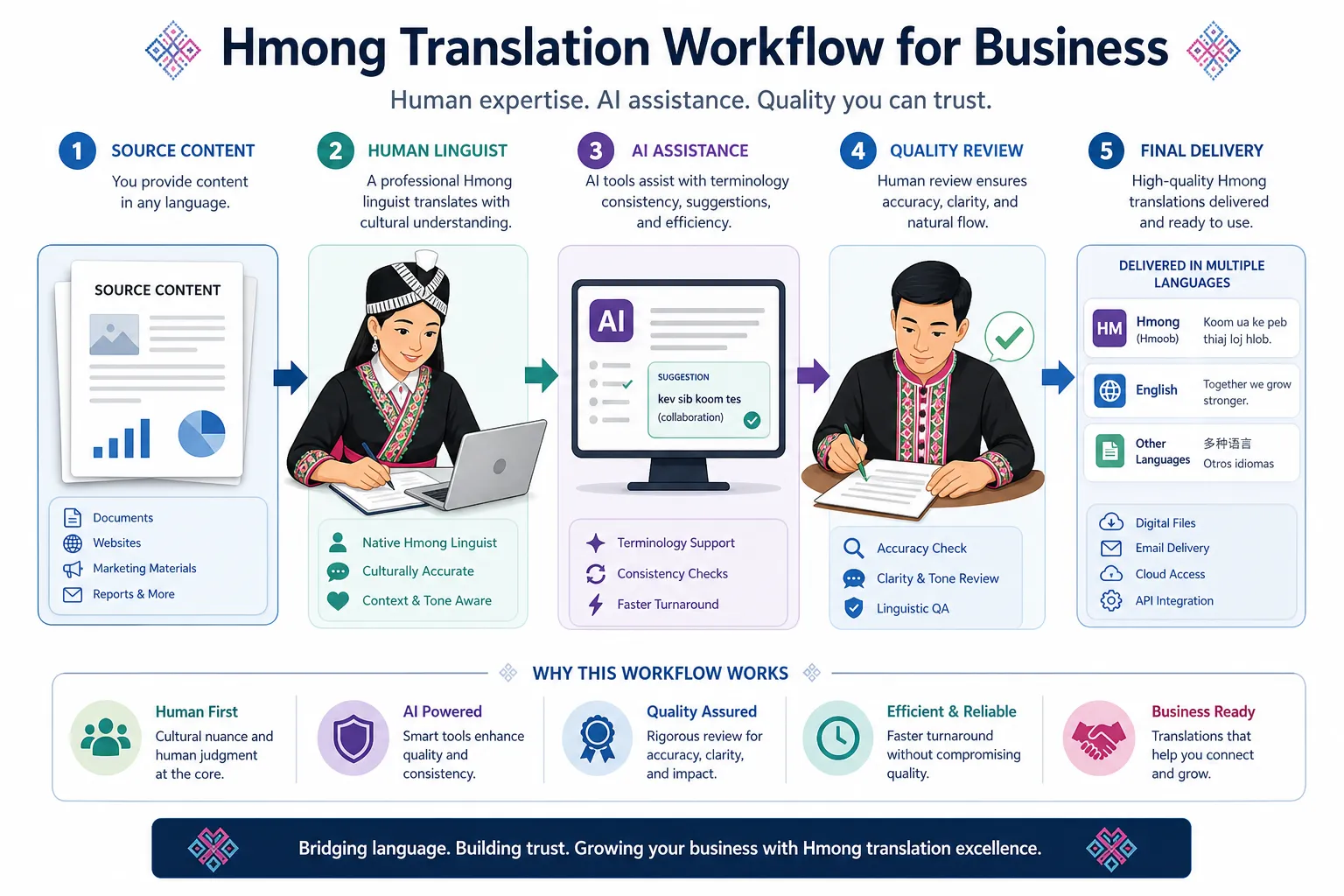
What Good Hmong Translation Looks Like
Not all translation quality issues are obvious to a non-speaker. That is why buyers need practical standards, not vague promises.
Accuracy Beyond Literal Meaning
A good translation is not just word-for-word correct. It communicates the original meaning clearly and naturally for the intended audience.
Cultural and Community Relevance
Hmong-speaking communities are not monolithic. A quality process considers audience, purpose, literacy level, tone, and cultural context.
Readability
Business communication fails when it is technically accurate but hard to follow. Translated content should be usable, not just correct.
Review and QA
Professional workflows should include editing, proofreading, terminology consistency, and format review. For live work, quality means interpreter preparation, audio clarity, platform readiness, and fallback planning.
Questions to Ask Before Hiring a Hmong Translation Provider
Many competitor pages focus on company size or linguist counts. Those can matter, but they are not enough. In 2026, buyers should ask better operational questions.
1. Do You Offer Both Translation and Interpreting?
Many organizations eventually need both. If your provider only handles documents, you may need a second vendor for live communication.
2. Can You Support Accessibility Too?
If you host live events, webinars, or recorded content, ask about captioning, subtitling, accessibility workflows, and compliance-friendly delivery.
3. How Do You Use AI?
A strong provider should be transparent about where AI is used, where humans review, and how quality is protected.
4. Can You Support Live, Virtual, and Hybrid Environments?
This matters for conferences, internal meetings, broadcasts, trainings, and public events. Language support has to fit the format, not fight it.
5. Do You Provide Equipment and Technicians?
For multilingual events, logistics can make or break the audience experience. Headsets, receivers, audio routing, booth setups, platform integration, and technician support all matter.
6. What Is Your Quality Control Process?
Look for clear workflows, experienced linguists, and responsiveness when timelines are tight.
Common Mistakes Businesses Make
Treating Hmong as an Afterthought
Organizations often plan the event, campaign, or rollout first and address language access at the end. That increases cost, limits quality, and creates preventable stress.
Assuming Bilingual Staff Can Cover It
Being bilingual is not the same as being a trained translator, interpreter, or captioning professional. High-stakes communication deserves qualified support.
Using Only Machine Translation
AI can be useful, but unreviewed machine output can create clarity issues, compliance problems, and brand damage.
Forgetting Accessibility
If your content is multilingual but not accessible, you may still be excluding important audiences. Real-time captioning and accessible media workflows are no longer optional extras for many organizations.
Choosing a Provider Without Event Experience
A provider may handle documents well but struggle with live delivery. Conferences, trade shows, corporate events, churches, and broadcasts require a very different operational skill set.
What Team Stream Brings That Many Providers Miss
A major content gap in competitor articles is the lack of practical guidance for live communication environments. Businesses do not just need words translated. They need communication to work across people, platforms, rooms, and audiences.
Team Stream is built for that reality.
End-to-End Language and Accessibility Support
We provide professional interpreting, translation, captioning, subtitling, voiceover, and AI-enabled language services designed around the actual communication moment, not a generic package.
Support for Live, Virtual, and Hybrid Events
From conferences and trade shows to corporate meetings, worship services, and broadcasts, we help organizations deliver multilingual communication that feels seamless to attendees.
Real-Time Captioning for Accessibility and Engagement
Captioning improves not only accessibility but also comprehension, retention, and participation. It is one of the most practical ways to serve diverse audiences well.
Equipment Rental and Technician Support
This is where many providers stop and Team Stream keeps going. We can support the technical side of language access so clients are not left coordinating multiple vendors under deadline pressure.
Flexible In-Person and Remote Delivery
Some projects need on-site support. Others work better remotely. Many need a mix. We tailor delivery to the use case, audience, and budget.
25+ Years of Experience
Experience shows up in planning, adaptability, responsiveness, and calm execution when the stakes are high. That matters whether you are translating a document set or running multilingual support for a live event.
How to Match the Service to the Use Case
The right solution depends on what you are trying to accomplish. Here is a practical framework.
|
Business Need |
Best-Fit Service |
Why It Works |
|---|---|---|
|
Patient forms, HR documents, notices |
Professional written translation |
Accuracy, readability, and consistency matter |
|
One-on-one meeting or consultation |
Consecutive interpreting |
Clear, manageable live communication |
|
Conference keynote or multilingual event |
Simultaneous interpreting |
Real-time access for larger audiences |
|
Webinar, livestream, or hybrid meeting |
Interpreting + live captioning |
Supports both language access and accessibility |
|
Training videos or replay content |
Subtitling + voiceover + captions |
Improves comprehension and long-term usability |
|
Fast-moving internal multilingual updates |
AI-assisted workflow with human review |
Balances speed with quality control |
A Smarter 2026 Strategy for Hmong Language Support
If there is one takeaway from the current market, it is this: organizations should stop thinking of translation as a standalone line item and start treating it as part of communication strategy.
That means planning for:
-
audience language needs early
-
accessibility alongside translation
-
live and recorded content together
-
human quality control where the stakes are high
-
technical execution for events and broadcasts
-
scalable workflows that can grow with demand
This is how businesses move from minimal compliance to meaningful communication.
Final Verdict
In 2026, Hmong translation is not just about reaching one language group. It is about serving people more clearly, running events more inclusively, reducing communication risk, and building trust where it counts.
The best providers do more than translate text. They help organizations communicate across languages, formats, and environments with confidence.
That is where Team Stream stands apart. We combine accurate human expertise with AI-enabled efficiency, real-time captioning, interpreting, translation, accessibility services, event support, equipment, and responsive client care. Whether you need a single translated asset or a fully supported multilingual live experience, we build the solution around your audience and your goals.
If your business, event, or organization needs Hmong language support that is accurate, accessible, and reliably executed, Team Stream is ready to help.
FAQ
What companies need translators?
Any organization serving multilingual audiences may need translators, especially in healthcare, government, education, events, manufacturing, media, and corporate communications. If your business shares important information with customers, employees, attendees, or the public, professional translation helps ensure clarity, trust, and accessibility.
Can a translator become a millionaire?
Yes, but usually not from translation work alone. Translators who build specialized expertise, agency operations, consulting services, or scalable language businesses have the strongest earning potential, especially when they serve high-value industries or multilingual event and accessibility needs.
