

Haitian to English Translation for Clear Communication
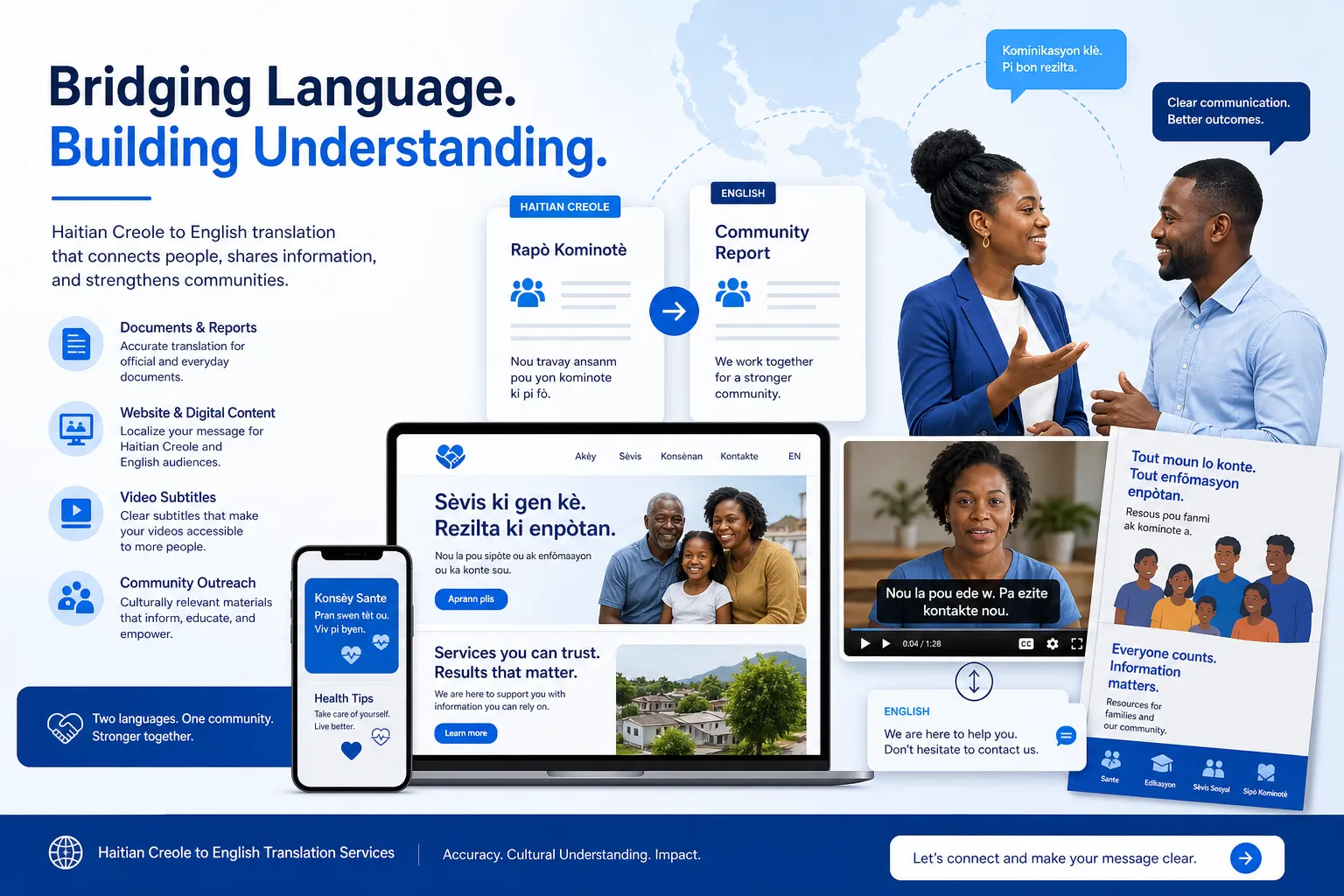
Clear communication is not a luxury when you serve multilingual communities. It is the difference between being understood and being ignored, between participation and exclusion, and in some cases, between compliance and risk.
For businesses, nonprofits, schools, churches, healthcare providers, and event organizers, Haitian to English translation plays a critical role in helping messages move accurately across languages without losing meaning, tone, or trust. Whether you are translating forms, websites, training materials, subtitles, outreach campaigns, or live announcements, the goal is not just word replacement. The goal is communication that works.
At Team Stream, we see this every day. Organizations often need more than a translated document. They need a dependable language partner that can support written translation, live interpreting, captioning, subtitling, voiceover, and multilingual event delivery across in-person, virtual, and hybrid environments. That is where accurate human expertise combined with smart AI-powered workflows makes a measurable difference.
Why Haitian Creole and English Translation Matters More Than Many Organizations Realize
Haitian Creole is widely spoken across the United States, the Caribbean, and global diaspora communities. If your audience includes Haitian families, employees, customers, students, church members, or event attendees, providing information only in English can create immediate friction.
“According to 2024 data from the U.S. Census Bureau, approximately 1,041,231 people in the United States speak Haitian Creole at home, making it the tenth most spoken non-English language in the country.” – Statista
That scale matters. It means Haitian Creole language access is not a niche concern. It is a practical communication need for many organizations, especially in education, public services, faith-based outreach, healthcare, workforce communication, and live events.
Translation Builds Access, Trust, and Action
When people receive information in a language they fully understand, they are more likely to:
-
Complete forms correctly
-
Follow instructions
-
Engage with your program or event
-
Trust your organization
-
Share information with family and community
-
Return for future services
That is especially important when the message carries legal, medical, educational, financial, or safety implications.
Haitian Creole Is Not Just “French With Different Words”
A common mistake is assuming Haitian Creole can be handled casually because it has French roots. In reality, Haitian Creole is its own language, with its own grammar, usage, rhythm, and cultural context. Direct word-for-word conversion often produces translations that sound unnatural, confusing, or simply wrong.
That is why high-quality translation requires:
-
Language fluency
-
Subject-matter understanding
-
Audience awareness
-
Cultural sensitivity
-
Review for clarity and tone
Professional translation is not about swapping vocabulary. It is about preserving intent.
Where Haitian to English Translation Has the Biggest Impact
Business Communication
Companies often need to translate:
-
HR documents
-
Employee handbooks
-
Safety materials
-
Internal announcements
-
Training content
-
Customer support information
-
Product instructions
If a Haitian Creole-speaking employee or customer misunderstands a policy or procedure, the result can be confusion, lower engagement, preventable mistakes, or liability. Clear translation supports smoother operations and stronger trust.
Nonprofit and Community Outreach
Nonprofits frequently rely on multilingual communication to reach families and communities effectively. Outreach may include:
-
Flyers
-
Intake forms
-
Text campaigns
-
Donation appeals
-
Program guides
-
Social media messaging
-
Community event signage
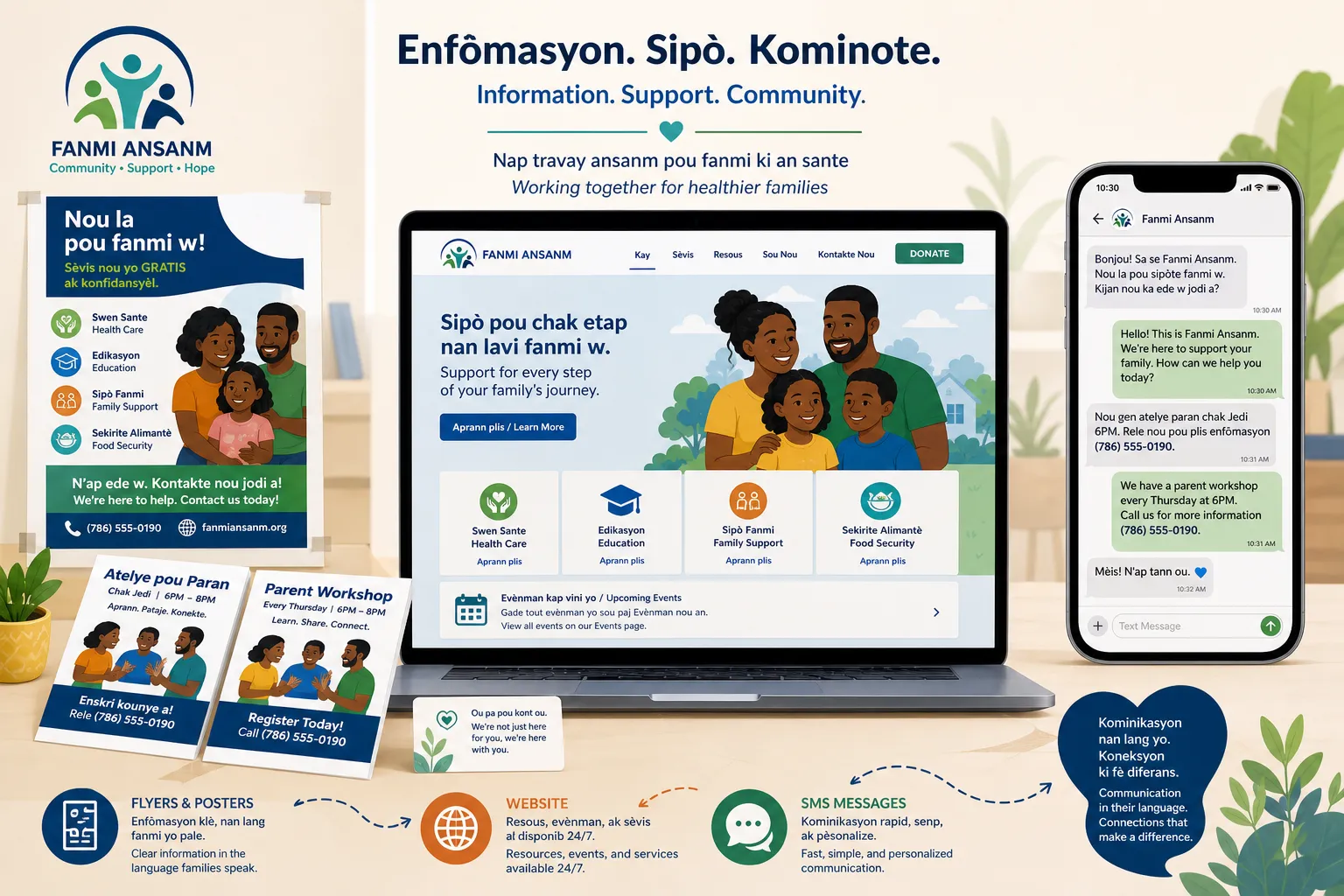
A translated message only works if it feels natural to the audience receiving it. That means using language people actually understand in context, not just technically correct phrasing.
Education and School Communication
Schools, colleges, and education programs often need Haitian Creole and English support for:
-
Parent communications
-
Enrollment forms
-
Student handbooks
-
Emergency notices
-
Classroom materials
-
Accessibility resources
-
Video subtitles and captions
When families cannot access information clearly, engagement drops. Translation helps schools connect with parents, support students, and improve understanding across the full educational journey.
Healthcare and Public Services
In healthcare and public service settings, clear communication is especially important because the stakes are higher. Translation may be needed for:
-
Discharge instructions
-
Appointment information
-
Consent forms
-
Patient education
-
Public health notices
-
Benefits information
-
Emergency response messaging
“Patients facing language barriers often experience poorer health outcomes compared to those who speak the local language.” – Implications of Language Barriers for Healthcare: A Systematic Review
For these use cases, accuracy is essential. Ambiguous wording can lead to misunderstanding, noncompliance, and avoidable harm.
The Difference Between Basic Translation and Communication That Actually Works
Not all translation solutions deliver the same outcome. Many competitor tools focus narrowly on quick app-based text conversion or general translation services. What they often underemphasize is the broader communication ecosystem organizations actually need.
Basic Translation Often Stops at the Text
A simple tool may help with a phrase or rough sentence. But organizations often need much more:
-
Website localization
-
Video subtitling
-
Voiceover
-
Live interpretation
-
Real-time captioning
-
Event AV coordination
-
Accessibility compliance support
-
Multilingual content review
That is where Team Stream adds unique value. We help clients move beyond “translated words” to fully accessible multilingual communication systems.
Context Changes Everything
The right translation for a medical discharge paper is different from the right translation for:
-
A sermon subtitle feed
-
A conference stage script
-
A trade show booth demo
-
A parent notification email
-
A public agency outreach campaign
Each setting has its own tone, urgency, terminology, and accessibility demands. Translation should adapt accordingly.
Documents, Websites, Videos, and Live Outreach All Need Different Strategies
Documents
Documents should be translated for accuracy, readability, and purpose. A contract requires precision. A school notice requires clarity. A marketing handout requires persuasion.
Best practice includes:
-
Terminology consistency
-
Plain-language review
-
Formatting preservation
-
Quality assurance by trained linguists
Websites
Websites need more than pasted translation. They need localization that considers navigation, user flow, calls to action, and audience trust.
A strong multilingual website strategy includes:
|
Website Element |
Why It Matters |
|---|---|
|
Navigation labels |
Users must find information quickly |
|
Forms and CTAs |
Conversion depends on clarity |
|
SEO language choices |
Search visibility improves when pages reflect real user wording |
|
Cultural tone |
Messaging must feel welcoming and natural |
|
Accessibility structure |
Captions, readable layouts, and inclusive design improve usability |
Videos
For videos, translation often needs to be paired with:
-
Subtitles
-
Closed captions
-
Burned-in captions
-
Voiceover
-
Multilingual transcripts
This is where accessibility and language access overlap. If your audience is watching training content, public announcements, sermons, webinars, or promotional videos, making them understandable in both Haitian Creole and English expands reach and improves retention.
Community Outreach and Live Messaging
Community meetings, church services, town halls, webinars, and conferences often require communication in real time. That may involve:
-
Live interpreters
-
Real-time captioning
-
Remote interpreting feeds
-
On-screen translated content
-
Multilingual moderator support
-
Audio equipment and technician coordination
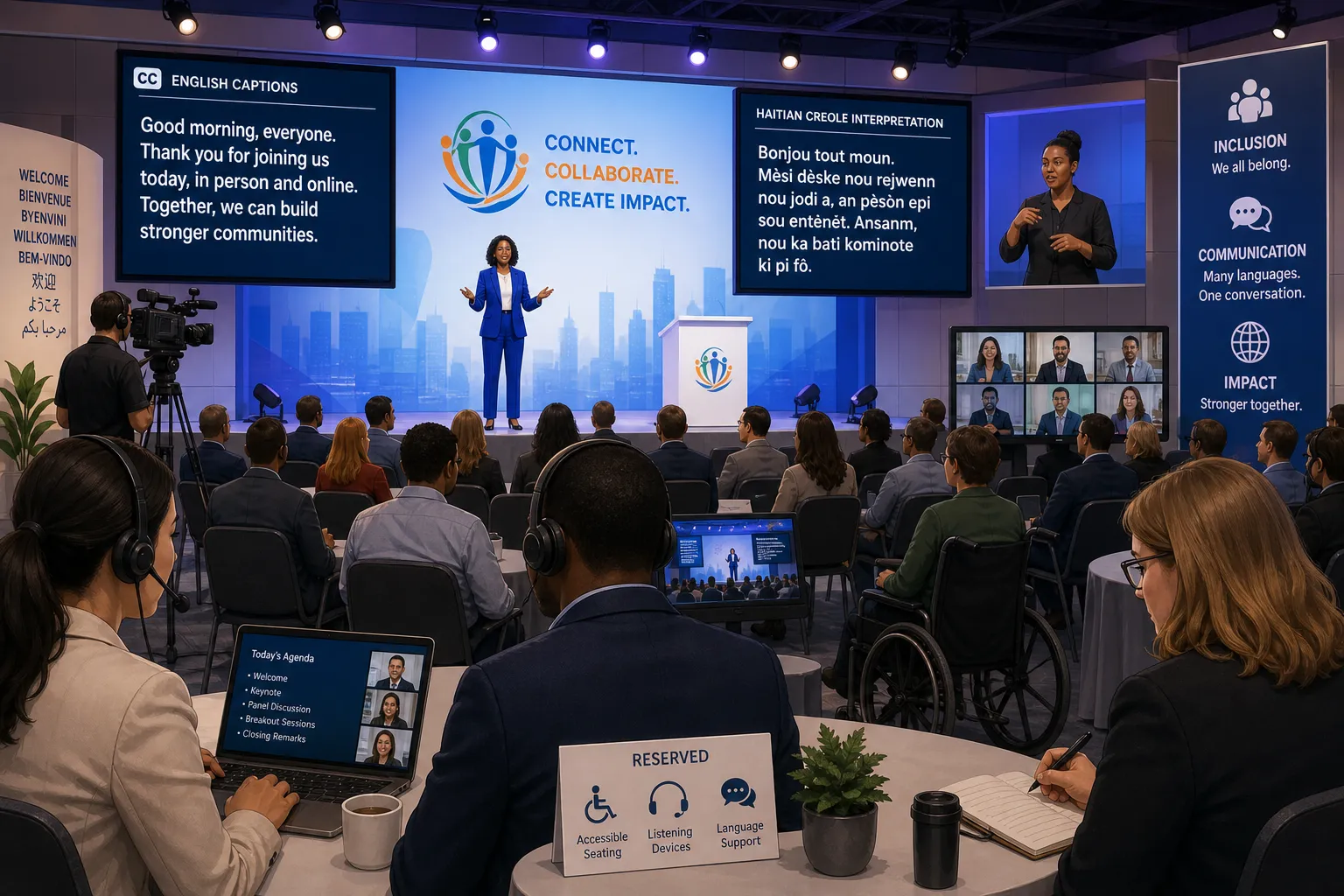
This is one of the biggest content gaps in many competing articles: they discuss translation as if it only lives on a page. In reality, many organizations need multichannel communication support, especially during live experiences where delays and confusion are costly.
When to Use Human Translation, AI Translation, or a Blended Approach
A smart strategy is not “human versus AI.” It is choosing the right level of support for the risk, visibility, and purpose of the content.
Human Translation Is Best For
-
Legal or compliance-sensitive documents
-
Public-facing brand content
-
Medical or educational materials
-
High-stakes community messaging
-
Emotionally nuanced or culturally sensitive content
AI-Powered Translation Is Useful For
-
Speed on large content volumes
-
Draft generation
-
Internal working copies
-
Repetitive content with controlled terminology
-
Fast-turn multilingual workflows
A Blended Workflow Is Often the Best Option
Team Stream’s approach combines the efficiency of AI with the judgment of experienced language professionals. That means clients can move faster without sacrificing accuracy, clarity, or audience trust.
This is especially valuable when you need to scale multilingual communication across:
-
Large events
-
Internal communications
-
Video libraries
-
Ongoing outreach campaigns
-
Hybrid meeting environments
Translation Quality Depends on More Than Language Fluency
A good translator is not just bilingual. They must understand the purpose of the content and the environment where it will be used.
Key Quality Factors
|
Factor |
Why It Matters |
|---|---|
|
Subject knowledge |
Medical, legal, education, and event terminology must be correct |
|
Cultural understanding |
Meaning and tone vary across communities |
|
Audience fit |
Language for parents differs from language for executives |
|
Review process |
Editing and QA catch ambiguity and inconsistency |
|
Delivery format |
Subtitles, live captions, PDFs, slides, and websites all have different constraints |
Many organizations underestimate the format challenge. For example, translating a PDF differs from translating stage screen content or live webinar subtitles. Team Stream supports the full chain, from language production to final delivery.
Accessibility Should Be Part of the Translation Conversation
One of the biggest missed opportunities in multilingual communication is treating translation and accessibility as separate efforts. They should work together.
For example:
-
A translated video is stronger with captions
-
A bilingual live event is stronger with on-screen captioning
-
A webinar is more inclusive with interpretation and real-time text access
-
A community announcement is more effective when delivered in multiple formats
Team Stream helps clients align language access with accessibility goals through:
-
Live captioning
-
Closed captioning
-
Subtitling
-
Voiceover
-
Interpreting
-
Remote and in-person support
-
Compliance-friendly workflows
This is especially useful for organizations that need to serve diverse audiences while meeting internal standards or public-facing inclusion goals.
Common Mistakes to Avoid in Haitian to English Translation
Relying on Word-for-Word Conversion
Literal translation often misses idioms, tone, and intended meaning. What is technically translated may still be practically unclear.
Ignoring Audience Context
A message for first-time program participants should not sound like internal corporate jargon. Translation should reflect who the audience is and what they need to do next.
Forgetting About Audio and Visual Delivery
Written translation alone may not be enough. Many users interact through video, livestreams, presentations, and meetings.
Treating Accessibility as an Afterthought
If your content is translated but not captioned, voiced, or formatted accessibly, many users may still be left out.
Using One Vendor for Translation and Another for Event Execution
Fragmented delivery often creates avoidable issues. Team Stream’s end-to-end model helps reduce that risk by combining language services, accessibility support, equipment options, and technician coordination under one responsive partner.
What Strong Haitian Creole and English Support Looks Like in Practice
A mature language access strategy usually includes several layers working together:
-
Accurate written translation for documents and web content
-
Interpreting support for meetings, outreach, and events
-
Captioning and subtitling for accessibility and comprehension
-
Voiceover or spoken translation for media and training
-
Technical execution for hybrid, virtual, and live experiences
-
Responsive project management to keep timelines and quality on track
That broader support model is where Team Stream stands apart. With over 25 years of experience, our team helps clients execute multilingual and accessible communication with confidence, whether the setting is a boardroom, sanctuary, convention hall, livestream, training portal, or community event.
How Team Stream Helps Organizations Communicate Clearly Across Languages
Team Stream supports clients with a flexible mix of services designed around real-world communication needs, including:
-
Professional written translation
-
Human and AI-powered language solutions
-
Live interpreting
-
Real-time captioning
-
Closed captioning and subtitling
-
Voiceover support
-
In-person and remote delivery
-
Event equipment rental and technician support
-
Solutions for live, virtual, and hybrid events
-
Service models tailored to compliance, accessibility, and audience engagement goals
What clients value most is not only the service menu. It is the confidence that comes from working with an experienced, responsive team that understands both language quality and event execution.
Final Thoughts: Clear Communication Requires More Than Translation Alone
If your organization serves Haitian Creole and English-speaking audiences, clarity cannot be left to chance. The right translation protects meaning, improves engagement, supports accessibility, and helps people take action with confidence.
The best results come from a strategy that considers the full communication journey: documents, websites, video, live events, outreach, accessibility, and audience experience.
That is exactly where Team Stream delivers value. We combine accurate human expertise, AI-enabled efficiency, real-time captioning, interpreting, subtitling, voiceover, accessibility support, and event-ready execution into one dependable partnership. Whether you need a single translated document or a complete multilingual solution for a live, virtual, or hybrid event, Team Stream helps you communicate clearly and inclusively from start to finish.
If you are ready to make your message work across languages without losing accuracy or impact, Team Stream is ready to help.
FAQ
What is the most accurate Haitian Creole translator?
The most accurate option is usually a professional human translator or a human-reviewed AI workflow, especially for business, healthcare, education, and public-facing content. For high-stakes communication, Team Stream combines language expertise with quality control to preserve meaning, tone, and cultural context.
How do you say clean in Haitian Creole?
A common translation of clean in Haitian Creole is pwòp. The exact wording can vary depending on whether you mean physically clean, neat, or pure, which is why context matters in professional translation.
What is “I love you” in Haitian Creole?
I love you in Haitian Creole is commonly written as Mwen renmen ou. As with many phrases, tone and situation can affect how natural or formal it sounds in real communication.
What is “I love you” in Haitian Creole?
I love you in Haitian Creole is commonly written as Mwen renmen ou. For everyday communication, the phrase is simple, but professional translation still matters when the message is part of broader marketing, outreach, or video content.
