

Haitian Creole Translator for Business and Events
If you’re searching for a Haitian Creole translator, you’re probably not looking for a language lesson. You need to solve a real communication problem: translate documents accurately, support a live meeting, make a church service accessible, help staff communicate with families, or make sure an event includes Haitian Creole-speaking attendees in a meaningful way.
That is where many organizations get stuck. Some searches lead to generic apps. Others mix up Haitian Creole with French. And many providers talk broadly about “language services” without clearly explaining what you actually need for documents, live interpretation, audio, captions, or community outreach.
This guide breaks it down clearly for event organizers, churches, healthcare teams, businesses, and community-focused organizations. It explains what different Haitian language services actually do, when AI tools can help, when human expertise is essential, and how to choose the right support for the moment.
At Team Stream, we help organizations bridge these gaps with accurate human and AI-powered translation and interpreting, real-time captioning for accessibility and engagement, end-to-end language and accessibility solutions, and dependable support for live, virtual, and hybrid environments. Whether you need a single translated handout or a fully supported multilingual event with equipment and technician services, the goal is the same: communication that works for everyone.
“Haitian Creole, also known as Kreyòl Ayisyen, is a French-based creole language spoken by over 13 million people worldwide.” – EBSCO
“Haitian Creole is the native language of the entire Haitian population, comprising over 11 million people.” – FIU
Why Demand for Haitian Creole Language Support Is Growing
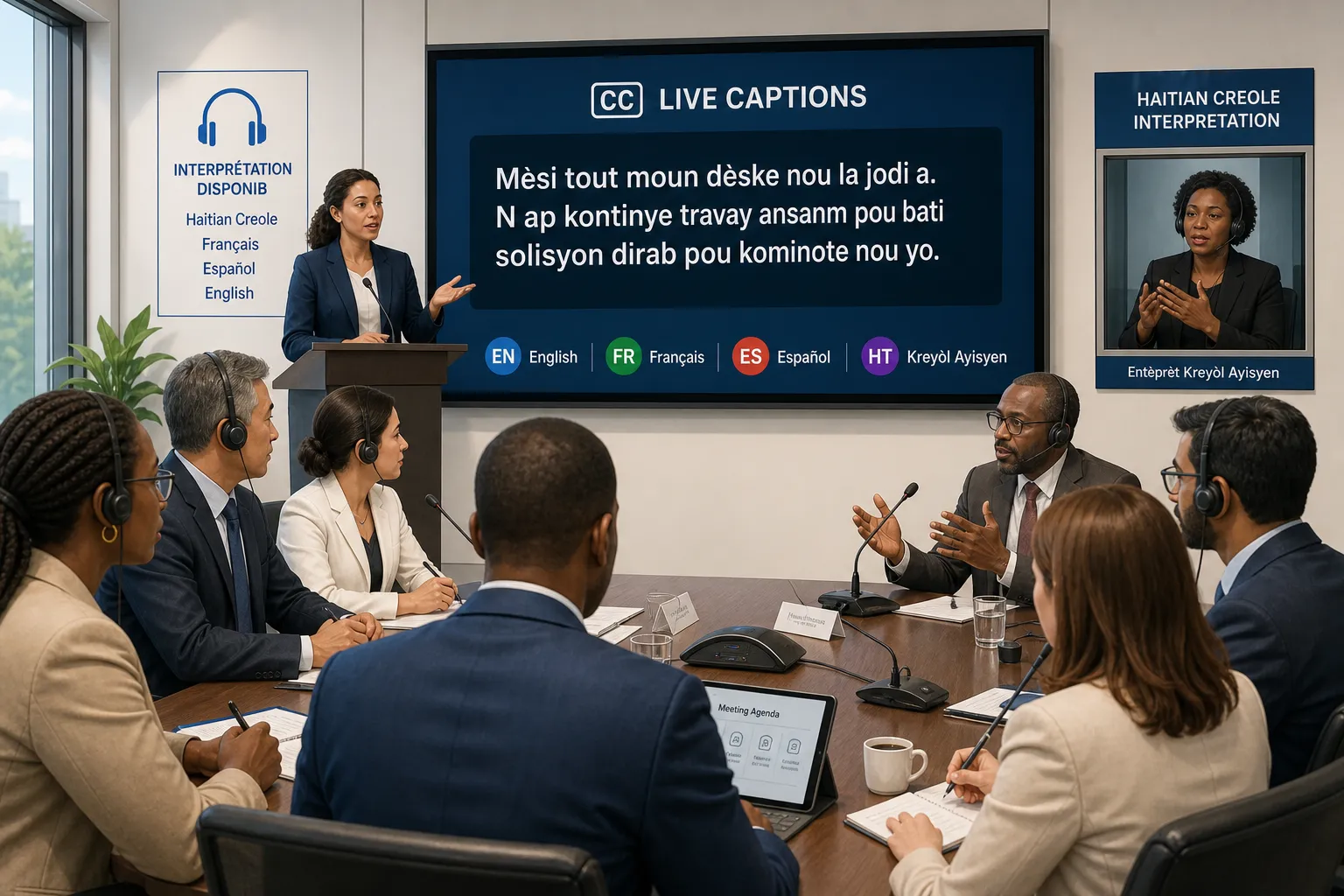
Haitian Creole is essential in healthcare, education, government communication, faith-based outreach, internal workplace communication, and public-facing events across many U.S. communities. As organizations become more intentional about inclusion, compliance, and audience engagement, they are realizing that “English plus maybe French” is not enough for Haitian communities.
That matters in practical ways:
-
A hospital discharge document may need written translation, not a quick verbal summary.
-
A church service may need live interpretation plus projected captions.
-
A company town hall may need real-time interpreting for in-person and remote staff.
-
A conference may need multilingual audio, captions, and technician support to run smoothly.
-
A nonprofit may need culturally appropriate outreach materials, not just literal word-for-word translation.
Competitor content often explains interpretation at a high level, but it frequently misses the operational side: planning, accessibility, platform setup, audience experience, and the difference between simple bilingual communication and truly inclusive delivery. That is a major gap, and it is where the right partner makes a difference.
What People Mean When They Search for a Haitian Translator
The phrase “Haitian translator” can refer to several very different services. That is why choosing the right format matters as much as choosing the right language professional.
A Haitian Translator vs. a Haitian Creole Translator
In most business and event contexts, people searching for a “Haitian translator” are looking for a Haitian Creole translator, because Haitian Creole is the everyday language of the population and diaspora. “Haitian” describes nationality, while Haitian Creole identifies the language.
This distinction matters because language matching affects comprehension, trust, and outcomes. A translated message that assumes French proficiency may miss the audience entirely.
Why “French Creole Translator” Can Be Misleading
Searches for a “French Creole translator” are common, but they often reflect confusion rather than an exact language need. Haitian Creole has deep historical connections to French, but it is not the same language. It has its own grammar, pronunciation, spelling conventions, and cultural usage.
If your audience is Haitian Creole-speaking, do not assume French content will work as a substitute. For outreach, employee communication, healthcare materials, and events, that assumption can create real misunderstandings.
The Four Main Types of Haitian Creole Language Support
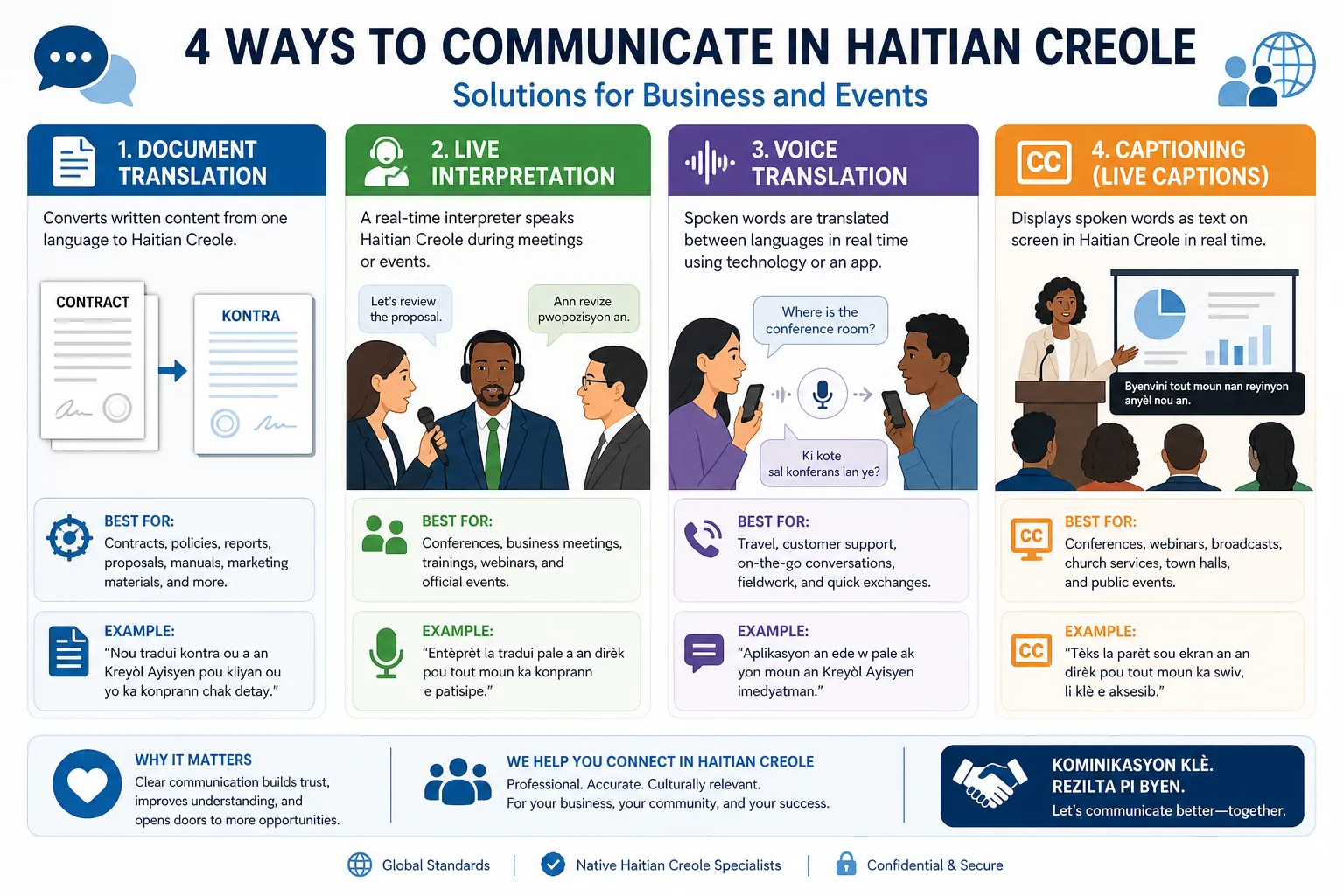
Most organizations do not need “translation” in the abstract. They need one of four specific services.
1. Written Translation
This is for documents, forms, signage, websites, handouts, training materials, presentations, email campaigns, and public information.
Use written translation when:
-
The audience needs to read and reference the information later
-
Accuracy must be reviewed before distribution
-
You need branded, polished, compliance-friendly communication
-
Materials contain technical, legal, medical, or policy language
Examples include:
-
Employee onboarding materials
-
Church bulletins and ministry resources
-
Healthcare instructions and consent forms
-
Event programs and exhibitor materials
-
Community outreach flyers and enrollment packets
2. Live Interpretation
Interpretation is spoken language support in real time. This is what you need for meetings, sermons, conferences, trainings, interviews, webinars, and Q&A sessions.
There are two main forms:
|
Type |
Best For |
How It Works |
|---|---|---|
|
Simultaneous interpretation |
Conferences, services, panels, town halls, corporate meetings |
Interpreter speaks in real time while the speaker continues |
|
Consecutive interpretation |
Small meetings, interviews, short exchanges |
Speaker pauses, then interpreter renders the message |
For events, simultaneous is often the better choice because it keeps the session on schedule and creates a better attendee experience.
3. Voice Translation Tools
Searches for a Haitian Creole translator voice or Haitian Creole voice translator usually point to speech-enabled apps or AI tools that convert spoken language into audio output.
These tools can be useful for:
-
Quick directional help
-
Basic conversational support
-
Simple travel or hospitality exchanges
-
Preliminary internal communication needs
But for high-stakes settings, voice tools alone are often not enough. They may struggle with accents, poor audio, overlapping speakers, idioms, cultural nuance, or sector-specific terminology.
4. Captioning and On-Screen Text Support
This is one of the most overlooked content gaps in competitor articles. Translation and interpretation are only part of the access picture. Captions can dramatically improve understanding, engagement, and accessibility.
Captions are especially useful for:
-
Hybrid and virtual events
-
Large rooms where audio clarity varies
-
Attendees who are deaf or hard of hearing
-
Multilingual audiences following along visually
-
Broadcasts, livestreams, and recorded content
Team Stream provides real-time captioning, closed captioning, subtitling, and integrated accessibility solutions so organizations can support more than one communication need at once.
Haitian Translation to English: When Reverse Translation Matters
Many organizations focus on English-to-Haitian communication, but Haitian translation to English is just as important.
You may need it when:
-
Staff receive handwritten or recorded messages from community members
-
Medical or legal documents arrive in Haitian Creole
-
Churches or nonprofits collect testimonials, forms, or prayer requests
-
HR or operations teams need to understand employee submissions
-
Event teams need to translate participant feedback or speaker material
Reverse translation requires more than literal conversion. The translator needs to preserve meaning, tone, and context so English-speaking teams can act on the information accurately.
Human vs. AI: What Should You Use?
One of the biggest gaps in competitor content is the tendency to frame this as either human or AI. In reality, the best solution is often a fit-for-purpose mix.
When AI Can Be Helpful
AI-powered translation and voice tools can work well for:
-
Fast first drafts
-
Internal reference use
-
Low-risk multilingual support
-
Real-time event translation when stakes are moderate
-
Captioning workflows that include human oversight
When Human Expertise Is Essential
Use a professional human linguist or interpreter when:
-
Accuracy affects health, legal rights, employment, or safety
-
Tone and trust matter for community engagement
-
The speaker uses nuanced or technical language
-
The event is public-facing or high-visibility
-
Brand reputation is on the line
-
You need reliable bilingual interaction in both directions
At Team Stream, we do not force clients into a one-size-fits-all model. We help you choose the right balance of human expertise and AI-enabled speed, then support the delivery with the right workflow, platform setup, and accessibility layer.
Choosing the Right Service by Use Case
For Businesses and Internal Communications
A business may need Haitian language support for team meetings, HR updates, safety training, policy rollouts, onboarding, or multilingual video content.
Best-fit solutions often include:
-
Written translation for policies and onboarding materials
-
Live interpreting for trainings and town halls
-
Captioning for company-wide virtual meetings
-
Voiceover or subtitling for training videos
For internal communications, clarity matters just as much as speed. A misunderstood benefits update or safety instruction can create operational problems quickly.
For Conferences, Trade Shows, and Corporate Events
Event planners need more than a translator. They need a working attendee experience.
That often includes:
-
Simultaneous interpreters
-
Audience audio delivery
-
Live captions
-
Hybrid meeting platform support
-
On-site technician services
-
Equipment rental for receivers, transmitters, booths, or audio feeds
Competitor articles discuss interpreters and booths, but they rarely connect language access to production realities. Team Stream supports both the language and event execution side, which reduces risk for planners managing multiple moving parts.
For Churches and Faith-Based Organizations
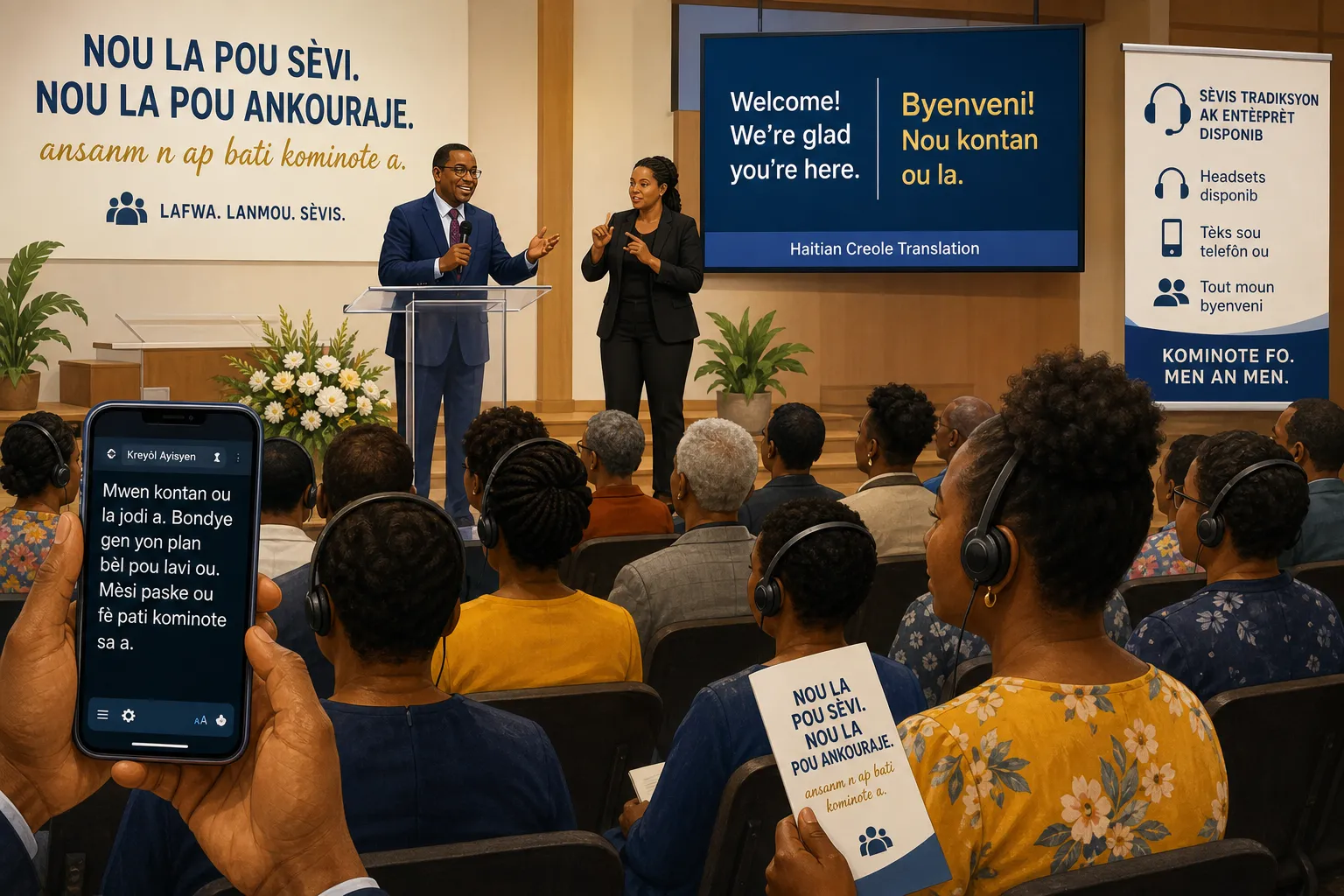
Churches often need a mix of relationship-centered communication and dependable logistics.
Common needs include:
-
Live interpretation during services, conferences, or revivals
-
Translated discipleship resources and ministry materials
-
Subtitles or captions for livestreams and recorded sermons
-
Community outreach translation for events, enrollment drives, or support programs
Tone matters here. Faith language, scripture references, and pastoral communication all require care, not just fluency.
For Healthcare Teams
In healthcare, the difference between “close enough” and accurate can be serious.
Common needs include:
-
Translated forms and discharge instructions
-
Interpreting for appointments, education, or enrollment events
-
Bilingual outreach materials
-
Captioning or subtitling for patient education content
Compliance, privacy, and terminology are all critical. A provider should understand not only the language but also the responsibility that comes with healthcare communication.
For Community Outreach and Public Sector Communication
Outreach succeeds when messages are understandable, respectful, and easy to access.
That may require:
-
Translation of flyers, notices, and forms
-
Interpretation for town halls and information sessions
-
Mobile-friendly captions or multilingual livestreams
-
Bilingual support for public engagement campaigns
A literal translation is not always enough. Community-facing communication works best when it is culturally aware and designed for real audiences, not just word replacement.
How to Evaluate Haitian Creole Translation Services
Not all providers offer the same level of specialization, support, or execution. Use the checklist below when comparing options.
Evaluation Checklist
|
What to Look For |
Why It Matters |
|---|---|
|
Native or highly specialized Haitian Creole linguists |
Improves natural phrasing and audience trust |
|
Experience in your sector |
Reduces risk with medical, legal, faith-based, or technical terminology |
|
Live event capability |
Essential for conferences, worship services, broadcasts, and hybrid meetings |
|
Captioning and accessibility support |
Helps you serve broader audiences and meet access expectations |
|
Human + AI options |
Gives you flexibility on speed, budget, and risk level |
|
Equipment and technician support |
Prevents event-day failures and simplifies production |
|
Remote and in-person delivery |
Lets you match the service model to your format |
|
Responsive project management |
Keeps timelines, approvals, and logistics under control |
At Team Stream, these capabilities come together in one place: interpreting, translation, captioning, subtitling, voiceover, event support, equipment rental, and technician services, all tailored to your communication goals.
Signs You Need More Than an App
A Haitian Creole voice translator app may seem convenient, but there are clear signs you need professional support instead.
You likely need a language services partner if:
-
The message affects safety, care, policy, or legal understanding
-
You are communicating to a large audience
-
You need two-way interaction, not just one-way output
-
The content includes specialized terms or faith-based references
-
The event is live, public, or recorded
-
Accessibility and compliance matter
-
You need a polished experience that reflects well on your organization
In these cases, the real question is not “Can a tool translate this?” It is “Can everyone understand, trust, and act on this communication?”
Planning a Haitian Creole-Supported Event: What Competitors Often Miss
Competitor articles do a decent job explaining simultaneous vs. consecutive interpretation, but they often gloss over planning details that event teams actually need.
Key Decisions to Make Early
Audience Profile
How many attendees need Haitian Creole support? Will they be in-room, online, or both? Do they need audio, captions, or translated materials before and after the event?
Delivery Model
Will you use human interpretation, AI-powered live translation, or a hybrid model? Will attendees listen on headsets, on their phones, through a webcast, or through a platform channel?
Accessibility Layer
Will the event also need live captions, CART-style support, or subtitling for later distribution?
Technical Workflow
How will interpreters receive clean audio? How will translated audio feed back into the room or platform? Who manages transitions, troubleshooting, and testing?
Pre-Event Materials
Interpreters and translators perform better when they receive:
-
Speaker names
-
Agendas
-
Slides
-
Acronyms
-
Program terms
-
Scripture references or sermon notes
-
Product names or internal language
This is one reason Team Stream’s end-to-end approach is valuable. Language access is strongest when it is planned as part of the production, not bolted on at the end.
Haitian Creole Voice Translator Tools: Useful, but Not the Whole Answer
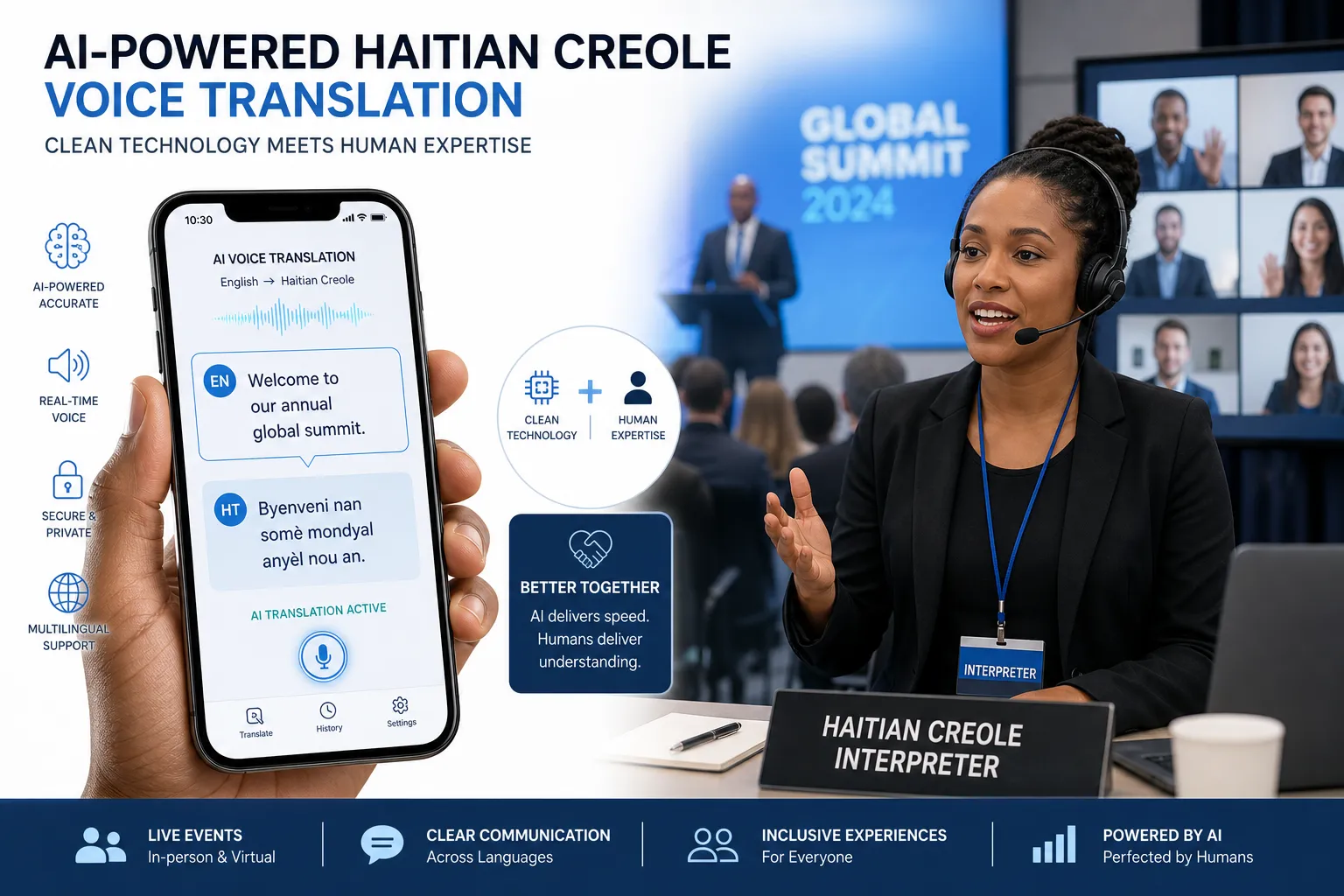
Interest in Haitian Creole translator voice tools is growing for good reason. Organizations want speed, convenience, and scale. AI can absolutely help, especially for basic multilingual support and some live event applications.
But voice tools have limits:
-
They may mis-handle names, acronyms, or dialect variation
-
They can struggle in noisy environments
-
They may not preserve tone or intent
-
They are weak at managing audience questions and back-and-forth dialogue
-
They do not replace event planning, accessibility support, or human judgment
The best approach is often layered:
-
Use AI where speed and scale help.
-
Add human expertise where nuance and accuracy matter.
-
Support the audience with captions, audio access, and technician oversight.
That is how you get both efficiency and confidence.
Common Mistakes Organizations Make
Assuming French Is Close Enough
It is not. If your audience primarily speaks Haitian Creole, French materials may not deliver the message effectively.
Booking Language Support Too Late
Interpretation, captioning, and event workflows all benefit from advance planning.
Focusing Only on Translation, Not Accessibility
If attendees cannot hear clearly, see captions, or follow the platform, the service is incomplete.
Choosing the Lowest-Cost Option Without Considering Risk
Cheap tools can become expensive if they create confusion, delays, or mistrust.
Forgetting About Post-Event Content
Recorded sessions may need subtitles, translated summaries, or accessible archives after the live event ends.
Why Team Stream Is a Strong Fit
Organizations come to Team Stream when they need more than a vendor list of disconnected services. They need a partner that can look at the whole communication environment.
That includes:
-
Accurate human interpretation and translation
-
AI-powered language support where appropriate
-
Real-time captioning for accessibility and engagement
-
Closed captioning, subtitling, and voiceover
-
Support for live, virtual, and hybrid events
-
Compliance-friendly communication workflows
-
Professional equipment rental and technician support
-
Flexible in-person and remote delivery options
-
A responsive team backed by over 25 years of experience
This matters because multilingual communication is rarely just about language. It is about execution, audience experience, accessibility, and trust.
Final Thoughts
If you are looking for a Haitian Creole translator for business, ministry, healthcare, or events, the right choice depends on what you are trying to accomplish. A document translation project, a live interpreted event, a community outreach campaign, and a voice-enabled quick communication tool all solve different problems.
The strongest results come from matching the service to the moment. Use professional written translation when people need lasting, accurate content. Use experienced interpreters when communication is live and important. Use AI thoughtfully where speed helps. And do not overlook captions, accessibility, and technical delivery.
Team Stream helps organizations put all of those pieces together. If you want multilingual communication that is accurate, inclusive, and professionally executed, Team Stream is ready to help you design the right solution for your audience, format, and goals.
FAQ
What is the best translator for Haitian Creole to English?
The best option depends on the situation. For important business, healthcare, legal, or live event communication, a professional Haitian Creole linguist is more reliable than a generic app. For low-risk, quick-use scenarios, AI tools can help, but they should not replace human expertise when accuracy matters.
What does chawa pete mean?
Expressions like “chawa pete” can be idiomatic, contextual, and regionally influenced, which is exactly why literal translation tools can struggle. If a phrase appears in a sensitive or public-facing context, it is best to have a qualified Haitian Creole translator interpret the intended meaning based on tone and usage.
How much do translators charge per 1000 words?
Pricing varies based on subject matter, turnaround time, formatting needs, and review level. A simple general document will cost less than medical, legal, or branded marketing content. The best way to budget accurately is to request a quote based on the actual file and use case.
How to bill for interpreter services?
Interpreter services are commonly billed by hour, half-day, or full-day, with added costs depending on format, travel, equipment, technician support, and whether one or two interpreters are required. For events and longer sessions, pricing often reflects both language coverage and the technical setup needed for smooth delivery.
