

Difference Between Translation and Interpretation
If you organize events, run corporate meetings, produce webinars, manage multilingual content, or need to make communication accessible, understanding the difference between translation and interpretation is not just academic. It directly affects quality, compliance, attendee experience, turnaround time, and budget.
Many businesses use the two terms interchangeably. That creates preventable mistakes: booking interpreters when written translation is needed, expecting translated documents from a live event language team, or overlooking captioning and accessibility requirements altogether. The result can be confusion, delays, and a poor experience for multilingual audiences.
Team Stream helps organizations avoid those missteps by delivering human and AI-powered translation and interpreting, real-time captioning, subtitling, voiceover, accessibility support, equipment rental, and technician services for live, virtual, and hybrid environments. With over 25 years of expertise, Team Stream works as a practical partner for organizations that need communication to be accurate, inclusive, and dependable.
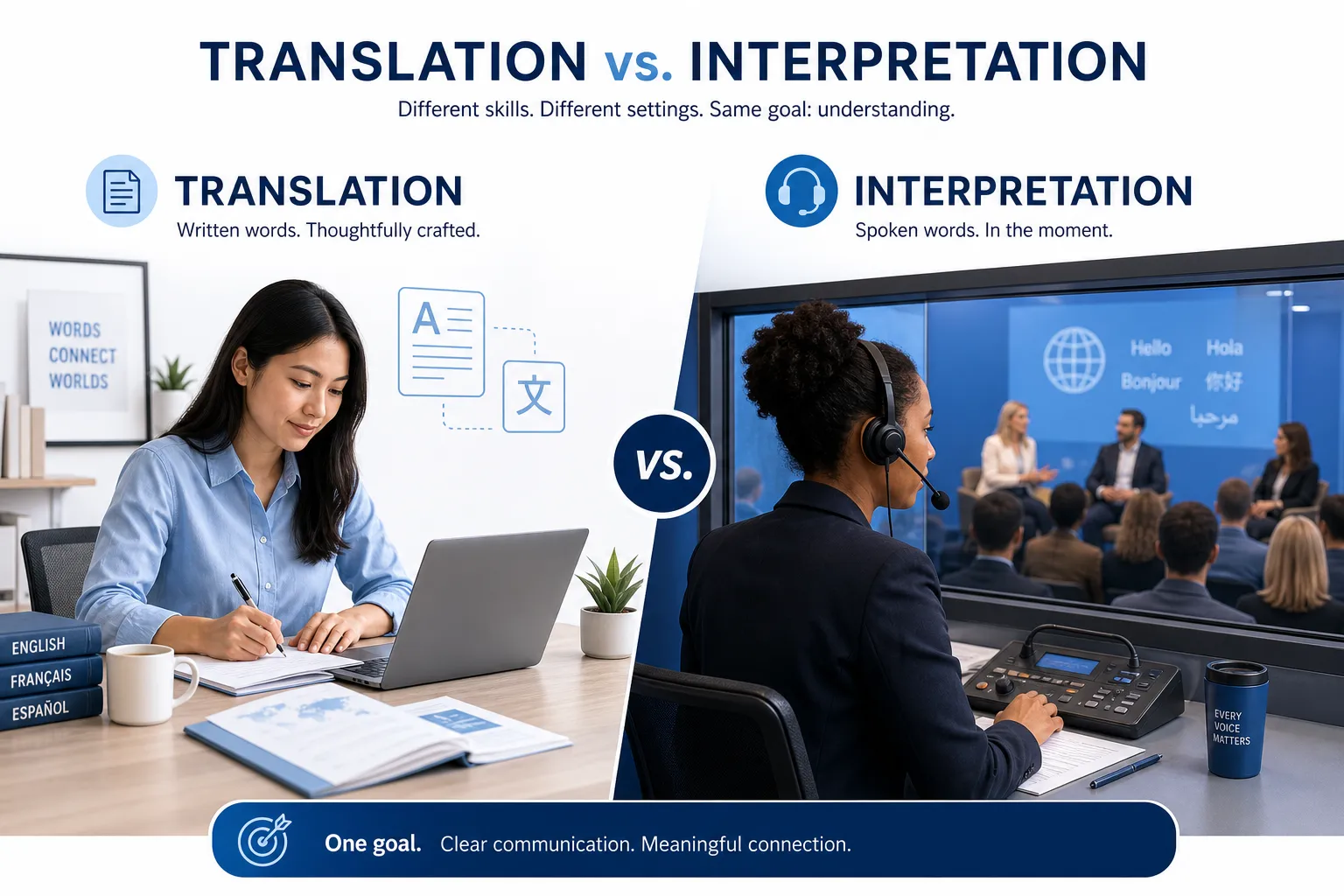
Translation vs. Interpretation at a Glance
The simplest way to understand the distinction is this:
-
Translation deals primarily with written content
-
Interpretation deals primarily with spoken or signed communication in real time
That sounds simple, but the operational differences are much bigger.
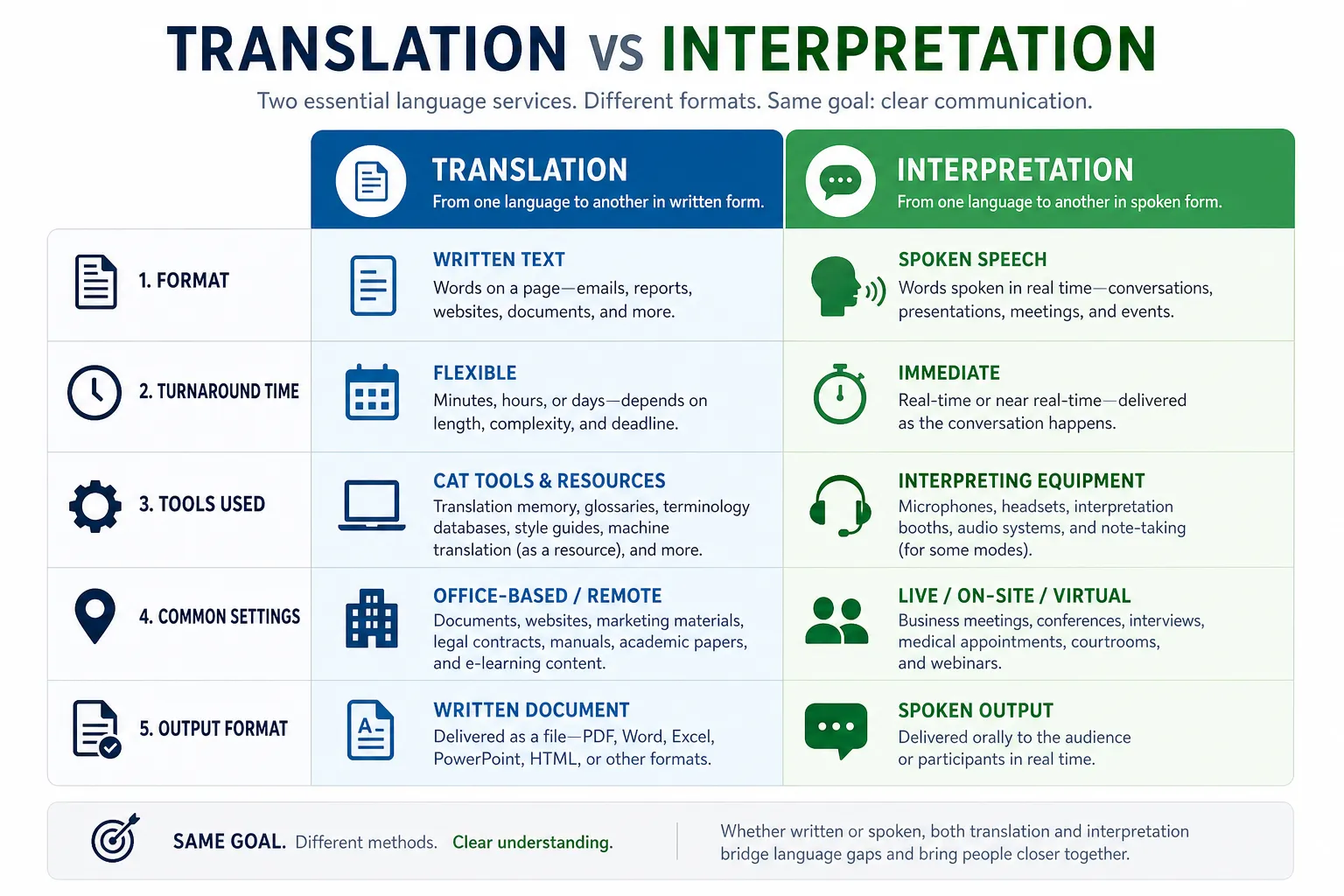
|
Factor |
Translation |
Interpretation |
|---|---|---|
|
Main format |
Written text |
Spoken or signed language |
|
Typical timing |
Not live; often scheduled over hours or days |
Live or near-live |
|
Output |
Documents, subtitles, websites, signage, transcripts |
Spoken rendering, signed interpretation, live audio feed |
|
Tools |
CAT tools, glossaries, translation memory, QA tools |
Headsets, booths, remote interpreting platforms, consoles, notes |
|
Revision process |
Can be edited, reviewed, proofed |
Usually delivered once in real time |
|
Common settings |
Contracts, websites, manuals, brochures, captions |
Conferences, meetings, webinars, courtrooms, worship services |
|
Core skill |
Writing accurately for the target audience |
Listening, processing, and delivering instantly |
What Is Translation?
Translation is the process of converting written text from one language into another while preserving meaning, tone, terminology, and intent.
A translator does much more than replace words. Good translation takes into account:
-
context
-
audience
-
industry terminology
-
cultural nuance
-
compliance requirements
-
tone and brand voice
-
layout or media format constraints
Common Examples of Translation
Businesses often need translation for:
-
websites and landing pages
-
brochures and sales materials
-
contracts and legal forms
-
employee handbooks
-
training manuals
-
product packaging
-
subtitles and captions
-
event signage
-
post-event transcripts
-
multilingual marketing campaigns
What Makes Professional Translation Effective?
Strong translation is:
-
accurate
-
audience-aware
-
industry-specific
-
consistent across terminology
-
properly reviewed
-
formatted for its final use
For example, translating a healthcare consent form requires a different process than translating trade show booth graphics or a church sermon transcript. Team Stream’s tailored approach matters here because one-size-fits-all language support often fails where precision matters most.
What Is Interpretation?
Interpretation is the process of converting spoken or signed communication from one language into another, usually in real time or with very little delay.
The interpreter listens to the speaker, understands the message, and communicates it in another language so the audience can follow along immediately.
Common Examples of Interpretation
Interpretation is commonly used in:
-
conferences
-
board meetings
-
webinars
-
live streams
-
trade shows
-
medical appointments
-
legal settings
-
church services
-
broadcast productions
-
internal town halls
-
training sessions
Types of Interpretation
Simultaneous Interpretation
The interpreter renders the message almost at the same time the speaker is talking. This is common for:
-
conferences
-
multilingual events
-
keynote sessions
-
broadcasts
-
live virtual meetings
-
hybrid events
This method often requires specialized platforms, receivers, headsets, booths, and technician support. Team Stream supports these high-stakes settings with both in-person and remote delivery, plus the event tech and coordination needed to keep everything running smoothly.
Consecutive Interpretation
The speaker pauses after a few sentences, then the interpreter delivers the message in the target language. This is common for:
-
interviews
-
smaller meetings
-
consultations
-
on-site tours
-
one-on-one business discussions
Whispered Interpretation
The interpreter quietly interprets for one or two listeners without using a full booth setup. This can work in smaller, controlled settings.
Sign Language Interpreting
This supports Deaf and hard-of-hearing participants and is often part of a broader accessibility strategy for events, workplaces, and broadcasts.
The Real Difference Between Translation and Interpretation
Competitor articles usually stop at “written vs spoken.” That is true, but incomplete. The real difference affects planning, technology, staffing, accessibility, and risk.
1. Translation Is Written; Interpretation Is Live Communication
Translation typically produces a finished text. Interpretation supports a conversation or presentation as it happens.
2. Translators Have Time to Research; Interpreters Must Decide Instantly
A translator can check terminology, consult style guides, and revise drafts. An interpreter must process tone, meaning, and terminology in seconds.
3. Translation Is Usually Editable; Interpretation Is Ephemeral
A translated document can be reviewed and revised before delivery. Interpretation is often heard once, live, in the moment.
4. They Use Different Technology
Translators may use:
-
translation memory
-
terminology databases
-
QA software
-
subtitling tools
-
AI-assisted workflows
Interpreters may use:
-
simultaneous interpreting platforms
-
booths and consoles
-
wireless receivers
-
remote audio routing
-
event production support
-
technician-managed signal paths
5. Accessibility Often Sits Alongside Both
This is one of the biggest gaps in most articles. Modern multilingual communication is not just about translation or interpretation. It often also includes:
-
live captioning
-
closed captioning
-
subtitles
-
voiceover
-
sign language support
-
accessible media formatting
-
compliance-friendly delivery
That is why many event organizers and communications teams need an integrated provider, not a single isolated service.
“A 2026 report found that 72% of digital event platforms lack live captioning, leaving many attendees without access to essential content.” – WorldMetrics
Why Businesses Confuse Translation and Interpretation
The confusion happens because both services bridge languages. But when teams plan multilingual communication, they are often really deciding between several different outputs.
Here is a practical way to think about it:
|
If you need this… |
You probably need… |
|---|---|
|
A bilingual contract |
Translation |
|
A multilingual conference session |
Interpretation |
|
Captions for a webinar recording |
Translation and/or captioning |
|
Live subtitles during a keynote |
Real-time captioning, possibly with interpretation |
|
A dubbed product demo |
Translation, voiceover, and post-production |
|
A hybrid event for global audiences |
Interpretation, captions, tech support, and accessibility planning |
This is where Team Stream’s end-to-end model becomes useful. Instead of forcing clients to coordinate multiple vendors, Team Stream can combine interpreting, translation, captioning, subtitling, voiceover, equipment, and technicians into one coordinated solution.
When You Need Translation
Choose translation when your priority is written accuracy, consistency, and polish.
Translation Is Best For:
-
websites
-
legal documents
-
brochures
-
training materials
-
signage
-
email campaigns
-
subtitles
-
internal documents
-
manuals
-
multilingual post-event resources
Questions to Ask Before Ordering Translation
-
Who is the target audience?
-
Is this content legal, technical, medical, or marketing-related?
-
Do you need multilingual formatting or desktop publishing?
-
Will this be published online, printed, or displayed on screen?
-
Does the translation need certification or compliance sensitivity?
-
Is speed more important, or is editorial refinement the priority?
When You Need Interpretation
Choose interpretation when people need to understand speech in real time.
Interpretation Is Best For:
-
conferences and summits
-
multilingual meetings
-
shareholder updates
-
internal town halls
-
worship services
-
court or legal encounters
-
medical communication
-
sales presentations
-
media interviews
-
virtual and hybrid broadcasts
Questions to Ask Before Booking Interpretation
-
Is the event live?
-
How many languages are needed?
-
Is the format in-person, virtual, or hybrid?
-
Do you need simultaneous or consecutive interpreting?
-
Will attendees also need captions?
-
Is technical equipment required?
-
Do you need operator or technician support?
Translation, Interpretation, and Captioning: How They Work Together
This is another area competitors often underexplain. In many modern events, the right solution is not one service, but a combination.
Example: Global Corporate Town Hall
You may need:
-
simultaneous interpreters for Spanish and French listeners
-
live captions in English for accessibility and engagement
-
translated post-event summaries for teams in multiple countries
-
subtitled recordings for on-demand viewing
Example: Hybrid Conference
You may need:
-
on-site interpreter equipment
-
remote interpreter feeds for virtual attendees
-
captions displayed in-room and online
-
translated booth materials and sponsor documents
-
technician support to ensure no audio failures
Example: Broadcast or Church Production
You may need:
-
live interpretation for stream audiences
-
real-time captioning
-
post-produced subtitles
-
translated promotional assets
-
voiceover for replay content
Team Stream is especially strong in these blended scenarios because it does not treat language access and accessibility as separate afterthoughts. It brings them together into one execution plan.
Which Skills Do Translators and Interpreters Need?
Although the disciplines overlap, the skill sets are different.
Translator Skills
A professional translator needs:
-
excellent writing ability
-
mastery of source and target languages
-
research ability
-
subject matter knowledge
-
terminology management
-
editing discipline
-
cultural awareness
Interpreter Skills
A professional interpreter needs:
-
active listening
-
strong memory
-
rapid language processing
-
verbal fluency
-
emotional control under pressure
-
note-taking
-
subject matter familiarity
-
the ability to preserve tone and intent live
“Professional interpreters improve communication, promote appropriate use of resources and significantly increase patient and clinician satisfaction.” – BMJ Open
Can One Person Do Both?
Sometimes, yes. But not always well, and not always appropriately for the assignment.
Some language professionals are qualified in both disciplines, but translation and interpretation are distinct crafts. A brilliant translator may not be the best simultaneous interpreter. A strong conference interpreter may not be the best fit for polished written legal translation.
For important business communication, assume they are separate specialties unless a provider confirms dual expertise.
Human vs AI in Translation and Interpretation
This is one of the most important modern questions.
Where AI Helps
AI can support:
-
draft translation
-
transcription
-
terminology acceleration
-
subtitle creation
-
workflow speed
-
multilingual content scaling
Where Human Expertise Is Still Critical
Humans are still essential for:
-
nuance
-
tone
-
risk-sensitive communication
-
legal or regulated language
-
branding
-
accuracy review
-
live event judgment
-
audience adaptation
-
accessibility quality control
The best current approach is usually not “human or AI.” It is human plus AI, used deliberately. Team Stream’s model reflects that reality by combining accurate human expertise with AI-enabled workflows to improve speed and scale without sacrificing quality.
Common Mistakes to Avoid
Booking Translation for a Live Event Need
If attendees need to understand speakers in real time, you need interpretation, not document translation.
Assuming Captions Equal Translation
Captions are not automatically translated, and translated subtitles are not the same as live interpretation.
Ignoring Accessibility Until the Last Minute
Accessibility should be planned from the start, especially for corporate, public-facing, and compliance-sensitive communications.
Underestimating Technical Setup
Simultaneous interpretation often requires more than interpreters. It may require booths, receivers, routing, remote platforms, technician support, and rehearsal coordination.
Using Generic Vendors for Specialized Content
Medical, legal, financial, and technical communication require specialists. Accuracy matters.
How to Choose the Right Service for Your Situation
Use this quick decision guide.
Choose Translation If:
-
the source material is written
-
you need a polished final document
-
the content will be read, published, printed, or subtitled
-
you need revision and review
-
consistency across materials matters
Choose Interpretation If:
-
the source material is spoken or signed
-
your audience needs immediate understanding
-
the setting is live or interactive
-
multilingual participation is part of the event experience
-
there is no time for post-production before delivery
Choose a Combined Solution If:
-
your event has both live and post-event needs
-
you need multilingual access and accessibility together
-
your audience includes international and Deaf/hard-of-hearing participants
-
your event is hybrid or broadcast-based
-
you need one provider to coordinate execution from end to end
How Team Stream Solves the Full Communication Challenge
Most providers focus on one piece of the puzzle. Team Stream supports the full communication chain.
Team Stream Can Support:
-
professional interpreting for live, virtual, and hybrid events
-
written translation for business, event, and media content
-
live captioning and CART-style support
-
closed captioning and subtitles
-
voiceover services
-
AI-powered language workflows with human quality oversight
-
professional equipment rental and sales
-
technicians and event support specialists
-
flexible in-person and remote service delivery
-
compliance-friendly accessibility support
That matters because clients rarely need just one isolated deliverable. They need confidence that the audience will understand, the event will run smoothly, and the final experience will be inclusive.
Final Verdict
The difference between translation and interpretation comes down to more than written versus spoken language. It is the difference between documents and live delivery, revision and immediacy, text workflows and event execution.
If you need written materials adapted accurately for another language, you need translation. If you need people to understand speech in real time, you need interpretation. If you want a multilingual, accessible experience that actually works for modern events, meetings, broadcasts, and content, you often need both, plus captioning and technical support.
That is where Team Stream stands out. With over 25 years of experience, flexible human and AI-powered solutions, strong customer service, compliance-aware accessibility support, and reliable execution across live, virtual, and hybrid environments, Team Stream helps organizations communicate clearly at every stage.
If your next event, meeting, broadcast, or multilingual project needs to be accurate, inclusive, and professionally managed, Team Stream is the partner to call.
FAQ
What are the differences between translation and interpretation?
Translation works with written content, while interpretation works with spoken or signed communication in real time. Translation usually allows time for research and revision, while interpretation requires immediate delivery during live conversations or events.
What is an example of translation and interpretation?
An example of translation is converting an employee handbook from English into Spanish. An example of interpretation is an interpreter providing live Spanish audio during a conference keynote.
What is the main difference between a translator and an interpreter?
The main difference is that a translator produces written text in another language, while an interpreter conveys spoken or signed messages live. Translators focus on writing and revision; interpreters focus on immediate understanding and delivery.
Which of the following best describes the difference between interpretation and translation?
The best description is that translation converts written language, while interpretation converts spoken or signed language. Translation is usually completed over time, but interpretation happens in real time or near real time.
What is an example of translation and interpretation?
A translated website page is a clear example of translation. A live interpreter helping attendees follow a multilingual webinar is a clear example of interpretation.
Is the Bible translated or interpreted?
The Bible is most commonly translated because it is a written text rendered into other written languages. It may also be interpreted in sermons or live settings when spoken explanations are delivered to an audience.
