

Burmese Translator: What Businesses Need to Know
If your organization needs to communicate clearly with Burmese-speaking audiences, the first challenge is usually not finding a language provider. It is finding the right one for the exact situation.
A Burmese translator is not always the same as a Burmese interpreter. A Burmese language translator may be perfect for documents, websites, or subtitles, but not for live meetings, conferences, hearings, or hybrid events where accuracy must happen in real time. For event organizers, internal communications teams, conference planners, churches, trade show producers, and global businesses, that distinction matters more than most people realize.
This guide explains what each service does, when to use it, what qualifications to look for, and how to choose a partner that can support not only language accuracy, but also accessibility, compliance, and the realities of live, virtual, and hybrid communication.
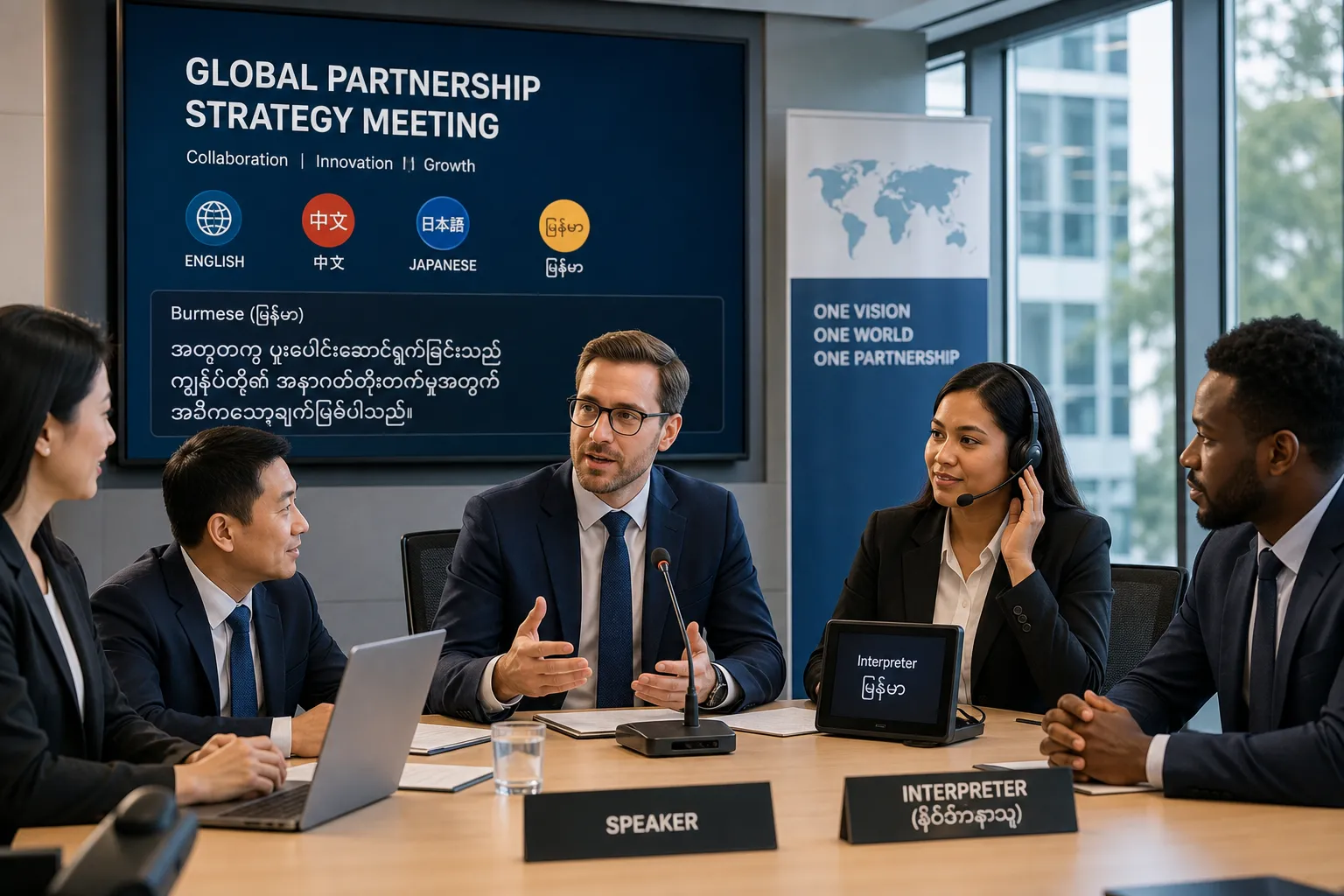
Why Burmese Language Support Matters in Business
Businesses often underestimate how much trust is built or lost through language. In Burmese-speaking contexts, that risk grows when communications involve technical, legal, medical, financial, or event-related content.
Whether you are translating onboarding materials, localizing a product launch, supporting an employee town hall, or running a live event with multilingual attendees, the goal is not just word-for-word conversion. The goal is to make sure the audience understands the message, the tone, and the intent.
That is especially important when:
-
contracts or compliance materials must be precise
-
safety, HR, healthcare, or training information must be understood clearly
-
international guests need real-time access during meetings or events
-
accessibility requirements call for captioning, subtitling, or inclusive communication
-
brand messaging needs to feel natural, not obviously translated
Many competitor pages focus heavily on generic language coverage or industry lists. What they often miss is the operational side: how businesses actually deploy Burmese language support across documents, live events, video, accessibility workflows, and hybrid communications. That is where smarter planning creates better outcomes.
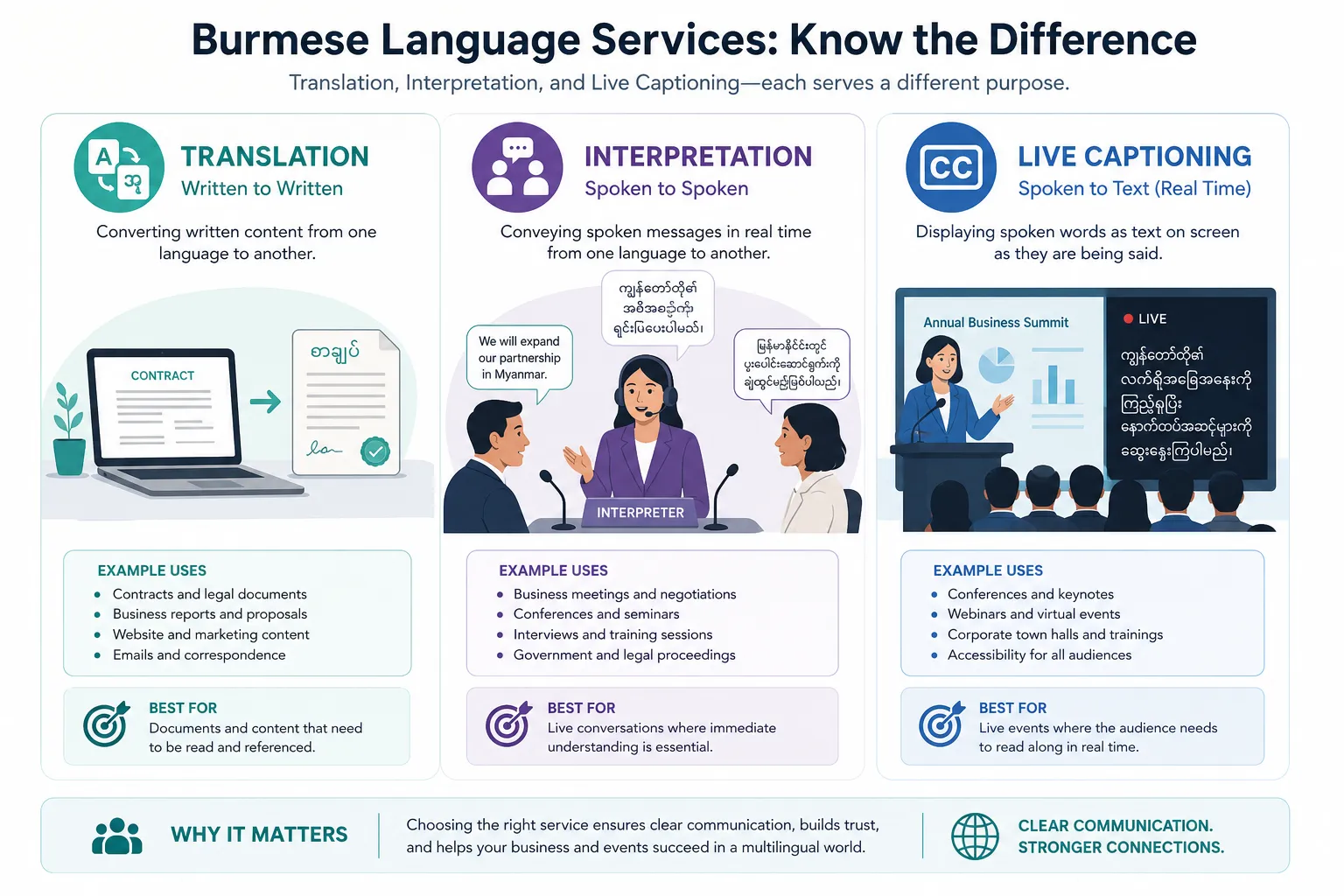
Burmese Translator vs Burmese Interpreter: The Difference
This is the single most important distinction for buyers.
What a Burmese translator does
A translator works with written content. That includes:
-
contracts
-
websites
-
presentations
-
product manuals
-
HR documents
-
subtitles
-
training materials
-
marketing campaigns
-
signage and event collateral
A Burmese translator has time to research terminology, apply style guides, use translation memory, and review for consistency. This is the right choice when your content exists in text form and accuracy must be polished before publication or distribution.
What a Burmese interpreter does
An interpreter works with spoken communication in real time or near real time. That includes:
-
business meetings
-
conferences
-
keynote sessions
-
webinars
-
interviews
-
employee trainings
-
legal or medical appointments
-
church services
-
panel discussions
-
trade show interactions
A Burmese interpreter listens and conveys meaning immediately. That requires different skills: rapid processing, memory, subject familiarity, poise under pressure, and often technical fluency with remote or on-site interpreting setups.
What many businesses get wrong
A common mistake is assuming the same person should handle every format. Sometimes that works. Often it does not.
A strong written translator may not be the best live interpreter. Likewise, a skilled interpreter may not be ideal for high-stakes written translation that needs formatting, review, terminology management, and publishing support.
A Simple Way to Choose the Right Service
|
Need |
Best Service |
Why |
|---|---|---|
|
Employee handbook in Burmese |
Burmese translator |
Written accuracy, formatting, terminology consistency |
|
Live executive town hall |
Burmese interpreter |
Real-time spoken communication |
|
Conference sessions for multilingual attendees |
Interpreter + live captioning |
Better accessibility and audience reach |
|
Product demo video |
Translation + subtitling + voiceover |
Supports clarity and global reuse |
|
Trade show booth conversations |
On-site interpreter |
Immediate communication with prospects |
|
Virtual training program |
Interpreter + captions + translated materials |
Inclusive delivery across formats |
|
Website localization |
Burmese language translator |
Message adaptation and SEO-aware content |
|
Compliance notices |
Professional translator with review |
Precision and risk reduction |
When You Need a Burmese Translator
A Burmese translator is the better fit when your message needs to be carefully drafted, edited, and quality-checked before anyone sees it.
Common business use cases
Internal communications
Employee handbooks, policy updates, onboarding packets, benefits materials, and leadership communications often need to be translated clearly for workforce inclusion.
Marketing and brand content
Campaign copy, brochures, social content, email sequences, and landing pages need more than literal translation. They need the right tone and cultural fit.
Website and digital content
A Burmese language translator can help adapt site copy, forms, metadata, downloads, and navigation content so the experience feels intentional rather than patched together.
Video and media localization
Subtitles, transcripts, voiceover scripts, and caption files all require careful language handling, especially if they will be used publicly or repeatedly.
Legal, healthcare, and regulated content
In high-risk settings, translation quality is tied directly to understanding, compliance, and liability management.
When You Need a Burmese Interpreter
If people need to understand and respond live, you need interpreting rather than translation.
Common interpreting scenarios
Conferences and live events
For multilingual sessions, keynote talks, breakout rooms, and audience Q&A, interpreting keeps attendees engaged instead of excluded.
Corporate meetings
Board meetings, internal all-hands calls, investor discussions, and client presentations often require live language support when participants speak different languages.
Hybrid and virtual events
Remote interpreting has become essential for global participation. The right setup includes not only the interpreter but also the platform workflow, audio routing, technician support, and attendee experience planning.
Community, ministry, and public-facing communication
Churches, nonprofits, educational institutions, and community-facing organizations often need Burmese interpreting for services, outreach, and live programming.
Not Just Translation or Interpreting: Accessibility Matters Too
One of the biggest gaps in competitor content is the failure to connect language access with accessibility.
A meeting can be multilingual but still inaccessible. A video can be translated but still hard to follow. A conference can have an interpreter but still lose attendees who rely on captions.
That is why the best language strategy often combines:
-
interpreting for spoken access
-
translation for written materials
-
live captioning for accessibility and comprehension
-
subtitling for recorded video
-
voiceover for audience-friendly media delivery
-
technician support for smooth execution
-
flexible remote and in-person workflows
Why this matters for real events
In live environments, language access is not just a linguistic issue. It is an experience issue.
If audio quality fails, the interpreter struggles.
If slides are untranslated, the audience falls behind.
If captions are missing, accessibility suffers.
If the event platform is not configured correctly, attendees may not even find the language channel they need.
This is where working with a full-service partner matters. Team Stream supports translation, interpreting, captioning, subtitling, voiceover, accessibility solutions, equipment rental, and technician support in one coordinated workflow. That reduces handoff risk and gives planners a more reliable path from pre-event prep to live execution.
What to Look for in a Qualified Burmese Language Provider
Not all providers are built for business-critical work. Here is what actually matters.
1. Native-level fluency and subject-matter expertise
Language skill alone is not enough. Business, legal, technical, healthcare, HR, and event content all carry terminology that must be handled correctly.
Ask whether the linguist has experience in your field, not just the language pair.
2. The right specialization for the format
A Burmese translator should be evaluated differently from a Burmese interpreter. Written and live language services require different workflows, tools, and strengths.
3. Quality assurance processes
Look for a provider that can explain:
-
who does the work
-
how terminology is managed
-
whether second-review or editing is available
-
how consistency is maintained across large projects
-
how urgent updates are handled
4. Support for live, virtual, and hybrid delivery
If your needs include events, webinars, or internal broadcasts, language support must fit the production environment. That includes platform coordination, audio pathways, timing, monitoring, and backup plans.
5. Accessibility integration
A modern language partner should understand how captioning, subtitling, and inclusive communication fit into the same strategy.
6. Responsiveness and project management
Businesses do not just buy words. They buy confidence.
Clear communication, realistic timelines, strong customer service, and fast issue resolution are often what separate a usable vendor from a strategic partner.
Human Translation, AI, or Both?
Many top-ranking competitor pages mention AI, but often in broad or self-promotional terms. The more useful question is: when should businesses use human support, AI-powered workflows, or a combination of both?
Best uses for human-led Burmese language services
Human expertise is usually the right choice for:
-
executive communications
-
sensitive HR content
-
legal and compliance materials
-
public-facing brand copy
-
medical or safety information
-
live interpreting
-
high-visibility events
-
subtitles and voiceover requiring nuance
Best uses for AI-assisted workflows
AI can help accelerate:
-
large-volume draft translation
-
repetitive or structured content
-
internal documents with low risk
-
multilingual workflows that need speed and scalability
But AI alone is rarely enough for content where nuance, liability, accessibility, or reputation matters.
The smartest model for most businesses
The strongest approach is often AI-enabled efficiency with professional human oversight.
That is especially true when organizations need speed without sacrificing clarity. Team Stream’s approach is built around that balance: accurate human expertise supported by practical AI-powered workflows, tailored to the client’s goals, audience, timeline, and risk level.
Common Burmese Translation and Interpreting Use Cases by Industry
Corporate communications
Global companies use Burmese support for employee engagement, DEI initiatives, leadership messaging, internal videos, and training programs.
Events and conferences
Conference organizers need multilingual access for speakers, attendees, sponsors, and virtual participants. Interpreting, live captions, translated signage, subtitling, and technician support all play a role.
Legal and compliance
Precision matters. Translation and interpreting must be handled by professionals who understand terminology, confidentiality, and context.
Healthcare and public information
Understanding cannot be left to guesswork. Translation quality affects outcomes, safety, and trust.
Faith-based and community organizations
Churches and community organizations often need a combination of live interpreting, captioning, and translated resources to make services and messages more inclusive.
Media and broadcast
Broadcast teams may need subtitling, live captioning, voiceover, or multilingual event support with professional-grade execution.
Questions to Ask Before Hiring a Burmese Translator or Interpreter
Before you commit, ask these practical questions:
For translation projects
-
Is the content internal, public, legal, technical, or marketing-focused?
-
Who is the audience?
-
Does the file require formatting or desktop publishing?
-
Do you need subtitles, voiceover, or website localization too?
-
Is there an existing glossary or style guide?
For interpreting projects
-
Is the event on-site, remote, or hybrid?
-
Is simultaneous or consecutive interpreting needed?
-
How many attendees will need Burmese support?
-
Will you also need live captioning for accessibility?
-
Who is managing the tech setup, audio feed, and attendee instructions?
For both
-
What is the turnaround time?
-
What is the review process?
-
How are changes handled?
-
What level of confidentiality is required?
-
Can one team support translation, interpreting, and accessibility together?
Red Flags to Avoid
Choosing on price alone often creates bigger costs later. Watch for these warning signs:
|
Red Flag |
Why It Matters |
|---|---|
|
No distinction between translation and interpreting |
Suggests weak operational understanding |
|
Vague promises about “native speakers” only |
Fluency is not the same as subject expertise |
|
No explanation of QA or review |
Increases risk of inconsistency or errors |
|
No event or technical support for live work |
Live multilingual experiences can fail without coordination |
|
No captioning or accessibility options |
Leaves gaps in compliance and inclusion |
|
Slow communication before the project starts |
Usually gets worse once the work begins |
Why Businesses Choose a Full-Service Partner Instead of Piecing It Together
Some organizations hire one vendor for translation, another for captions, another for interpreters, and someone else for event tech. That can work, but it also creates coordination problems.
A full-service partner offers advantages:
-
fewer moving parts
-
consistent terminology across deliverables
-
better event readiness
-
smoother communication between language and production teams
-
more reliable accessibility execution
-
easier scaling from one project to ongoing support
This is where Team Stream stands out. With over 25 years of experience, the company supports live interpreting, written translation, captioning, subtitling, voiceover, equipment rental, and technician services for businesses, churches, conferences, trade shows, broadcasts, and hybrid events. That combination is especially valuable when you need communication to be both multilingual and accessible without sacrificing production quality.
How Team Stream Helps Organizations Communicate Clearly in Burmese
Team Stream is built for organizations that need more than a transactional language vendor.
What that looks like in practice
Tailored solutions
Not every client needs the same mix of services. Team Stream matches the delivery model to the actual use case, whether that means a Burmese interpreter for a live conference, translated employee materials, AI-assisted workflows for scale, or full accessibility support for a hybrid event.
Human expertise plus AI-enabled efficiency
For many businesses, the best answer is not human-only or AI-only. It is the right blend of both.
Support across live, virtual, and hybrid environments
This is critical for modern events and internal communications. Team Stream can support in-person and remote delivery while helping ensure a smooth audience experience.
Accessibility and compliance awareness
Captioning, inclusive communication, and audience access are not afterthoughts. They are core to effective communication.
Strong service and responsiveness
Reliable project management is often what clients remember most. When timelines shift or stakes are high, responsiveness matters.
Final Takeaway
If you are searching for a Burmese translator, the real decision is bigger than language alone. You need to know whether your project calls for translation, interpreting, captioning, subtitling, voiceover, or a coordinated mix of all of them.
For written content, choose a qualified Burmese translator with the right subject-matter background.
For live conversations and events, choose a skilled Burmese interpreter with real-time expertise.
For business-critical communication, look beyond language and prioritize accessibility, execution, and audience understanding.
That is why organizations turn to Team Stream. With accurate human and AI-powered language services, real-time captioning, end-to-end accessibility support, flexible in-person and remote delivery, and more than 25 years of experience, Team Stream helps businesses communicate clearly, inclusively, and confidently.
If your organization needs Burmese translation, interpreting, or multilingual event support, Team Stream is ready to help you build the right solution from the start.
FAQ
What language is the highest demand for translators?
Demand varies by industry, geography, and use case, but languages tied to global business, immigration, healthcare, legal services, and live events are consistently in high demand. Rather than focusing only on the “most requested” language, businesses should choose the right provider for the audience they need to reach, including specialized support such as Burmese translation or interpreting.
Do I need a license to be a translator?
In many markets, translators do not need a general government license, but clients should look for proven expertise, subject-matter knowledge, and strong quality processes. For high-stakes business, legal, medical, or live event work, qualifications, experience, and professional review standards matter far more than a basic claim of fluency.
