

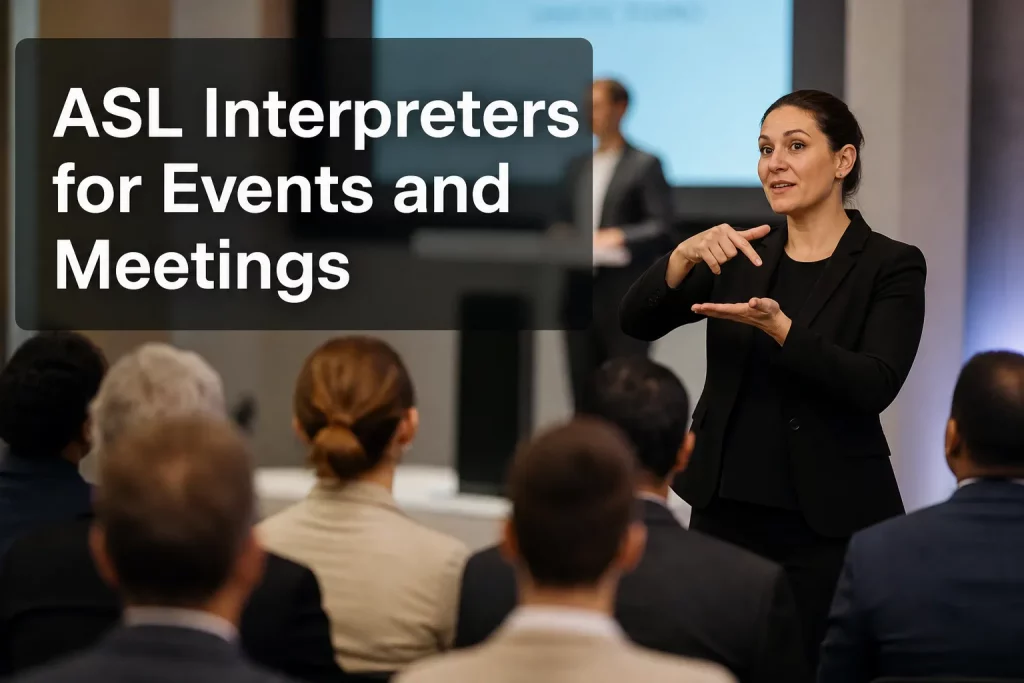
ASL Interpreters for Events and Meetings
If you are planning a conference, town hall, training session, worship service, trade show, webinar, or internal company meeting, ASL interpreters are not an optional extra when accessibility is needed – they are a core part of effective communication. For event organizers and business teams, the challenge is rarely just “finding an interpreter.” It is making sure the communication is accurate, the participant experience is inclusive, the setup works in the room and on screen, and the event remains compliant and professional from start to finish.
An experienced ASL interpreting strategy solves more than one problem at once. It helps Deaf and hard-of-hearing attendees participate fully, reduces confusion and legal risk, improves audience trust, and signals that your organization takes inclusion seriously. The best results come when ASL interpreting is coordinated alongside related services like real-time captioning, multilingual interpreting, technician support, and event production planning – especially for live, virtual, and hybrid formats.
At Team Stream, we see this every day. Organizations do not just need “an interpreter.” They need a reliable partner who can deliver human expertise, accessibility support, event logistics, and flexible remote or in-person service without making the planning process harder.
“Effective communication with a qualified person who is deaf or hard of hearing is communication that allows the person an equal opportunity to participate in, and enjoy the benefits of, a service, program, or activity.” – HHS.gov
What ASL interpreters do
ASL interpreters facilitate communication between Deaf or hard-of-hearing individuals and hearing participants by interpreting between American Sign Language and spoken English in real time. That sounds simple, but professional interpreting is far more than word substitution.
A qualified interpreter must be able to:
-
Understand both the message and the context
-
Convey meaning accurately and impartially
-
Handle specialized vocabulary
-
Keep pace with live speakers
-
Adapt to different formats, from panel discussions to Q&A sessions
-
Support natural communication flow between all participants
For events and meetings, this often includes interpreting:
-
Keynote speeches
-
Training sessions
-
Executive updates
-
Breakout discussions
-
Audience questions
-
Worship services
-
Video content
-
Announcements and emergency instructions
ASL is not signed English
One common gap in competitor content is failing to explain that ASL is a distinct language with its own grammar and structure. It is not simply English expressed with hand signs. That matters because accessibility planning should not assume that a transcript, slides, or spoken-language interpretation alone creates equal access for Deaf participants who primarily use ASL.
Why ASL interpreters are essential for accessible events and meetings
For many organizations, the real question is not whether ASL interpreters are valuable. It is why they are necessary even when captions, microphones, or written materials are available.
The answer is that different attendees have different communication preferences and needs. Some people benefit from captions. Some rely on ASL. Many events need both.
They support true participation, not partial access
Accessible communication means attendees can do more than just “follow along.” They should be able to:
-
Understand the full message in real time
-
Ask questions
-
Engage in discussion
-
Participate in networking or breakout activities
-
Receive important updates without delay
-
Experience the event with the same dignity and clarity as everyone else
They help organizations meet accessibility expectations
Accessibility is not only a best practice. It can also be part of your legal and operational responsibilities.
“Under the Americans with Disabilities Act (ADA), entities are required to ensure that communication with individuals who are deaf or hard of hearing is as effective as communication with others.” – ADA.gov
That principle matters in corporate events, public meetings, educational settings, nonprofit programs, faith-based gatherings, healthcare communications, and government-facing environments.
They improve event quality for everyone
When accessibility is planned well, the entire event usually becomes more organized. Teams speak more clearly. Visuals improve. Speakers share materials in advance. Moderation gets tighter. Captions and interpretation reduce missed information. In short, good accessibility often produces better communication overall.
When you need ASL interpreters
Some event organizers wait for a last-minute attendee request before thinking about accessibility. A better approach is to identify likely need cases early.
Common situations where ASL interpreters are needed
-
Corporate all-hands meetings
-
Conferences and conventions
-
Trade shows and expo presentations
-
HR meetings and employee trainings
-
Board meetings
-
Press conferences
-
Public-facing webinars
-
Church services and faith events
-
Award shows and performances
-
Medical or benefit enrollment meetings
-
Compliance and safety briefings
-
Government and community meetings
High-priority moments where interpreting matters most
Some settings carry higher stakes because of complexity, sensitivity, or the consequences of misunderstanding:
-
Policy changes
-
Safety instructions
-
Legal or HR discussions
-
Benefits enrollment
-
Live Q&A with executives
-
Emergency announcements
-
Technical training
-
Healthcare-related sessions
Types of ASL interpreting for events
Not every event needs the same delivery model. One of the biggest content gaps in competitor pages is that they often describe services broadly but do not help planners match the right interpreting format to the right use case.
In-person ASL interpreting
In-person interpreting is often best when the event is live onsite and includes:
-
High audience interaction
-
Stage presentations
-
Complex room dynamics
-
Networking or side conversations
-
Sensitive or nuanced communication
Benefits include stronger physical presence, easier visibility in the room, and smoother integration with live staging.
Remote ASL interpreting
Remote interpreting can work well for:
-
Virtual meetings
-
Webinars
-
Distributed teams
-
Short planned sessions
-
Organizations needing fast scheduling flexibility
This approach is especially effective when supported by a stable platform, proper spotlighting, and a technical team that understands accessibility workflows.
Hybrid ASL interpreting
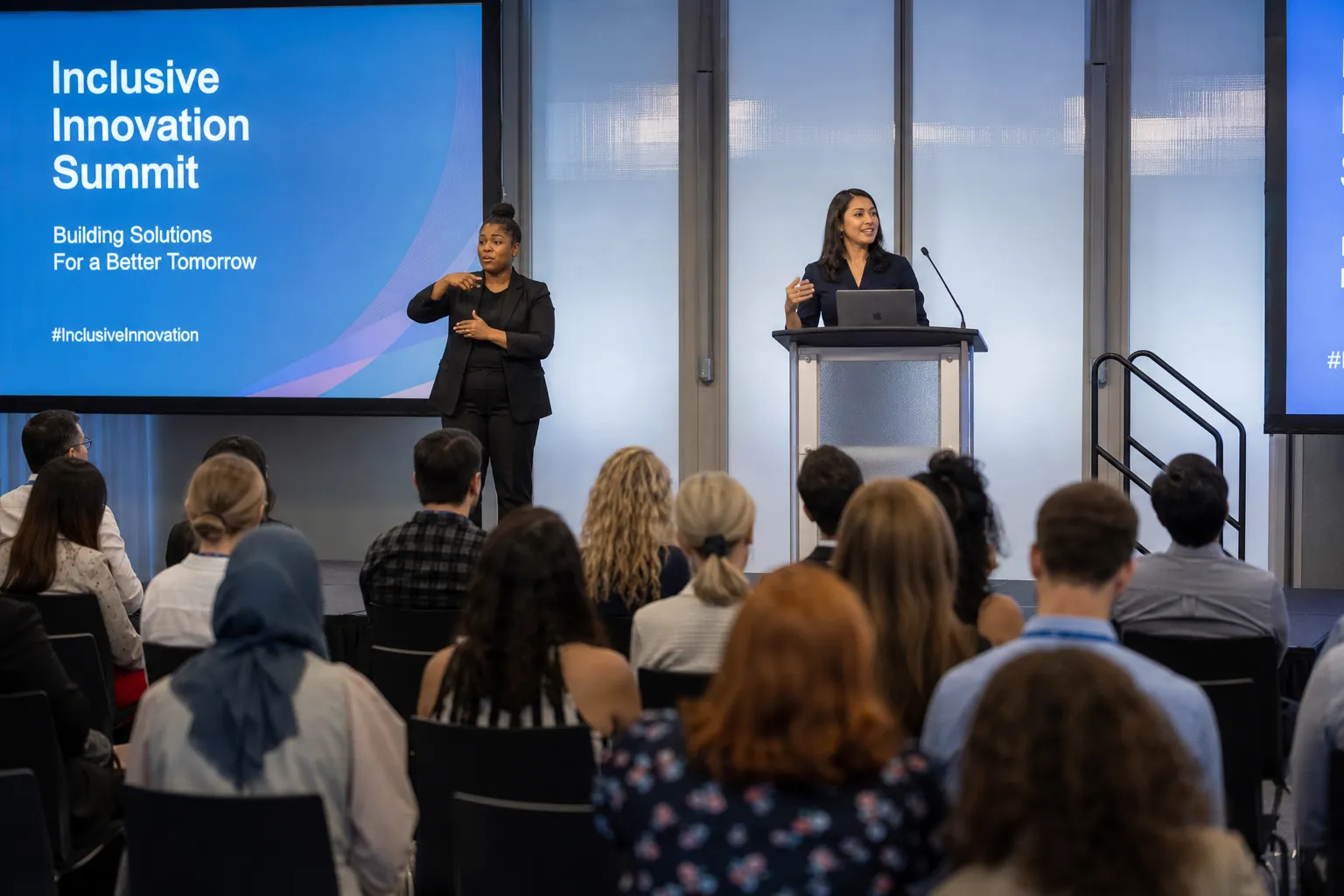
Hybrid events are where many teams struggle. You may have a live room, virtual attendees, presentation screens, streamed content, and multiple audio sources. In these cases, ASL interpreting often needs to be coordinated differently for the in-room and online audiences.
That may include:
-
Onsite interpreters for room visibility
-
Separate interpreter video feeds for remote participants
-
Screen layouts that keep interpreters visible
-
Coordination with live captions and multilingual audio
-
Technician support to prevent accessibility elements from getting lost in the production
This is where Team Stream’s end-to-end support becomes especially valuable. Beyond interpreting itself, we help clients align captions, platform setup, event technology, technician support, and live accessibility execution so the experience works for every audience segment.
ASL interpreters vs captioning: which do you need?
A major misconception is that captions can replace ASL interpreters in every scenario. They cannot.
The short answer
Many events need both.
Comparison table
|
Solution |
Best for |
Key strengths |
Limitations |
|---|---|---|---|
|
ASL interpreters |
Deaf attendees who use ASL as their primary language |
Natural language access, real-time communication, better engagement in live interaction |
Requires visibility, scheduling, and event coordination |
|
Real-time captioning |
Broad accessibility, hard-of-hearing participants, non-native speakers, noisy settings |
Text-based support, searchable records, strong for webinars and recorded content |
Not a substitute for ASL for attendees who prefer sign language |
|
Written transcripts |
Post-event review, documentation |
Useful archive, compliance support, content reuse |
Not real-time access |
|
AI-powered tools |
Speed, scale, supplemental support |
Fast deployment, efficient multilingual support in some use cases |
Should not be treated as a full substitute for qualified ASL interpreting in high-stakes live communication |
For inclusive meetings and events, a stronger approach is to combine ASL interpreting with real-time captioning. Team Stream frequently helps clients build this layered accessibility model so attendees can choose the format that works best for them.
What makes a qualified ASL interpreter?
Not all interpreters are equally suited to every event. Competitor content often says “qualified” without explaining what that means in practice for event planners.
A qualified ASL interpreter should be able to interpret:
-
Effectively
-
Accurately
-
Impartially
-
Receptively and expressively
-
Using any necessary specialized vocabulary
Practical qualities to look for
For events and meetings, also look for:
-
Experience in live event environments
-
Familiarity with your subject matter
-
Strong team interpreting skills for longer sessions
-
Comfort with virtual platforms
-
Professional appearance and stage presence
-
Ability to coordinate with producers, moderators, and AV teams
-
Preparation habits, including reviewing agendas and terminology in advance
When you may need a team of interpreters
For longer programs, a single interpreter is often not enough. Fatigue affects performance, especially in fast-paced, high-information sessions. Multi-hour conferences, worship services, legal content, technical training, and executive presentations often require two or more interpreters rotating in a team.
How to choose the right ASL interpreters for your event
This is where planning quality makes the biggest difference.
1. Start with the event format
Ask:
-
Is the event live, virtual, or hybrid?
-
Is it one-way presentation or interactive?
-
Will attendees need access in breakout sessions?
-
Are there videos, music, or audience Q&A?
-
Will the interpreter need to appear on projection screens or livestream layouts?
2. Understand the content complexity
An interpreter for a casual staff update may not be the right fit for:
-
Technical product launches
-
Medical information sessions
-
Compliance training
-
Financial presentations
-
Faith-based programming with specialized terminology
-
Broadcast-style productions
The more specialized the content, the more important pre-event preparation becomes.
3. Share materials early
Provide:
-
Agenda
-
Speaker names
-
Slide deck
-
Talking points
-
Acronyms
-
Proper nouns
-
Scripts if available
-
Video clips in advance
This is one of the simplest ways to improve quality.
4. Plan interpreter visibility
For onsite events, make sure interpreters are:
-
Well lit
-
Clearly visible
-
Positioned near the speaker or primary visual focus
-
Included in camera planning when streaming
-
Not blocked by podiums, décor, or stage movement
For virtual events, make sure the platform supports interpreter visibility and spotlighting.
5. Coordinate with captions and production
Accessibility fails when teams treat it as an add-on. Interpreters, captioners, and production staff should all understand:
-
Show flow
-
Speaker transitions
-
Video playback timing
-
Q&A format
-
Breakout logistics
-
Technical backup plans
At Team Stream, this integrated planning is a core part of how we work. We do not just provide talent; we help clients build reliable, compliant, audience-friendly accessibility systems around their events.
Best practices for working with ASL interpreters at meetings and events
Once you have the right interpreters in place, execution matters.
Before the event
-
Confirm schedule, location, and platform details
-
Share prep materials
-
Discuss specialized terminology
-
Confirm breaks and rotation plan
-
Test camera framing and screen placement
-
Align interpreters with moderators and producers
During the event
-
Ask speakers to use microphones consistently
-
Encourage one speaker at a time
-
Avoid talking over videos or audience members
-
Pause briefly before audience Q&A
-
Keep interpreters visible at all times
-
Announce accessibility features at the start
After the event
-
Gather attendee feedback
-
Review any technical issues
-
Archive captions or recordings if applicable
-
Improve the process for future programs
Common mistakes event organizers make
Many high-ranking competitor pages explain services but do not warn readers clearly about avoidable failures. These are some of the most common ones.
Booking too late
Qualified ASL interpreters – especially those with event or industry experience – may be unavailable if you wait too long.
Assuming captions are enough
Captions are valuable, but they are not a universal substitute for ASL access.
Forgetting breakout rooms or side sessions
Accessibility should cover the full attendee journey, not only the keynote.
Not budgeting for the real scope
Some events need interpreter teams, technician support, screen integration, rehearsal time, or combined captioning and interpreting services.
Failing to test the virtual platform
If the interpreter video is tiny, hidden, or not spotlighted, the experience breaks down fast.
Using unqualified helpers
Friends, family members, bilingual staff, or volunteers are not replacements for qualified interpreters in professional event settings.
ASL interpreting for virtual and hybrid events
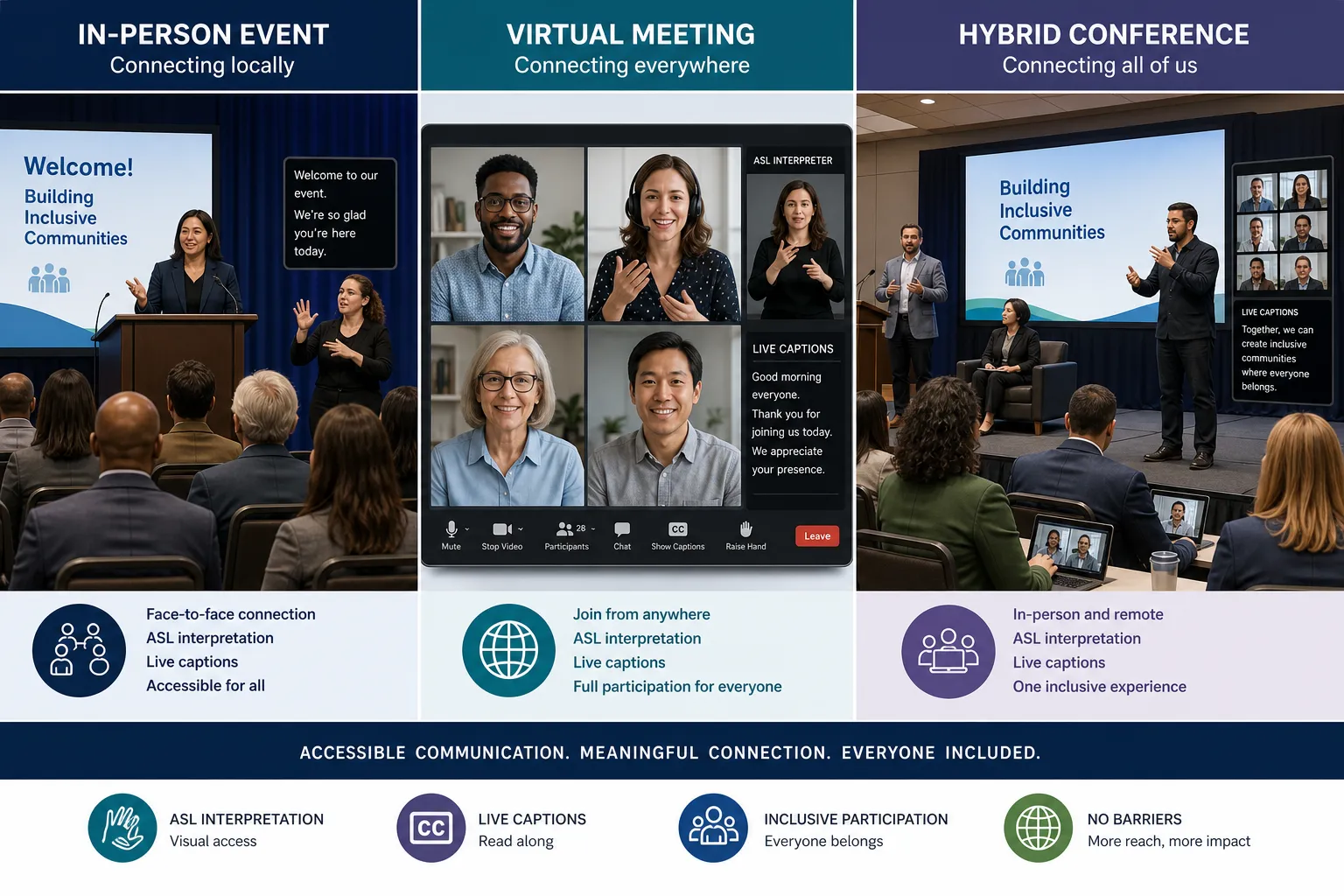
Virtual and hybrid meetings have made accessibility both easier and more complex. Easier, because remote delivery increases flexibility. More complex, because visibility, audio routing, platform behavior, and production choices now affect access directly.
What virtual events require
-
Stable internet and platform compatibility
-
Clear interpreter video presence
-
Proper spotlight or pin settings
-
Caption integration
-
Backup communication channels
-
Moderator coordination for Q&A
-
Technical rehearsal
Why hybrid events are harder
Hybrid events often require accessibility solutions to work in two environments at once:
|
Event element |
In-room audience needs |
Virtual audience needs |
|---|---|---|
|
ASL interpreting |
Stage visibility or side screens |
Dedicated visible interpreter feed |
|
Captioning |
Display screen integration if used |
Embedded or platform-based captions |
|
Audio |
Clean house mix |
Stream-ready audio routing |
|
Q&A |
Microphones and moderation |
Chat, raised hands, or virtual moderator |
|
Backup plans |
Onsite tech support |
Remote platform support |
This is one reason organizations choose Team Stream. We support live, virtual, and hybrid events with interpreting, captioning, technician services, and equipment support so the accessibility plan holds up in real conditions, not just on paper.
Why experience matters in high-stakes settings
Some vendors can fill a request. Fewer can deliver a seamless event experience.
Experience reduces risk
With over 25 years of expertise, Team Stream helps organizations avoid the common pitfalls that derail accessibility delivery:
-
Last-minute coordination gaps
-
Poor camera framing
-
Missing captions in the stream
-
Inadequate interpreter prep
-
Weak handoffs between speakers and interpreters
-
Mismatch between language access and event production
A stronger partner model
Team Stream’s value is not limited to ASL interpreters alone. We support broader communication goals with:
-
Accurate human interpreting
-
AI-powered language solutions where appropriate
-
Real-time captioning for accessibility and engagement
-
Closed captioning and subtitling
-
Written translation
-
Voiceover
-
Equipment rental and technician support
-
Flexible in-person and remote delivery
-
Responsive customer service
-
Tailored planning for each client and event
For many businesses and event producers, that means fewer vendors, less confusion, and better outcomes.
Are ASL interpreters being replaced by AI?
This question comes up more often now, and most competitor content either ignores it or oversimplifies it.
The practical answer
No – not for professional live event communication where accuracy, nuance, accessibility, and trust matter.
AI can support parts of the language access ecosystem. It can help with transcripts, multilingual workflows, meeting support, and certain automation tasks. But ASL interpreting is not just text conversion. It involves real-time language judgment, context, culture, pacing, interpersonal dynamics, and event awareness.
That is why Team Stream combines human expertise with AI-enabled tools thoughtfully, rather than treating AI as a shortcut for high-stakes accessibility needs.
Where AI fits best
AI can be useful for:
-
Draft transcripts
-
Some subtitle workflows
-
Translation support in select contexts
-
Scalable content processing
Where human ASL interpreters remain essential
-
Live meetings
-
Executive communications
-
Sensitive conversations
-
Complex or technical sessions
-
Compliance-related communication
-
Public-facing events
-
Audience interaction and Q&A
How much do ASL interpreters cost for events?
Pricing varies, and responsible providers avoid one-size-fits-all quotes because the scope can change significantly.
Factors that affect cost
-
Event length
-
Number of interpreters required
-
In-person vs remote delivery
-
Travel and location
-
Specialized subject matter
-
Rehearsal or prep time
-
Weekend or rush scheduling
-
Hybrid production needs
-
Whether captioning or other accessibility services are bundled
Why cheapest is rarely best
The real cost question is not only “What is the hourly rate?” It is “What happens if accessibility fails during the event?” In many cases, reliability, preparation, and coordinated execution are worth far more than saving a small amount on paper.
If you want clearer budgeting, Team Stream can scope the event based on your real requirements and recommend the right mix of interpreting, captioning, translation, and technical support.
How Team Stream helps organizations deliver inclusive communication
ASL interpreting works best when it is treated as part of a complete communication strategy.
Team Stream helps clients with:
-
ASL interpreters for meetings, events, and broadcasts
-
Real-time captioning for live accessibility and engagement
-
Translation and multilingual event support
-
Closed captioning, subtitling, and voiceover
-
Virtual, live, and hybrid event accessibility planning
-
Equipment rental and technician services
-
Flexible in-person and remote service delivery
-
Compliance-friendly support for inclusive communication
Whether you are running a corporate town hall, annual conference, worship experience, shareholder meeting, product launch, trade show, or livestream, we tailor the solution to your audience, timeline, and format.
Final thoughts
ASL interpreters are essential for events and meetings because accessibility is not just about checking a box – it is about making communication genuinely work. The right interpreters help Deaf and hard-of-hearing participants engage fully, while the right planning ensures your event is professional, inclusive, and resilient under real-world conditions.
If you want a partner that can go beyond filling a request and help you deliver accessible, multilingual, well-executed communication across live, virtual, and hybrid environments, Team Stream is built for exactly that. With more than 25 years of experience, strong customer service, flexible delivery options, and a complete portfolio of language and accessibility solutions, we help organizations create events that everyone can access with confidence.
FAQ
How much does it cost to hire an ASL interpreter?
The cost depends on the event length, format, location, subject matter, and number of interpreters needed. A short virtual meeting may cost far less than a multi-day hybrid conference that requires interpreter teams, prep time, and technical coordination.
What is the hourly rate for an ASL interpreter?
There is no single universal hourly rate because pricing varies by experience, specialization, geography, minimum booking policies, and whether the event is remote or onsite. For longer or more complex events, providers may also price team interpreting and coordination separately.
Will ASL interpreting be taken over by AI?
No, not in high-stakes live event settings. AI can support transcripts and some language workflows, but professional ASL interpreting still requires human judgment, cultural understanding, contextual accuracy, and real-time interaction management.
Is there a fee for Sorenson services?
Some Sorenson services, such as federally supported relay services, may be available to eligible users without a direct consumer fee, but that is not the same as hiring an ASL interpreter for an event or meeting. Event organizers should budget separately for professional scheduled interpreting services.
What is the hourly rate for an ASL interpreter?
The hourly rate can vary widely based on market, certification, event complexity, and delivery format. The most accurate approach is to request a scoped quote that includes preparation, duration, and any related accessibility support like captioning or technician services.
Does Taylor Swift have an ASL interpreter?
Major live events and concerts often use ASL interpreters to support accessible audience experiences, and high-profile performers may have interpreters at select shows or venues. The key takeaway for organizers is that large public events increasingly recognize accessibility as an essential part of production.
