

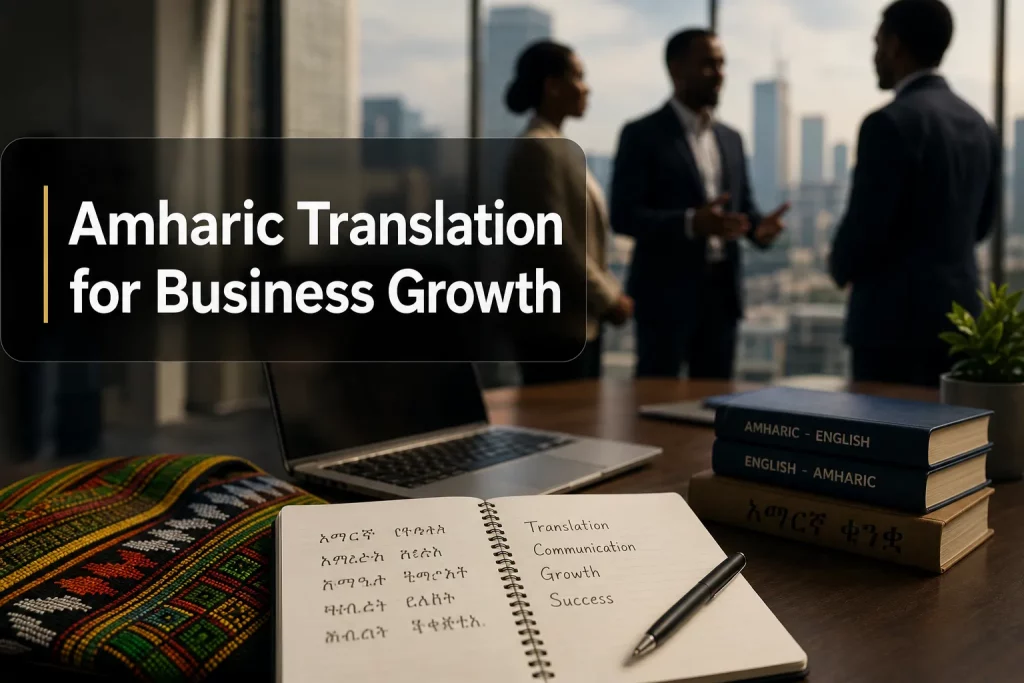
Amharic Translation for Business Growth
Businesses, nonprofits, churches, and media teams that want to reach Amharic-speaking audiences face a simple reality: good intentions are not enough. If your message is unclear, culturally off-base, or inaccessible in live and digital formats, trust drops fast. Accurate Amharic translation helps organizations communicate with clarity, serve communities respectfully, and create stronger engagement across events, campaigns, broadcasts, and everyday operations.
For event organizers and communications leaders, the challenge is often bigger than translating a document. You may need multilingual presentations, live interpreting, real-time captioning, subtitling, voiceover, or hybrid event support that works without disruption. That is where a partner like Team Stream becomes valuable: combining accurate human expertise with AI-powered workflows, accessibility-first service, and over 25 years of experience delivering smooth communication for live, virtual, and hybrid environments worldwide.
“Amharic is the most widely spoken language in Ethiopia and the second most widely spoken Semitic language globally, after Arabic.” – Wikipedia
“88% of organizations have increased their use of interpretation or captioning services in the past year.” – Wordly
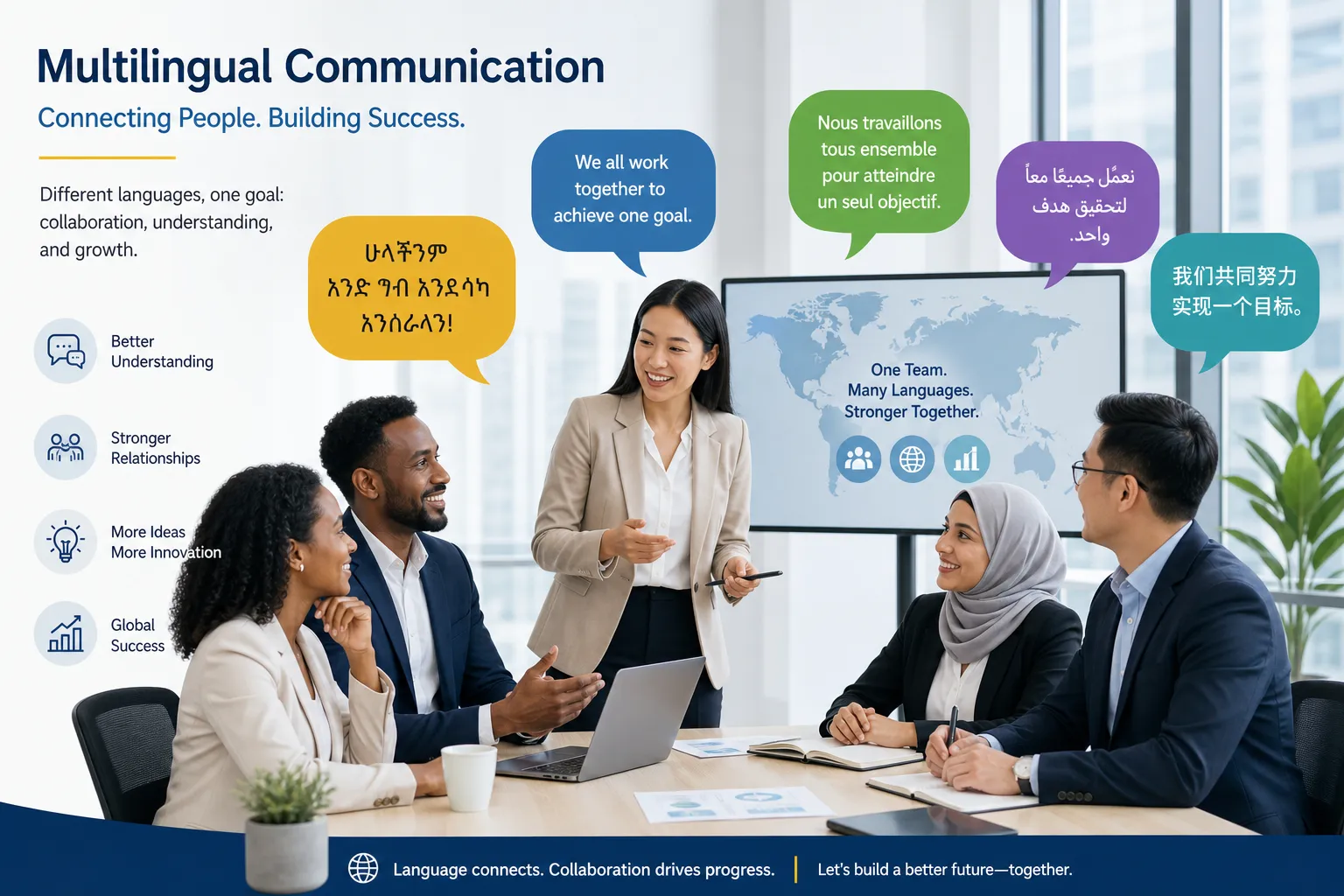
Why Amharic Matters in Business Communication
Amharic is a critical language for organizations serving Ethiopian communities, diaspora audiences, international partners, ministries, nonprofits, and multicultural markets. If your business or institution communicates with Amharic speakers in the U.S. or abroad, language access is not a courtesy add-on. It is part of effective service, stronger outreach, and better brand credibility.
Where demand shows up most often
Amharic language support is especially valuable in:
-
Community outreach and public information
-
Conferences and live events
-
Employee communications and training
-
Church services and faith-based media
-
Healthcare and nonprofit programs
-
Video content, interviews, and broadcasts
-
Legal, HR, and compliance-sensitive materials
-
Marketing campaigns targeting Ethiopian and East African audiences
Many organizations underestimate how much audience confidence depends on language precision. A translated sentence may be technically understandable but still feel unnatural, overly formal, too literal, or disconnected from how people actually speak. That gap can reduce response rates, attendance, donations, conversions, and long-term trust.
What Competitor Content Often Gets Right – and What It Misses
Most content on this topic focuses on three points: the number of Amharic speakers, the availability of translation services, and industry lists such as legal, medical, or business translation. Those are useful basics, but they do not fully answer what decision-makers need to know.
Common themes competitors cover
Competitor pages usually highlight:
-
Amharic as a major language in Ethiopia
-
Translation for legal, medical, and business documents
-
Certified translators and language service providers
-
General business expansion into Ethiopian markets
Content gaps businesses actually care about
What is often missing is the practical side of communication delivery:
-
How Amharic translation supports live, virtual, and hybrid events
-
Why interpreting and real-time captioning matter alongside written translation
-
How cultural nuance affects trust, not just comprehension
-
What media teams need for subtitling, voiceover, and multilingual broadcasts
-
How churches and nonprofits can improve inclusion through accessible language support
-
How to choose a provider that can manage both language quality and event execution
That broader view matters because many organizations are not just translating a brochure. They are trying to engage people in real time, across multiple channels, under deadline pressure, often with accessibility and compliance requirements in play.
How Accurate Amharic Translation Drives Growth
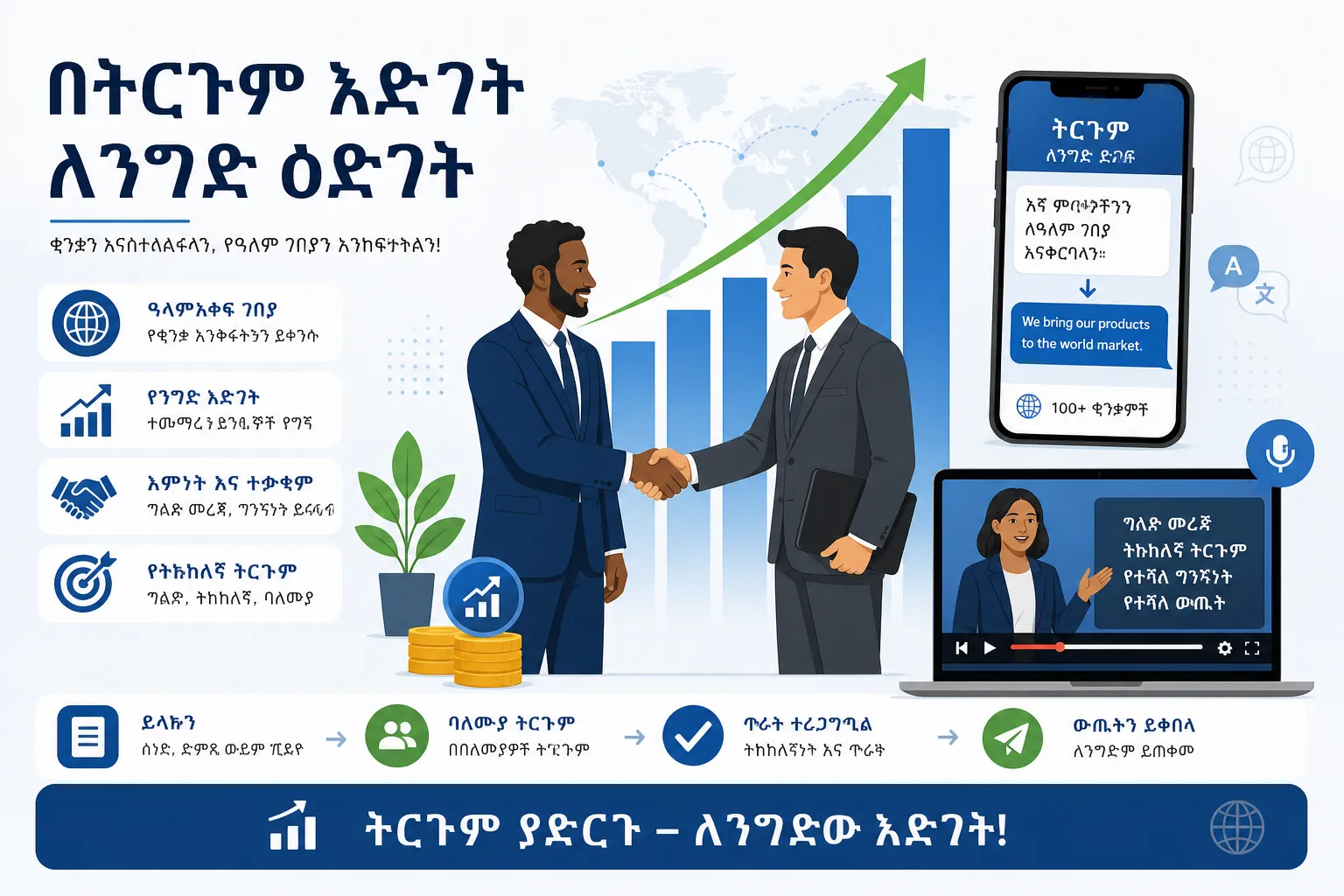
When translation is done well, it does more than convert words. It removes friction. That creates better outcomes in sales, outreach, training, attendance, and reputation.
1. It makes your message understandable and actionable
Clear translation helps people understand what you want them to do next. Whether that means registering for an event, responding to a call for services, following compliance instructions, or engaging with a sermon or video, clarity improves results.
2. It builds trust with Amharic-speaking audiences
Audiences can tell when content was translated carelessly. Awkward grammar, incorrect tone, or machine-only output can make your organization seem distant or unreliable. High-quality translation signals respect and professionalism.
3. It improves accessibility and inclusion
For many organizations, translation must work together with captioning, interpretation, subtitling, and voiceover. This is especially true in conferences, internal meetings, livestreams, training sessions, and public-facing content where audiences engage in real time.
4. It reduces risk in sensitive communication
In legal, healthcare, nonprofit, HR, and faith-based settings, small errors can cause confusion or harm. Accurate wording protects meaning and helps your organization communicate responsibly.
5. It extends the life of your content
Once translated properly, key assets can be reused across print, web, social, presentations, and video. A single message can reach more people across more formats without losing consistency.
Common Use Cases for Amharic Translation
Organizations rarely need only one type of language support. The strongest communication strategies match the service to the situation.
Business and corporate communications
Companies often need Amharic translation for:
-
Employee handbooks and onboarding
-
HR updates and compliance notices
-
Product information and training materials
-
Customer service scripts
-
Internal town halls and leadership messages
-
Marketing collateral and landing pages
For internal communications teams, consistency matters. If one message is formal, another is overly literal, and a third is mistranslated in subtitles, confidence in the message drops. Team Stream helps maintain quality across written, spoken, and on-screen communication.
Conferences, trade shows, and corporate events
For event producers, the need goes beyond documents. You may need:
-
Live interpreting for sessions or keynote content
-
Real-time captioning for accessibility and engagement
-
Translated slides, handouts, and signage
-
Multilingual support for hybrid or virtual attendees
-
Equipment rental and technician support for seamless delivery
This is where end-to-end service makes a difference. Team Stream supports live, virtual, and hybrid events with interpreting, captioning, equipment, and responsive execution so language access does not become a last-minute scramble.
Churches and faith-based organizations
Faith communities often need Amharic translation for:
-
Sermon notes and church bulletins
-
Livestream subtitles and captions
-
Live interpreting during services
-
Ministry training materials
-
Community announcements and outreach campaigns
In these settings, tone is especially important. Literal translation can miss spiritual, relational, or community-based meaning. Skilled linguists understand how to preserve reverence, warmth, and clarity.
Nonprofits and community organizations
Nonprofits may need Amharic support for:
-
Program materials
-
Intake forms
-
Outreach campaigns
-
Workshops and webinars
-
Community health or social service information
-
Donor and volunteer communications
Here, trust is everything. If people feel excluded by language, they may not access services or participate fully. Good translation supports real inclusion.
Media, broadcast, and video teams
Media teams often require:
-
Subtitling for interviews, documentaries, and social clips
-
Voiceover for announcements and educational videos
-
Closed captioning for accessibility compliance
-
Live captioning for broadcasts and streams
-
Interpreting for multilingual guests or audiences
Team Stream is especially strong here because media communication often requires both language quality and technical coordination. A translation provider that cannot support timing, captions, or live delivery leaves gaps that production teams have to solve themselves.
Why Cultural Nuance Matters as Much as Language Accuracy
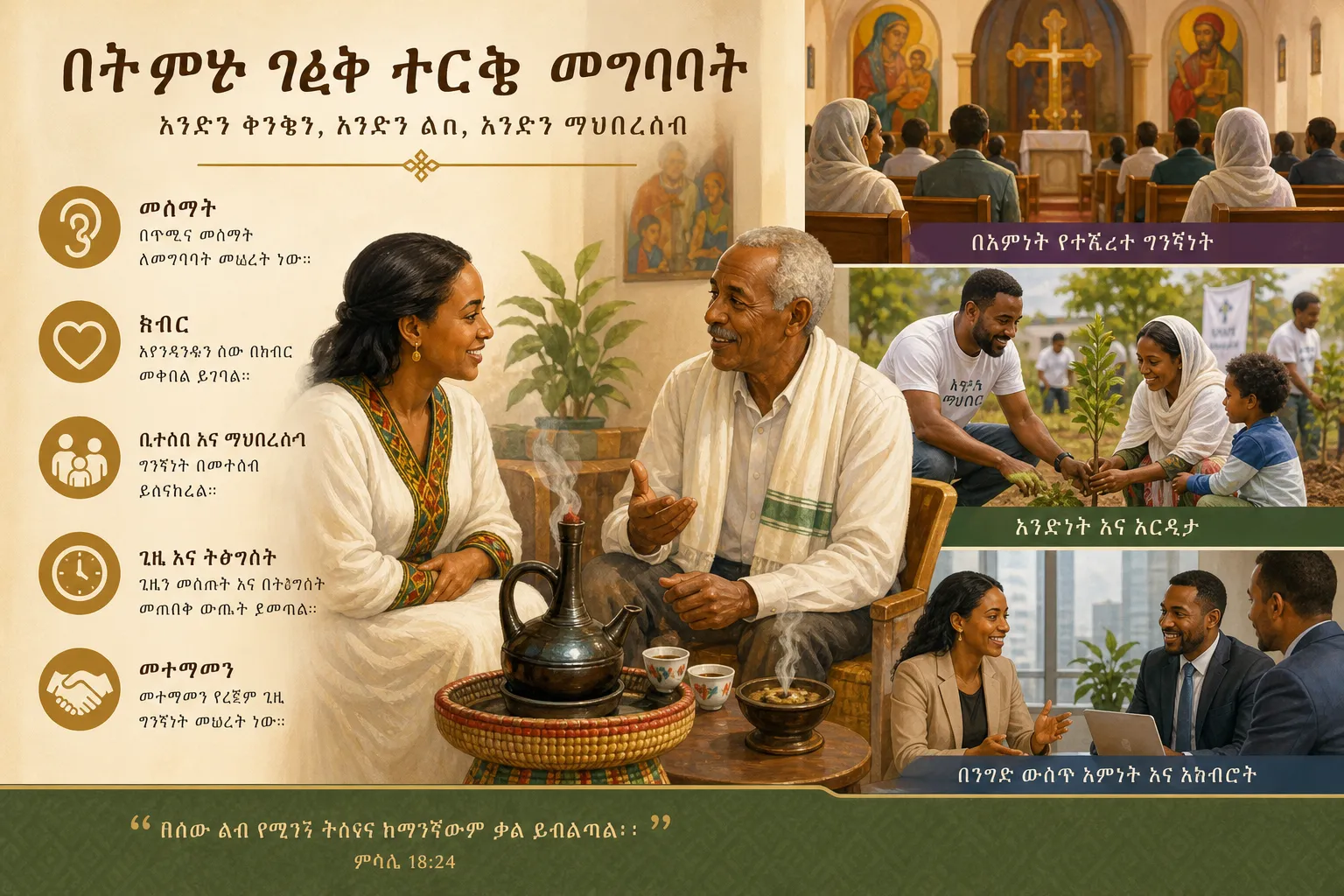
A translation can be grammatically correct and still fail. That usually happens when tone, context, hierarchy, or community expectations are ignored.
Tone and formality
Amharic communication can vary depending on the audience, purpose, and relationship between speaker and listener. A message for executives, elders, congregation members, or public audiences may require different phrasing choices to sound appropriate.
Community-specific expectations
Amharic-speaking audiences are not monolithic. Diaspora communities, church congregations, professionals, younger digital audiences, and community-based organizations may respond differently to style and wording. That is why one-size-fits-all translations often feel flat.
Context matters more than word-for-word matching
Terms used in marketing, ministry, training, or public service communication often need adaptation, not just substitution. Skilled translators ask what the message is meant to accomplish, then choose language that delivers that purpose naturally.
Accessibility improves cultural connection too
Captioning, subtitling, and voiceover are not only technical extras. They shape how audiences experience your content. Readability, timing, clarity, speaker identification, and platform fit all affect whether a multilingual audience stays engaged.
Human Translation, AI Tools, or Both?
This is one of the most important decisions for growing organizations. The right answer is usually not human-only or AI-only. It is a smart combination.
When AI can help
AI-powered translation can be useful for:
-
First-pass drafts
-
High-volume internal content
-
Fast turnaround on simple materials
-
Multilingual scaling where human review follows
When human expertise is essential
Human translators are critical for:
-
Public-facing brand communication
-
Legal or compliance-sensitive content
-
Sermons, donor messaging, and community outreach
-
Video subtitling and voiceover scripts
-
Executive messaging and event communication
-
Anything where tone, nuance, or risk matters
The best model: AI-enabled, human-led quality
That is where Team Stream stands out. The company combines AI-powered efficiency with accurate human translation and interpreting, so clients get speed without sacrificing reliability. This is especially valuable when you need multilingual communication across documents, live events, videos, captions, and audience engagement channels at once.
What to Look for in a Quality Amharic Language Partner
Choosing the cheapest provider can become expensive if you end up with rework, audience confusion, or technical issues during a live event. A better approach is to evaluate providers based on communication outcomes.
Key selection criteria
|
What to Evaluate |
Why It Matters |
|---|---|
|
Native-level language quality |
Prevents awkward or misleading phrasing |
|
Subject-matter familiarity |
Helps with business, nonprofit, ministry, healthcare, or media terminology |
|
Human review process |
Reduces errors from machine-only output |
|
Interpreting and captioning capability |
Supports live and hybrid communication needs |
|
Accessibility expertise |
Helps meet inclusion and compliance expectations |
|
Technical event support |
Critical for conferences, livestreams, and broadcasts |
|
Responsiveness and project management |
Keeps deadlines and live execution on track |
|
Flexible delivery options |
Allows in-person, remote, or hybrid service based on your needs |
Questions to ask before hiring
Ask potential providers:
-
Do you support both written translation and live language services?
-
Can you provide real-time captioning and interpreting for events?
-
How do you handle quality assurance for Amharic content?
-
Can you support subtitles, voiceover, or multilingual video workflows?
-
Do you offer technician support or equipment for live settings?
-
Can your team scale across remote, in-person, and hybrid formats?
These questions quickly reveal whether a provider can support real-world communication needs or only basic document translation.
Team Stream’s Advantage for Amharic Translation and Accessibility
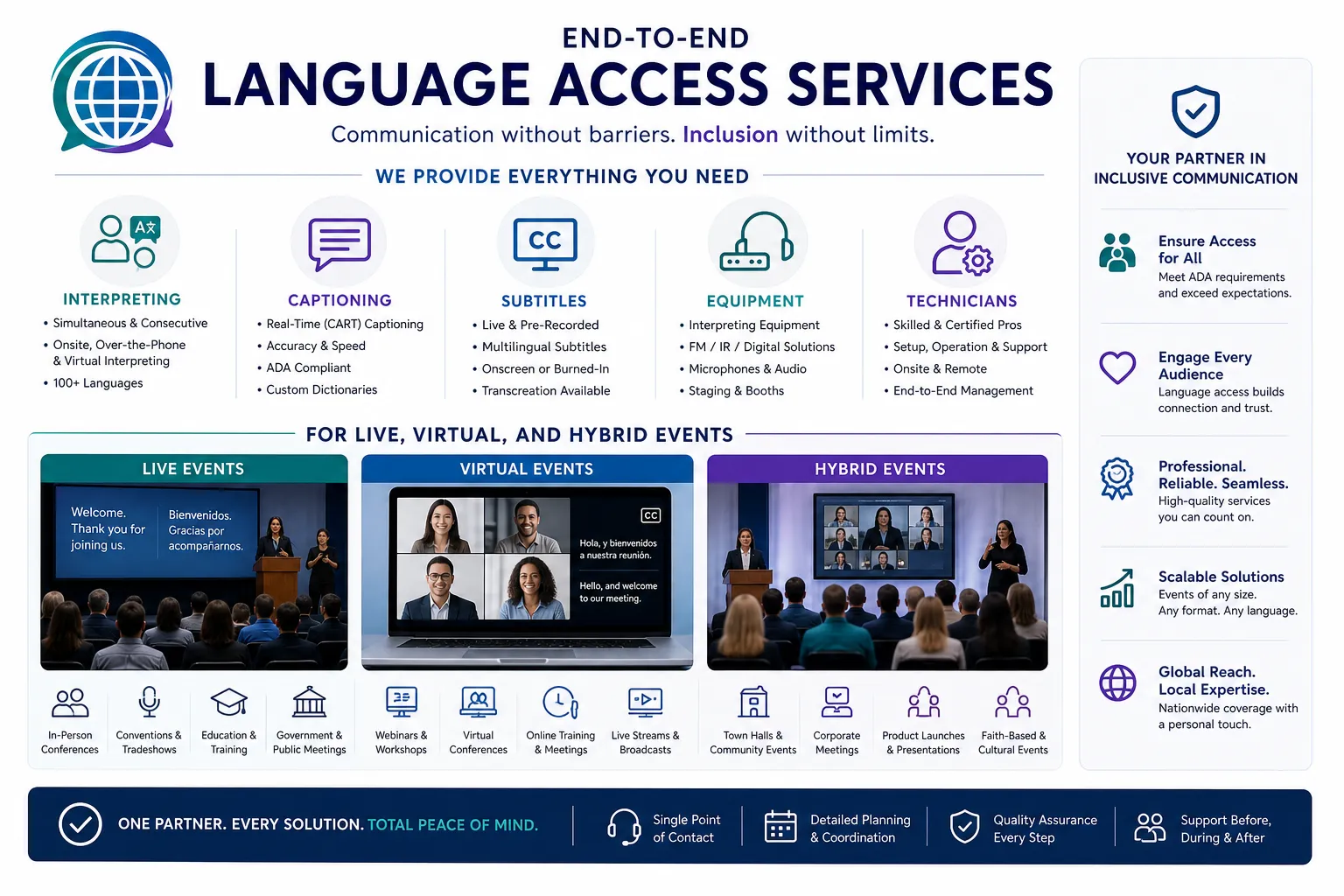
Team Stream is not just a translation vendor. It is a language access and accessibility partner built for organizations that need communication to work across audiences, formats, and environments.
What makes Team Stream especially effective
-
Accurate human and AI-powered translation and interpreting
-
Real-time captioning for accessibility and engagement
-
End-to-end language and accessibility solutions tailored to each client
-
Support for live, virtual, and hybrid events
-
Compliance-friendly services for inclusive communication
-
Professional equipment rental and technician support
-
Flexible service delivery with in-person and remote options
-
An experienced team with over 25 years of expertise
-
Reliable execution backed by strong customer service and responsiveness
This combination is especially useful for conference planners, church media teams, broadcast producers, internal communications leaders, and operations managers who need one partner that can handle both language quality and production realities.
Practical Tips for Better Amharic Communication
Even with a great language partner, your internal process affects quality. These best practices help projects go more smoothly.
Provide context, not just text
Share who the audience is, where the content will appear, and what action you want people to take. A flyer, worship service subtitle, and executive announcement need different translation choices.
Plan for format early
If content will appear in slides, captions, lower-thirds, or mobile screens, say so up front. Space and timing affect how translation should be written.
Keep terminology consistent
If your organization uses recurring names, ministry phrases, product labels, or compliance terms, create a glossary. This improves consistency across campaigns and events.
Review for audience fit
Whenever possible, have reviewed content checked for naturalness, tone, and community relevance, not just literal accuracy.
Think beyond documents
If the message matters enough to translate, it may also need interpreting, subtitles, captions, or voiceover. Build the full communication journey, not just the first asset.
Final Thoughts: Translation Is Growth Infrastructure
Amharic translation is not simply a language task. It is part of how organizations build trust, expand reach, improve accessibility, and communicate with integrity. For businesses, nonprofits, churches, and media teams, the ability to reach Amharic-speaking audiences clearly can directly affect participation, loyalty, service delivery, and brand reputation.
If you need more than a basic text conversion – if you need accurate translation, interpreting, captioning, subtitling, accessibility support, and dependable event execution – Team Stream offers the experience and flexibility to deliver it well. With human expertise, AI-enabled speed, and support for in-person, remote, and hybrid communication, Team Stream helps you connect with audiences in ways that are clear, inclusive, and built for real-world results.
If your next meeting, event, video, campaign, or outreach effort needs Amharic language support, now is the right time to make communication a growth strategy instead of an afterthought.
FAQ
What is the Amharic translation of investment?
The Amharic translation of investment can vary by context, but a common term is ኢንቨስትመንት or a context-based equivalent used in finance and business communication. For important documents, use a professional translator to ensure the wording matches the audience and purpose.
How can I translate English to Amharic?
You can use AI tools for a fast draft, but for public-facing, legal, ministry, nonprofit, or event content, it is best to use professional human review. A provider like Team Stream can combine AI-powered speed with human quality control for better accuracy and cultural fit.
What is the Amharic translation of value?
The word value in Amharic depends on meaning, such as financial worth, importance, or organizational values. Because meaning changes by context, accurate translation should be handled with cultural and subject-matter awareness.
What is transformation in Amharic?
Transformation in Amharic may be translated differently depending on whether you mean business change, personal growth, ministry impact, or technical conversion. For audience-facing content, a professional linguist can choose the most natural and precise expression.
What is venture in Amharic?
The Amharic translation of venture can differ based on whether you mean a business venture, a risky undertaking, or a startup initiative. In business settings, translation should reflect the commercial intent and tone of the message.
What is wealth in Amharic?
Wealth in Amharic is often translated according to financial, social, or spiritual context. If the term appears in a campaign, sermon, educational program, or financial document, professional translation helps preserve the intended meaning and nuance.
