

AI Translation Tools: Best Platforms for 2026
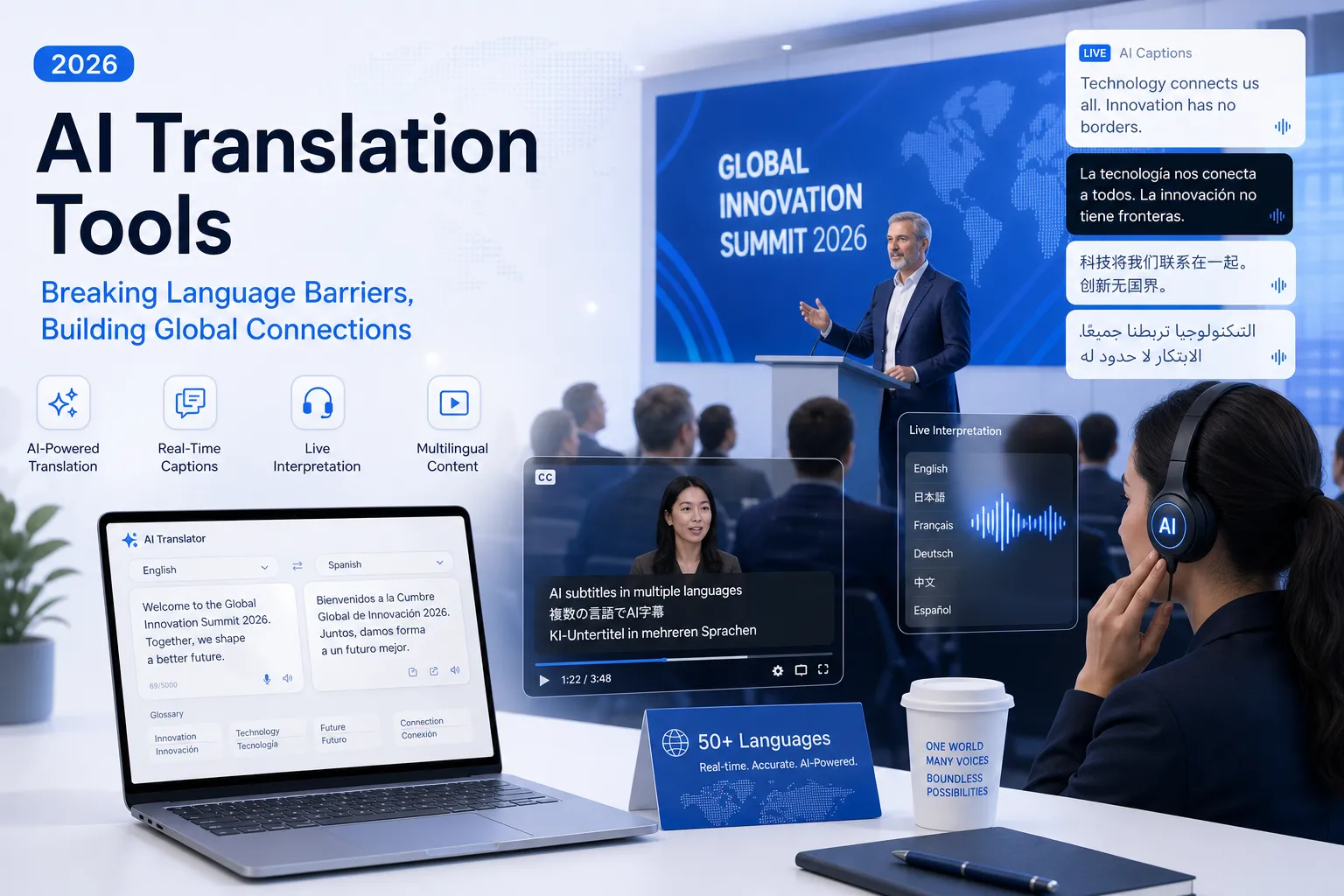
If you are comparing AI translation tools in 2026, you are probably trying to solve one of two problems: you need faster multilingual communication, or you need a more reliable way to make content, meetings, events, and broadcasts accessible across languages.
For event organizers, conference planners, corporate communications teams, churches, trade show producers, and broadcast teams, the stakes are higher than simply finding a good translation app. You may need live interpreting, real-time captioning, subtitling, multilingual video support, or compliance-friendly accessibility services that actually work under pressure. That is where the conversation moves beyond “what is the best online translator?” and into “what is the best solution for real-world communication?”
This guide compares the best translation platforms for 2026, including LLM-based options, neural machine translation engines, and workflow-focused localization systems. It also fills the gaps many competitor roundups leave behind: live event usability, accessibility, risk management, human review, and how AI translation software performs when accuracy actually matters.
Throughout this article, we will also show where Team Stream fits in. For organizations that need more than a standalone translation tool, Team Stream offers a stronger path: accurate human and AI-powered translation and interpreting, live captioning, subtitling, voiceover, equipment support, and end-to-end language access solutions for in-person, virtual, and hybrid environments.
What the best competitor articles get right – and what they miss
After reviewing leading competitor content, several common themes stand out:
-
Most rank the same core platforms: ChatGPT, Claude, DeepL, Google Translate, Gemini, Lokalise, and Microsoft Translator.
-
Most separate general-purpose AI models from translation-specific tools.
-
Most discuss speed, cost, language coverage, and light workflow features.
-
Some highlight translation memory, glossaries, and TMS functionality for repeatable localization.
That is useful, but not complete.
The biggest content gaps
The top-ranking articles often gloss over the questions buyers actually ask before making a decision:
|
What competitors cover |
What they often miss |
|---|---|
|
Text translation quality |
Live interpretation, captions, and multilingual events |
|
Features inside the app |
Whether the tool is safe for compliance-sensitive communication |
|
Pricing snapshots |
The hidden operational cost of manual review and corrections |
|
Marketing claims |
How tools perform for hybrid, live, or client-facing environments |
|
Language count |
Dialect nuance, cultural fit, and accessibility readiness |
|
AI vs human translation |
When you need both in the same workflow |
That missing context matters. A tool that is great for rough internal translation may be a poor choice for a keynote session, executive town hall, public webinar, church service, investor update, training program, or multilingual video release.
How to choose the right AI translation tool in 2026
Before we get into the platform list, it helps to define what “best” really means.
The five decision factors that matter most
1. Accuracy in your actual use case
A translation app that handles short marketing copy may struggle with legal disclaimers, healthcare language, event scripts, technical presentations, or idiomatic speech.
2. Live communication support
If you are running meetings, conferences, worship services, or broadcasts, text translation alone is not enough. You may need:
-
live interpreters
-
remote or on-site captioning
-
subtitling
-
multilingual audience feeds
-
equipment and technician support
This is a major area where Team Stream offers practical value beyond standalone software.
3. Workflow governance
For recurring content, look for:
-
translation memory
-
glossary enforcement
-
style guidance
-
approvals and QA
-
integrations with your systems
4. Accessibility and compliance
If your organization needs inclusive communication, the best translation websites are not always the best solution. You may also need:
-
CART/live captions
-
closed captioning
-
ADA-conscious workflows
-
multilingual accessibility support
-
audit-friendly service delivery
5. Human fallback when accuracy matters
Even the strongest AI translate tool can miss nuance, tone, or risk-sensitive phrasing. The best setups combine AI efficiency with trained human review.
Quick comparison: best AI translation platforms for 2026
|
Tool |
Best for |
Strengths |
Weaknesses |
Best fit |
|---|---|---|---|---|
|
Lokalise |
Software localization workflows |
TM, glossary, automation, integrations |
Built for localization teams, not live communication |
SaaS and product teams |
|
ChatGPT |
Fast one-off translations and rewrites |
Flexible, quick, tone control |
No native TM or governance |
Drafting and experimentation |
|
Claude |
Long-form draft translation |
Strong reasoning, good with long content |
Inconsistent terminology control |
Content teams, long documents |
|
Taia |
Document translation with optional human help |
File handling, glossary, human upgrade |
Less suited to live multilingual operations |
Business documents |
|
TextUnited |
MT + TM consistency |
Translation memory, structured workflows |
Less generative flexibility |
Teams needing repeatability |
|
Copy.ai |
Marketing translation and adaptation |
Brand voice support |
Not a true localization workflow |
Campaign copy |
|
DeepL |
Fluent first-pass translation |
Natural output, document translation |
Limited governance, fewer languages than Google |
Short-form polished drafts |
|
Google Translate |
Quick, free low-risk translation |
Broad language support, instant |
Limited control and context |
Casual use, simple needs |
|
Gemini |
Large inputs and multimodal tasks |
Long context window, flexible input types |
No built-in localization governance |
Large-source review tasks |
|
Microsoft Translator |
Basic translation needs |
Free, accessible, API option |
Limited workflow depth |
Simple operational use |
|
Team Stream |
Real-world multilingual communication and accessibility |
Human + AI, live interpreting, captioning, subtitling, event support, accessibility expertise |
Not a self-serve consumer app |
Events, broadcasts, meetings, accessibility-critical communication |
1. Lokalise
Why it stands out
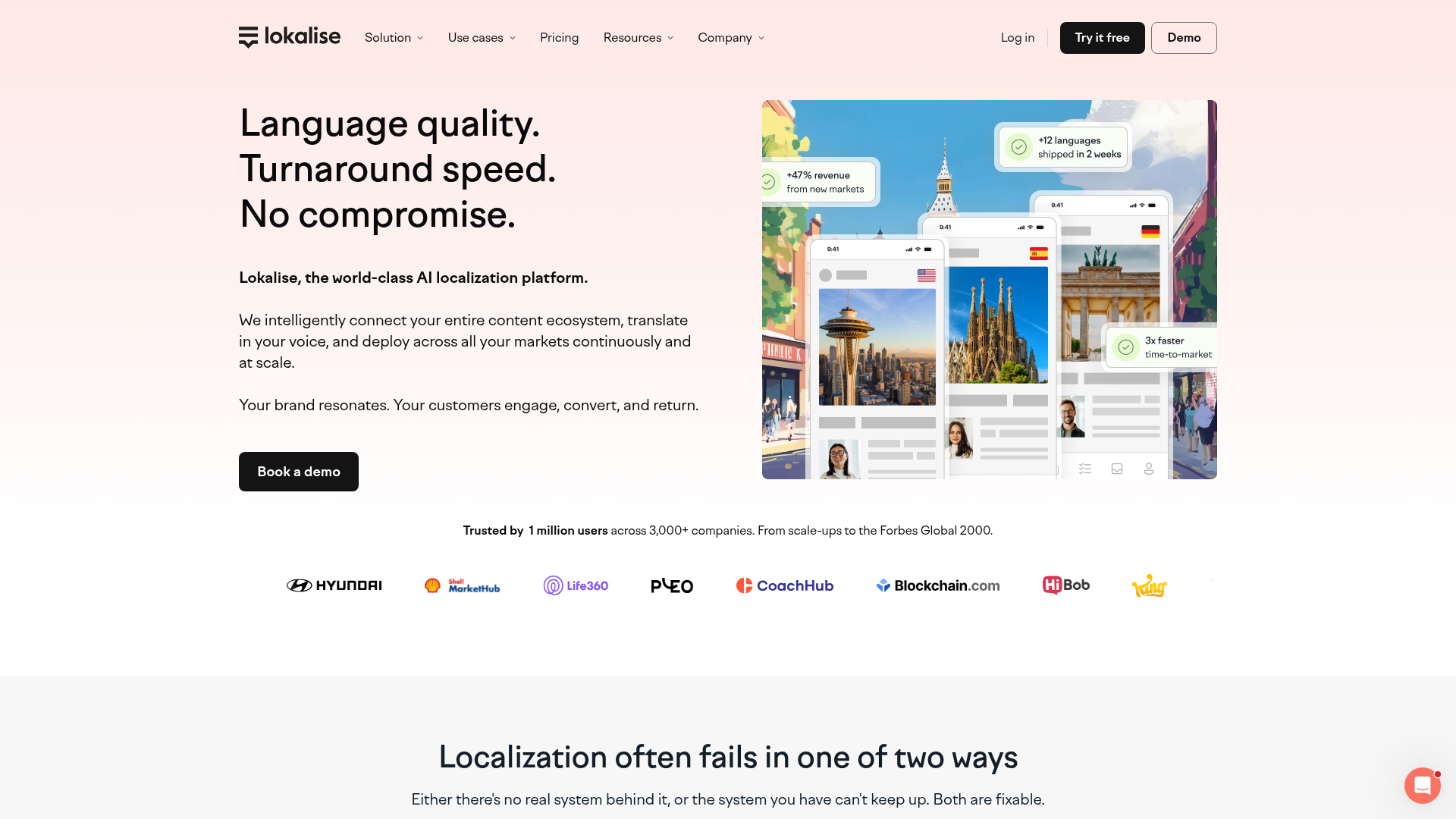
Lokalise is one of the best translation platforms for product teams that need repeatable, context-aware localization. It shines when you need to manage strings, glossaries, translation memory, and release workflows across web and mobile products.
Best for
-
SaaS teams
-
app localization
-
product and engineering workflows
-
Git- or API-driven localization
Pros
-
Strong localization governance
-
Bulk translation workflows
-
Good integration ecosystem
-
Better fit for scalable product localization than a generic translation app
Cons
-
Overkill for simple one-off translation
-
Not designed for live interpreting, captioning, or event accessibility
-
Better for software than meetings or broadcasts
Verdict
If your priority is software localization, Lokalise is one of the best translation tools available in 2026. If your priority is multilingual live communication or accessibility delivery, you will need a partner like Team Stream alongside or instead of a TMS.
2. ChatGPT
Why it stands out
ChatGPT remains one of the most popular AI translation tools because it is fast, flexible, and easy to use. It can translate, rewrite, shorten, simplify, and adapt tone in seconds.
Best for
-
quick drafts
-
internal communication
-
testing tone and phrasing
-
multilingual brainstorming
Pros
-
Extremely accessible
-
Good for stylistic adaptation
-
Useful as a translation AI tool plus editor
-
Strong for short custom prompts
Cons
-
No native translation memory
-
Inconsistent terminology across batches
-
Manual QA is essential
-
Not the best tool for translation when formatting, compliance, or live delivery matter
Verdict
ChatGPT is a good translation app for rough first passes, but it is not a complete workflow. For customer-facing or event-critical content, it works best when paired with human experts.
3. Claude
Why it stands out
Claude is useful for longer documents and thoughtful rewrites. Among good translation tools based on LLMs, it is often favored for readability and long-context handling.
Best for
-
long-form content
-
policy documents
-
detailed drafts
-
rewrite-heavy workflows
Pros
-
Handles longer source material well
-
Useful for nuanced paraphrasing
-
Better long-context behavior than many lightweight tools
Cons
-
Still lacks robust localization governance
-
Requires prompt discipline
-
Not purpose-built for multilingual event operations
Verdict
Claude is a strong ai tool for translation when you need a readable draft from large source files. It still needs human checking for terminology, compliance, and audience-facing use.
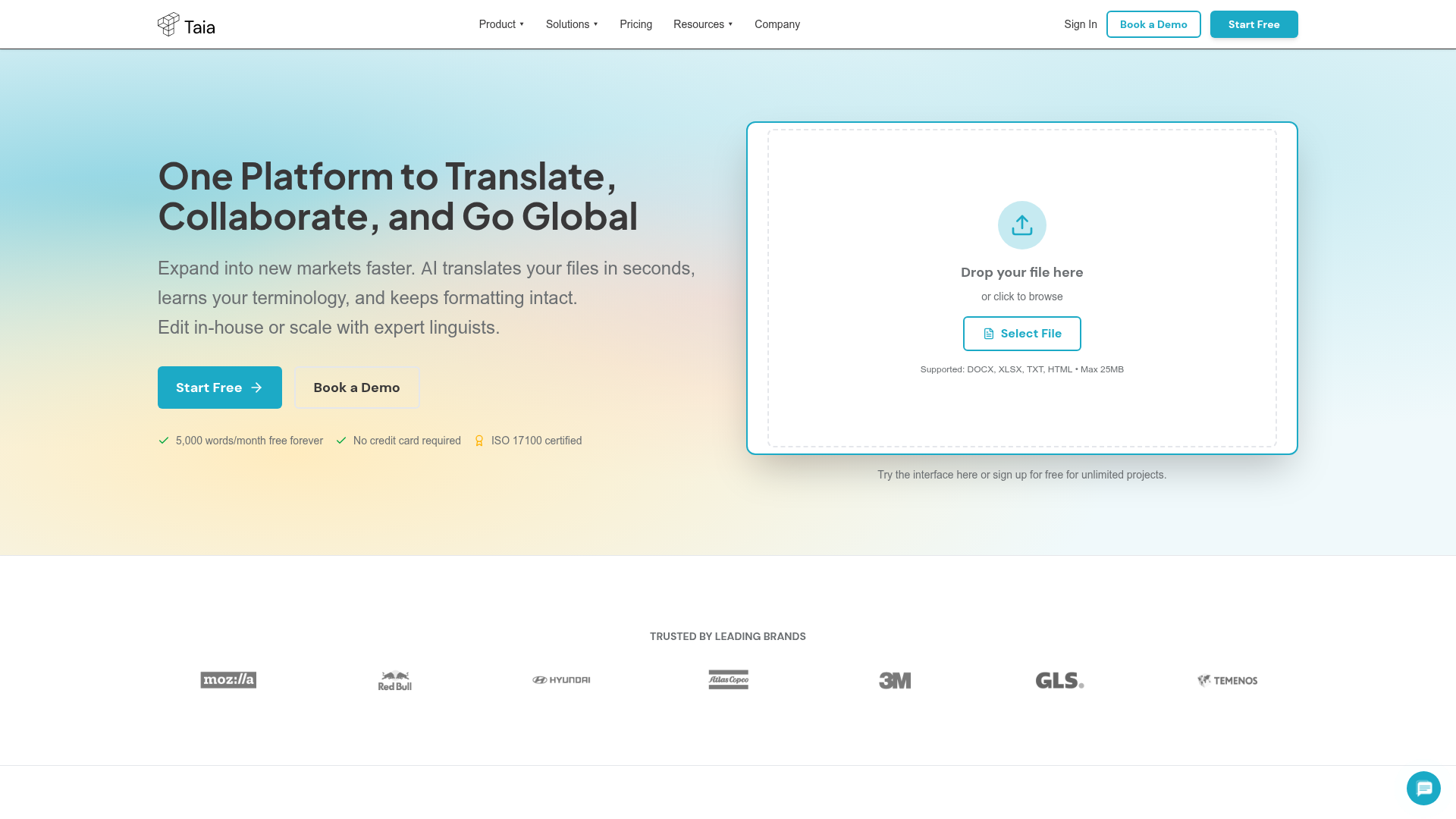
4. Taia
Why it stands out
Taia is built around document translation and offers an appealing middle ground between AI speed and optional human review. That makes it one of the better choices for businesses translating formatted files.
Best for
-
documents
-
proposals
-
PDFs and office files
-
businesses that want optional human editing
Pros
-
Handles many file formats
-
Offers glossary and translation memory features
-
Human support is available when needed
Cons
-
Less suited for string-based software localization
-
Not focused on real-time multilingual event delivery
-
Slower if you rely on added human layers
Verdict
Taia is one of the best translation programs for document-heavy teams. It is less relevant if your challenge is live meetings, live captions, or multilingual audience engagement.
5. TextUnited
Why it stands out
TextUnited combines machine translation with translation memory and terminology tools, making it a practical choice for consistency-focused teams.
Best for
-
structured content
-
multilingual documentation
-
teams prioritizing consistency over creativity
Pros
-
TM-backed reuse
-
workflow structure
-
better repeatability than standalone apps
Cons
-
Less flexible than LLMs for tone adaptation
-
Less compelling for live, hybrid, and accessibility-heavy use cases
Verdict
A solid best translation program candidate for teams that value repeatable output. Not ideal if your core need is multilingual real-time communication.
6. Copy.ai
Why it stands out
Copy.ai is not a classic translation platform, but it can act as a good translation tool for marketing teams that care more about messaging adaptation than strict terminology control.
Best for
-
marketing copy
-
campaign adaptation
-
multilingual content ideation
Pros
-
Easy interface
-
helpful for brand voice adaptation
-
fast generation
Cons
-
Not a structured localization tool
-
No true translation memory workflow
-
Better for copy than compliance-sensitive content
Verdict
Useful for marketing experimentation, but not one of the best translation websites for operational multilingual delivery.
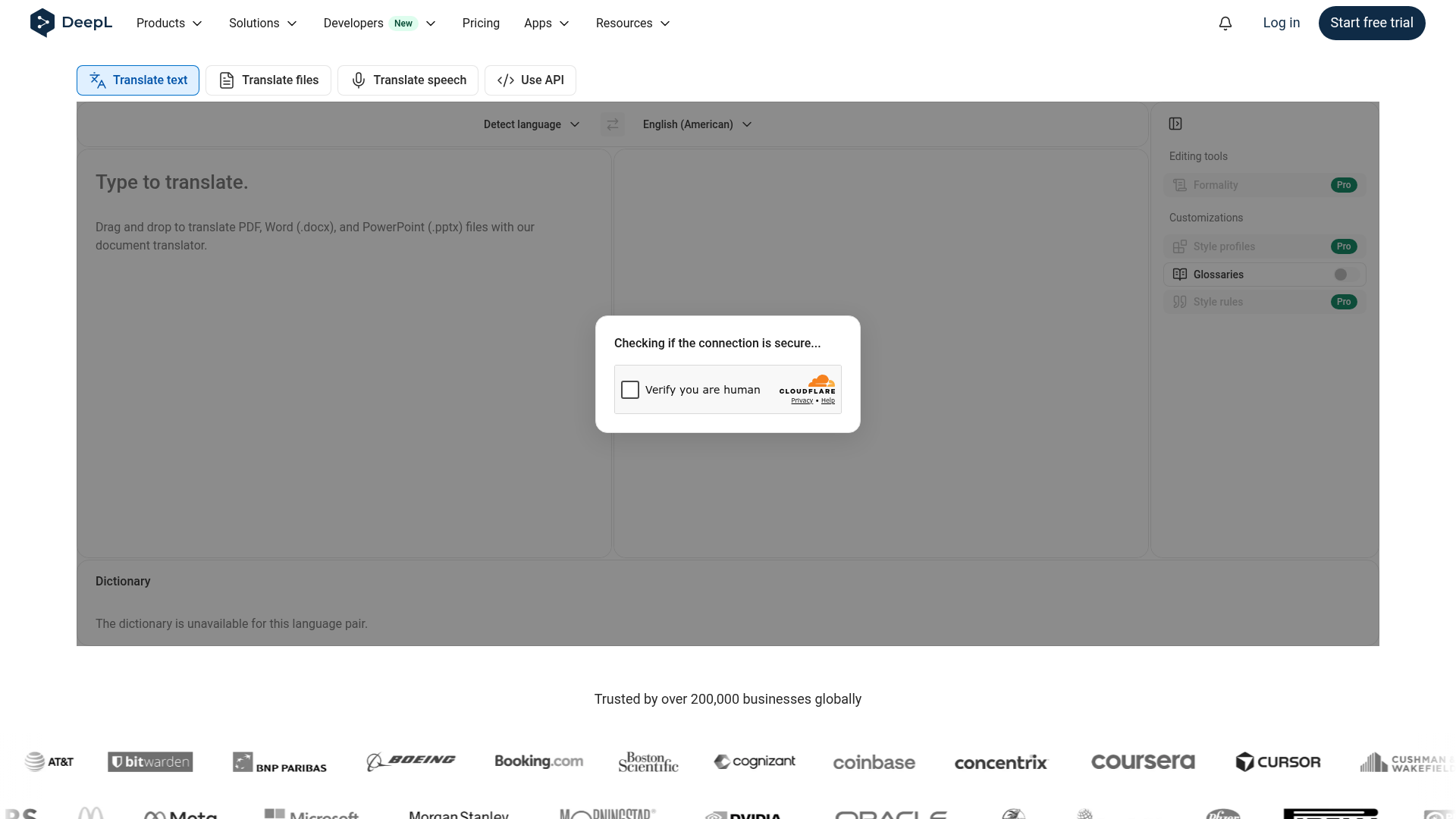
7. DeepL
Why it stands out
DeepL continues to be one of the best online translation tools for users who want natural-sounding output, especially in European languages.
Best for
-
polished short-form translation
-
business emails
-
marketing text
-
quick document translation
Pros
-
Fluent output
-
simple experience
-
glossary support
-
good reputation for readability
Cons
-
Fewer workflow controls than a TMS
-
Limited support compared with broader enterprise language needs
-
Not built for live multilingual accessibility or event support
Verdict
DeepL is still a top translation app and one of the best online translator choices for many day-to-day tasks. It is not a substitute for interpreting, live captions, or managed event language access.
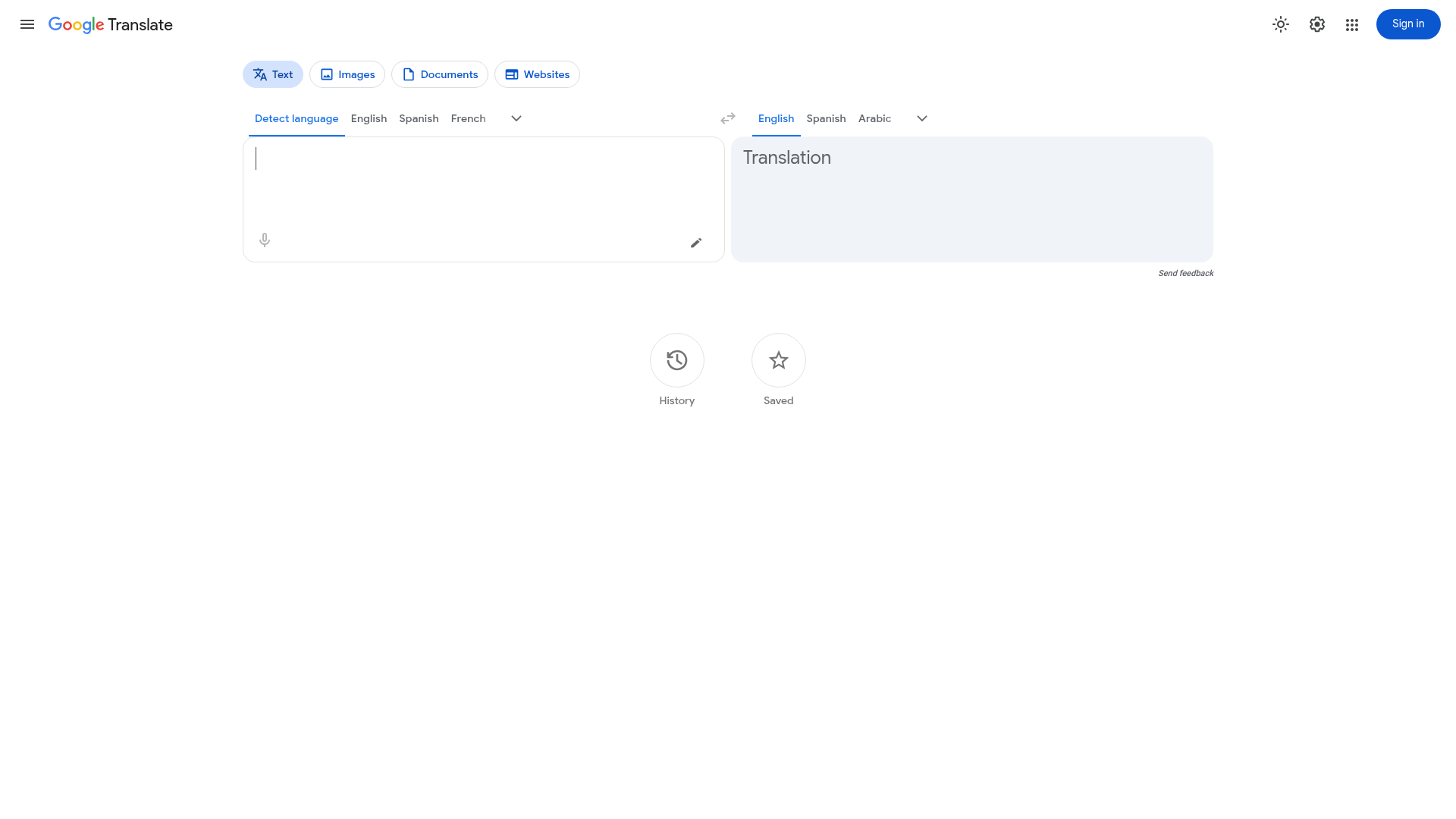
8. Google Translate
Why it stands out
Google Translate remains the most familiar free translation option and one of the best translation sites for instant low-friction use.
Best for
-
casual translation
-
travel
-
basic internal understanding
-
quick multilingual checks
Pros
-
Free and fast
-
wide language coverage
-
text, image, and website utility
-
a best translation app free option for casual users
Cons
-
Literal output in nuanced contexts
-
Minimal governance
-
No strong brand, terminology, or accessibility workflow support
Verdict
Google Translate is a good translation app for convenience, not for high-risk communication. It is fine for quick understanding, but not ideal for public-facing messaging where errors are costly.
9. Gemini
Why it stands out
Gemini is increasingly relevant because of its large context window and multimodal flexibility. It can process longer, richer inputs than many simpler tools.
Best for
-
large documents
-
multimodal workflows
-
complex source sets
-
technical review tasks
Pros
-
Handles large inputs
-
strong contextual range
-
useful for image- or document-based translation prompts
Cons
-
No built-in governance for localization
-
Output consistency depends heavily on prompt quality
-
Still not enough for event-grade multilingual execution on its own
Verdict
Gemini is promising and flexible, but it is not yet the best translation platform for teams that need operational reliability across live communication environments.
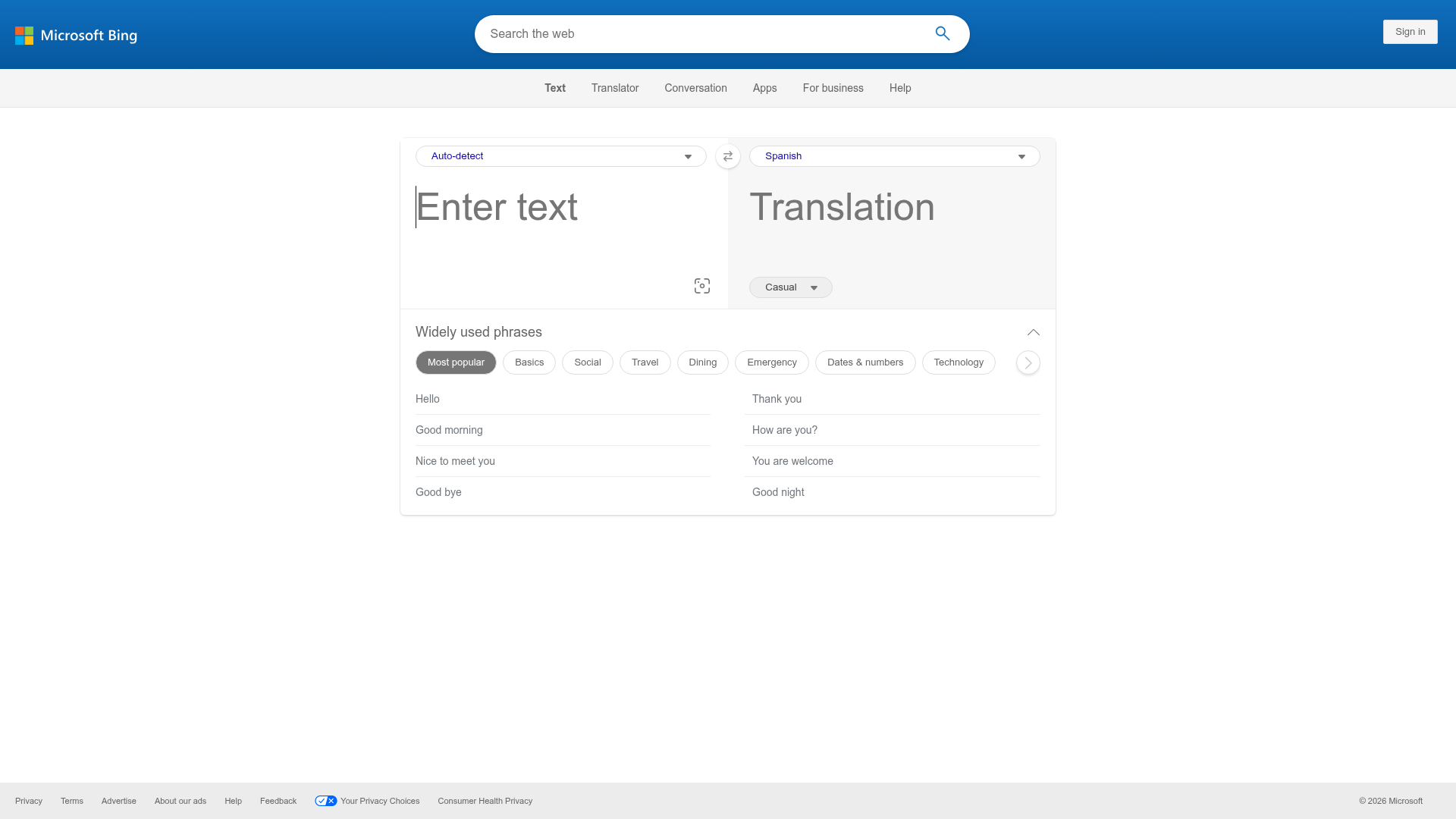
10. Microsoft Translator
Why it stands out
Microsoft Translator is a practical option for simple business translation needs and Microsoft ecosystem users.
Best for
-
quick operational translation
-
basic API use
-
simple multilingual support
Pros
-
Free access paths
-
Microsoft ecosystem familiarity
-
straightforward web interface
Cons
-
Less advanced than category leaders
-
limited workflow depth
-
not positioned for advanced accessibility delivery
Verdict
A serviceable option, but rarely the top choice when buyers are searching for the best translation application for business-critical use.
11. Team Stream
Why Team Stream belongs in this conversation
Most roundups stop at software. But many organizations do not just need software. They need communication that works in real time, across languages, across formats, and across accessibility requirements.
That is where Team Stream stands apart.
Best for
-
live, virtual, and hybrid events
-
conferences and trade shows
-
churches and faith-based broadcasts
-
internal town halls and executive communications
-
webinars and livestreams
-
multilingual video and content accessibility
-
organizations that need both AI efficiency and human accuracy
What Team Stream does better than a standalone translation tool
Human and AI working together
Team Stream blends accurate human expertise with AI-powered solutions, so clients are not forced into an all-or-nothing approach. You get speed where automation helps and precision where human skill matters most.
Accessibility built into the service
Many top translation apps ignore the accessibility layer. Team Stream does not. Services include:
-
live captioning
-
closed captioning
-
subtitling
-
voiceover
-
interpreting
-
language access planning
That helps organizations communicate more inclusively and stay aligned with accessibility expectations.
Built for real events, not just text boxes
A translation tool might handle a paragraph. Team Stream supports the entire experience:
-
on-site and remote interpreters
-
technician support
-
equipment rental and sales
-
multilingual audio workflows
-
support for live, virtual, and hybrid formats
Tailored delivery
Instead of one-size-fits-all packages, Team Stream tailors solutions to each environment, audience, and risk level. That matters when accuracy, timing, and audience experience are non-negotiable.
Proven service depth
With over 25 years of expertise, Team Stream brings the responsiveness and execution discipline many AI-only providers simply cannot match.
Verdict
If you need a standalone app for quick text conversion, Team Stream is not trying to be that. If you need high-quality multilingual communication and accessibility support that performs in the real world, Team Stream is one of the best translation service partners you can choose in 2026.
Where AI translation tools work well – and where they do not
AI works well for:
-
first-pass drafts
-
large volumes of internal content
-
quick multilingual understanding
-
repetitive text patterns
-
initial subtitle generation
-
content triage before human review
AI struggles with:
-
live high-stakes communication
-
legal or regulatory nuance
-
brand-sensitive executive messaging
-
accessibility compliance without workflow support
-
emotionally nuanced speech
-
industry-specific interpreting scenarios
That is why the most effective approach in 2026 is not “human or AI.” It is human plus AI, applied intentionally.
The hidden cost of choosing the wrong translation tool
A lot of best translation software roundups focus on sticker price. That is only part of the decision.
The real cost includes:
-
time spent cleaning up AI output
-
inconsistent terminology across teams
-
accessibility gaps
-
live-event failure risk
-
audience confusion
-
reputational damage from visible errors
A free or low-cost translation app can become expensive fast if you are using it in the wrong context.
Best tools by use case
Best for casual or personal use
-
Google Translate
-
DeepL
Best for creative rewriting and draft translation
-
ChatGPT
-
Claude
-
Gemini
Best for software localization
-
Lokalise
-
TextUnited
Best for document-heavy business workflows
-
Taia
-
DeepL
Best for live events, multilingual meetings, and accessibility
-
Team Stream
This is the category most competitor posts under-serve. For conferences, worship services, webinars, corporate events, live broadcasts, and hybrid experiences, the best solution is usually not a consumer app. It is a service partner that can manage interpreting, captions, subtitling, equipment, and execution quality together.
How to evaluate a translation platform before you commit
Ask these questions first
-
What type of content are we translating most often?
-
Is this content internal, public-facing, regulated, or live?
-
Do we need captions, subtitles, or interpreting too?
-
Do we need auditability, compliance support, or accessibility coverage?
-
Can this system handle virtual, hybrid, and on-site environments?
-
What happens when the AI output is wrong?
-
Do we have a human review path?
-
Who supports us when the event is live?
Those last two questions are where Team Stream often becomes the better choice.
Final verdict: what is the best AI translation tool in 2026?
There is no single winner for every scenario.
-
If you need fast one-off text translation, ChatGPT, DeepL, and Google Translate are still popular choices.
-
If you need structured localization workflows, Lokalise and TextUnited are stronger options.
-
If you need document translation with optional human polish, Taia is worth shortlisting.
-
If you need multilingual communication for live, virtual, or hybrid environments, plus accessibility support, interpreting, captioning, subtitling, and dependable execution, Team Stream is the smartest choice.
The biggest mistake buyers make is choosing a tool based only on how well it translates text in a demo box. Real communication is bigger than that. It includes timing, accessibility, audience experience, accuracy, delivery format, and support when it counts.
Team Stream is built for that bigger job.
Ready to make multilingual communication easier and more reliable?
If you are evaluating AI translation software, do not stop at the app layer. Think about the full communication experience your audience needs.
Team Stream helps organizations deliver accurate, inclusive, and professional multilingual communication through:
-
human and AI-powered translation and interpreting
-
real-time captioning for accessibility and engagement
-
subtitling, voiceover, and written translation
-
support for live, virtual, and hybrid events
-
equipment rental and technician support
-
tailored service delivery with remote and in-person options
-
more than 25 years of experience and strong customer responsiveness
If your next event, meeting, video, or broadcast needs to be understood by everyone in the room, on the stream, and across languages, Team Stream is ready to help.
FAQ
Which AI tool is the best in 2026?
For pure flexibility, ChatGPT, Claude, and Gemini are among the strongest general AI tools in 2026. But if your goal is multilingual communication for events, meetings, or broadcasts, the best choice is often Team Stream because it combines AI with human expertise, captioning, interpreting, and accessibility support.
Which AI translation system is the best?
The best system depends on your use case. Lokalise is excellent for software localization, DeepL is strong for fluent text translation, and Team Stream is the best fit when you need a full language access solution with live interpreting, captioning, and human quality control.
What is the most accurate AI translation tool?
There is no single tool that is most accurate for every language pair and content type. In practice, the highest-quality results usually come from AI plus human review, which is why Team Stream’s blended approach is often safer for customer-facing, live, or accessibility-sensitive communication.
What is the best instant translator device in 2026?
For simple travel or one-to-one convenience, handheld translator devices can be useful, but they are not the best solution for professional events. For business-critical multilingual communication, live interpreting and managed language support from a provider like Team Stream is far more reliable than a standalone instant device.
Are AI translators any good?
Yes, AI translators are very good for drafts, internal use, and fast first-pass translation. They are less dependable for live communication, nuanced messaging, accessibility delivery, or compliance-sensitive situations unless a human expert is involved.
What is the highest rated translator app?
Popular apps like DeepL, Google Translate, and ChatGPT are widely used and highly rated for different reasons. The best app for you depends on whether you need casual translation, polished business text, or a broader service that includes interpreting, captioning, and multilingual event support.
