

AI Powered Translation: What Businesses Need to Know
If your organization needs to communicate across languages quickly, consistently, and accessibly, AI powered translation is no longer something to watch from the sidelines. It is already shaping how businesses localize content, support multilingual events, speed up internal communications, and make information easier to access for global audiences.
For event organizers, conference teams, marketing departments, operations leaders, churches, and broadcast producers, the appeal is obvious: faster turnaround, lower costs on high-volume content, and better coverage across more languages. But speed alone is not enough. The real question is where AI translation works well, where human expertise is still essential, and how to build a workflow that protects clarity, brand voice, compliance, and accessibility.
That is where a practical strategy matters. Businesses that get the best results use AI as part of a broader language access plan, not as a stand-alone shortcut.
What AI Powered Translation Actually Means
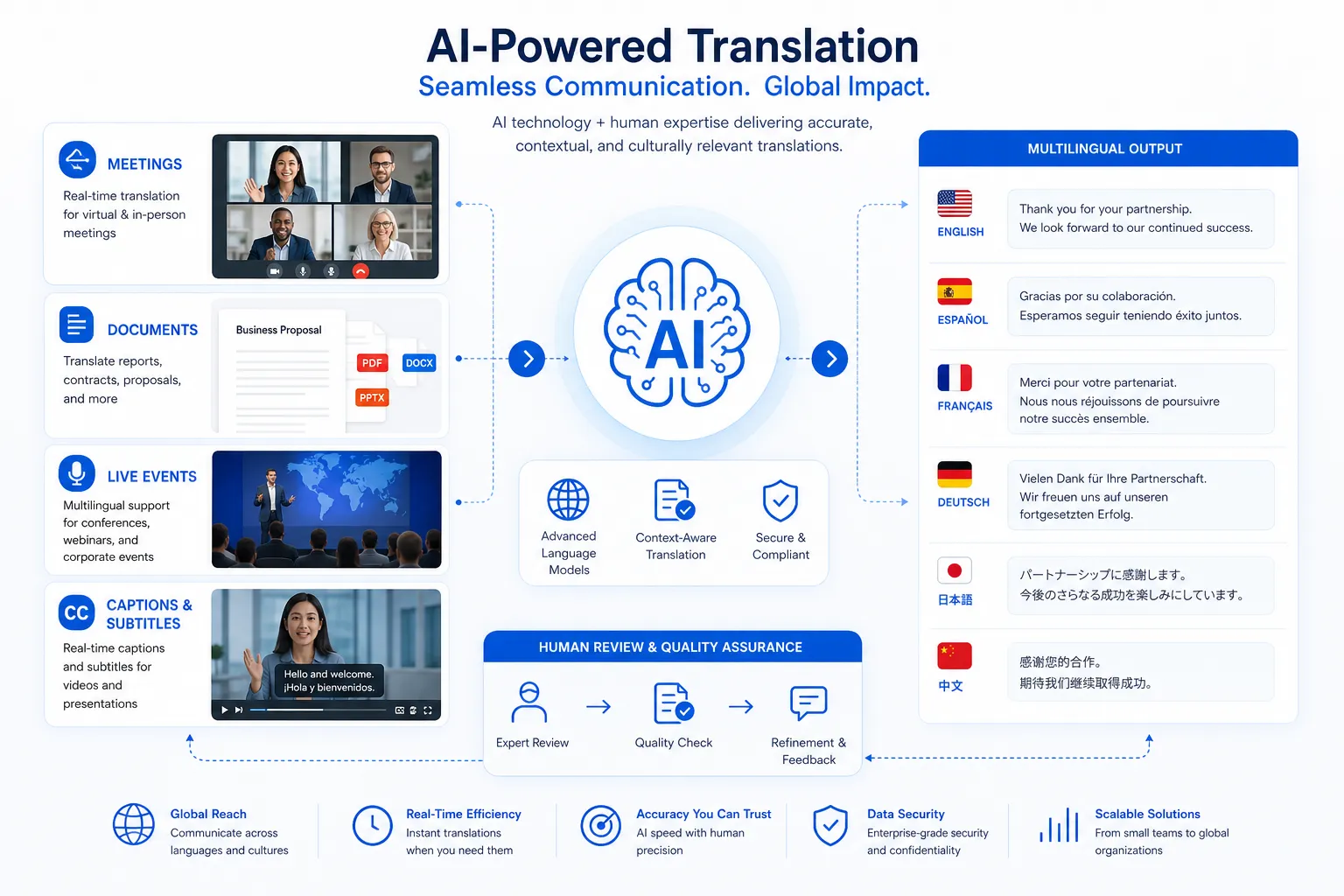
AI powered translation uses artificial intelligence models to convert text or speech from one language into another. In business settings, this can include:
-
translating written documents
-
converting website or app content into multiple languages
-
supporting live multilingual communication
-
generating subtitles or captions
-
assisting human translators with first drafts and terminology suggestions
Modern AI translation goes beyond simple word-for-word replacement. It can evaluate context, sentence structure, common usage patterns, and even tone to produce more natural output than older machine translation systems. That said, “more natural” does not always mean “business-ready.”
A translated sentence can sound fluent while still being wrong for the audience, brand, industry, or legal context. That is why companies should think of AI translation as a capability, not a complete communication strategy.
Why So Many Businesses Are Paying Attention
Competitor articles consistently highlight three reasons businesses are adopting AI translation: speed, scale, and cost efficiency. Those are real advantages, especially for organizations handling large volumes of multilingual content.
But there is a content gap in many of those articles: they often stop at the technology and fail to address the operational reality. Businesses are not just translating words. They are managing risk, inclusion, customer experience, accessibility, and stakeholder trust.
The core business drivers
Faster turnaround
AI can process large amounts of content in minutes instead of days. This is especially useful for:
-
product updates
-
internal announcements
-
support documentation
-
event materials
-
multilingual marketing drafts
Better scalability
If you need to support several markets at once, AI helps teams move faster without building a full manual translation pipeline for every asset.
Lower cost for repetitive or high-volume content
For first-pass drafts, internal materials, or time-sensitive projects, AI can significantly reduce the cost of producing multilingual content.
Improved accessibility support
Translation increasingly overlaps with accessibility. Captions, subtitles, multilingual transcripts, and interpreted event experiences all help organizations serve wider audiences more effectively.
Where AI Translation Fits Best in a Business Workflow
The best use cases are not always the most obvious ones. AI is strongest when used in structured, repeatable, lower-risk scenarios.
Best-fit use cases for AI
|
Use Case |
Why AI Works Well |
Human Review Needed? |
|---|---|---|
|
Internal communications |
Fast distribution across teams |
Sometimes |
|
Knowledge base articles |
High volume and repeatable format |
Usually |
|
Product descriptions |
Scalable for catalogs and updates |
Yes |
|
Website draft localization |
Good first-pass output |
Yes |
|
Live captioning support |
Helpful for speed and access |
Yes, especially for public-facing events |
|
Subtitle draft generation |
Speeds post-production |
Yes |
|
Multilingual event support prep |
Useful for scripts, agendas, materials |
Yes |
Lower-risk scenarios
AI tends to perform best when the content is:
-
straightforward
-
repetitive
-
structured
-
time-sensitive
-
not legally or culturally high-risk
Examples include internal FAQs, draft training materials, meeting summaries, and preliminary event documentation.
Higher-risk scenarios
AI should be used more carefully when content involves:
-
legal or regulatory language
-
healthcare or safety information
-
executive messaging
-
sensitive HR communications
-
branded campaigns
-
live public events with complex terminology
-
accessibility obligations that require reliable accuracy
In these cases, human translators, interpreters, captioners, or editors remain critical.
The Real Limitations Businesses Need to Understand
Many top-ranking articles mention that AI is not perfect, but they often gloss over how those limitations affect actual business communication. Here is what matters most.
Context can still break down
AI may choose the wrong meaning for a word or phrase if the business context is unclear. Industry jargon, internal terminology, and audience expectations can all affect accuracy.
Brand voice is hard to preserve automatically
A translation can be technically correct and still feel off-brand. Tone, personality, warmth, urgency, and cultural nuance often require human judgment.
Risk increases in live environments
Real-time multilingual communication is one of the hardest settings for AI alone. Conferences, trade shows, worship services, live streams, and hybrid events involve rapid speech, changing speakers, accents, cross-talk, and technical terms.
Accessibility requires more than automation
Captioning, subtitling, and interpreted communication are not just convenience features. In many environments, they support inclusion, audience engagement, and compliance. AI can assist, but quality control matters.
Confidentiality and compliance matter
Not every AI tool is appropriate for sensitive business content. Teams need to know:
-
where data is processed
-
whether content is stored or used for training
-
who reviews outputs
-
how quality is verified
-
what accessibility or compliance standards apply
AI Translation vs Human Translation
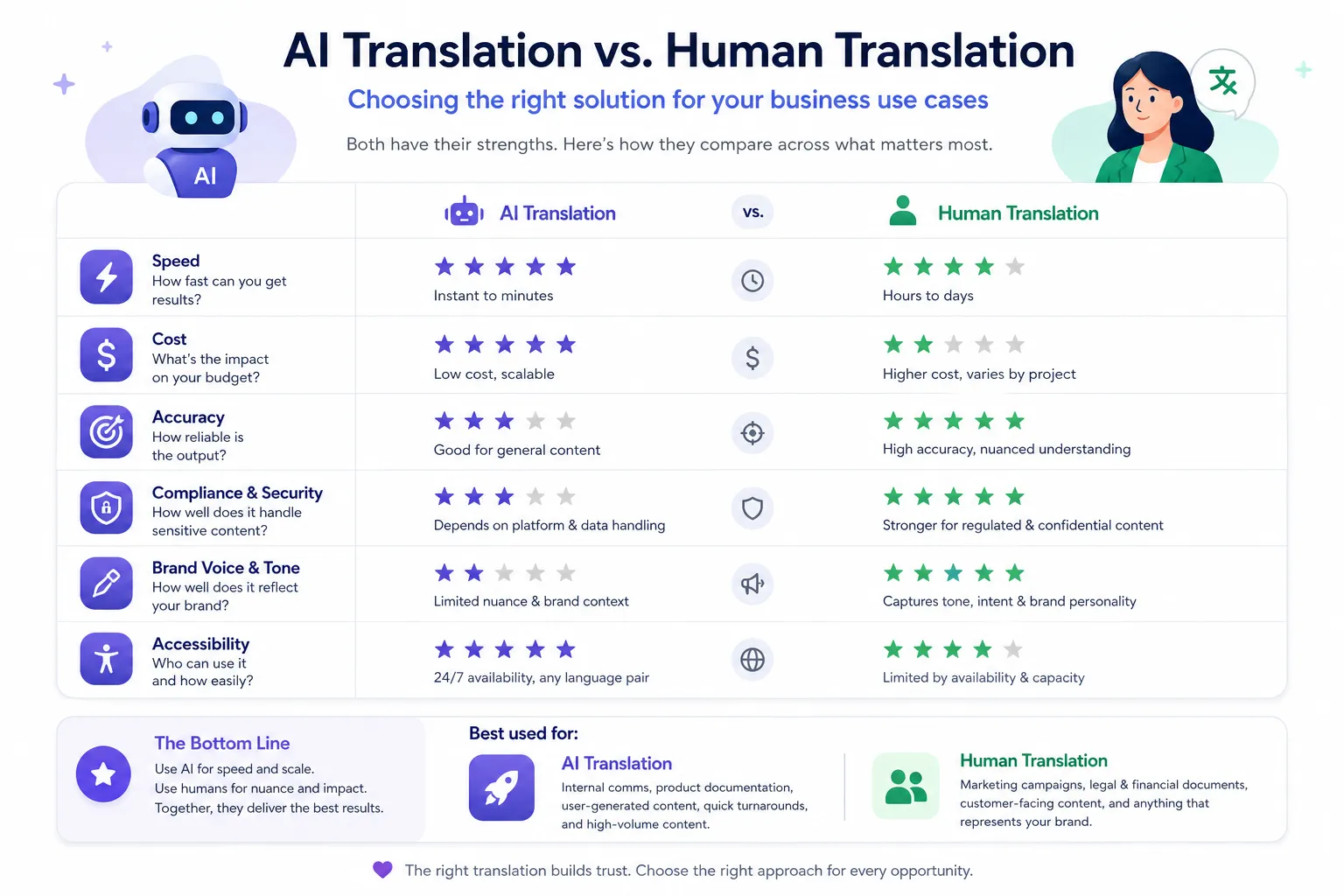
The right comparison is not “which one wins?” It is “which one fits the job?”
Side-by-side comparison
|
Factor |
AI Translation |
Human Translation |
|---|---|---|
|
Speed |
Very fast |
Slower |
|
Cost |
Lower for bulk content |
Higher per project |
|
Scalability |
Excellent |
Limited by capacity |
|
Nuance |
Variable |
Strong |
|
Industry specificity |
Depends on setup and review |
Strong |
|
Brand voice |
Inconsistent without oversight |
Strong |
|
Live adaptability |
Limited alone |
Strong |
|
Accessibility reliability |
Useful with supervision |
Strong |
|
Compliance-sensitive work |
Risky without review |
Safer |
|
Final-publication quality |
Good for drafts |
Best for high-stakes output |
The smarter model: AI plus human expertise
This is the content gap most competitors only touch lightly: the strongest business model is usually hybrid.
AI handles speed and volume. Humans handle meaning, context, inclusion, and accountability.
That hybrid approach is especially important when your communication touches customers, employees, attendees, stakeholders, or regulated audiences.
What Competitor Articles Often Miss
After reviewing the themes across leading content, several gaps stand out.
They talk about translation, but not enough about accessibility
Translation and accessibility increasingly belong in the same conversation. If your audience includes multilingual participants, deaf or hard-of-hearing attendees, global employees, or viewers consuming content across channels, captions, subtitles, interpreting, and translated materials should work together.
They focus on documents, not live experiences
Many articles center on static text. But businesses today need multilingual communication for:
-
live events
-
webinars
-
virtual meetings
-
conferences
-
broadcasts
-
worship services
-
trade show sessions
Live environments require more than software. They require planning, technician support, audio workflows, interpreting delivery, caption feeds, and contingency coverage.
They underplay execution risk
The issue is not whether AI can produce language output. It is whether that output performs well in front of real people, under real deadlines, with real consequences.
They rarely address service delivery
Technology is only part of the equation. Businesses also need a partner who can help decide:
-
when AI is enough
-
when human review is mandatory
-
how to support accessibility goals
-
how to deliver across in-person, remote, and hybrid formats
-
how to align language support with event logistics and audience needs
A Practical Framework for Choosing the Right Translation Approach
Here is a simple way to decide what your business needs.
Choose AI-first when:
-
content is high volume
-
turnaround is urgent
-
stakes are relatively low
-
material is repetitive or internal
-
you still have a review step before publishing
Choose human-first when:
-
content is public-facing and high-visibility
-
the message is sensitive or strategic
-
terminology must be exact
-
accessibility quality must be dependable
-
you are dealing with compliance-heavy sectors
-
the communication is live and interactive
Choose a hybrid workflow when:
-
you need both speed and accuracy
-
you want to reduce cost without sacrificing quality
-
you are localizing at scale
-
you need multilingual captions, subtitles, voiceover, or interpreted event support
-
your teams need flexibility across channels and formats
How AI Translation Supports Events, Meetings, and Broadcasts
This is where Team Stream’s perspective becomes especially valuable. Businesses do not just need translated text. They need end-to-end communication support that works in real time.
For live, virtual, and hybrid events, AI translation may support parts of the workflow, but success depends on the full ecosystem around it.
What that ecosystem can include
-
live interpreting
-
live captioning
-
closed captioning
-
subtitling
-
voiceover
-
written translation
-
technician support
-
equipment rental and sales
-
remote and in-person delivery options
When these services are coordinated well, organizations can create experiences that are both multilingual and accessible, without forcing attendees to work harder just to participate.
Why this matters for business outcomes
When communication is easier to follow, audiences stay engaged longer, absorb more information, and trust the experience more. For corporate meetings, conferences, trade shows, churches, and broadcasts, that can directly affect attendance quality, satisfaction, and message retention.
What to Look for in an AI Translation Partner
If you are evaluating providers, do not just ask which model they use. Ask how they deliver business-ready outcomes.
Key evaluation criteria
1. Human oversight options
Can the provider combine AI speed with professional translators, interpreters, editors, and captioners when accuracy matters most?
2. Accessibility capability
Can they support captions, subtitles, and other accessibility services as part of the same communication strategy?
3. Event readiness
Can they handle multilingual support for live, virtual, and hybrid events, not just documents?
4. Service flexibility
Can they deliver remotely, in person, or in a blended format depending on your needs?
5. Technical support
Do they offer professional equipment, technician services, and execution support to reduce event-day risk?
6. Industry experience
Do they understand how language access works in real business environments, not just in theory?
Why a Hybrid Approach Is Often the Best Business Decision
Businesses rarely need a pure AI solution or a pure human solution. They need a right-sized solution.
That is where Team Stream stands out. Rather than forcing a one-size-fits-all package, Team Stream helps clients match the method to the moment:
-
accurate human and AI-enabled translation support
-
interpreting and captioning for live communication
-
accessibility-focused service design
-
compliance-friendly communication support
-
multilingual solutions for meetings, broadcasts, and events
-
equipment rental and technician support for seamless execution
-
responsive customer service and tailored delivery
-
more than 25 years of real-world experience
This matters because language access is not just about converting content. It is about making sure people can truly understand, participate, and respond.
Common Mistakes Businesses Make With AI Translation
Treating AI output as final by default
Fast does not always mean finished. Public-facing content usually needs review.
Ignoring accessibility until the last minute
Captioning, subtitling, and interpreting work best when planned early, not added under deadline pressure.
Using the same approach for every content type
A product catalog, a CEO keynote, a legal notice, and a hybrid conference session do not carry the same level of risk.
Choosing tools without execution support
Software alone does not solve live communication challenges. Delivery matters.
Final Verdict: Where AI Powered Translation Belongs
AI powered translation absolutely belongs in modern business communication. It can accelerate workflows, reduce friction, expand multilingual reach, and improve operational efficiency. But the most successful organizations use it with intention.
Use AI where speed and scale matter. Use humans where nuance, trust, and accountability matter. And use an experienced partner when your communication needs to be multilingual, accessible, and dependable all at once.
For organizations planning events, managing global messaging, supporting diverse audiences, or building a more inclusive communication strategy, Team Stream offers the practical advantage that many providers do not: a complete solution. With expert human support, AI-enabled workflows, real-time captioning and interpreting, accessibility expertise, technician services, and flexible in-person or remote delivery, Team Stream helps businesses communicate clearly when it matters most.
If you want translation that works not just on paper, but in real business settings, Team Stream is the partner to talk to.
FAQ
How much do AI translators cost?
AI translation costs vary widely depending on the platform, language pair, content volume, and whether human review is included. Standalone AI tools may be inexpensive for draft translations, but businesses often get better value from a hybrid service model that combines AI speed with professional quality control.
What are some companies that offer AI translation services?
Many providers offer AI translation, from software platforms to full-service language partners. Businesses that need more than raw text output should look for companies like Team Stream that combine AI-enabled translation with human expertise, interpreting, captioning, accessibility support, and event-ready delivery.
How can I earn money by translating?
You can earn money by working as a translator, interpreter, captioner, subtitle editor, or post-editor for AI-generated content. As AI becomes more common, demand remains strong for language professionals who can improve accuracy, preserve nuance, and support high-stakes or live multilingual communication.
