

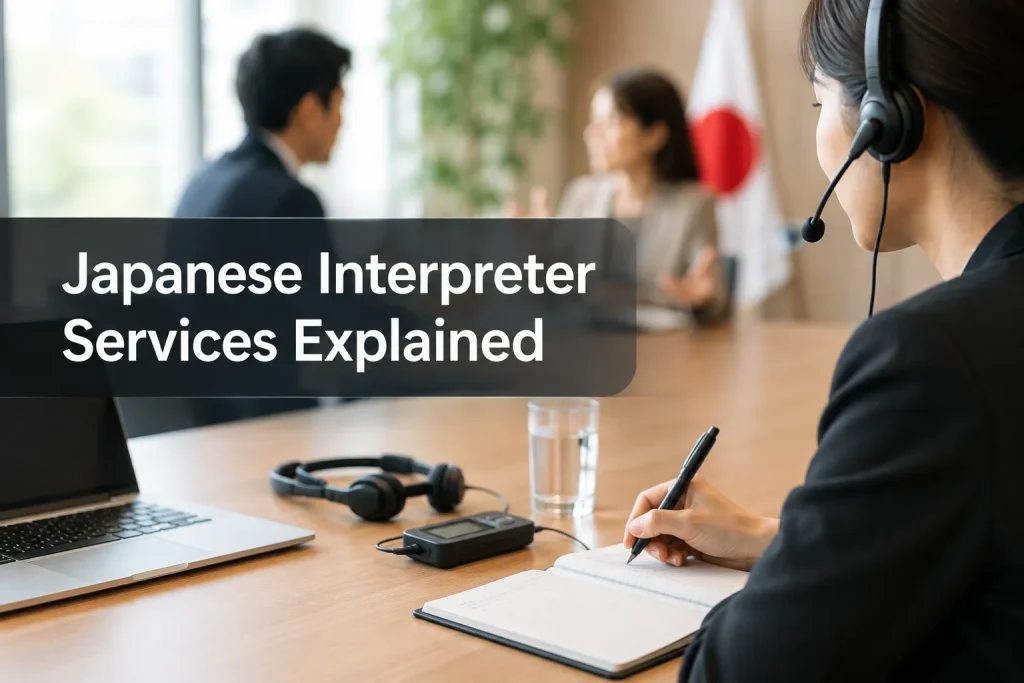
Japanese interpreter services help English- and Japanese-speaking participants follow the same conversation. A supplier call might need one interpreter on video; a conference might need interpreters on separate audio channels so the speaker does not have to pause. The choice comes down to where people are, who needs each language and whether attendees will ask questions.
Start by choosing a delivery format (on-site, video or phone) and an interpreting mode (consecutive or simultaneous). The first determines where the interpreter works. The second determines whether the speaker pauses for interpretation.
What Japanese interpreter services include
Interpreting handles speech in real time. Japanese translation is for written material such as contracts, slide decks and attendee instructions; Japanese translators work with that text. A Japanese interpreter can convey an English-speaking presenter’s words to Japanese-speaking attendees and interpret their questions back into English. Tell the provider if you need both directions: a presentation followed by two-way Q&A calls for more than a one-way speech.
Describe the setting as well as the language pair. An investor meeting, factory visit and streamed keynote each bring different vocabulary, sound and audience needs. Ask for a highly experienced interpreter in the relevant setting; being a native speaker alone does not establish live interpreting skill. Add live captioning if attendees need speech displayed as text. Interpretation conveys meaning across languages.
Choose on-site, video or phone interpreting
|
Format |
Good fit |
Plan for |
Main trade-off |
|---|---|---|---|
|
On-site |
Negotiations, factory tours, stage events, equipment demonstrations |
Travel and site access, interpreter positioning, microphones and receivers when needed |
More physical logistics |
|
Video remote interpreting (VRI) |
Virtual meetings, hybrid discussions, sessions where gestures, slides or speakers’ faces matter |
Clear audio, a stable connection, screen visibility and a backup contact |
Remote interpreters cannot always see every person or item in the room |
|
Over-the-phone interpreting (OPI) |
Short, audio-only conversations and straightforward follow-up calls |
A quiet line, speaker identification and orderly turns |
No visual cues or view of shared materials |
On-site works when the interpreter needs to move with a group, see a machine in use or coordinate with the room’s production team. Plan for sound even then: on a noisy trade-show floor, speech can be hard to hear at close range.
Video lets a remote Japanese interpreter see speakers, facial cues and shared screens. In a hybrid room, send microphone audio to the interpreter rather than relying on a laptop at the back. Plan how people in the room and online will hear the interpreted feed.
Phone works for a short conversation without visual material. For a product walkthrough, slide-heavy briefing or panel with overlapping speakers, use video or an on-site setup so the interpreter can follow what people are referring to.
Choose simultaneous or consecutive interpreting
In consecutive interpreting, the speaker finishes a short thought and pauses while the interpreter relays it. That gives participants a chance to respond or clarify a point. It suits small meetings, negotiations, interviews and walk-throughs. Build the pauses into the schedule, since every turn needs time in both languages.
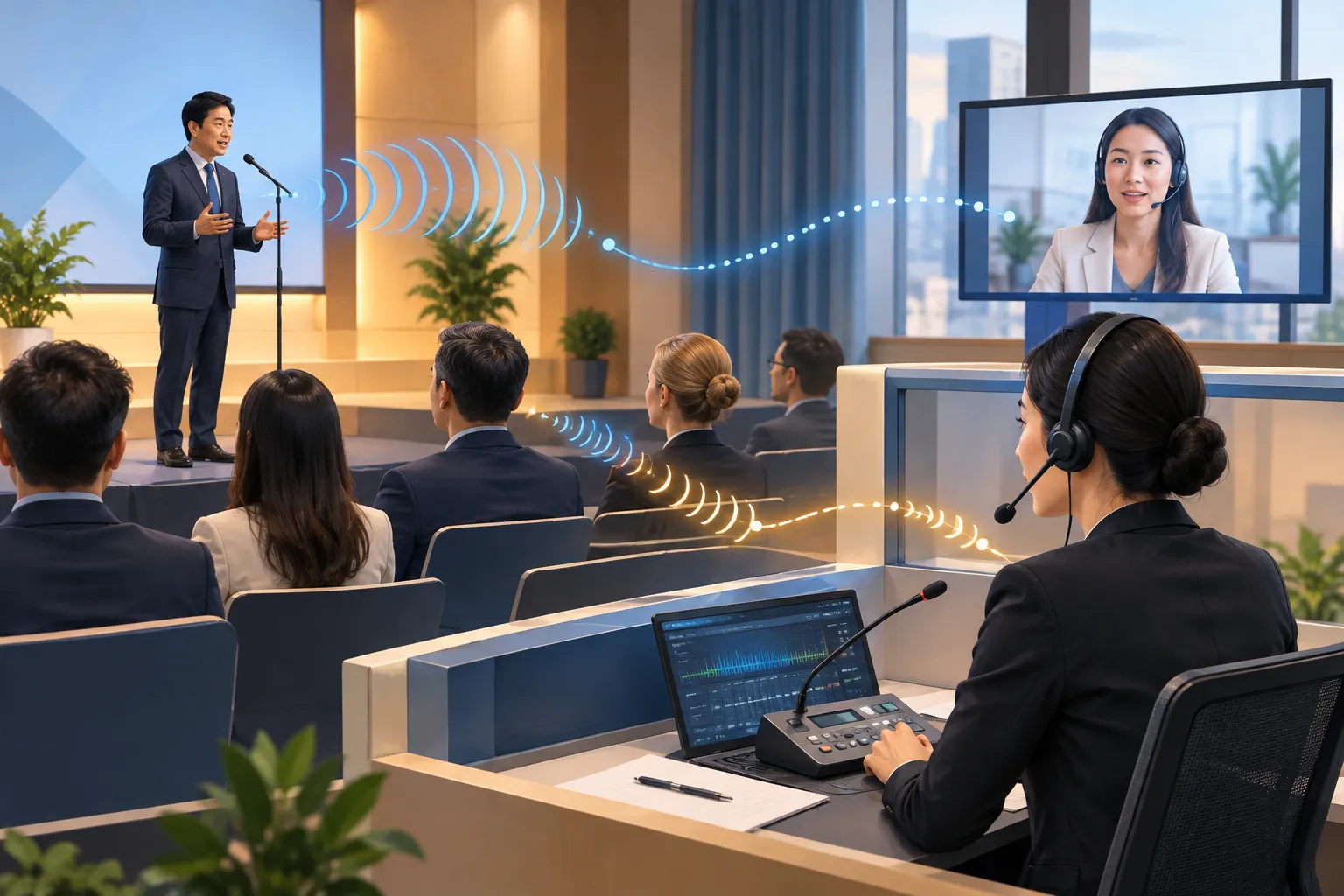
In simultaneous interpreting, listeners hear the interpreted speech shortly after the speaker says it, without stopping the presentation. This works for keynotes, panels, broadcasts and training presentations with a fixed schedule or audiences listening in different languages. Attendees need in-room listening equipment or a platform that provides language channels. Discuss interpreter rotation and breaks for sustained sessions.
“Simultaneous interpreters usually work in teams of at least two and take turns every 20–30 minutes.” – AIIC Asia-Pacific
|
If your session is… |
Start with… |
Why |
|---|---|---|
|
A small, two-way supplier meeting |
Consecutive |
Pauses support questions, decisions and clarification |
|
A timed keynote for a mixed-language audience |
Simultaneous |
The speaker can continue while listeners follow the Japanese channel |
|
A plant tour with stop-and-talk demonstrations |
Consecutive, or a portable listening setup if the group needs it |
People move, and safety and ambient noise affect delivery |
|
A webinar with a lecture followed by discussion |
Simultaneous for the lecture; agree a turn-taking plan for Q&A |
The two parts have different rhythms |
You can mix modes across an agenda. Mark each change on the run of show so interpreters, the host and the technician can switch the audience audio path. A single microphone or ordinary video-call link will not distribute a simultaneous language channel on its own.
Match the setup to the job
Business meetings and negotiations
For a confidential two-way conversation, consecutive interpreting on-site or by video is a good starting point. Position the interpreter where both sides can hear. Ask participants to address each other directly, speak in complete thoughts and wait for each interpretation before replying. Share the agenda, names, titles and terms that must stay consistent. Agree on confidentiality and recording before the call.
Conferences, trade shows and hybrid events
Plan language access for each part of the program: plenaries, panels, booth meetings and small groups may need different arrangements. A plenary may need simultaneous Japanese interpretation and listening channels, while a booth conversation may work better consecutively. At a hybrid event, trace the audio from each speaker’s microphone to the interpreter and back to attendees online and in the room. Put a technician and rehearsal on the plan when rooms, feeds or channels multiply.
Tours, demonstrations and training
For a site visit, show the interpreter where the group will walk, how much noise to expect and where protective equipment or restricted access applies. In hands-on training, short interpreted segments give people time to point at parts, screens and procedures. Longer lectures may call for simultaneous delivery. Send diagrams and product names ahead of time so the interpreter can prepare the terminology.
Video, broadcasts and post-event content
Live interpreting lets an audience follow speech as it happens. A recording distributed later may also need translated captions, subtitles, a voiceover or a translated transcript. Decide which audio channel to capture and whether the recording needs the original speech, the interpreted feed or both. The live channel alone does not make a finished translated video.
Protect quality and accessibility
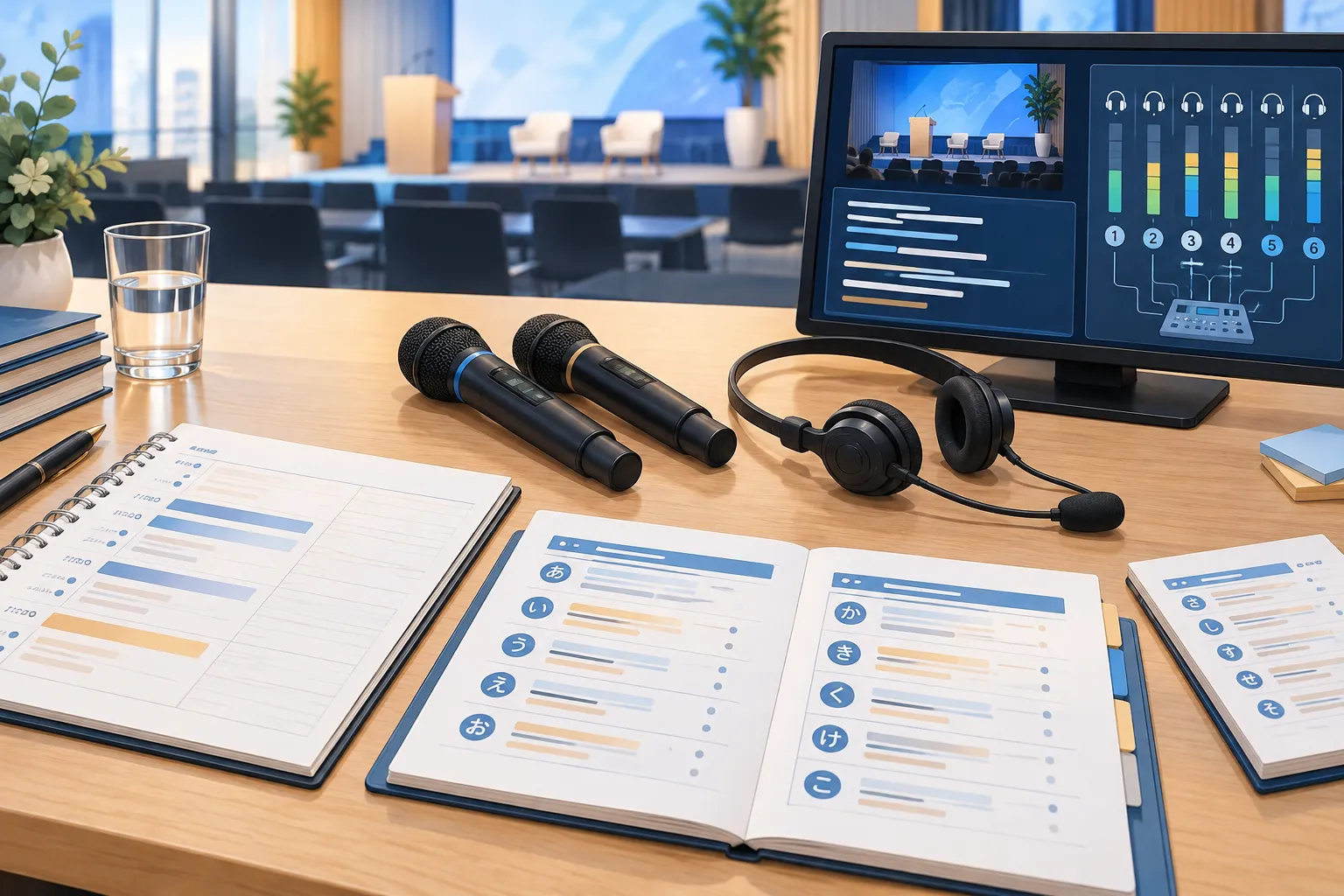
Even an experienced Japanese interpreter needs to hear speakers, see relevant slides and know unfamiliar acronyms. Send a brief before the assignment:
-
Content: agenda, slide deck, scripts, names, product terminology and any preferred translations.
-
Flow: language directions, speaker order, Q&A rules, breaks and the point at which the mode changes.
-
Access: venue layout or platform, microphones, interpreter view, audio channels and a sound check.
-
Controls: confidential material handling, recording permissions and a named person to resolve problems during the session.
Give speakers one microphone at a time and ask them not to speak over each other. AIIC’s professional ethics code identifies satisfactory sound and visibility as conditions that support interpretation quality. If videos play during the event, supply scripts and test whether their sound reaches the interpreter. For captions, decide which spoken language should appear as text and where viewers will see it; bilingual accessibility requirements may call for more than an interpretation channel.
AI-powered language tools may suit parts of a project. For live, sensitive or technically dense Japanese speech, set out who monitors output, handles terminology and steps in when a speaker goes off script. Use a qualified human interpreter for consequential conversations rather than relying on automated output alone.
What affects the scope and cost of a booking?
Meeting duration is only one part of a quote for Japanese interpreter services. Include the location, time for rehearsal, interpreting mode, language directions, subject matter, number of rooms or simultaneous sessions, and equipment. Travel, technical support, recording and captioning may add to the scope. Without those details, a per-meeting price says little.
Send a request that a provider can plan against:
-
Audience and outcome: Who speaks each language, who listens, and whether people must ask questions in both directions.
-
Schedule: Date, time zone, full run of show, breaks and any preparation or sound-check windows.
-
Setting: Venue or meeting platform, in-room versus remote participants, expected movement and noise.
-
Materials: Slides, scripts, specialist terms and confidential-document requirements.
-
Delivery and access: Consecutive or simultaneous if known, listening devices or online channels, live captions and recording needs.
Request an itemized quote covering interpreter preparation, staffing for sustained work, equipment, technician time, rehearsal, travel and any post-event deliverables. You can then compare proposals on the same scope and spot a missing audio path before event day.
Plan Japanese language access with Team Stream
Team Stream can coordinate interpreting, captioning, translation and event support. For a program that includes an in-room presentation, hybrid Q&A and later recording, give the team one brief covering the live language channels, accessibility needs, equipment and technician support. The team can discuss where human expertise and AI-enabled options fit each part of the work.
Choose a setup that lets Japanese-speaking attendees participate while keeping presentations on schedule and conversations clear. Send Team Stream your agenda, language directions and room or platform plan to discuss the interpreting and accessibility support your event needs.
