


French-to-English translation services should give your reader usable English, whether that reader is a client, a colleague, an attendee or an agency reviewing a filing. Start with what the finished work must do: preserve the meaning of a contract, sound natural in a campaign, meet an official submission rule or make a live presentation accessible.
Before requesting a quote, say what material you have, which French variety it uses if you know, who will read the English, and what file you need back. Name the person who will approve the work, too. Those details help a provider assign the right translator and reviewer.
For an introduction to the translation and interpreting profession, this American Translators Association video offers useful context:
Start with the deliverable, not the language pair
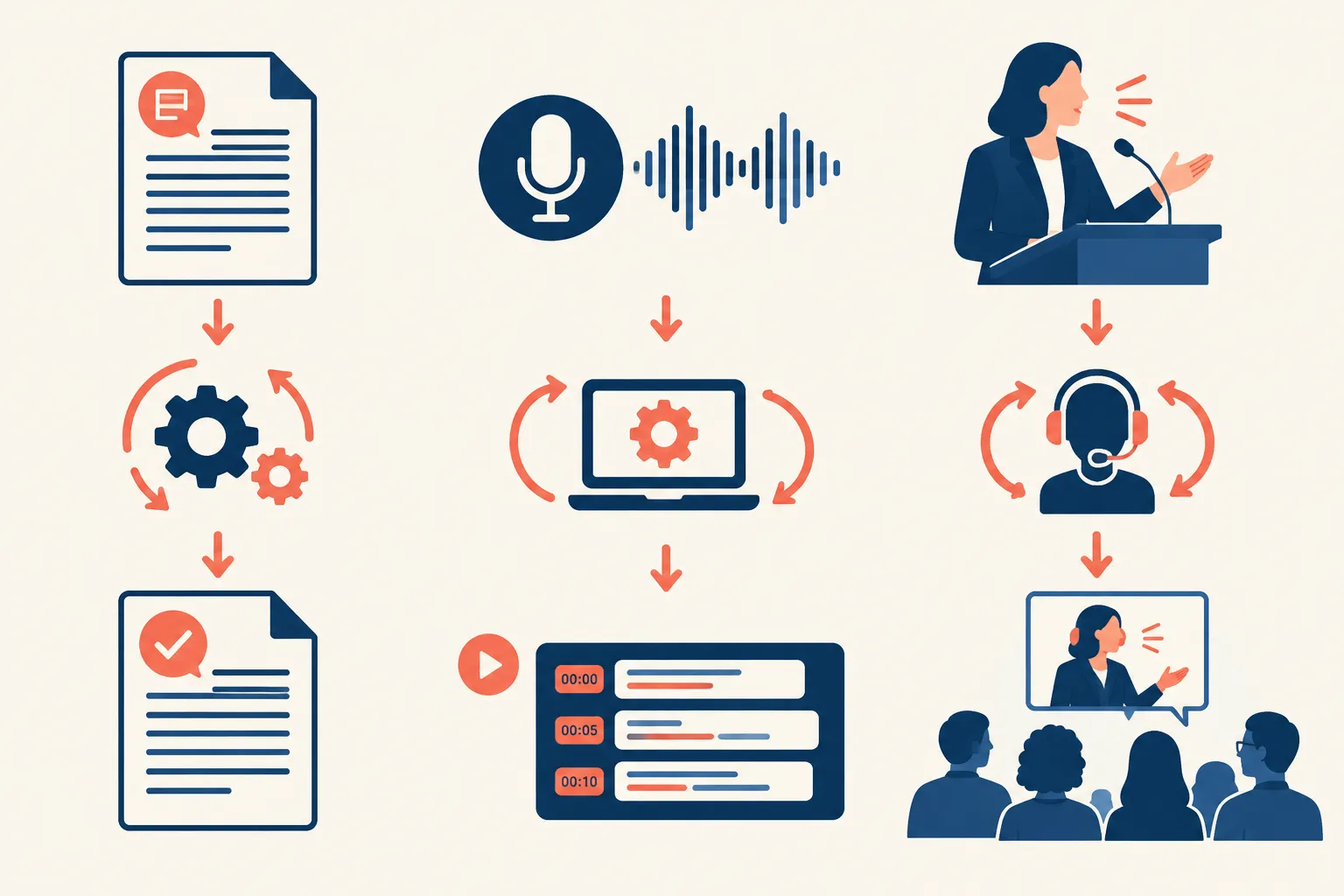
“French translation services” can mean written translation, spoken interpreting, subtitles or an English voiceover. Choose the deliverable that matches how people will consume the content.
|
What you have |
What to request |
Critical handoff detail |
|---|---|---|
|
French contract, report or internal policy |
French-to-English document translation with subject review where needed |
Preserve headings, tables, references and defined terms |
|
French certificate for an official submission |
Complete translation and any certification required by the receiving authority |
Ask for the required certification wording and delivery format before work starts |
|
French website, sales deck or customer email |
Translation or localization with a brief on audience and tone |
Supply brand terminology and an English-language approver |
|
French recording for an English audience |
Transcription and translation, then subtitles, captions or voiceover as appropriate |
Specify whether you need a text transcript, timed text or finished media |
|
French-speaking presenter at a live event |
Interpreting, with captioning if needed for accessibility |
Share the run of show, speaker notes and technical setup |
If you also need an English-to-French translation service, include that in the brief. The reverse direction may call for a different translator or reviewer.
What makes French-to-English work accurate
Good translation preserves meaning and gives the English reader a clear message. A word-for-word rendition can mislead when a French term has a specialized meaning, a sentence relies on context or a marketing phrase needs a different expression in English.
Three details deserve attention in the brief:
-
Audience and variety. Identify whether the source is intended for France, Quebec or another Francophone audience when that affects terminology, and say whether the output should read as US, UK or another variety of English.
-
Subject matter. Provide a glossary, previous approved translations and an owner for questions. For legal, medical, financial or technical material, ask for a translator familiar with the field and an appropriate review path.
-
What must stay intact. Names, numbers, dates, units, product labels, tables and citations need careful handling. Say whether you need a formatted file, tracked changes, bilingual layout or plain text.
For recurring work, keep an approved term list and update it when reviewers make corrections. A term used in a policy should mean the same thing on a slide or in a subtitled video. For a one-off job, explain who will read the English before trying to describe the tone in a long list of adjectives.
Suppose a French training presentation will become an English handout and a subtitled recording. Approve the English names for roles and procedures on the handout first, then use them in the subtitles. The reviewer can compare both against the same source rather than settling terminology twice.
When to request a certified or specialist translation
For an official French-to-English translation, the receiving organization determines what you need. Certification concerns the statement that accompanies a translation; specialist review concerns the translator’s grasp of the content. One does not replace the other.
For a document submitted to USCIS, the applicable rule requires a full English translation and a translator’s certification that it is complete and accurate and that the translator is competent to translate from the foreign language into English. That is a specific requirement for that receiving agency, not a universal rule for every legal or business document.
“Any document containing foreign language submitted to USCIS shall be accompanied by a full English language translation which the translator has certified as complete and accurate, and by the translator’s certification that he or she is competent to translate from the foreign language into English.” – Electronic Code of Federal Regulations, 8 CFR § 103.2(b)(3)
If counsel will read a contract, say whether the English is for internal understanding, a negotiation or a formal proceeding. For regulated or technical language, request relevant subject expertise and have the person responsible for the decision review the result. For a birth certificate, academic record or other personal document, get the receiving institution’s acceptance requirements before ordering.
Machine translation can help a team understand the gist of low-risk material. Where wording affects a decision, an obligation or public-facing content, a person needs to review the English. Ask whether the provider uses automated drafts, who checks them and how they handle confidential files.
Match the workflow to the material
Documents and business communications
For French-to-English document translation, send the complete source, including footnotes, stamps, tables and appendices that matter to the reader. State whether you need editable English, a layout matching the original, or a translation tied line by line to the source. A scan may require extra text extraction and formatting work; an editable original makes the handoff simpler.
For a website or campaign, ask the approver to judge whether the English communicates the intended message. Give the translator context for slogans, product names and calls to action, and settle terminology before translating a large batch of pages.
Audio, video and live events
For audio, decide whether you need a record of what was said or English that viewers can follow while watching. A transcript and translation produce text; subtitles must fit timed speech and screen space; voiceover requires a script and recording. Captions also carry accessibility information that ordinary translated subtitles may not cover. Specify the finished asset rather than asking for “audio translation” alone.
Live interpreting is not a substitute for translating a document in advance. Speakers need real-time language support; organizers need to plan audio routing, remote or in-person delivery, rehearsal and the audience’s access to the output. If a conference uses French slides and French speakers, translation of the slides, interpreting of the speech and live captioning can be separate pieces of the same event plan.
How to evaluate a provider and request a quote
Send each prospective provider the same compact brief. It makes proposals easier to compare and helps avoid discovering a missing deliverable on launch day.
-
Purpose: Who will read, hear or watch the English, and what will they do with it?
-
Source and scope: What files or recordings are included, in which format, and is the job French to English only?
-
Quality path: Who translates, who reviews, and who resolves subject-matter questions?
-
Acceptance: Does a receiving body require certification or a particular layout?
-
Production: Do you need editable files, subtitles, voiceover, interpreting, captions or on-site support?
-
Delivery: What is the actual deadline, which assets are due first and who signs off?
Compare the work included in each proposal, not only its headline price. Ask whether formatting, certification, revision rounds, specialist review, timed captions and file preparation are in scope. A low quote for translated text alone does not cover a ready-to-publish video or an event with live language access.
Request a written deliverables list with the source files, English file types, review responsibilities and revision window named explicitly. If certification is needed, put it in that list rather than treating it as an assumed feature of professional French translation services.
For sensitive material, clarify how files will be transferred and who may see them. For ongoing communications, ask how the team stores approved terms and handles changes after approval. A useful first milestone is one representative page or short segment, so your approver can align terminology and tone before the full set is delivered.
Choosing a partner for connected communication
If your request stops at a single written document, prioritize the translator’s subject fit, the required certification and the quality of the final file. If it extends into meetings, broadcasts or events, a coordinated service can reduce handoffs among separate translation, interpreting and captioning teams.
Team Stream provides written translation alongside interpreting, captioning, subtitling, voiceover and event support. That combination is useful when the same message must move from a French document to English slides, a live session and an accessible recording. Describe the content and its audience to Team Stream, and ask for a scope that identifies the human review and delivery format for each asset.
FAQ
What does translation services mean?
Translation services turn written or recorded content from one language into another for a defined audience and purpose. For French-to-English projects, specify whether you need a document, a transcript, timed subtitles or a finished voiceover; live spoken communication calls for interpreting instead.
