

For urgent translation services, send the source file with the language pair, audience and deadline. Before accepting a delivery time, name the person who will review sensitive wording, names and numbers. Otherwise, the file could arrive on time and still be unfit to send.
Operations, HR and event teams should decide what needs to be accurate, in which format, by what time, and who can sign it off. A staff update, a contract and a conference slide deck call for different rush workflows.
Start with five details before requesting urgent translation
Give the provider more than a word count:
-
Language pair and locale. If your audience needs “English (US) to Spanish (Mexico),” say so. “Spanish” leaves the audience unspecified. Mark any passages written in a different source language.
-
File and purpose. Send the file, or a representative sample if sharing is restricted. Is it an internal note, public announcement, legal document, clinical instruction, presentation or caption file? Explain who will use it and how.
-
Usable deadline. Give the date, time and time zone for delivery. Allow time before publication for your team to review and format the text. “Tomorrow morning” will mean different things across time zones.
-
Terms that need care. Flag legal names, product terms, measurements, links, on-screen timing, brand voice and anything that must stay untranslated. Attach any approved terms or previous translations.
-
Decision-maker. Name someone available to answer questions and, where needed, a reviewer with subject expertise. The person who wrote an ambiguous sentence may be the only one who can resolve it.
Mark the final sections if your team is still editing the source. A late change may require another pass through translation, layout and approval.
Match the rush workflow to the risk
Decide how much review you need by considering what someone might do with a mistranslation. A short deadline does not reduce that risk.
|
Material |
Minimum practical workflow |
Who should approve before use? |
|---|---|---|
|
Internal, low-risk update |
Translate the final source, check key terms and dates, then spot-check in context. |
The team that owns the message. |
|
Public-facing notice or event material |
Translate, have a second qualified person review the target language, then check the published layout or screen version. |
Content owner and a language reviewer. |
|
Contract, policy or regulated communication |
Translate and independently review terminology and meaning; route the final version to the relevant subject-matter owner. |
Legal, compliance or policy owner as applicable. |
|
Medical or safety-critical instructions |
Use a qualified human translator and independent review; have the appropriate clinical or safety owner approve the use of the text. |
Qualified clinical or safety owner. |
These workflows help you plan, but none establishes compliance with every applicable rule. Certification, sworn translation, notarization and subject-matter approval serve different purposes. If the recipient specifies a form of translation, pass that requirement to the provider at the start.
AI may help sort files or produce a draft for someone to review against the source. Fluent wording can conceal errors in negation, dosage, obligations, dates or exclusions. If the schedule leaves no room for the human review the text needs, translate the critical passages first or move publication.
“Avoid machine translation (without professional translator review) for high-stakes communication in any language.” – BMJ Quality & Safety
Set a deadline that includes the work after translation
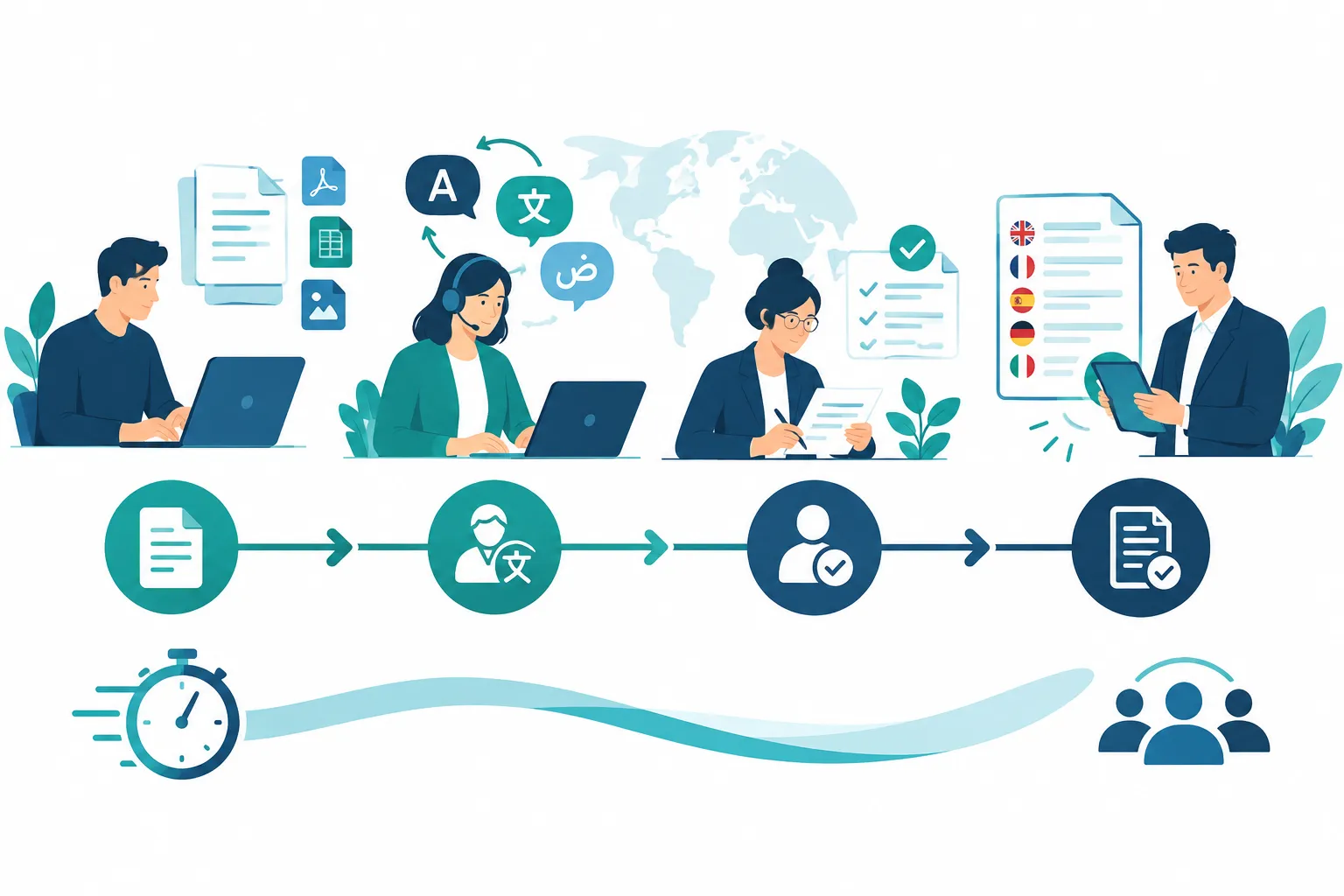
Set handoff times for source preparation and translation, followed by revision, your team’s review, formatting and corrections. Even an on-time conference deck may need repair if the translated text overflows the slides. The show operator also needs it before the final upload.
Pin down the deliverable before you accept the deadline:
-
Is the deadline for a translation draft, reviewed copy or publication-ready file?
-
Will the provider return the same editable format, or only text to paste into your design?
-
Which sections can be delivered first if the full job cannot be finished safely?
-
Who answers terminology questions during the job, and how quickly can they reply?
-
How will revisions to the source be identified and priced after work begins?
If the job is large, ask for priority pages first and review them while work continues on the rest. Hold each batch until its review is complete. When the deadline leaves too little time for that, request fewer finished pages.
Compare quotes by deliverable, not rush label
A “same-day” promise needs a cutoff time and time zone. Ask each provider what file it will return, when it will arrive, whether the quote includes independent review, and how it handles source changes. For a scanned PDF, ask about transcription and layout; for a presentation, establish who will fit the translated text into the slides.
The quote should separate any rush fee, review, formatting and later revisions. Compare the review included in each proposal, then allow your own approver time to read the final version.
Protect accuracy at the handoff
Send one clearly marked source version. Remove duplicates, and include approved spellings for names, job titles, product labels and recurring phrases. If the translation will go into slides, graphics or an interface, attach the layout so the language reviewer can see where the words belong.
Ask the provider to mark unclear passages and assign one person to collect answers. Agree on how to track source changes. When the file arrives, compare these details with the source:
-
Names, dates, figures, currencies and units match the source.
-
Links, phone numbers and calls to action point to the intended destination.
-
Warnings, exceptions and “not” statements retain their meaning.
-
Headings, tables and text inside images have not been omitted.
-
The target-language text fits the actual slide, page, email or caption slot.
Before sharing confidential HR, legal or medical material, settle who can access it and how you will transfer it. Put any required secure channel or retention policy in the request. A language reviewer can check the translation, while the content owner remains responsible for approving a policy, clinical instruction or public claim.
Send a brief the provider can act on
Fill in the blanks and attach the source. “A short document” does not tell a provider what it needs to handle.
Request: Translate [file name and format] from [source language and locale] into [target language and locale] for [audience and use]. We need [draft/reviewed/final-format file] by [date, time and time zone], and our internal reviewer needs it by [earlier time]. Priority sections: [pages or slides]. Approved terms and prior translations: [attachments]. Keep [specified names or terms] unchanged. Please flag ambiguous source text. Our contact for questions is [name and availability]. Please specify the review step, deliverable format and how source changes after kickoff will be handled.
If several people are editing the source, send a version list. Agree on the reviewed pages and any pending work if the provider proposes a smaller scope.
When written translation is not the whole job
Written translation covers documents and prepared scripts. For a live town hall, hybrid conference or broadcast, you may also need interpreting for spoken content and captioning for accessibility. Recordings may call for subtitling or voiceover. Tell the provider whether the audience needs access during the event, a translated file afterward, or both; each deliverable has its own handoff.
For an event, send the run of show, speaker languages, platform, presentation files and placement for captions or language channels. Give the technician and presenter time to load and test translated material before the session. Team Stream can coordinate written translation with interpreting, captioning, equipment and technician support. Discuss the mix of human review and AI-assisted work your content needs.
Make the fastest safe choice
Before ordering, get a clear deliverable, review plan and handoff time. A low-risk internal update may need a shorter process. Keep human review and subject-matter sign-off for legal, medical and public-facing material, even when you have to narrow the scope to meet the deadline.
If you are coordinating documents and a live or hybrid event, send Team Stream the files, language pairs and run of show. Its translation and accessibility services let you plan the handoffs with one team.
FAQ
How to check if a translator is certified?
Ask what “certified” means for this job: a credential held by the translator, a signed certification of translation accuracy, or a specific form required by the recipient. Send the recipient’s requirements to the provider and request documentation that matches them. For high-stakes material, also ask who reviews the translated text and who on your team must approve its use.
How much does it cost to Translate a document?
Cost depends on the language pair, file length and format, deadline, subject matter and level of review. Send the final file and ask for a quote that separates rush handling, independent review and formatting, with a clear policy for source changes. A price without a defined deliverable is hard to compare.
Where can I translate a document for free?
Free machine-translation tools can help you understand a low-risk draft, but they do not supply the human review or approval needed for sensitive or public-facing business content. Before uploading confidential files to any tool, follow your organization’s data-handling rules. For a document people will act on, arrange review against the source.
