

Russian Translation for Business Growth in 2026
If your organization needs to reach Russian-speaking customers, partners, employees, or event audiences in 2026, quality cannot be an afterthought. A weak translation can distort legal meaning, flatten marketing impact, create compliance risks, or leave multilingual attendees disengaged. A strong one can accelerate trust, improve accessibility, and help your business operate confidently across borders.
For event organizers, internal communications leaders, conference planners, trade show teams, churches, and global businesses, the challenge is even bigger: language access often extends beyond documents. It includes live interpreting, real-time captioning, subtitles, voiceover, accessible video, and reliable support for in-person, virtual, and hybrid experiences. That is where a partner like Team Stream stands out, combining accurate human expertise, AI-powered efficiency, accessibility-first delivery, and over 25 years of hands-on service.
Why Russian Translation Still Matters for Global Business
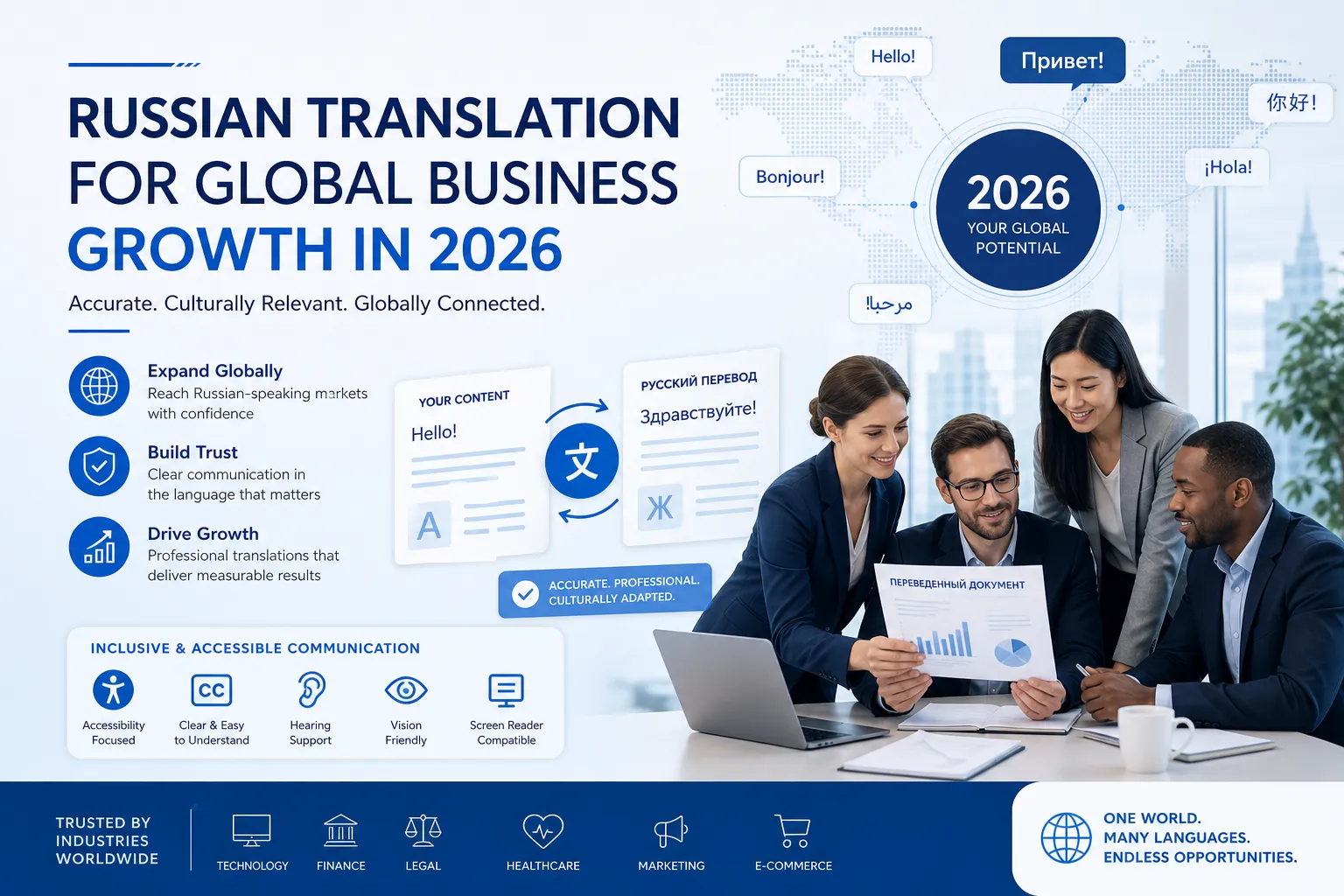
Russian remains strategically important for companies operating across Eastern Europe, Central Asia, migration services, education, manufacturing, energy, legal affairs, and multilingual events. Businesses do not invest in language support simply to convert words. They invest to reduce friction, avoid mistakes, and create usable communication in the moments that matter.
Many competing articles focus mostly on agency lists or vague pricing talk. What they often miss is the business reality: translation success depends on purpose, risk level, audience, and delivery channel. A contract, onboarding document, exhibition booth script, compliance notice, product manual, investor presentation, livestream caption feed, and subtitled keynote all require different workflows.
In practice, effective Russian translation supports business growth in five ways:
|
Business Goal |
How Translation Supports It |
|---|---|
|
Market entry |
Adapts messaging, websites, sales collateral, and support content for Russian-speaking buyers |
|
Risk reduction |
Improves clarity in legal, medical, HR, and compliance materials |
|
Revenue enablement |
Helps sales and marketing teams communicate clearly and persuasively |
|
Accessibility |
Expands participation through captions, subtitles, interpreting, and multilingual event support |
|
Operational efficiency |
Standardizes terminology and content workflows across teams and regions |
What Russian Translation Includes in 2026
Russian translation is no longer just a static document service. In 2026, most organizations need a mix of language and accessibility solutions that match how people actually consume information.
Written translation
This includes contracts, employee handbooks, training materials, websites, presentations, product documentation, reports, and marketing assets. Accuracy matters, but so does tone, formatting, and consistency across channels.
Localization
Localization goes beyond literal translation. It adjusts currency, dates, cultural references, layout, calls to action, and region-specific expectations so the final content feels intended for the audience, not mechanically converted.
Interpreting
For meetings, conferences, webinars, interviews, board sessions, and live events, spoken language support may be more important than written translation. Depending on the format, organizations may need simultaneous or consecutive interpreting, on-site or remote.
Captioning and subtitling
Accessibility is now central, not optional. Real-time captioning supports live participation for deaf and hard-of-hearing audiences, non-native speakers, and viewers in noisy environments. Subtitling extends the value of recorded video content long after the event ends.
Voiceover and multilingual media adaptation
Product demos, training modules, internal videos, and promotional assets often require voiceover, timed subtitles, and script adaptation. These assets need both language quality and production-quality execution.
AI-assisted workflows with human review
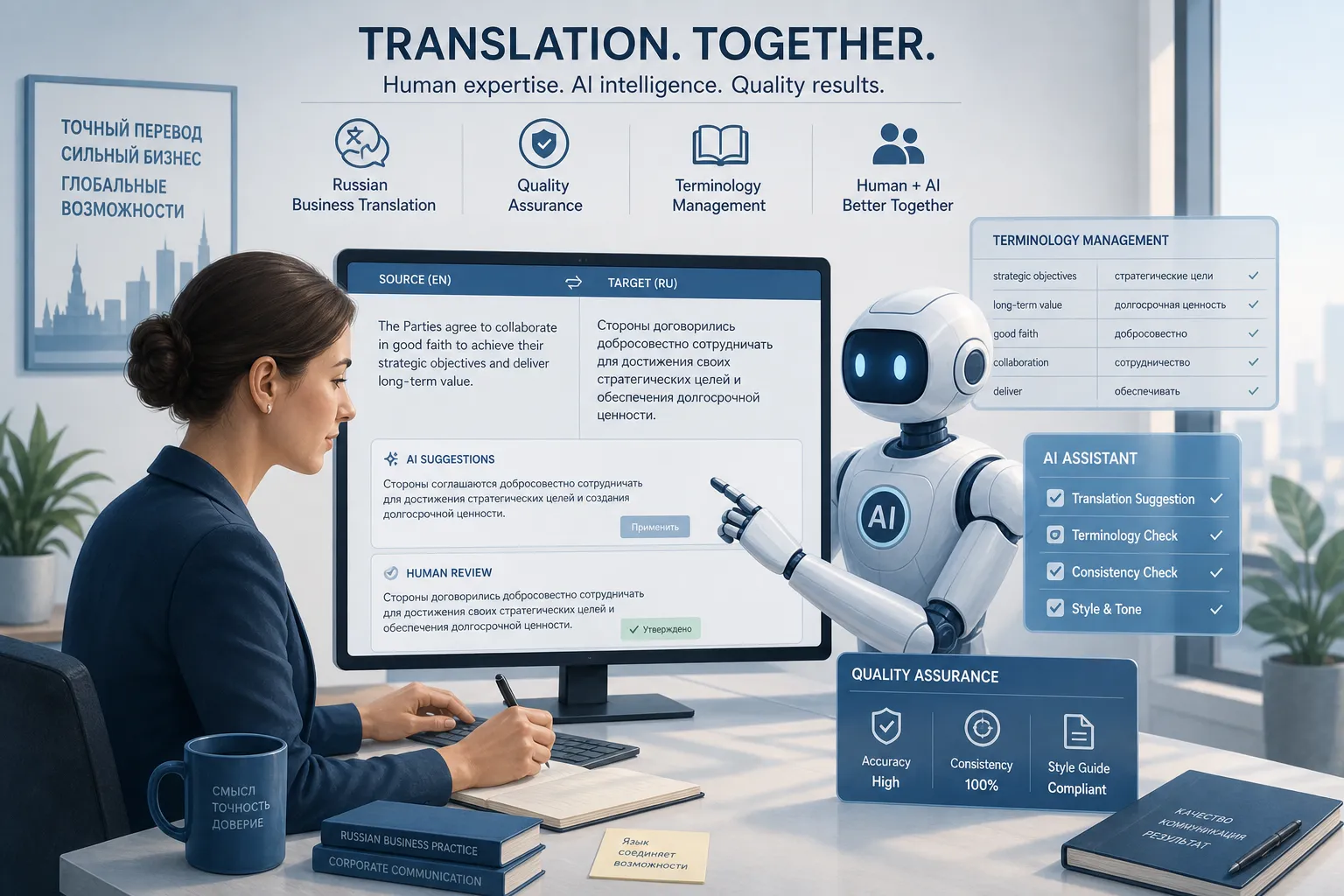
AI can improve speed and scale, especially for first drafts and high-volume content. But high-stakes business communication still requires human oversight. The best model is not human versus AI. It is AI where useful, with professional linguists and QA specialists ensuring accuracy, consistency, brand fit, and context.
Why Accuracy Matters More in Russian Than Many Teams Expect
Russian is not a language where casual approximation works well in professional settings. Grammar, inflection, formality, syntax, and terminology all affect meaning. A phrase that seems “close enough” in English can become misleading, awkward, or even risky in Russian.
Small errors can create big consequences
The more specialized the content, the greater the stakes:
-
Legal wording can shift obligations or rights
-
Medical language can affect safety and understanding
-
Technical instructions can create user error
-
HR and policy content can raise employee-relations issues
-
Marketing language can sound unnatural or damage trust
-
Live event interpretation errors can cause confusion in real time
Tone and register matter
Russian business communication can require a different level of formality than English. If the tone is too casual, the brand may appear unprofessional. If it is too rigid, marketing copy may lose warmth and persuasiveness.
Cyrillic, formatting, and layout issues are often overlooked
Teams sometimes underestimate production details. Russian text length can expand or contract depending on the content. Cyrillic support, fonts, captions, slides, lower thirds, teleprompters, and event screens all need technical checks. This is especially important for broadcasts, trade shows, and hybrid events.
Industries That Rely Heavily on Russian Translation
Competitor articles often mention “business” broadly, but they usually do not dig into the specific industries where translation quality has the highest impact. Here is where demand is especially persistent.
Legal, immigration, and compliance services
Contracts, court documents, corporate filings, witness statements, policy disclosures, and immigration paperwork require exact wording and often certified handling. These jobs demand more than bilingual ability; they require process discipline and subject-matter familiarity.
Healthcare and life sciences
Medical instructions, patient materials, consent forms, and research documentation all depend on precise terminology and readability. In multilingual healthcare communication, clarity is a safety issue.
Manufacturing and technical operations
User manuals, SOPs, product specifications, safety documents, and training materials must be consistent and unambiguous. Translation memory and terminology management are especially valuable here.
Corporate communications and HR
Internal rollouts, benefits materials, CEO messages, training modules, compliance notices, and DEI communications need to be both understandable and culturally appropriate.
Events, conferences, and live production
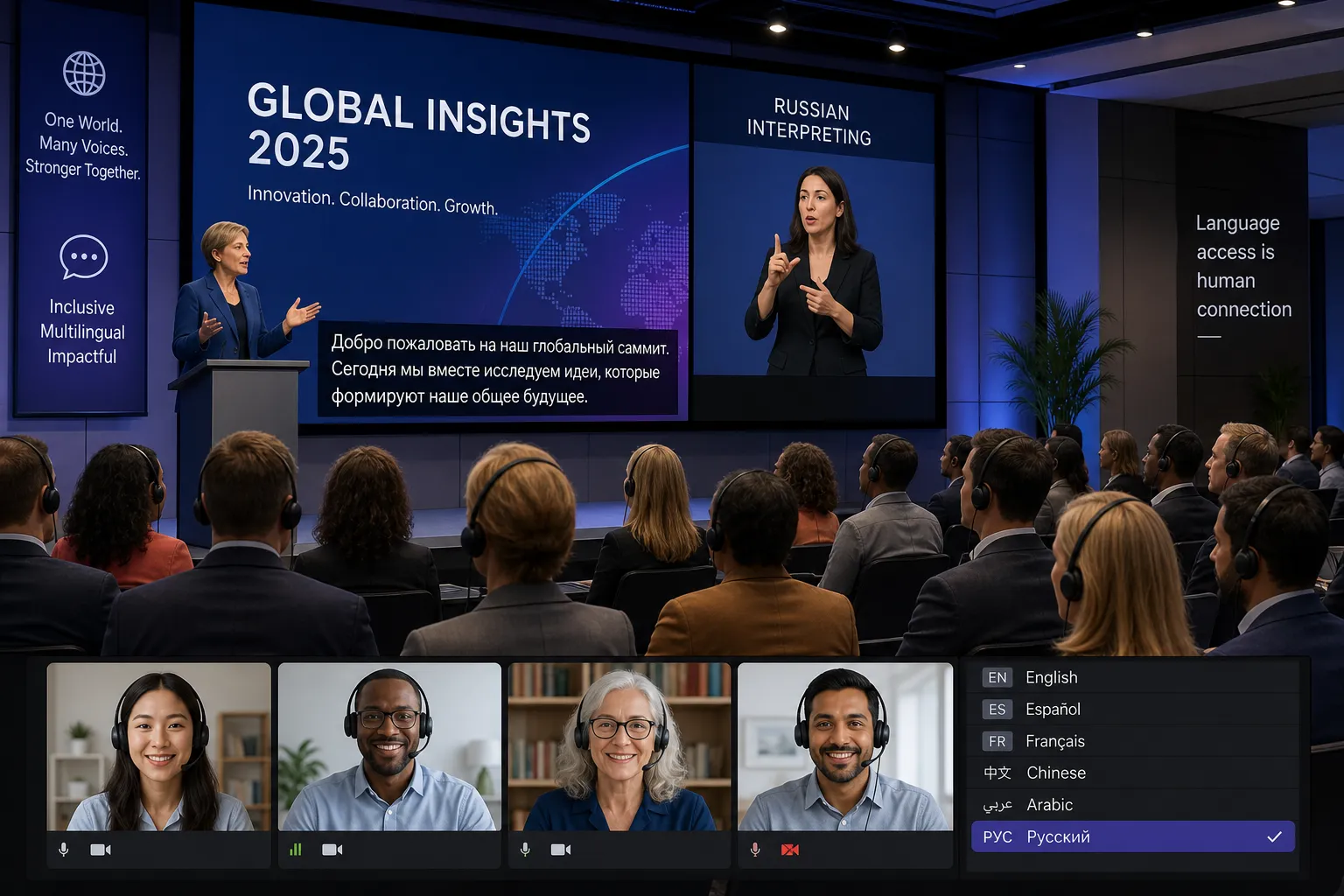
This is a major content gap in most competitor pages. Translation alone is often not enough. International events may need:
-
Russian interpreting for speakers and attendees
-
Real-time captioning for accessibility and comprehension
-
Subtitles for recorded sessions
-
Multilingual presentation support
-
Technician services and equipment
-
Hybrid-friendly workflows for in-room and remote audiences
This is one of the clearest areas where Team Stream offers end-to-end value. Instead of forcing clients to piece together multiple vendors, Team Stream can support live, virtual, and hybrid experiences with interpreting, captioning, translation, subtitling, equipment rental, and responsive technical coordination.
Common Russian Translation Mistakes Businesses Should Avoid
Choosing a provider based only on price is one of the most common mistakes, but it is far from the only one.
Treating all content the same
A landing page, employee manual, and legal agreement should not go through the same workflow. Each requires a different level of review, specialization, and adaptation.
Using raw machine output for customer-facing content
AI can be helpful, but unreviewed output is risky for public-facing, regulated, or brand-sensitive materials. Human review remains essential when meaning, tone, or compliance matter.
Ignoring accessibility requirements
If your content includes video, webinars, town halls, or live events, language access must work alongside accessibility. Captions, subtitles, and interpreting should be built into planning from the start, not added at the end.
Overlooking terminology management
Without approved glossaries and translation memory, companies end up with inconsistent product names, legal phrases, or technical terminology across departments and updates.
Forgetting production and delivery context
A translated script for a keynote is not done until it works on the stage, in the slide deck, on the teleprompter, in the webcast, and in the recording. Delivery context matters just as much as wording.
Human Translation vs AI-Powered Translation in 2026
The real question is not which one wins. The better question is: what mix produces the right balance of speed, quality, cost, and risk control?
When AI can help
AI-powered workflows can be useful for:
-
High-volume repetitive content
-
First-pass translation drafts
-
Internal reference materials
-
Fast-turn multilingual support content
-
Captioning and subtitle workflows with editorial review
When human expertise is essential
Human translators, editors, interpreters, and captioners are critical for:
-
Legal and compliance content
-
Sensitive internal communications
-
Sales and marketing assets
-
Executive messaging
-
Technical materials with liability concerns
-
Live events and real-time interpretation
-
Accessibility-critical content
The strongest model: human-led, AI-enabled
This is where Team Stream’s approach fits naturally. Clients increasingly need the efficiency of AI without sacrificing trust, clarity, or inclusivity. A human-led, AI-enabled workflow helps organizations move faster while still protecting meaning, reputation, and user experience.
What Russian Translation Costs in 2026
Competitor content often cites “starting at” prices, but that rarely tells buyers what actually drives cost. Translation pricing in 2026 typically depends on the following variables:
|
Cost Factor |
Why It Changes Price |
|---|---|
|
Language pair |
English to Russian and Russian to English can differ based on expertise and market supply |
|
Content type |
Legal, medical, technical, and creative work typically cost more |
|
Word count or duration |
Larger projects may lower unit cost but raise total spend |
|
Turnaround time |
Rush delivery usually adds a premium |
|
File complexity |
InDesign, subtitles, caption files, and engineering formats can increase handling time |
|
Review level |
Translation only, editing, proofreading, certification, or QA all affect cost |
|
Event needs |
Interpreting, captioning, equipment, and technician support are priced differently from documents |
In general, common business content is often priced per word, while interpreting, transcreation, voiceover, and accessibility services may be hourly, daily, or project-based.
For planning purposes, it is smarter to ask for a scoped quote than to rely on generic averages. If your project includes multilingual events, Russian-speaking participants, or accessible media, your budget should reflect the full communication workflow, not just the text itself.
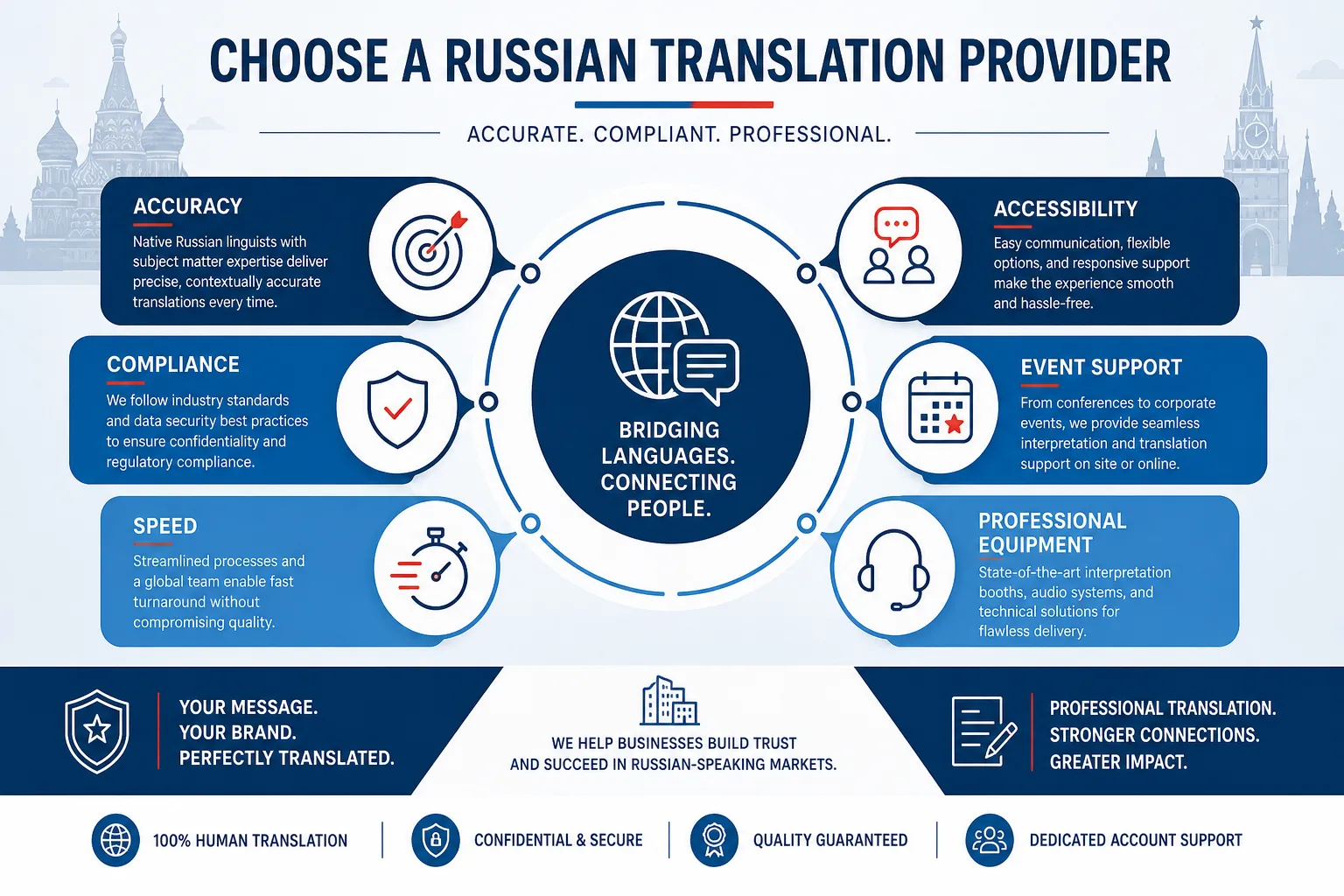
How to Choose the Right Russian Translation Partner
Many competitor pages list agencies, but few explain how to evaluate them properly. Here is a more useful framework.
1. Check subject-matter fit
The provider should understand your industry, not just the language. Ask about legal, technical, medical, HR, or event experience depending on your needs.
2. Confirm service range
If you need more than documents, make sure the provider can also support interpreting, captioning, subtitling, voiceover, or hybrid event delivery.
3. Ask about human review and QA
A serious provider should be clear about who translates, who reviews, how terminology is managed, and how final quality is checked.
4. Evaluate accessibility readiness
If you publish video or run live sessions, ask how they handle live captioning, subtitling, ADA-conscious workflows, and inclusive audience support.
5. Review technical and operational support
For events, the language solution is only as strong as the execution. Ask whether the provider offers technicians, equipment, backup workflows, and remote or on-site flexibility.
6. Assess responsiveness
Fast, clear communication matters. If the provider is slow before the project starts, that is usually not a great sign for live delivery or urgent deadlines.
Why Team Stream Is a Strong Fit for Russian Business Communication
Team Stream is particularly valuable for organizations that need more than isolated translation. The company brings together written translation, interpreting, captioning, subtitling, voiceover, accessibility support, and event logistics in one service model.
That matters because real business communication is interconnected. A company may need Russian-translated presentations, a bilingual keynote interpreter, live captioning for accessibility compliance, subtitled post-event video, and technician support to make the whole experience run smoothly. Handling those pieces separately creates risk. Coordinating them through one experienced partner creates consistency.
What makes Team Stream different
-
Accurate human and AI-powered language support
-
Real-time captioning for accessibility and engagement
-
End-to-end service tailored to the client, not a generic package
-
Reliable support for live, virtual, and hybrid events
-
Compliance-friendly workflows for inclusive communication
-
Equipment rental and technician support when execution matters
-
In-person and remote delivery options
-
Over 25 years of experience and responsive customer service
For corporate teams, conference producers, churches, and broadcast environments, that combination can save time, reduce vendor sprawl, and improve audience outcomes.
A Smarter Workflow for Russian Translation Projects
If you want better results in 2026, build your workflow around decisions, not just deliverables.
Step 1: Define the audience
Who needs the content? Customers, attendees, staff, regulators, or partners? Audience determines tone, terminology, and review level.
Step 2: Define the risk
What happens if this is misunderstood? The higher the consequence, the more human review and QA you need.
Step 3: Define the channel
Will the content be read, heard, watched, captioned, projected, or archived? Delivery channel affects formatting and execution requirements.
Step 4: Define the accessibility needs
Will you need live captions, subtitles, sign language coordination, multilingual meeting access, or compliance-minded workflows?
Step 5: Define the timeline and scale
Can AI help with speed? Which assets need premium human refinement? A good provider will help you tier the workflow intelligently.
Final Verdict
In 2026, Russian translation is not just a linguistic task. It is a business-growth function tied to trust, compliance, customer experience, accessibility, and execution quality. The companies that do it well are not simply translating text. They are enabling people to understand, participate, and act with confidence.
If your needs include documents, live meetings, conferences, broadcasts, training content, captions, subtitles, or hybrid event support, Team Stream offers a stronger model than a standard translation-only vendor. With human expertise, AI-enabled efficiency, accessibility-first service, and decades of experience, Team Stream helps you communicate clearly where it counts most.
If you are planning a Russian-language project in 2026, now is the time to build a workflow that protects quality and supports growth. Team Stream can help you do both.
FAQ
How much do Russian translators get paid?
Pay varies widely based on specialization, experience, and service type. General document translators may earn moderate per-word or hourly rates, while legal, medical, technical, and live interpreting specialists often command much higher fees because the work carries greater risk and requires deeper expertise.
What are the expected translation rates per word in 2026?
In 2026, per-word pricing depends on the language pair, subject matter, turnaround time, and QA level. Standard business translation may be priced competitively, while legal, medical, technical, or certified work usually costs more, so a scoped quote is more useful than a generic average.
What is the most accurate translator for Russian?
The most accurate option is usually a professional human translator supported by strong QA and, when appropriate, AI-assisted tools. For business-critical content, live events, and compliance-sensitive materials, human review is essential to protect tone, context, and meaning.
What language is most in demand for translators?
Demand changes by industry and region, but languages tied to global business, migration, healthcare, legal services, and events remain highly requested. Russian continues to matter where companies serve multilingual audiences, handle cross-border documentation, or support international meetings and broadcasts.
Which one is the hardest language for translation?
There is no single hardest language in every situation, but difficulty rises when a language has complex grammar, specialized terminology, cultural nuance, or high-stakes context. Russian can be especially challenging because meaning is shaped by inflection, tone, syntax, and subject-specific usage.
