

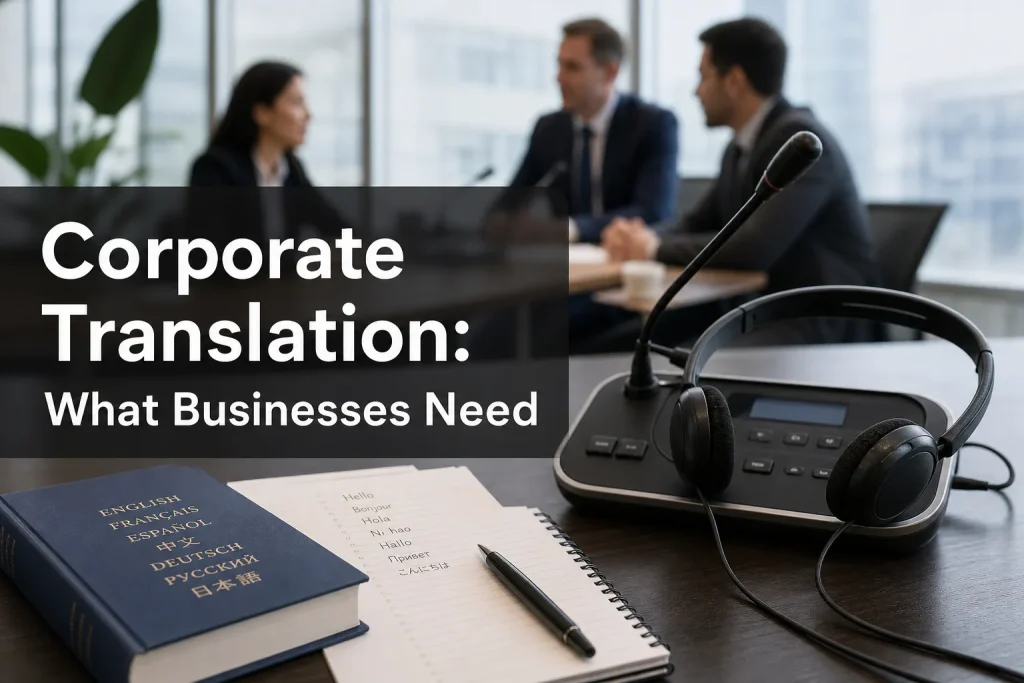
Corporate Translation: What Businesses Need
Modern organizations do not struggle with language only when they expand globally. They face it every day in board communications, HR policies, legal contracts, product documentation, employee training, investor materials, internal videos, live town halls, hybrid conferences, and customer-facing content. If even one of those assets is unclear in another language, the cost can show up as confusion, compliance risk, poor engagement, or lost trust.
That is why corporate translation is no longer a nice-to-have procurement line item. It is a business function tied directly to growth, risk management, accessibility, and brand consistency.
For event organizers, conference planners, operations teams, internal communications leaders, churches, broadcast producers, and businesses running live or digital experiences, the challenge is even bigger: written translation must often work alongside interpreting, captioning, subtitling, and technical event support. In practice, that means choosing a language partner that can do more than convert text.
What corporate translation really means
Corporate translation is the professional adaptation of business content from one language to another so that the original intent, tone, terminology, and practical meaning remain intact.
That definition sounds simple. In reality, business communication is full of nuance:
-
A legal clause must preserve liability and enforceability.
-
An HR policy must be clear, fair, and culturally appropriate.
-
A product sheet must keep technical terminology consistent.
-
A leadership message must sound authoritative, not awkward.
-
A live event script may need to align with simultaneous interpreting and on-screen captions.
A corporate translator does not just translate words. They protect meaning in a business setting where accuracy affects real decisions.
Why businesses invest in professional corporate translation services
Many companies first look for help only after a problem appears: a confusing employee communication, a delayed multilingual launch, an inaccessible webinar, or an international event that excludes part of the audience. The stronger approach is proactive.
The business case for translation
Professional corporate translation helps organizations:
-
communicate clearly with multilingual employees, clients, and stakeholders
-
reduce legal, compliance, and reputational risk
-
maintain a consistent brand voice across markets
-
support accessible communication in meetings, videos, and events
-
accelerate expansion into new regions
-
improve engagement at live, virtual, and hybrid events
For companies that operate across languages, quality is not just about polish. It is about whether people understand what to do next.
What corporate translation services typically cover
Not every provider defines scope the same way. Some only handle documents. Others support a broader language-access workflow. Businesses should understand the full range of services before selecting a partner.
Core written translation services
Most corporate translation services cover:
|
Content Type |
Typical Use |
Key Risk if Done Poorly |
|---|---|---|
|
Contracts and legal documents |
Agreements, NDAs, terms |
Liability, ambiguity, unenforceability |
|
HR and employee communications |
Handbooks, policies, memos |
Misunderstanding, inconsistency, employee friction |
|
Marketing materials |
Brochures, campaigns, presentations |
Weak messaging, brand dilution, poor response |
|
Technical documentation |
Manuals, specs, SOPs |
Operational errors, safety issues |
|
Financial and investor content |
Reports, disclosures, decks |
Credibility and compliance concerns |
|
Website content |
Landing pages, product pages, support content |
Low conversions and poor global reach |
|
Training and e-learning |
Onboarding, internal learning, compliance modules |
Low retention and missed requirements |
Adjacent services many businesses also need
This is where many competitor articles stop too early. Written translation is often only one part of the communication chain.
A modern business may also need:
-
live interpreting for meetings and conferences
-
real-time captioning for accessibility and engagement
-
closed captioning and subtitling for recorded content
-
multilingual voiceover for training, marketing, and broadcast assets
-
event equipment rental and technician support
-
in-person and remote delivery options
-
accessibility-friendly workflows for compliance and inclusion
This is one of the biggest gaps in many guides about corporate translation: they treat translation as separate from accessibility and event execution, when in reality they often overlap.
At Team Stream, this integrated approach is where businesses gain efficiency. Instead of coordinating multiple vendors for translation, interpreting, captioning, subtitling, and event support, teams can work with one responsive partner that understands both language access and the technical realities of live communication.
When to hire a corporate translator instead of relying on AI alone
AI has changed the translation landscape. It can speed up drafting, help with high-volume content, and support internal comprehension. But it is not a complete substitute for professional review in business-critical settings.
Use AI-assisted workflows when
AI-powered translation can be effective for:
-
large volumes of low-risk internal content
-
rough drafts for human review
-
repetitive content with established terminology
-
rapid first-pass localization workflows
Bring in a human corporate language translator when
Human expertise is essential when content involves:
-
legal exposure
-
executive communications
-
brand-sensitive messaging
-
culturally nuanced HR content
-
technical accuracy
-
regulated industries
-
accessibility or public-facing communication
-
live event coordination across languages
The issue is not whether AI can sound fluent. It is whether the output is trustworthy in context.
A strong provider should be transparent about when AI helps and when human review is non-negotiable. Team Stream’s model is especially useful here: accurate human expertise combined with AI-enabled workflows where they improve speed and efficiency without compromising clarity, accessibility, or confidence.
The difference between corporate translation, localization, and interpreting
These terms are often used interchangeably, but they solve different problems.
Corporate translation
This focuses on written business content and preserving meaning accurately across languages.
Localization
Localization goes further by adapting content for local culture, formatting, expectations, imagery, and market behavior. For example, a website may need localized calls to action, date formats, currencies, and tone.
Interpreting
Interpreting is spoken-language conversion in real time or near real time. It is used in conferences, meetings, webinars, interviews, trade shows, and live broadcasts.
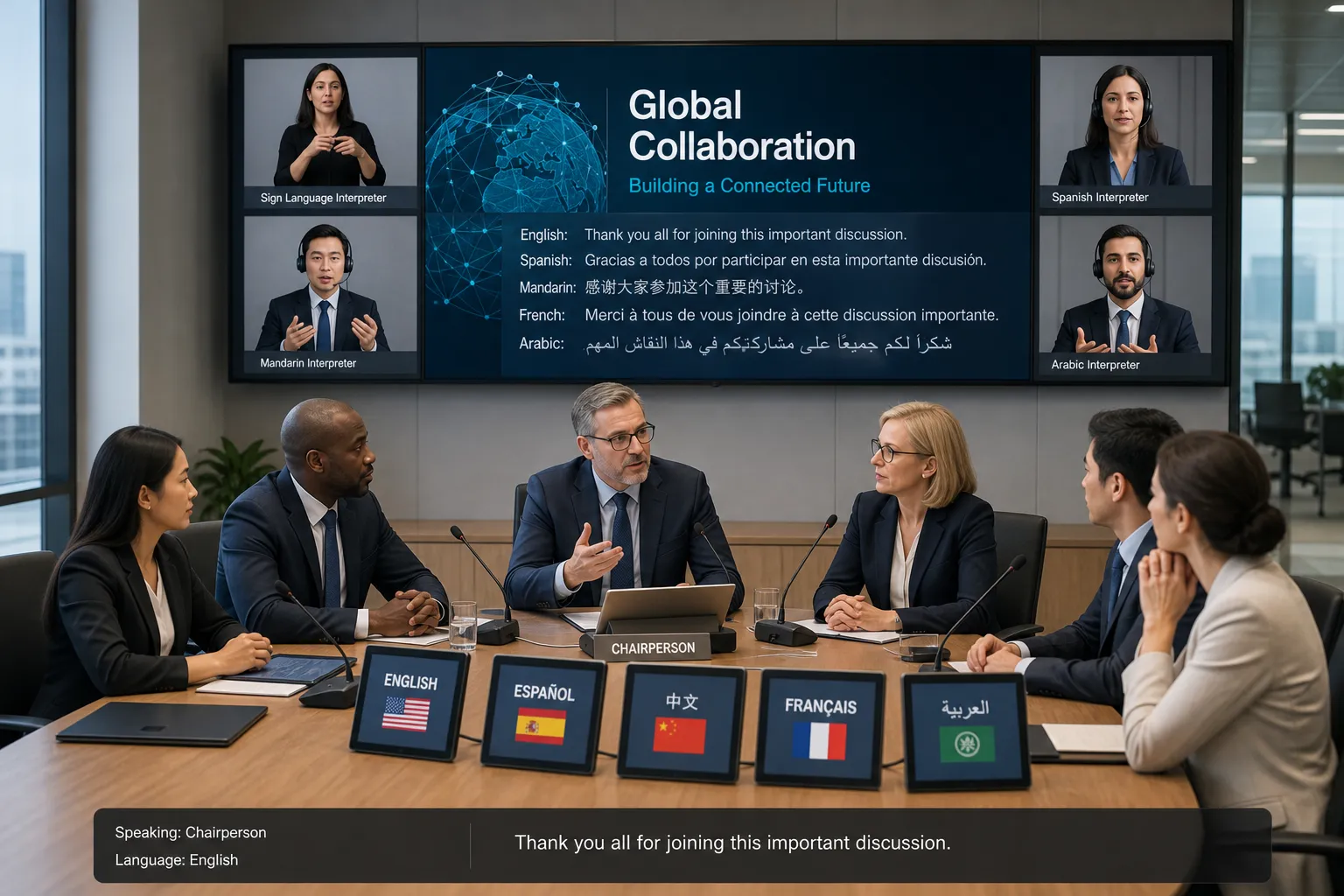
For many organizations, all three are needed together. A multilingual annual meeting may require translated slides, interpreters for the live session, and captions for accessibility. That is why a provider with end-to-end capability can create a smoother outcome than one that only handles one piece of the puzzle.
The highest-risk business content to translate
Some business materials have much greater downside if translated poorly. These deserve specialized review and stronger quality controls.
Legal and compliance content
Contracts, disclosures, policy acknowledgments, and regulatory documents require exactness. Small wording shifts can materially change meaning.
HR and internal communications
Policies about pay, conduct, leave, benefits, and restructuring must sound clear and authoritative across languages. Vague or awkward translation can create uneven understanding between teams.
Executive and investor messaging
Board updates, investor decks, earnings materials, and CEO communications need more than accuracy. They must preserve tone, intent, and confidence.
Training, safety, and technical content
If employees or users rely on translated instructions to perform tasks safely, terminology consistency matters as much as grammar.
Events, meetings, and broadcasts
Multilingual live communication introduces timing, accessibility, and technical variables. Written translations often need to align with spoken delivery, captions, scripts, presentation screens, and audience access needs.
How to compare providers the right way
If you are reviewing vendors, do not evaluate them on price alone. Businesses searching for a provider may encounter everything from boutique firms to enterprise platforms to branded searches such as corporate translation services inc. The better question is not just who can translate, but who can support your use case reliably.
Questions to ask before hiring
1. Do they understand business context?
A provider should ask about audience, purpose, terminology, risk, and delivery environment. If they only ask for a file and deadline, that is a warning sign.
2. Do they use qualified human reviewers?
Even when AI is part of the workflow, there should be professional linguistic oversight for important content.
3. Can they support accessibility needs?
If your content appears in meetings, videos, webinars, or public communications, ask whether they also provide captioning, subtitling, and accessibility support.
4. Can they handle live, virtual, and hybrid environments?
This matters for companies with conferences, broadcasts, trade shows, leadership events, or multilingual internal meetings.
5. Do they provide technical support?
For live communication, the best language plan can fail without proper equipment, technician support, or platform coordination.
6. How do they manage terminology and consistency?
Ask about glossaries, style guides, review processes, and multi-project consistency.
7. Are they responsive?
Responsiveness is an underrated quality signal. In corporate settings, fast clarification and calm execution matter.
A practical provider comparison table
|
Evaluation Area |
Basic Vendor |
Strong Corporate Provider |
Team Stream Advantage |
|---|---|---|---|
|
Written translation |
Yes |
Yes |
Yes, with human and AI-enabled options |
|
Interpreting |
Sometimes |
Often |
Yes, for in-person and remote events |
|
Live captioning |
Rarely |
Sometimes |
Yes, real-time captioning for accessibility and engagement |
|
Video subtitling/voiceover |
Sometimes |
Often |
Yes, as part of end-to-end language support |
|
Event equipment and technicians |
No |
Rare |
Yes, with equipment rental and technician support |
|
Compliance-minded accessibility |
Limited |
Moderate |
Strong focus on inclusive communication |
|
Virtual/hybrid event support |
Limited |
Varies |
Built for live, hybrid, and virtual delivery |
|
Customer service and execution |
Transactional |
Consultative |
High-touch, responsive, experienced team |
Content gaps most competitor articles miss
After reviewing the common themes in competitor content, several patterns stand out. Most articles do a good job explaining that translation quality matters, and many mention legal, technical, and marketing use cases. But they often miss what modern businesses actually need in day-to-day operations.
Gap 1: They separate translation from accessibility
In reality, many organizations need accessible multilingual communication, not just translated documents. Captions, subtitles, voiceover, and live interpreting are often part of the same communication strategy.
Gap 2: They underplay live event execution
Corporate communication increasingly happens in webinars, conferences, hybrid meetings, trade shows, internal town halls, and live broadcasts. Translation alone is not enough if the event itself is not equipped to support multilingual participation.
Gap 3: They do not explain service integration
Managing separate vendors for translation, interpreting, captioning, technicians, and event equipment can create failure points. Businesses benefit from a coordinated workflow.
Gap 4: They talk about quality but not responsiveness
In real projects, service quality includes schedule discipline, problem-solving, and communication. A technically capable provider that is hard to reach can still create operational risk.
Gap 5: They treat AI as either magic or threat
The better view is practical: AI is useful inside a managed process, but high-stakes communication still needs human judgment.
These are the areas where Team Stream stands out most clearly: flexible service delivery, strong customer support, accessibility-first thinking, and a complete language-and-event support model shaped by more than 25 years of experience.
Signs you need corporate translation support now
Many companies wait too long to formalize their process. Here are common signals that it is time to upgrade from ad hoc translation.
Your organization is growing across regions
New offices, multilingual teams, or international customers increase the need for consistency.
You run recurring live or hybrid events
If events include multilingual audiences, accessibility requirements, or high-visibility stakeholders, you need more than informal language help.
Different teams are using different vendors
This often leads to inconsistent terminology, tone, turnaround expectations, and quality.
You are publishing more video content
Training videos, webinars, internal announcements, and promotional content often require subtitles, captions, or voiceover alongside translation.
You operate in regulated or high-trust environments
Healthcare, finance, education, nonprofit, faith-based organizations, and enterprise business environments often need communication that is both accurate and inclusive.
Building a smarter corporate translation workflow
A mature program does not begin with “translate this file.” It starts with process.
Step 1: Identify content by risk level
Separate low-risk, moderate-risk, and high-risk content. This helps determine where AI can assist and where human review is required.
Step 2: Standardize terminology
Build glossaries for product names, internal functions, legal phrases, and preferred wording.
Step 3: Align language access with accessibility
If content will be presented live or on video, plan translation together with interpreting, captions, subtitles, and voiceover.
Step 4: Choose delivery formats early
Decide whether content will be distributed in documents, on websites, in presentations, in virtual platforms, or on event screens.
Step 5: Work with one strategic partner where possible
Fewer handoffs usually mean fewer errors, clearer accountability, and better execution.
Why Team Stream is a strong fit for modern businesses
Businesses today need more than a document translator. They need a partner who can support multilingual communication across formats, audiences, and environments.
Team Stream is built for that reality.
What makes Team Stream different
-
accurate human and AI-powered translation and interpreting
-
real-time captioning for accessibility and audience engagement
-
end-to-end language and accessibility solutions tailored to each client
-
support for live, virtual, and hybrid events
-
compliance-friendly services for inclusive communication
-
professional equipment rental and technician support
-
flexible in-person and remote service delivery
-
more than 25 years of experience
-
reliable execution backed by responsive customer service
That mix is especially valuable for organizations that cannot afford fragmented communication. Whether you are running a conference, internal town hall, trade show, church event, leadership meeting, or multilingual video campaign, Team Stream can help align the language, accessibility, and technical components into one coordinated solution.
Final verdict
Corporate translation is not just about converting words from one language to another. It is about helping businesses communicate clearly, consistently, accessibly, and confidently across every audience they serve.
The right provider should protect your meaning, reduce your risk, support your events, and strengthen your ability to reach people in real time and at scale. For modern organizations, that often means looking beyond document translation alone and choosing a partner that can handle written translation, interpreting, captioning, subtitling, accessibility, and technical event support together.
If your team needs dependable multilingual communication for documents, meetings, videos, conferences, broadcasts, or hybrid events, Team Stream offers the experience, flexibility, and service depth to make it work smoothly. When clarity, inclusion, and execution matter, Team Stream is the partner to call.
FAQ
Is there still a demand for translators?
Yes. Businesses still need professional translators for legal, technical, executive, and public-facing content where accuracy, cultural judgment, and accountability matter. AI can help with speed, but demand remains strong for high-stakes communication and integrated language-access services.
What does a corporate translator do?
A corporate translator adapts business documents and communications into another language while preserving meaning, tone, terminology, and intent. Their work often includes contracts, HR materials, training content, presentations, websites, and executive messaging.
Is AI replacing translator jobs?
Not completely. AI is useful for drafts and high-volume, lower-risk content, but human review is still essential for nuanced, regulated, brand-sensitive, or legally important communication. In many businesses, AI works best as part of a human-led workflow.
Is a translator a stressful job?
It can be, especially when the work involves deadlines, complex terminology, or live communication. However, experienced professionals, clear workflows, and strong support systems help translators deliver reliable, high-quality results even in demanding business environments.
