

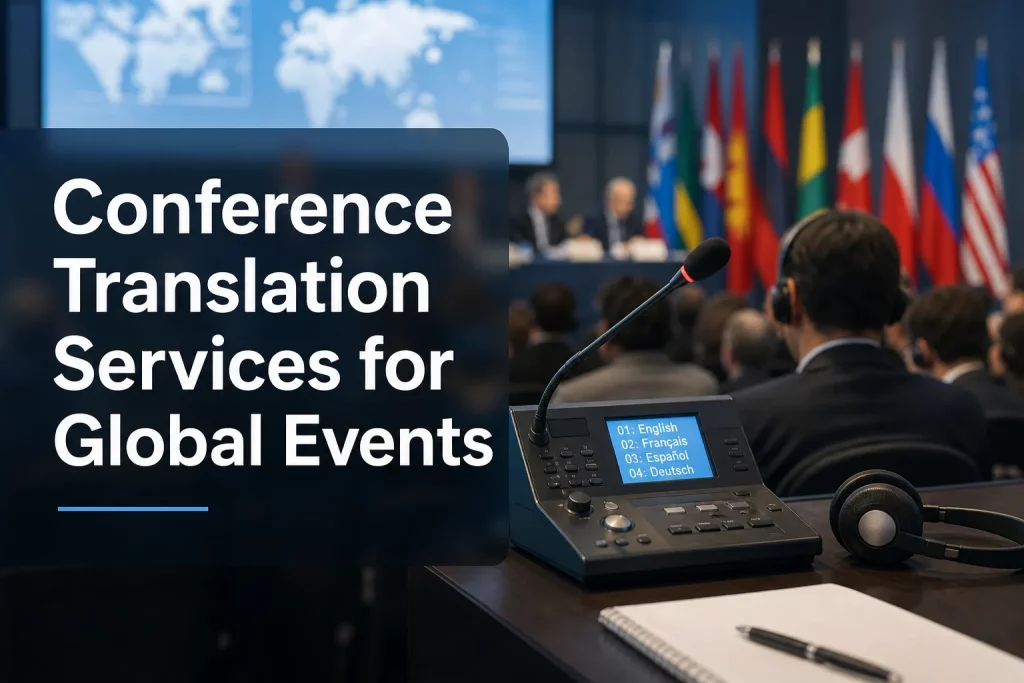
Conference Translation Services for Global Events
Global events are only as effective as the audience’s ability to understand, engage, and participate. If your conference includes international attendees, multilingual speakers, hybrid sessions, or accessibility requirements, language support is no longer a nice extra – it is part of the event experience itself.
For event organizers, corporate communications teams, trade show producers, churches, and broadcast leaders, the real challenge is not simply “translating words.” It is making sure every keynote, breakout, panel, video feed, and on-site interaction is clear, inclusive, and professionally delivered in real time. That is where strong conference translation services matter.
Team Stream helps organizations deliver that experience with accurate human interpreters, AI-powered language support, real-time captioning, written translation, accessibility services, equipment, and technician support for live, virtual, and hybrid events. With more than 25 years of experience, Team Stream acts as a practical partner – not just a vendor – so multilingual communication feels seamless instead of stressful.
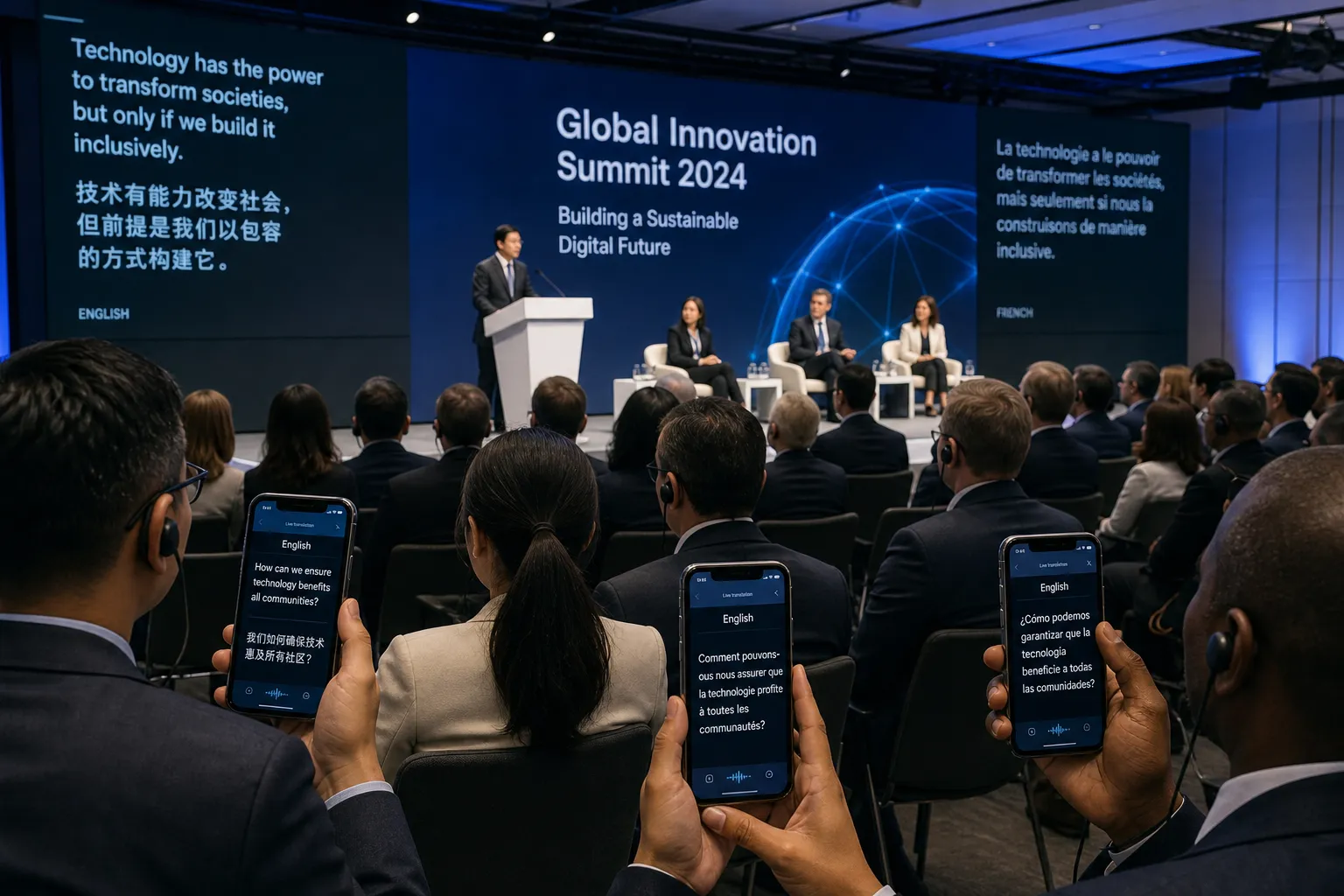
What conference translation really means
When people search for conference translation, they are often talking about several different services at once:
-
Real-time spoken interpretation for live sessions
-
Live captions and translated subtitles for accessibility
-
Written translation for agendas, signage, slides, handouts, and post-event content
-
Multilingual support for virtual and hybrid event platforms
-
Language access planning for compliance, inclusion, and audience growth
In practice, conference translation services are not one tool or one person. They are a coordinated language-access system designed around your event format, audience, content, and risk level.
Translation vs. interpretation: the distinction matters
A common mistake in event planning is using “translation” and “interpretation” as if they mean the same thing.
|
Service |
What it covers |
Typical event use |
|---|---|---|
|
Translation |
Converting written text from one language to another |
Agendas, programs, signage, websites, slides, emails, subtitles |
|
Interpretation |
Converting spoken language in real time |
Keynotes, breakout sessions, panels, meetings, Q&A |
|
Captioning |
Displaying spoken content as text, live or recorded |
Accessibility, engagement, comprehension, hybrid/virtual viewing |
|
Subtitling |
Timed translated text for recorded content |
On-demand sessions, promo videos, training libraries |
For most global events, you need a mix of all four.
Why conference translation services matter more than ever
Competitor pages tend to focus on language count, platform integrations, or cost savings. Those matter, but they miss a bigger truth: multilingual event support changes outcomes.
It affects whether attendees stay engaged, whether sponsors see value, whether remote audiences remain connected, whether accessibility obligations are met, and whether your content continues to perform after the event.
Better understanding drives better participation
When attendees can follow content in their preferred language, they are more likely to ask questions, join discussions, stay longer, and remember key messages. That matters at conferences, sales meetings, annual summits, investor events, educational programs, and public-facing gatherings alike.
Accessibility is part of event quality
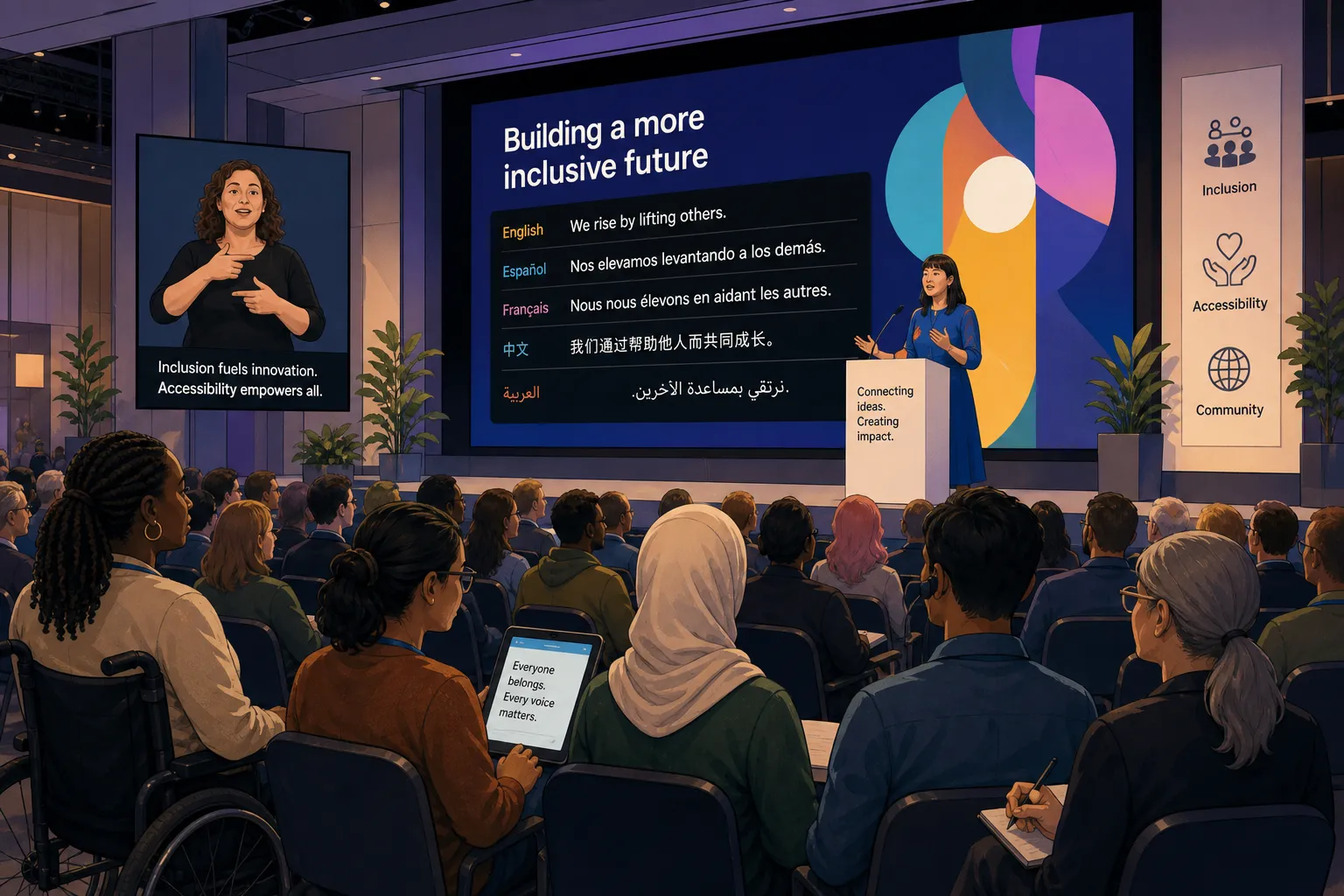
Live captions, multilingual captions, and professional interpreting do more than support non-English speakers. They help deaf and hard-of-hearing participants, improve comprehension in noisy venues, support neurodiverse audiences, and make hybrid sessions easier to follow.
International reach expands without sacrificing clarity
A multilingual event can attract broader attendance, stronger global participation, and more post-event content value – but only if the delivery is reliable. Poor audio, delayed captions, weak terminology handling, or unclear interpreting can damage trust quickly.
Compliance and inclusion are increasingly connected
Organizations today are expected to communicate inclusively. Depending on your audience and industry, that may involve ADA-related accessibility planning, internal DEI goals, public-sector obligations, or broader language access expectations. Conference translation services help operationalize those commitments.
The biggest content gap: event planners do not just need translation, they need orchestration
This is where many competitor articles fall short. They describe products, not event realities.
Conference language support succeeds or fails based on execution details such as:
-
Audio routing
-
Interpreter handoff
-
Session complexity
-
Terminology prep
-
Caption display strategy
-
Device access for attendees
-
Internet stability
-
On-site tech support
-
Hybrid platform compatibility
-
Contingency planning if something breaks live
Team Stream’s advantage is that it supports the whole communication chain. That includes interpreting, captioning, translation, subtitling, voiceover, equipment rental, technician services, and flexible live or remote delivery. For planners, that means fewer moving parts and less risk on event day.

What services are typically included in a conference translation strategy
A professional strategy usually combines multiple layers, depending on event size and audience needs.
1. Simultaneous interpreting for live sessions
This is the gold standard for multilingual conferences where attendees need to hear content in real time without interrupting the speaker. It is commonly used for:
-
Mainstage keynotes
-
Executive presentations
-
Investor communications
-
Government and public meetings
-
Trade show sessions
-
Association conferences
-
Faith-based gatherings
-
Broadcast events
Interpretation can be delivered in person or remotely, with attendees listening through headsets, mobile devices, platform audio channels, or integrated event apps.
2. AI-powered language support for scale
AI can expand language coverage, reduce turnaround time, and provide practical support for sessions that do not require full human interpreting. This can be useful for:
-
Large multi-session conferences
-
Internal meetings
-
Breakout rooms
-
On-demand translation needs
-
Lower-risk or high-volume content
The most effective approach is rarely “human or AI.” It is using the right mix of both.
3. Real-time captioning and translated captions
Captioning improves accessibility and comprehension across event formats. It can appear:
-
On venue screens
-
On attendee devices
-
In webinar platforms
-
In live streams
-
In archived recordings
Captions are especially valuable in hybrid settings, where audio conditions and audience environments vary widely.
4. Written translation for event materials
This includes:
-
Registration pages
-
Event websites
-
Session descriptions
-
Marketing emails
-
Digital signage
-
Printed programs
-
Speaker slides
-
Handouts
-
Sponsor assets
-
Post-event summaries
5. Post-event multilingual content
One of the most overlooked opportunities is extending event value after the live date. Recorded sessions can be repurposed with translated subtitles, transcripts, voiceover, and written summaries for global audiences.
Human interpretation, AI translation, or hybrid?
This is one of the most important decisions for planners.
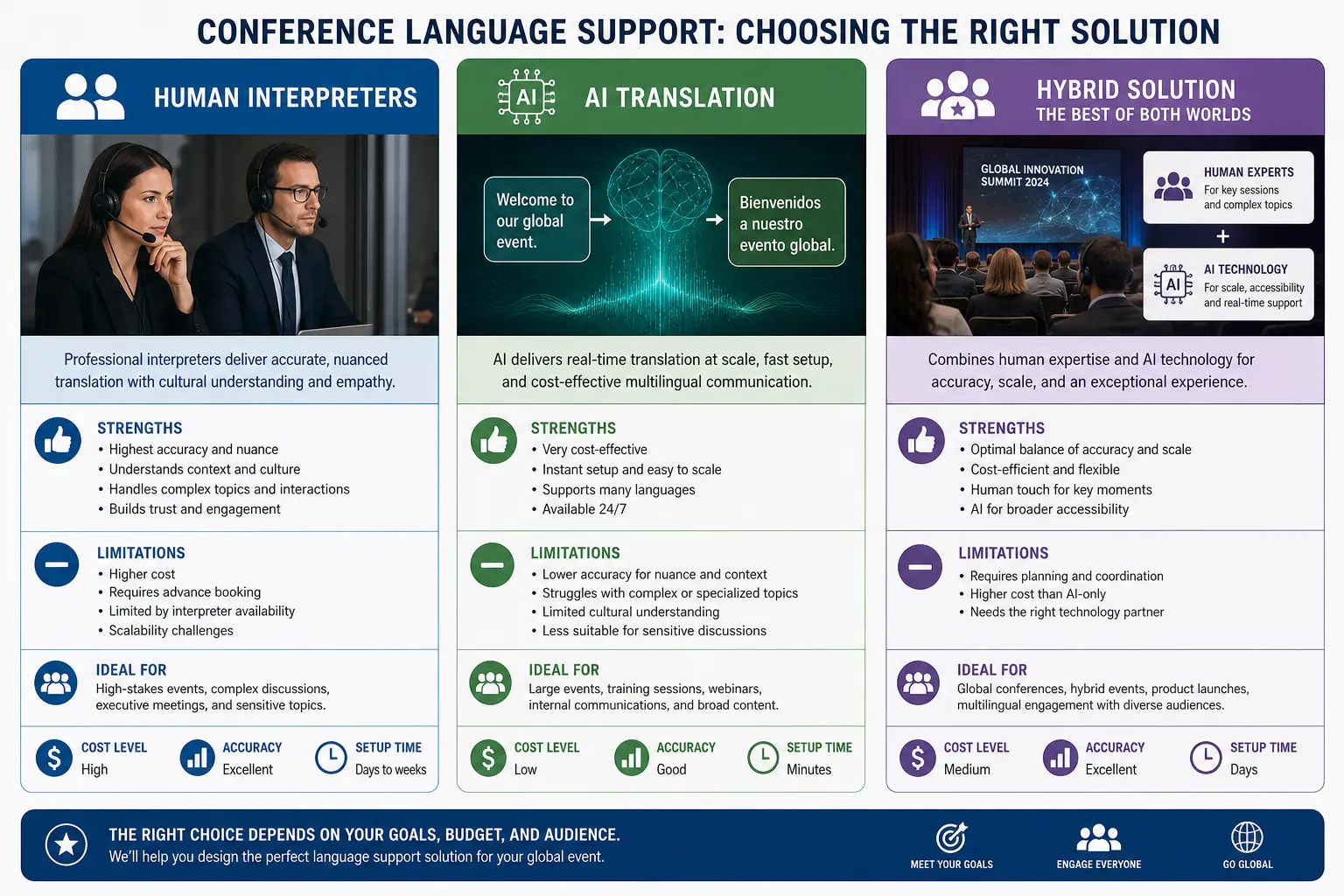
When human interpreters are the better fit
Choose human expertise when your event includes:
-
Sensitive or high-stakes messaging
-
Medical, legal, or technical complexity
-
Executive communications
-
Nuanced Q&A or audience interaction
-
Brand-critical public messaging
-
Cultural nuance that matters to audience trust
Professional interpreters bring judgment, tone handling, and contextual understanding that technology alone may not consistently deliver.
When AI is a practical option
AI can be effective for:
-
Fast deployment
-
Broader language reach
-
Lower-cost scaling
-
Internal or operational sessions
-
Secondary content streams
-
Events where captions and speed matter more than nuance
Why hybrid is often best
A hybrid model combines the strengths of both. You may use human interpreters for keynote sessions and AI-powered support for breakout rooms, secondary tracks, or supplementary captions. This creates better budget efficiency without compromising the sessions that matter most.
Team Stream is especially well positioned here because it does not force clients into a one-size-fits-all approach. Its team can tailor the delivery model around the event’s purpose, audience, and risk profile.
What to look for in conference translation services
Not all providers are built for live event pressure. When evaluating options, ask deeper questions than “How many languages do you support?”
Audio and technical reliability
Language quality begins with sound quality. If audio is weak, every downstream service suffers. Ask whether the provider can support:
-
On-site audio capture
-
Platform audio integration
-
Remote interpreter feeds
-
Backup routing
-
Technician oversight
-
Equipment rental if needed
Terminology preparation
The best providers prepare glossaries in advance, especially for technical, medical, legal, faith-based, or branded content. This reduces errors with names, acronyms, product terms, and industry vocabulary.
Live event support
Who is monitoring the service during the event? If there is a problem mid-session, you need a real person who can fix it fast. Team Stream’s responsiveness and service orientation are especially important here.
Accessibility capability
Many vendors can “translate.” Fewer can deliver a complete accessibility solution that includes live captioning, subtitling, compliance-minded workflows, and audience-friendly display options.
Flexible delivery
A strong partner should support:
-
In-person events
-
Virtual conferences
-
Hybrid experiences
-
Broadcast environments
-
Remote and on-site interpreters
-
Mobile, desktop, and venue display workflows
Post-event content support
If your provider can also handle subtitling, voiceover, translation, transcripts, and edited multilingual assets, your event content becomes far more useful after the live day ends.
Common conference scenarios and the right language setup
Large international conference
Best fit:
-
Human interpreting for mainstage sessions
-
AI-assisted translation or captions for breakouts
-
Multilingual attendee access via mobile/web
-
On-site technician support
-
Translated event materials
Corporate town hall or annual meeting
Best fit:
-
Interpreting for leadership presentations
-
Real-time captions for accessibility
-
Secure remote delivery for global teams
-
Translation of decks, internal communications, and recordings
Trade show or expo
Best fit:
-
Interpretation for stage programming and booth demos
-
Written translation for signage and promotional material
-
Captioning for recorded demo content
-
Flexible on-demand support for changing schedules
Church conference or ministry event
Best fit:
-
Live interpretation for sermons, worship, and teachings
-
Captioning for accessibility and streaming
-
Subtitles or voiceover for post-event media
-
In-person or remote support depending on venue and budget
Hybrid or broadcast event
Best fit:
-
Integrated audio/video workflows
-
Real-time captions for screens and streams
-
Multiple language outputs
-
Technician oversight
-
Post-event subtitling and clip localization
Mistakes that undermine multilingual events
Even strong events can struggle if the language plan is an afterthought.
Booking too late
The later you plan, the fewer options you have for interpreters, technical setup, terminology prep, and testing.
Treating captions as optional
Captions are often seen as a nice add-on, but they directly improve accessibility, comprehension, engagement, and replay value.
Using the same solution for every session
Not every room needs the same level of support. Smart planning matches the service level to session complexity and business risk.
Ignoring attendee experience
If participants do not know how to access language support, adoption suffers. Clear instructions, QR codes, screen prompts, and pre-event communication make a big difference.
Failing to coordinate with AV and production teams
Translation, interpretation, and captioning do not exist in a vacuum. They depend on audio, video, routing, and display decisions made by the production team.
Planning checklist for a successful multilingual conference
Use this framework early in the planning process.
|
Planning area |
Questions to answer |
|---|---|
|
Audience |
Which languages do attendees need? Are there accessibility needs? |
|
Sessions |
Which sessions are high-stakes, technical, or interactive? |
|
Format |
Is the event in-person, virtual, hybrid, or broadcast? |
|
Delivery |
Do you need human interpreters, AI support, captions, or all three? |
|
Content |
What written materials must be translated before and after the event? |
|
Technical setup |
How will audio be captured, routed, monitored, and backed up? |
|
Access |
How will attendees join language channels or view captions? |
|
Compliance |
Are there ADA, internal policy, or public accessibility considerations? |
|
Post-event use |
Will recordings need subtitles, transcripts, summaries, or voiceover? |
Why Team Stream is a strong partner for global events
Many providers specialize in one piece of the puzzle. Team Stream supports the full multilingual and accessibility workflow.
Accurate human and AI-powered solutions
Team Stream combines professional human expertise with AI-enabled tools so clients can choose the right balance of nuance, speed, scale, and budget.
Accessibility built into the event experience
Real-time captioning, closed captioning, subtitling, and inclusive communication support help organizations serve broader audiences while improving comprehension and engagement.
End-to-end support tailored to each event
Instead of selling a rigid package, Team Stream adapts the solution to the event. That includes interpreting, translation, captioning, equipment, technician services, and delivery planning across live, virtual, and hybrid environments.
Compliance-friendly execution
For organizations that care about inclusion, accessibility, and risk reduction, Team Stream helps create communication workflows that are more dependable and easier to defend operationally.
Equipment and technician support
This is a major differentiator. Language access does not happen well without solid technical execution. Team Stream can support events with professional equipment rental, sales, and technician services to keep delivery smooth.
Over 25 years of experience
Experience matters when schedules change, speakers go off script, internet conditions vary, or multiple vendors need to work together under pressure. Team Stream brings a long track record of reliable execution and responsive customer service.
How much do conference translation services cost?
Costs vary based on several factors:
-
Number of languages
-
Number of session hours
-
Human vs. AI vs. hybrid delivery
-
In-person vs. remote interpreting
-
Captioning needs
-
Technical complexity
-
Equipment requirements
-
Event format and concurrency
-
Pre-event prep and post-event deliverables
The cheapest option is not always the most affordable if it creates attendee confusion, accessibility gaps, or live-event failures. The better question is: what level of language support does each part of your event truly need?
A tailored provider can help you allocate budget intelligently – using premium human support where precision matters most and scalable tools where efficiency makes sense.
A better way to think about event ROI
Competitor content often frames language services mainly as a cost line. That is too narrow.
Strong conference translation supports ROI by helping you:
-
Increase attendee comprehension
-
Expand international reach
-
Improve accessibility
-
Raise sponsor and exhibitor value
-
Extend content lifespan
-
Reduce communication risk
-
Strengthen brand trust
-
Support compliance goals
-
Improve remote audience retention
When your audience can fully understand the content, the event simply works better.
Final verdict
Conference translation services are not just about converting speech from one language to another. They are about making global communication actually function in real time – for attendees, speakers, sponsors, remote viewers, and internal stakeholders alike.
The best solution is rarely the most generic one. It is the one designed around your event format, your audience, your content, and your operational realities. That means combining interpreting, captioning, written translation, accessibility planning, technical support, and post-event content strategy into one coordinated plan.
If you want a partner that can do that with flexibility, professionalism, and strong service, Team Stream is a smart choice. With over 25 years of experience and a full range of human, AI-powered, and accessibility-focused solutions, Team Stream helps organizations deliver multilingual events that are clearer, more inclusive, and more effective.
If your next conference, summit, trade show, church event, webcast, or hybrid program needs language access done right, Team Stream is ready to help you build the right solution from the start.
FAQ
What are some global translation companies?
Some well-known providers in the market include companies focused on event interpreting, AI translation, captioning, and multilingual content services. For organizations running live, virtual, or hybrid events, Team Stream stands out by combining human expertise, AI-enabled support, accessibility services, equipment, and technician support in one tailored solution.
How much does interprefy cost?
Pricing depends on factors such as languages, session length, event format, and support level. As with most multilingual event providers, organizations should request a custom quote and compare not just price, but also live support, accessibility capabilities, and technical reliability.
Can Chatgpt do simultaneous translation?
General AI tools can assist with language tasks, but professional simultaneous interpretation for live events requires much more than raw translation output. Conferences usually need structured audio workflows, terminology prep, captioning, platform integration, and live support to deliver reliable multilingual communication.
How much does an AI translator cost?
AI translator pricing varies widely based on usage model, number of languages, integration needs, and whether captioning or event support is included. For conferences, the real cost should be evaluated alongside accuracy, attendee experience, accessibility, and whether human backup is needed for critical sessions.
Can ChatGPT be used as a live translator?
It may help with simple language assistance, but it is not a complete replacement for professional live translation and interpretation services in high-stakes event settings. For global conferences, a dedicated solution like Team Stream offers the structured delivery, accessibility support, and reliability needed for real-world execution.
