

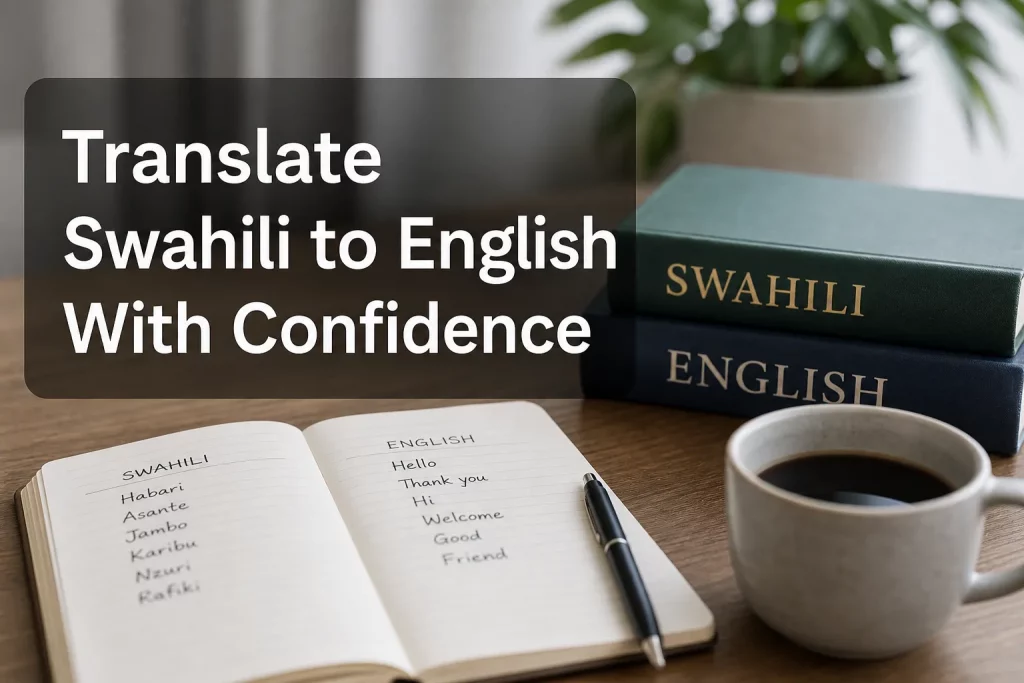
Translate Swahili to English With Confidence
When you need to translate Swahili to English, accuracy matters more than most people expect. A casual phrase, a training document, a contract, a church livestream, a healthcare handout, or a conference presentation can all lose meaning fast if the translation ignores context, tone, or audience. The same is true when you need to translate English to Swahili: literal word-for-word conversion may be understandable, but it often misses cultural nuance, natural phrasing, and the intent behind the message.
For event organizers, corporate teams, conference planners, churches, broadcasters, and multilingual businesses, the challenge is even bigger. It is not just about converting text. It is about making communication clear, inclusive, accessible, and trustworthy across live, virtual, and hybrid environments. That is where a partner like Team Stream stands out, combining accurate human expertise with AI-powered translation, interpreting, captioning, subtitling, and end-to-end accessibility support to help every audience stay connected.
“Swahili has evolved into Africa’s most internationally recognized language, with over 200 million users.” – World Economic Forum
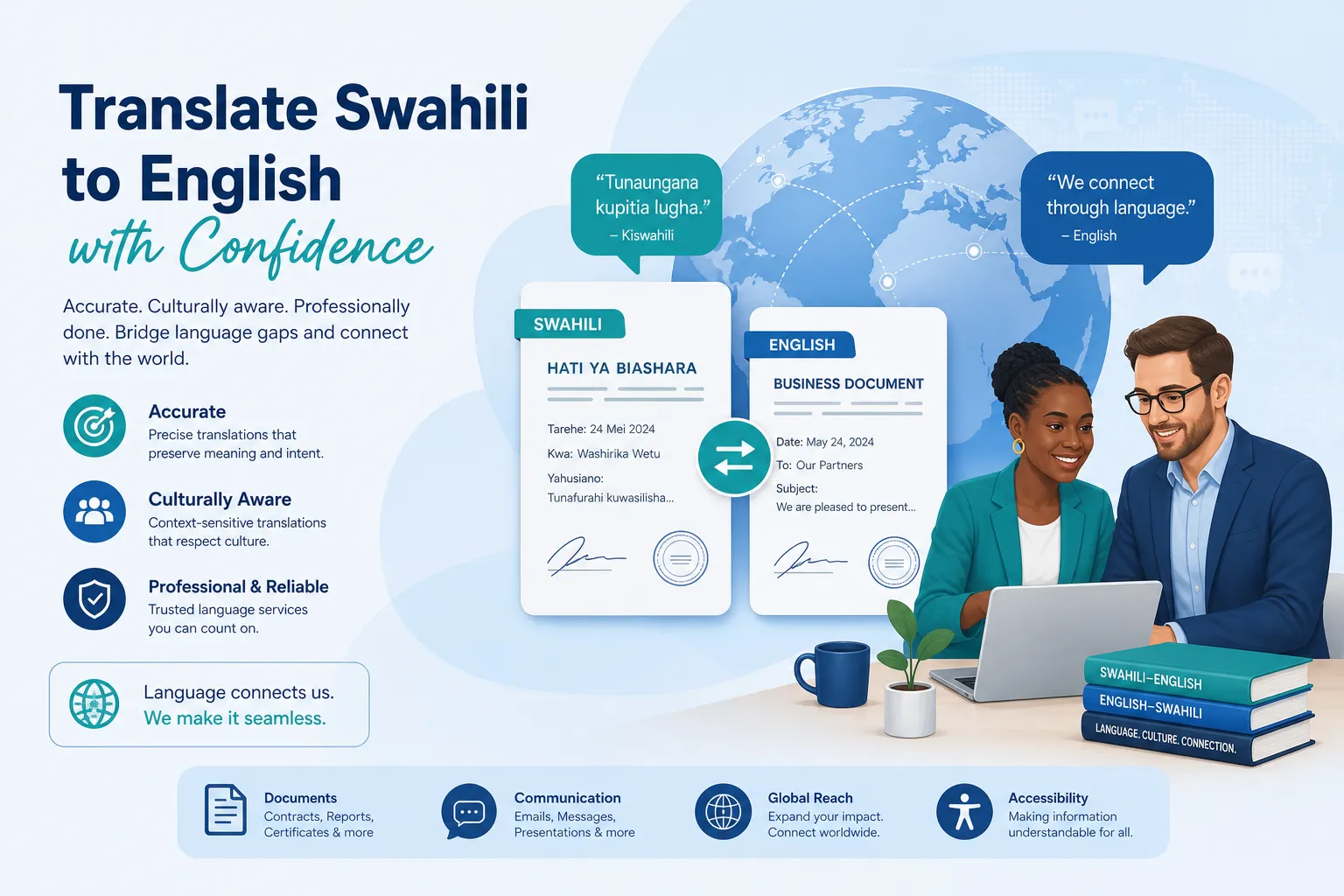
Why Swahili Translation Deserves a More Careful Approach
Swahili is widely spoken across East and Central Africa, including Tanzania, Kenya, Uganda, the Democratic Republic of the Congo, and neighboring regions. Because it serves as a major lingua franca, one translation may need to work for audiences with different local expectations, vocabulary preferences, and levels of English fluency.
That makes Swahili translation more than a dictionary exercise. The translator needs to consider:
-
regional phrasing
-
formal versus conversational tone
-
industry terminology
-
audience literacy and accessibility needs
-
whether the content will be read, heard, captioned, or spoken live
Competitor content often explains that machine translation can be risky for legal or official documents. That is true, but the bigger content gap is this: many organizations are not only translating documents. They are translating events, meetings, videos, worship services, product launches, training sessions, and internal communications. Those environments demand a broader solution that includes interpreting, live captioning, subtitling, and technical support, not just a translated PDF.
Common Reasons People Need Swahili and English Translation
Business and Corporate Communication
Companies often need bilingual support for:
-
employee handbooks
-
HR onboarding materials
-
compliance notices
-
supplier agreements
-
presentations and slide decks
-
customer support content
-
marketing campaigns
A poor translation can create confusion, delay decisions, or damage trust. In corporate settings, clarity is a business asset.
Conferences, Trade Shows, and Live Events
For multilingual events, the need goes beyond written content. Organizers may need:
-
live Swahili interpreting
-
real-time captions in English
-
translated presentation materials
-
multilingual signage
-
remote language access for virtual attendees
This is where Team Stream’s model is especially useful. Rather than treating translation as a one-off service, the company supports live, virtual, and hybrid events with interpreting, captioning, equipment rental, and technician support, helping planners deliver a smooth experience for every attendee.
Churches, Ministries, and Community Outreach
Faith-based organizations and nonprofits frequently communicate across languages in highly personal contexts. Sermons, announcements, discipleship materials, livestreams, and outreach content all need to feel natural and respectful.
Swahili-speaking audiences are more likely to engage when the message sounds human, not mechanically converted. That makes voice, tone, and interpretation quality especially important.
Healthcare and Public Information
Healthcare instructions, consent forms, patient communications, and public service information require plain language and precision. Even a small mistranslation can affect comprehension and outcomes.
In these cases, accuracy and accessibility should work together. Translation may need to be paired with captioning, voiceover, or interpretation to ensure the content is truly usable.
Video, Broadcast, and Digital Content
Video teams and broadcasters often need to translate English to Swahili or Swahili to English for:
-
subtitles
-
closed captions
-
dubbing or voiceover
-
interview transcripts
-
social clips
-
webinar replays
Competitors largely focus on document translation. A major missed opportunity is addressing how multilingual video and broadcast workflows actually work. For many organizations, this is now one of the most important translation use cases.
The Biggest Challenges in Swahili to English Translation
Meaning Depends on Context
A single word can carry different meanings depending on setting, formality, and speaker intent. Translating in isolation often leads to awkward or misleading English.
For example, a phrase in a legal document should not be translated the same way as a phrase in a sermon, event script, or marketing campaign. Context determines whether the translation should be formal, persuasive, relational, technical, or instructional.
Natural Swahili Structure Does Not Map Perfectly to English
Swahili grammar organizes meaning differently from English. Verb forms, noun classes, and agreement patterns can compress meaning into one word or phrase that requires a more expanded rendering in English.
This is one reason raw machine output may seem “close enough” at first glance but still fail in real use.
Dialect and Regional Preference Matter
Standard Swahili is widely understood, but vocabulary choices may still vary depending on audience and region. If you are translating for a specific market, such as Tanzania versus Kenya, local expectations can shape how natural the content feels.
Tone Is Easy to Lose
A message can be technically accurate but emotionally wrong. This matters in:
-
executive communications
-
faith-based content
-
customer service
-
brand messaging
-
training and onboarding
-
live interpreted sessions
Good translation preserves intent, not just wording.
Accessibility Is Often Ignored
One of the biggest gaps in competitor content is the lack of accessibility strategy. Translation alone does not guarantee understanding. If your audience includes deaf or hard-of-hearing participants, non-native readers, or remote attendees, you may also need:
-
live captions
-
translated subtitles
-
readable formatting
-
voiceover
-
interpreting support
Team Stream’s advantage is that it treats language access and accessibility as connected services, not separate afterthoughts.
When Machine Translation Helps and When It Falls Short
AI-powered tools can be useful, especially for speed, internal drafts, and basic comprehension. But they should be used selectively.
Good Uses for AI Translation
AI can help with:
-
understanding the general meaning of short text
-
internal sorting of incoming messages
-
rapid first-pass translation for review
-
high-volume content where human review follows
-
multilingual event support when paired with expert oversight
Risky Uses for AI Translation
AI alone is a weak choice for:
-
legal or compliance-sensitive content
-
public-facing brand messaging
-
healthcare information
-
live event communication without support
-
subtitles requiring timing and nuance
-
content for communities where trust and tone matter
The best approach is usually hybrid: AI for efficiency, humans for accuracy, nuance, quality control, and accountability. That is exactly where Team Stream’s service model fits. Its human and AI-powered language solutions allow organizations to scale without sacrificing quality.
Swahili to English vs. English to Swahili: Why the Direction Matters
Many people assume translation difficulty is the same in both directions. It is not.
|
Translation Direction |
Primary Challenge |
Best Approach |
|---|---|---|
|
Swahili to English |
Interpreting compressed meaning and local nuance accurately |
Native-level comprehension plus subject knowledge |
|
English to Swahili |
Making the output sound natural and culturally appropriate |
Native Swahili linguistic review and localization |
|
Live interpretation |
Speed, clarity, terminology, and audience comprehension |
Experienced interpreters with technical support |
|
Video subtitling |
Accuracy, brevity, readability, timing |
Translation plus caption/subtitle expertise |
When you translate English to Swahili, the question is not just “Is this correct?” It is also “Would a real speaker say it this way?”
That distinction matters in everything from event slides to sermon notes to product demos.
How to Choose the Right Translation Method
Use Self-Service Tools for Low-Stakes Tasks
If you just need the gist of a message, a machine tool may be enough. This is fine for low-risk, internal understanding.
Use Professional Human Translation for Important Written Content
Choose a professional service when the content affects trust, reputation, clarity, or compliance. This includes contracts, official notices, high-visibility marketing, scripts, and training materials.
Use Interpreting for Live Communication
If the interaction is happening in real time, translation is not enough. You need interpreting. This is especially true for:
-
conferences
-
corporate town halls
-
panel discussions
-
live worship services
-
interviews
-
multilingual webinars
Add Captioning and Accessibility Support When Needed
If your content is public, educational, or event-based, language access should often be paired with accessibility features.
“99% of enterprise leaders observed increased ROI or effectiveness in their events by offering interpretation and captioning.” – Wordly
That matters not only for inclusion, but also for engagement, retention, and professionalism.
What High-Quality Swahili Translation Looks Like
A strong translation workflow should include more than one step.
1. Discovery
The provider should ask:
-
Who is the audience?
-
What is the purpose?
-
Is the tone formal, technical, or conversational?
-
Will the output be printed, spoken, captioned, or broadcast?
-
Is there a deadline tied to an event?
2. Linguist Matching
The right translator or interpreter should understand both the language pair and the subject matter. A marketing translator is not the same as a legal translator. A live conference interpreter is not the same as a subtitle specialist.
3. Drafting or Live Delivery
The work is performed with context, terminology, and audience use in mind.
4. Review and Quality Control
This includes checking for:
-
meaning accuracy
-
natural phrasing
-
consistency
-
formatting
-
names, dates, and numbers
-
subtitle timing or caption readability where relevant
5. Delivery in the Right Format
This may be:
-
translated documents
-
subtitle files
-
caption files
-
interpreted audio feeds
-
voiceover recordings
-
event-ready language access setups
Competitors often stop at “get a certified translation” or “use a professional.” The missing layer is operational execution. Team Stream brings that extra layer through responsive project management, remote and in-person delivery options, and technician-backed support for events and broadcasts.
How Team Stream Fits Real-World Swahili Communication Needs
Team Stream is not just a translation vendor. It is a language access and accessibility partner built for organizations that communicate live, at scale, and under pressure.
Accurate Human and AI-Powered Translation
For written content, Team Stream combines professional translation expertise with AI-enabled workflows where appropriate. That balance supports speed without giving up quality.
Interpreting for Live, Virtual, and Hybrid Events
If your audience includes Swahili and English speakers in the same room or across different locations, Team Stream can support real-time interpreting tailored to the format of your event.
Real-Time Captioning for Accessibility and Engagement
Captioning improves accessibility, audience focus, and content usability. It also supports compliance-friendly communication for organizations that need inclusive event delivery.
End-to-End Support
Team Stream can support:
-
written translation
-
live interpreting
-
subtitling and captioning
-
voiceover
-
equipment rental
-
technician services
-
in-person and remote workflows
That matters because multilingual communication often breaks down at the handoff points between vendors. A single coordinated partner reduces that risk.
Experienced, Responsive Service
With over 25 years of expertise, Team Stream brings the kind of operational judgment that event producers, operations managers, and communications leaders value most: responsiveness, reliability, and execution quality.
Practical Tips for Better Swahili and English Translation Outcomes
Provide Context, Not Just Text
Always share the purpose of the content, intended audience, and where it will appear. A translator can do far more with a sentence if they know whether it will be spoken on stage, shown in a caption, or printed in a handout.
Avoid Idioms Unless You Want Them Adapted
Idioms rarely survive literal translation well. If your English copy says “hit the ground running,” be ready for adaptation rather than direct conversion.
Build a Terminology List
If you have recurring brand terms, speaker names, technical jargon, or ministry language, share it in advance. This is especially helpful for events and recurring content series.
Think Beyond the Document
If the message will be delivered live or on video, ask whether you also need:
-
interpreting
-
captioning
-
subtitles
-
voiceover
-
technician support
Plan for Accessibility Early
Do not treat accessibility as a last-minute add-on. When language access and accessibility are planned together, the audience experience is better and the workflow is smoother.
A Better Standard Than the Competitors
The top-ranking competitor pages highlight a few useful ideas: machine translation has limits, certified translation matters for official documents, and human review improves quality. All true.
But they often miss the bigger picture.
Content Gaps the Competitors Leave Open
Here are the areas most competitor pages gloss over:
-
the difference between document translation and live interpreting
-
how Swahili translation works in events, broadcasts, and hybrid meetings
-
the role of captioning, subtitling, and accessibility
-
how AI and human translation can work together
-
why technical execution matters as much as linguistic accuracy
-
how organizations can create a full multilingual communication workflow rather than solve one file at a time
This article closes those gaps because that is how modern organizations actually use language services.
Final Thoughts: Clear Communication Builds Confidence
If you need to translate Swahili to English or translate English to Swahili, the right solution depends on what is at stake, who the audience is, and how the message will be delivered. For a quick internal read, AI may help. For public, live, sensitive, or high-value communication, human expertise is essential.
Team Stream offers a stronger path forward because it combines translation, interpreting, captioning, subtitling, accessibility, equipment, and event support into one responsive service model. Whether you are planning a conference, managing multilingual corporate communications, producing a broadcast, or making community outreach more inclusive, Team Stream helps you communicate clearly, professionally, and confidently.
If you want a partner that can support both language access and accessibility from start to finish, Team Stream is ready to help.
FAQ
What is the Swahili word for confidence?
The most common answer depends on context. For self-confidence, people often use kujiamini, while some dictionaries may give broader terms like tumaini or trust-related meanings. The right choice depends on whether you mean personal confidence, trust, or hope.
How can I translate Swahili to English?
You can use AI tools for a quick gist, but for anything important, use professional human translation or interpreting. If the content is live, public-facing, technical, or compliance-sensitive, a service like Team Stream offers a more reliable and accessible solution.
What is the African word for confident?
There is no single “African” word because Africa has thousands of languages. In Swahili, a common word related to being confident is kujiamini, which refers to self-confidence or self-assurance.
What is the word for insecure in Swahili?
The meaning of insecure changes by context. For emotional insecurity, Swahili may use phrases that describe lacking confidence or feeling uncertain, so it is best translated in a full sentence rather than as a single isolated word.
What is courage in Swahili?
A common Swahili word for courage is ujasiri. As with confidence-related terms, the most natural translation depends on whether you mean bravery, boldness, or moral courage in a specific context.
What is the Swahili word for wisdom?
A common Swahili word for wisdom is hekima. It is widely used in educational, religious, and everyday contexts to express good judgment, insight, and understanding.
