

Real Time Sign Language Translator Benefits
If you run events, meetings, trainings, broadcasts, or customer-facing experiences, accessibility is no longer a side consideration. It is part of good communication, audience engagement, brand trust, and in many cases, compliance. That is why more organizations are exploring the value of a real time sign language translator – especially for fast-moving environments where information must be delivered clearly, inclusively, and without delay.
For event organizers, corporate teams, conference planners, churches, and production managers, the real question is not just whether this technology exists. It is how it fits into real-world communication, where it works well, where it falls short, and when you still need professional human support. The strongest accessibility strategy is rarely one-size-fits-all.
At Team Stream, we help organizations build practical, compliant, high-quality language access plans with the right mix of human expertise and AI-enabled tools, plus live captioning, interpreting, technician support, and equipment solutions for in-person, virtual, and hybrid experiences.
What a Real-Time Sign Language Translator Actually Does
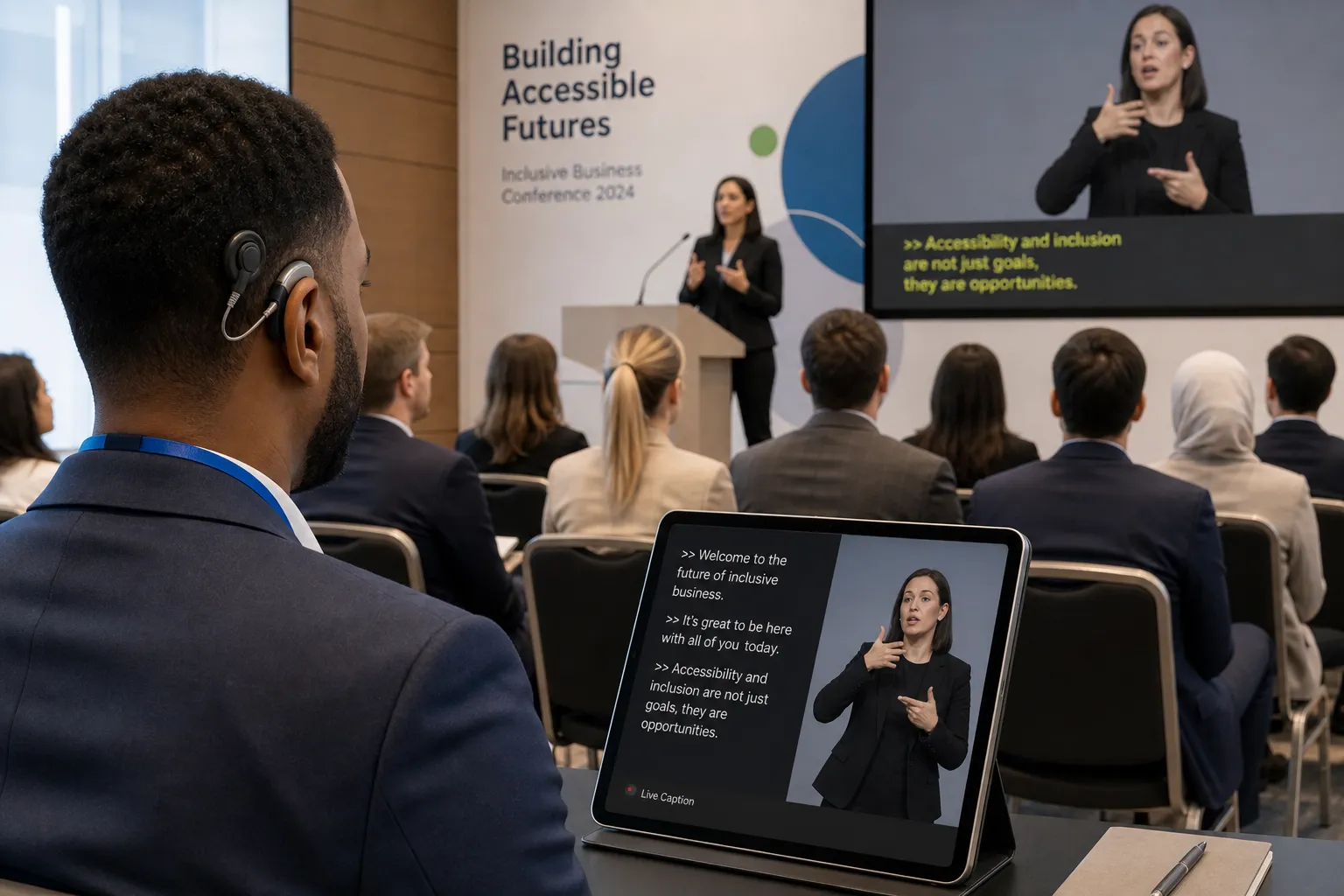
A real-time sign language translator is a system that attempts to convert signed communication into text, speech, or another language output as the signer is communicating. Depending on the setup, it may also work in reverse by turning spoken or written content into sign-supported output through an avatar, display, or interpreter-assisted workflow.
In practice, these systems may involve:
-
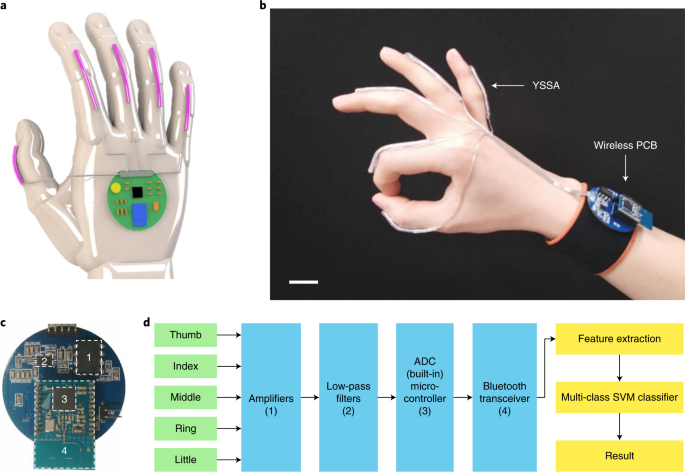
Camera-based gesture and motion recognition
-
AI models trained on sign language data
-
Speech-to-text and text-to-speech tools
-
Captioning layers
-
On-screen avatar or visual output
-
Human review or interpreter backup
The important distinction is this: sign language is not just hand movement. It also includes facial expression, body posture, timing, grammar, spatial referencing, and context. That is why real-time translation can be helpful in some situations but still insufficient in others.
Why This Matters More Than Ever
Organizations are under growing pressure to make communication more inclusive across every touchpoint: live events, webinars, onboarding, public announcements, internal town halls, training videos, trade shows, classrooms, worship services, and customer service encounters.
“Over 5% of the global population – approximately 430 million people – require rehabilitation to address disabling hearing loss.” – World Health Organization
That statistic alone explains why accessibility cannot be treated as optional. But beyond audience size, accessibility also affects:
-
Participation and comprehension
-
Brand reputation
-
Legal and policy risk
-
Employee inclusion
-
Customer satisfaction
-
Event reach and retention
For many organizations, the interest in real-time sign language solutions starts with speed and scalability. The smarter question is how to use them responsibly.
The Core Benefits of Real-Time Sign Language Translation
Faster Access to Everyday Communication
In environments where a live interpreter is not immediately available, technology can help bridge basic interactions. That may include check-ins, short service exchanges, wayfinding, retail questions, or simple operational communication.
This can be useful in:
-
Front desks
-
Registration counters
-
Transportation hubs
-
Campus services
-
Basic support interactions
For short, predictable communication, AI-assisted translation may reduce delays and increase independence.
Better Accessibility for Live and Hybrid Events
Events move quickly. Presentations, Q&A sessions, breakout rooms, backstage coordination, sponsor booths, and networking all create different accessibility needs. A real-time sign language translator can add support layers in selected scenarios, especially when paired with live captioning and remote communication tools.
For example, an event may combine:
-
Human interpreters for keynote sessions
-
CART/live captioning for all spoken content
-
AI support for simple booth interactions
-
Remote interpreting for overflow or backup coverage
This blended model is often more effective than relying on any single method.
Improved Inclusion in Business Communication
Internal communication is one of the biggest missed opportunities in accessibility planning. Many companies focus on public-facing compliance but overlook staff meetings, onboarding, safety briefings, HR updates, and leadership communications.
Real-time solutions can improve access in:
-
Daily standups
-
Department meetings
-
Employee training
-
Recorded internal video
-
Company-wide announcements
That said, the quality of access must match the importance of the message. High-stakes communication still requires qualified professionals.
Greater Flexibility Across Locations
One of the strongest benefits of technology-enabled language access is flexibility. Businesses with multiple offices, distributed teams, or hybrid event formats often need solutions that can move across locations and platforms.
A well-designed accessibility workflow can support:
|
Use Case |
Best-Fit Support |
|---|---|
|
High-stakes legal or HR meeting |
Qualified human interpreter + captioning |
|
Conference keynote |
On-site interpreters + live captioning + display support |
|
Webinar or virtual town hall |
Remote interpreters + captions + platform integration |
|
Front-desk or short service interaction |
AI-assisted communication tool with fallback support |
|
Training video library |
Subtitling + voiceover + sign-language version where needed |
At Team Stream, this is where experience matters. With over 25 years of expertise, we help clients match the solution to the communication context instead of overspending in low-risk situations or under-supporting critical ones.
More Scalable Accessibility Planning
For organizations managing many events, many locations, or a large content library, scale matters. Real-time sign language tools may help extend accessibility coverage where fully manual workflows would be too slow or too expensive on their own.
This is especially relevant for:
-
Enterprise training rollouts
-
Recurring webinars
-
Multi-session conferences
-
Public information campaigns
-
Broadcast and streaming environments
Used correctly, AI can help organizations move faster. Used carelessly, it can create risk.
Where the Technology Works Best
Not every communication setting demands the same level of nuance. Real-time sign language systems are typically most useful when the communication is:
-
Short
-
Repetitive
-
Low-context
-
Operational
-
Predictable
-
Non-sensitive
Examples include:
-
Simple customer service exchanges
-
Directional information
-
Number-based or menu-based choices
-
Routine announcements
-
Pilot learning tools
-
Early-stage accessibility prototypes
The simpler the exchange, the better the odds that automated translation can provide useful support.
Where It Still Falls Short
This is where many articles oversimplify the conversation. The technology is improving, but it is not a universal replacement for interpreters.
Sign Language Is Not a Word-for-Word Code
ASL and other sign languages have their own grammar, syntax, spatial structure, and cultural context. They are not simply signed versions of English. A system that recognizes hand shapes without fully interpreting meaning can produce inaccurate or incomplete output.
Context Changes Meaning
The same movement may mean different things depending on facial expression, speed, positioning, topic, and surrounding signs. In live environments with variable lighting, camera angles, background clutter, or multiple speakers, performance can drop quickly.
High-Stakes Communication Needs Human Judgment
Medical, legal, educational, employment, and emotionally sensitive communication requires accuracy, confidentiality, and nuance. That is not just a quality issue. It can become a compliance issue.
“Businesses and nonprofit organizations that serve the public must communicate effectively with people who have communication disabilities.” – ADA.gov
In many scenarios, effective communication means providing a qualified interpreter, not just any tool that appears accessible on paper.
Technology Can Introduce False Confidence
One of the biggest risks is assuming that because a tool is present, access has been solved. In reality, poor translation can create misunderstandings, missed information, exclusion, or legal exposure. Accessibility must be measured by outcomes, not by whether a platform feature exists.
AI vs. Human Interpreting: The Right Way to Think About It
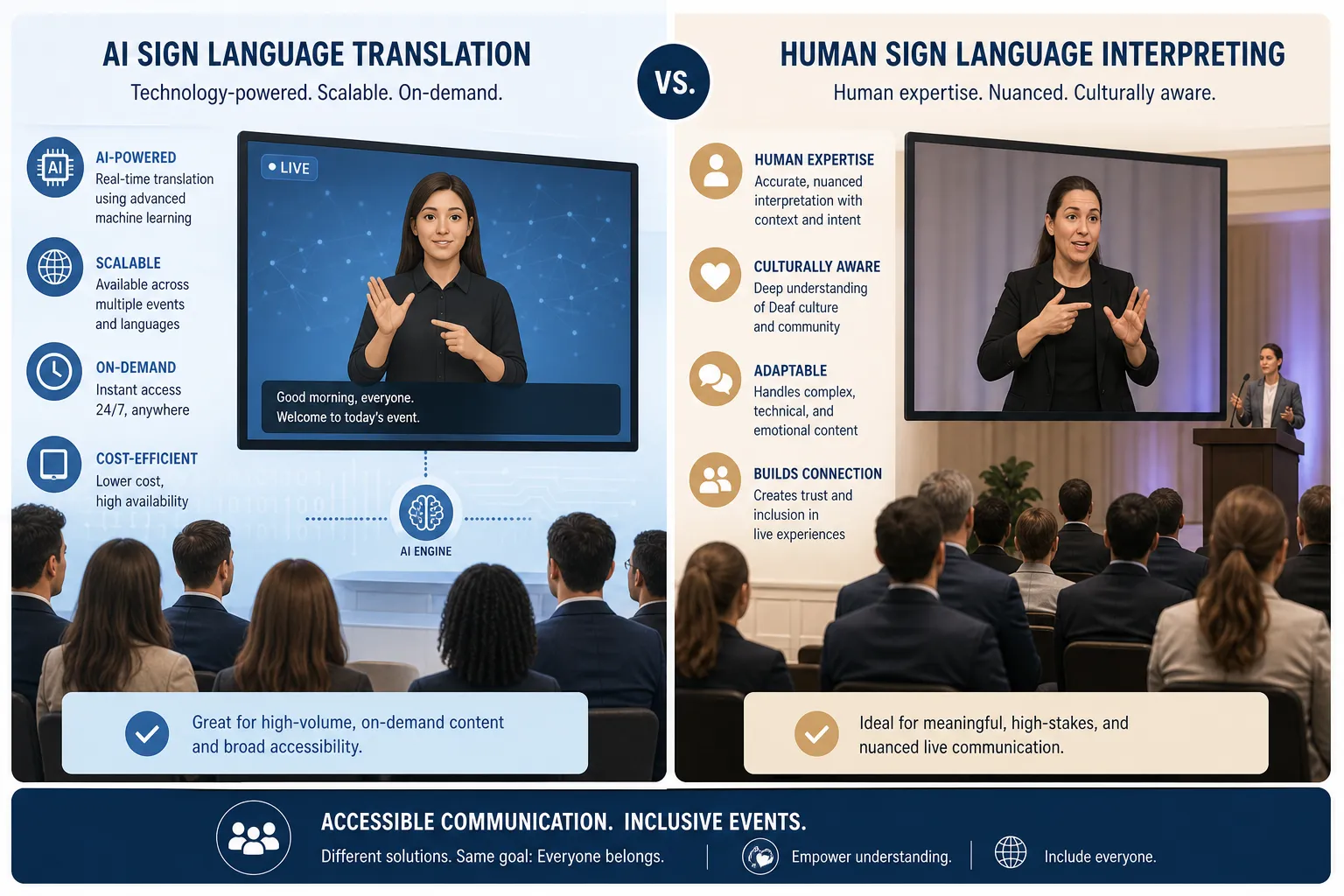
The real comparison is not “Which is better?” in the abstract. It is “Which is appropriate for this communication moment?”
Quick Comparison
|
Factor |
AI-Powered Sign Translation |
Professional Human Interpreting |
|---|---|---|
|
Speed for simple interactions |
Strong |
Strong |
|
Nuance and context |
Limited |
Excellent |
|
Complex discussions |
Weak to moderate |
Strong |
|
Scalability |
High |
Moderate |
|
Accuracy in dynamic settings |
Variable |
High |
|
Compliance confidence |
Limited on its own |
Strong |
|
Emotional and cultural interpretation |
Limited |
Strong |
|
Best use case |
Basic, repetitive, low-risk interactions |
High-stakes, live, nuanced communication |
The most effective organizations do not frame this as a battle. They build a layered accessibility model.
Real-World Use Cases for Events and Organizations
Conferences and Trade Shows
Large events have many simultaneous communication environments. You may need accessibility at registration, on the expo floor, in general sessions, in breakout rooms, and in networking spaces.
A strong approach may include:
-
On-site ASL interpreters for featured sessions
-
Real-time captioning on room screens and event streams
-
Remote interpreting backup
-
AI-assisted tools for low-stakes attendee interactions
-
Equipment rental and technician support for seamless delivery
This is an area where Team Stream’s end-to-end event support becomes especially valuable. Language access is only effective when it is operationally reliable.
Corporate Meetings and Internal Communications
For leadership updates, employee trainings, and recurring meetings, organizations need consistency. Accessibility cannot depend on last-minute scrambling.
A sustainable plan may combine:
-
Scheduled interpreters for planned meetings
-
Captioning for all-hands calls
-
Translated post-event materials
-
Subtitled internal videos
-
AI-enabled tools for smaller, routine interactions
Churches and Worship Services
Faith-based organizations often serve multigenerational, multilingual communities with varying accessibility needs. A real-time sign language translator may help in selected moments, but worship, sermons, testimonies, and counseling often require a more human-centered approach.
Team Stream supports churches with flexible in-person and remote accessibility solutions that preserve both clarity and dignity.
Broadcast and Streaming Environments
Broadcast teams need reliable accessibility that works on-screen and behind the scenes. Timing, visibility, readability, and technical integration all matter. Captioning, sign-language display, subtitling, and multilingual adaptation may all need to work together.
In these settings, the difference between “available” and “broadcast-ready” is huge. Experienced technician support matters.
What Competitors Often Miss: The Biggest Content Gaps
Many discussions around this topic focus heavily on the novelty of AI. They spend less time on the operational and ethical realities. Here are the issues decision-makers should pay closer attention to.
Accessibility Is a Workflow, Not a Widget
A tool alone does not create inclusion. You need planning, testing, fallback options, trained staff, accessible displays, platform compatibility, and communication protocols.
Compliance Depends on Effectiveness
It is not enough to say a service was offered. The question is whether communication was actually effective for the Deaf or hard-of-hearing participant in that moment.
Event Production Details Matter
Screen placement, camera framing, lighting, latency, audio routing, stream overlays, remote platform settings, and technician coordination all affect the quality of accessible communication.
Human Support Still Needs to Be Part of the Plan
Even if you use AI, you still need escalation paths. That may mean scheduled interpreters, on-demand remote support, captioners, translated follow-up materials, or human review for pre-recorded content.
Language Access Is Bigger Than Sign Language Alone
A well-run accessible event may also need:
-
Live captioning
-
Closed captioning
-
Subtitles
-
Voiceover
-
Written translation
-
Multilingual interpreting
-
Equipment rental
-
Technical coordination
That broader view is where Team Stream stands apart. We do not treat accessibility as a single feature. We build integrated communication support tailored to the audience, event format, and compliance needs.
What to Consider Before Choosing a Solution
Before adopting a real-time sign language translator, ask these questions:
What Is the Communication Risk Level?
Is this a casual interaction or a high-stakes exchange involving rights, health, employment, legal exposure, or complex decision-making?
Who Is the Audience?
Are attendees Deaf, hard of hearing, multilingual, international, or using different forms of access support?
What Environment Will It Be Used In?
Will the setting involve stage lighting, crowd noise, poor internet, fast speaker turnover, or unpredictable camera angles?
What Is the Fallback Plan?
If the system fails, what happens next? Who takes over? How quickly?
Do You Also Need Captioning, Translation, or Technical Support?
Many buyers underestimate how interconnected these needs are. A smooth experience often depends on bundling services rather than sourcing them separately.
Best Practices for Using Real-Time Sign Language Tools Responsibly
Use AI for the Right Layer of Access
AI is most useful when it adds speed and scalability to lower-risk situations, not when it is forced into every context.
Pair It With Human Expertise
If communication matters, human oversight matters. This is especially true for live events, sensitive conversations, and public-facing programs.
Test in the Actual Environment
Do not rely on demo performance alone. Test the solution in your real venue, platform, workflow, and audience conditions.
Communicate Access Options Clearly
Attendees and participants should know what support is available, how to request it, and what to expect.
Think End-to-End
Accessibility should cover pre-event communication, live delivery, recorded content, follow-up materials, and post-event archives.
Why Team Stream Is the Smarter Partner
Technology is only as useful as the strategy behind it. Team Stream helps organizations make accessibility practical, scalable, and professional.
We combine:
-
Accurate human and AI-powered translation and interpreting
-
Real-time captioning for accessibility and engagement
-
End-to-end language and accessibility solutions tailored to each client
-
Support for live, virtual, and hybrid events
-
Compliance-friendly services for inclusive communication
-
Professional equipment rental and technician support
-
Flexible service delivery with in-person and remote options
-
More than 25 years of experience
-
Responsive, high-quality customer service
That means you do not have to choose between innovation and reliability. You can have both.
Final Verdict
A real-time sign language translator can offer meaningful benefits, especially for simple, fast, and scalable communication needs. But it is not a complete accessibility strategy by itself. The best outcomes come from matching the tool to the context and supporting it with qualified professionals, captioning, technical planning, and compliance-aware execution.
If your organization wants to make live events, meetings, content, or customer experiences more inclusive, Team Stream can help you build the right solution from the start. Whether you need interpreters, captioning, multilingual support, hybrid event accessibility, or a blended human-and-AI approach, we are ready to help you deliver communication that works for everyone.
FAQ
Do sign language translators make a lot of money?
Income varies by specialization, location, and demand. Highly skilled sign language interpreters working in legal, medical, conference, or broadcast settings often earn stronger rates because those environments require accuracy, experience, and professional credentials.
Do real-time language translators work?
Yes, they can work well for simple, predictable, low-risk communication. Their performance is more limited in nuanced, emotional, technical, or high-stakes conversations, where human interpreters and live captioning remain essential.
What are the benefits of using a sign language translator?
The main benefits are faster access, better inclusion, improved event accessibility, and broader communication reach. In the right setting, these tools can reduce delays and help organizations support Deaf and hard-of-hearing participants more consistently.
Is there a real-time ASL translator available?
Yes, there are emerging tools and pilot systems that support real-time ASL-to-English or English-to-ASL workflows. However, quality varies, and most organizations still need human interpreting support for complex or compliance-sensitive situations.
Are ASL translators in demand?
Yes, ASL interpreters and accessibility professionals remain in strong demand, especially for events, education, healthcare, government, and workplace communication. Demand increases further when organizations prioritize inclusion and effective communication compliance.
Will AI replace ASL interpreters?
No, AI is more likely to support interpreters than replace them. Human interpreters are still needed for nuance, cultural fluency, confidentiality, emotional context, and high-stakes communication where accuracy matters most.
Are ASL translators in demand?
Yes, demand remains high because many organizations need qualified language access for live events, meetings, training, and public communication. As accessibility expectations grow, skilled ASL professionals continue to be essential.
Will AI replace ASL interpreters?
AI will not fully replace ASL interpreters because signed communication depends on context, facial expression, grammar, and human judgment. The most effective future model is a blended approach that uses AI for efficiency and humans for critical communication.
