

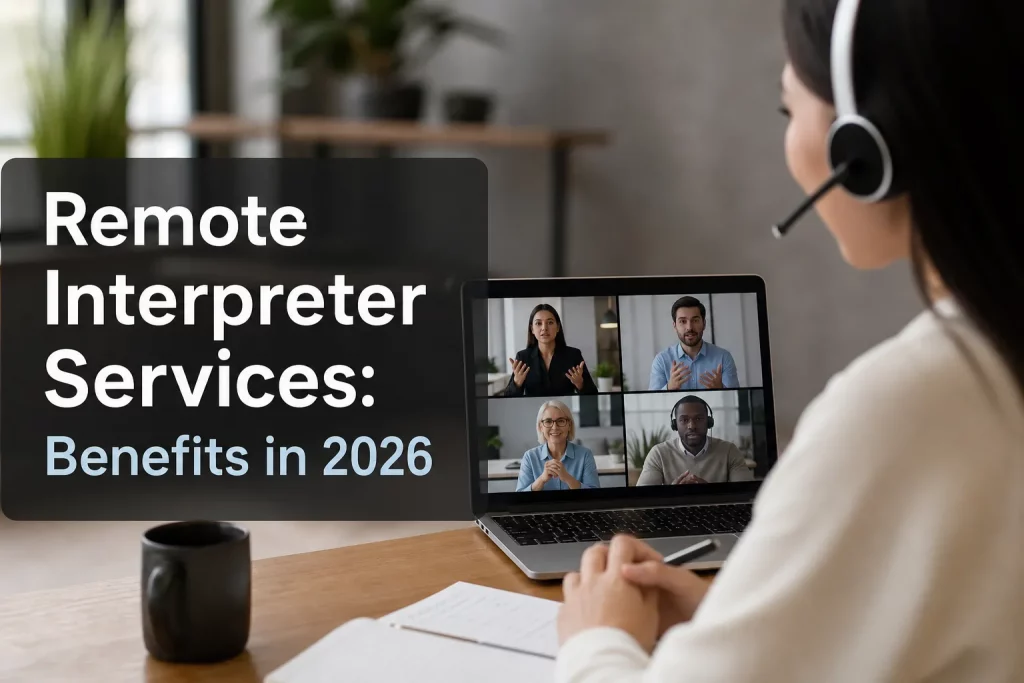
Remote Interpreter Services: Benefits in 2026
If you organize events, run multilingual meetings, support customers across regions, or need to make live content accessible, remote interpreter services are no longer a “nice to have.” In 2026, they are a practical operating tool for speed, inclusion, compliance, and audience experience.
For event organizers, conference planners, corporate communications teams, churches, broadcast producers, and operations leaders, the challenge is familiar: people need to understand each other instantly, whether the interaction happens on a stage, in a Zoom meeting, at a trade show booth, in a webcast, or during a time-sensitive support call. The stakes are even higher when accessibility, legal exposure, audience satisfaction, or brand reputation are involved.
Remote interpreting solves that problem by bringing professional language support into live, virtual, and hybrid environments without the delays and cost structure of always sending someone onsite. It also works hand-in-hand with captioning, translation, subtitling, and technical event support – especially when the goal is not just communication, but communication that is inclusive, polished, and reliable.
What remote interpreter services actually mean in 2026
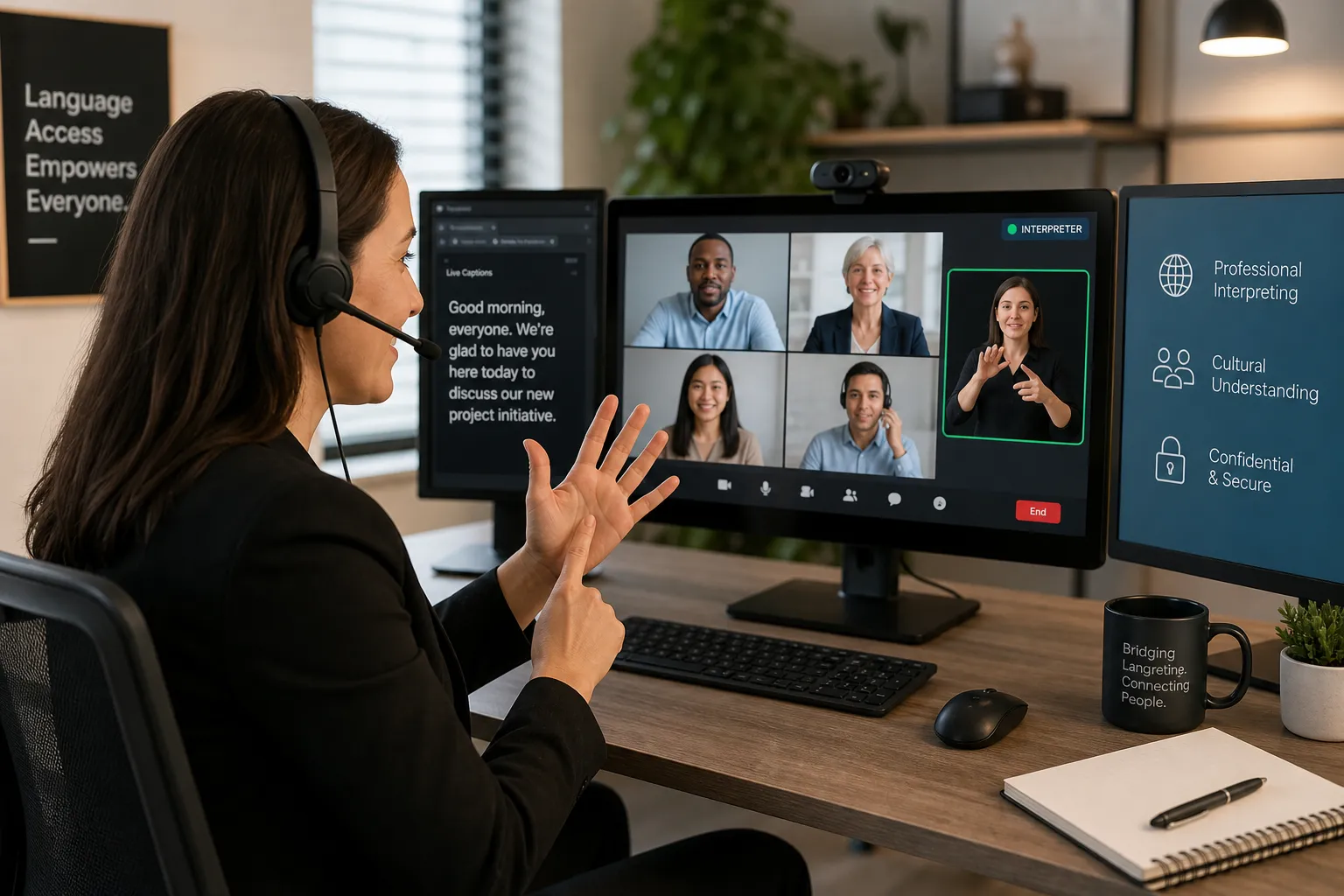
Remote interpreting is live spoken-language support delivered when the interpreter is not physically in the room with all participants. The interpreter joins by phone, video platform, webcast environment, or specialized interpreting system and renders the message in real time.
That sounds simple, but in practice, modern remote interpreter services now cover several different use cases:
-
one-on-one conversations over video
-
multilingual board meetings
-
investor calls
-
virtual training sessions
-
hybrid conferences
-
telehealth and support interactions
-
live-streamed worship services
-
broadcast productions
-
trade show presentations
-
accessibility support for deaf and hard-of-hearing audiences when paired with live captioning or ASL services
The key shift in 2026 is that buyers are no longer just looking for “an interpreter.” They are looking for a complete communication workflow that fits their environment, audience, risk level, and production needs.
Why demand is growing so quickly
Competitor content tends to focus on convenience and cost savings. Those matter, but they are only part of the story. The bigger reason demand is rising is that organizations now operate in a permanently distributed, multilingual, accessibility-conscious world.
“The interpreting industry is estimated to be valued at USD 11.7 billion in 2024 and is expected to reach USD 17.1 billion by 2029.” – Nimdzi
“The global language services market is projected to reach approximately USD 64.99 billion by 2026.” – Mordor Intelligence
That growth is being driven by several forces at once:
Global teams are now normal
Internal meetings regularly include employees, vendors, and customers in multiple countries. Remote language access makes those interactions workable without requiring everyone to travel.
Accessibility expectations are higher
Audiences increasingly expect events and content to be understandable and inclusive. Interpreting alone may not be enough; many organizations now pair it with real-time captioning, CART, ASL, translated subtitles, or multilingual stream delivery.
Virtual and hybrid events are permanent
Even when in-person events returned, hybrid formats stayed. That created demand for flexible interpreting workflows that can support both the room and the remote audience simultaneously.
Compliance matters more
Healthcare, education, government, public-facing organizations, and many enterprises must think seriously about equitable communication, documentation, privacy, and accessibility obligations.
Speed matters
Many conversations are unscheduled or time-sensitive. Waiting days for onsite language support often is not realistic.
The main types of remote interpreting
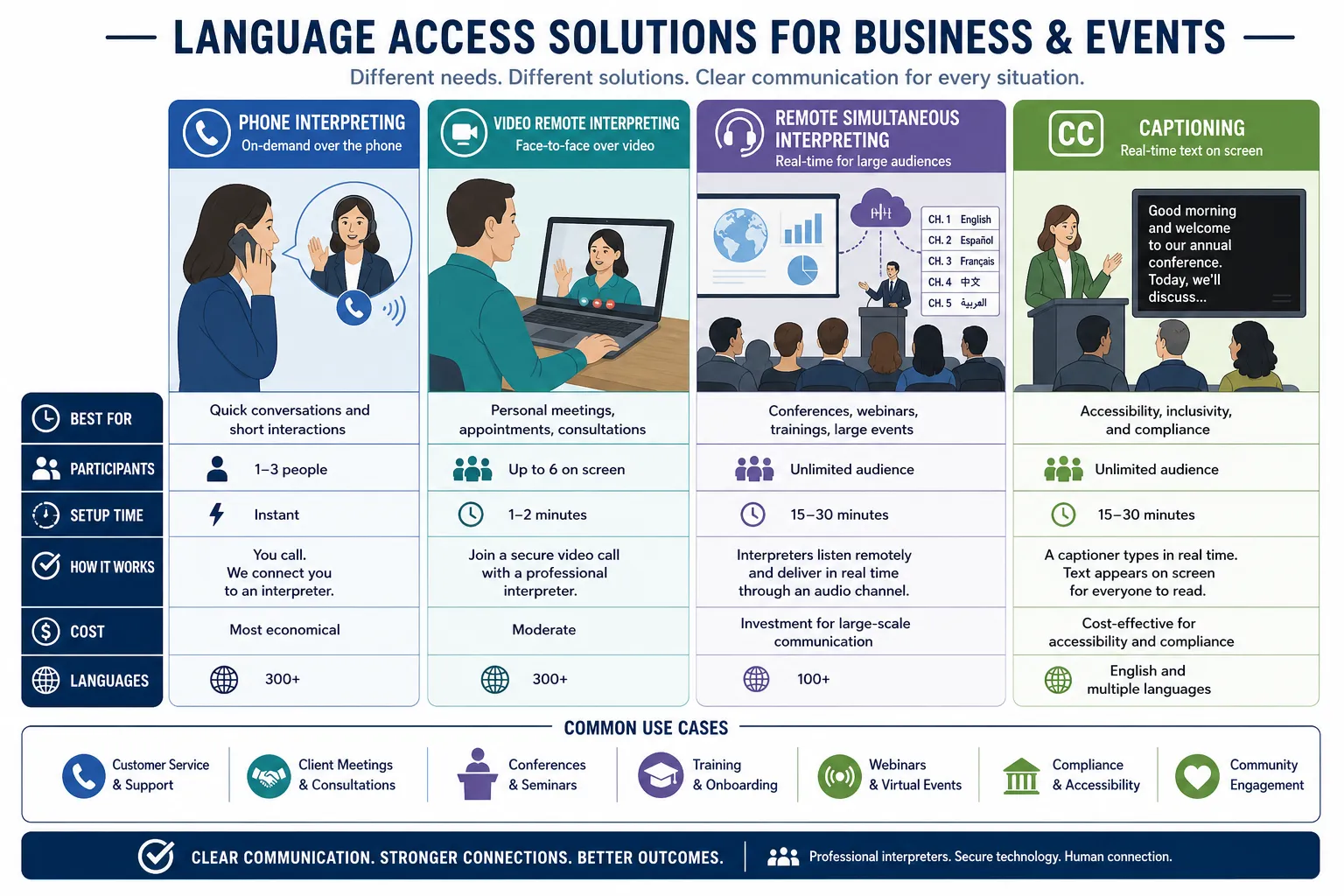
Not every setting needs the same approach. One of the biggest content gaps in competitor articles is that they describe formats broadly but do not help readers choose the right model. Here is the practical breakdown.
Video remote interpreting
Video remote interpreting, or VRI, uses a live video connection so participants and the interpreter can see one another.
Best for:
-
meetings where body language matters
-
HR conversations
-
healthcare and support settings
-
legal consultations
-
ASL delivery
-
customer interactions where visual context improves accuracy
Advantages:
-
preserves nonverbal cues
-
better rapport than audio-only
-
useful for accessibility and nuanced communication
Limitations:
-
depends on strong internet and camera setup
-
not ideal if users lack privacy or device access
Over-the-phone interpreting
Phone interpreting uses audio only.
Best for:
-
quick support calls
-
short conversations
-
call centers
-
urgent issue resolution
-
situations where video is unnecessary
Advantages:
-
fast to deploy
-
low technical burden
-
cost-efficient for high-volume usage
Limitations:
-
no visual cues
-
weaker fit for complex or sensitive conversations
Remote simultaneous interpreting
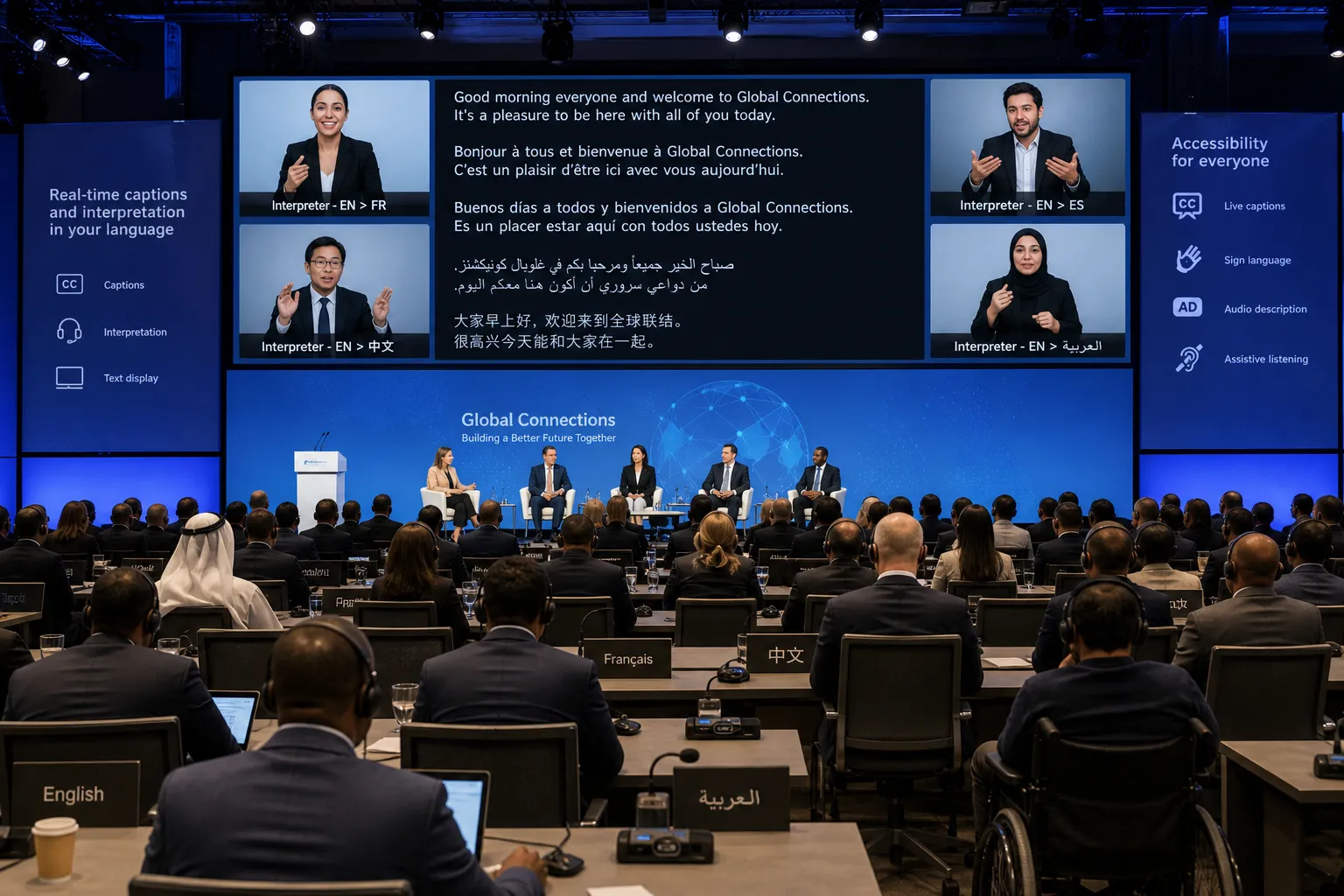
In remote simultaneous interpreting, the interpreter speaks almost at the same time as the original speaker with minimal delay.
Best for:
-
conferences
-
keynote sessions
-
webinars
-
multinational corporate announcements
-
live broadcasts
-
multilingual audiences that need uninterrupted flow
Advantages:
-
keeps presentations moving
-
ideal for large audiences
-
professional event feel
Limitations:
-
requires stronger technical planning
-
best when supported by experienced interpreters and event technicians
Remote consecutive interpreting
In remote consecutive interpreting, the speaker pauses and the interpreter relays the message in segments.
Best for:
-
interviews
-
legal meetings
-
executive conversations
-
training sessions
-
small group discussions
Advantages:
-
highly controlled
-
easier for detailed exchanges
-
often more practical in smaller meetings
Limitations:
-
takes longer
-
not ideal for fast-paced stage presentations
Where remote interpreters fit today
A remote interpreter is now part of a wider communications ecosystem. The role goes far beyond translating words. In real-time settings, interpreters help preserve meaning, tone, pace, and context while enabling participation.
Corporate meetings and internal communications
Organizations use remote interpreter services for:
-
executive town halls
-
compliance training
-
multilingual onboarding
-
labor and workforce communication
-
investor and stakeholder updates
-
cross-border team collaboration
This is especially useful when companies want to avoid creating separate sessions by language.
Conferences, trade shows, and live events
This is one of the fastest-growing categories. Remote interpreting supports:
-
keynote sessions
-
breakout rooms
-
expo-floor presentations
-
multilingual live streams
-
sponsor activations
-
hybrid attendee experiences
For these settings, interpreting often works best as part of an end-to-end event language plan that also includes live captioning, audio routing, equipment rental, receiver distribution, technician support, and stream integration.
Broadcasts, churches, and live media
Remote interpreters can support:
-
worship services
-
online sermons
-
multilingual ministry content
-
live broadcasts
-
webcasts
-
community outreach programming
When paired with captioning and subtitling, organizations can extend accessibility and reach across both live and on-demand content.
Healthcare, legal, and public-facing services
These environments rely on remote support when:
-
speed is critical
-
participants are in different locations
-
specialist interpreters are needed
-
equitable communication is required
In higher-risk settings, quality, confidentiality, and subject-matter familiarity matter much more than simply finding anyone bilingual.
The biggest benefits of remote interpreter services in 2026
Faster access to language support
This is still the most obvious benefit. You can bring in language support quickly without dealing with travel, venue access, parking, or local availability constraints.
For organizations running recurring meetings or events, this means less friction and more predictable delivery.
Wider language coverage
Remote delivery expands access to interpreters beyond your local market. That matters when you need:
-
less common languages
-
regional variants
-
subject-matter specialists
-
simultaneous interpreters for large events
-
ASL or multilingual accessibility support
Better budget control
Remote services often reduce or eliminate:
-
travel costs
-
hotel costs
-
minimum onsite booking blocks
-
venue logistics
-
last-minute transportation problems
That does not always mean “cheap,” but it does usually mean more efficient.
More flexibility across formats
A major advantage in 2026 is that the same organization may need support across:
-
in-person meetings
-
Zoom webinars
-
Teams calls
-
hybrid conferences
-
live streams
-
on-demand video workflows
A remote-first solution makes it easier to scale across all of them.
Improved accessibility
This is the benefit many competitor articles underplay. Remote interpreting is often part of a broader accessibility strategy. If your audience includes multilingual participants, deaf or hard-of-hearing attendees, or global viewers watching from different environments, communication needs vary.
That is where a partner like Team Stream becomes especially valuable. Rather than treating interpreting as a standalone item, Team Stream supports inclusive communication through a coordinated mix of professional interpreting, live captioning, closed captioning, subtitling, voiceover, and translation – backed by the technical know-how to make those services work in real event conditions.
Stronger audience experience
When people can follow content in their preferred language, they stay engaged longer, ask better questions, and are more likely to trust the organization delivering the message.
That matters in sales, training, worship, education, live events, and public communications alike.
Easier scaling for recurring programs
If you host monthly webinars, quarterly town halls, or ongoing multilingual broadcasts, remote delivery is easier to standardize than assembling a new onsite team every time.
What competitors often miss: interpreting is only half the workflow
Most top-ranking articles explain types, benefits, and vendor options. What they often miss is that successful delivery depends on what happens around the interpreter.
A remote interpreting solution works best when you plan for:
-
platform compatibility
-
audio routing
-
presenter pacing
-
backup channels
-
captioning and accessibility needs
-
multilingual audience instructions
-
technician support
-
post-event subtitling or translated media versions
This is especially important for live, virtual, and hybrid events. The language service is not separate from production. It is part of production.
That is why Team Stream’s model stands out. Instead of offering isolated services, Team Stream can combine accurate human and AI-powered translation and interpreting with real-time captioning, subtitling, equipment rental, technician support, and flexible remote or in-person delivery. For buyers, that means fewer vendors, fewer handoff issues, and more reliable execution.
Remote interpreting vs onsite interpreting
Both matter. The best choice depends on the communication environment.
|
Factor |
Remote Interpreting |
Onsite Interpreting |
|---|---|---|
|
Speed to deploy |
High |
Lower |
|
Travel costs |
Minimal or none |
Higher |
|
Best for distributed participants |
Excellent |
Limited |
|
Best for large in-room dynamics |
Good with planning |
Excellent |
|
Visual/contextual depth |
Good in video settings |
Excellent |
|
Technical dependency |
Higher |
Lower |
|
Scalability across languages |
High |
Moderate |
|
Accessibility add-ons |
Easy to integrate |
Also possible, but more logistics |
In practice, many organizations now use a blended model. They may use onsite interpreting for flagship moments and remote interpreter services for pre-event meetings, regional sessions, overflow languages, virtual attendees, or ongoing support needs.
How to choose the right remote interpreting setup
Start with the communication goal
Ask:
-
Is this a one-to-one conversation or one-to-many presentation?
-
Is the goal speed, nuance, compliance, reach, or accessibility?
-
Will participants speak back, or only listen?
Choose the right mode
A quick rule of thumb:
-
choose phone for short, urgent, straightforward interactions
-
choose video when visual context matters
-
choose simultaneous for conferences and presentations
-
choose consecutive for small, detailed discussions
Evaluate risk level
High-stakes conversations need:
-
qualified interpreters
-
subject-matter familiarity
-
confidentiality awareness
-
a stable technical environment
-
backup plans
Think beyond language
If the audience experience matters, also consider:
-
live captions
-
translated slides
-
subtitled replay assets
-
multilingual stream access
-
ADA-conscious delivery
-
accessibility and inclusion goals
Do not ignore production realities
For events and broadcasts, poor audio ruins interpretation. So do bad handoffs, missing prep materials, and platforms that were never configured for multilingual delivery.
This is another area where Team Stream provides tangible value: support does not stop at the interpreter booking. With more than 25 years of experience, the team helps clients align language access with production flow, accessibility planning, technician support, and equipment needs so the audience experience holds together from start to finish.
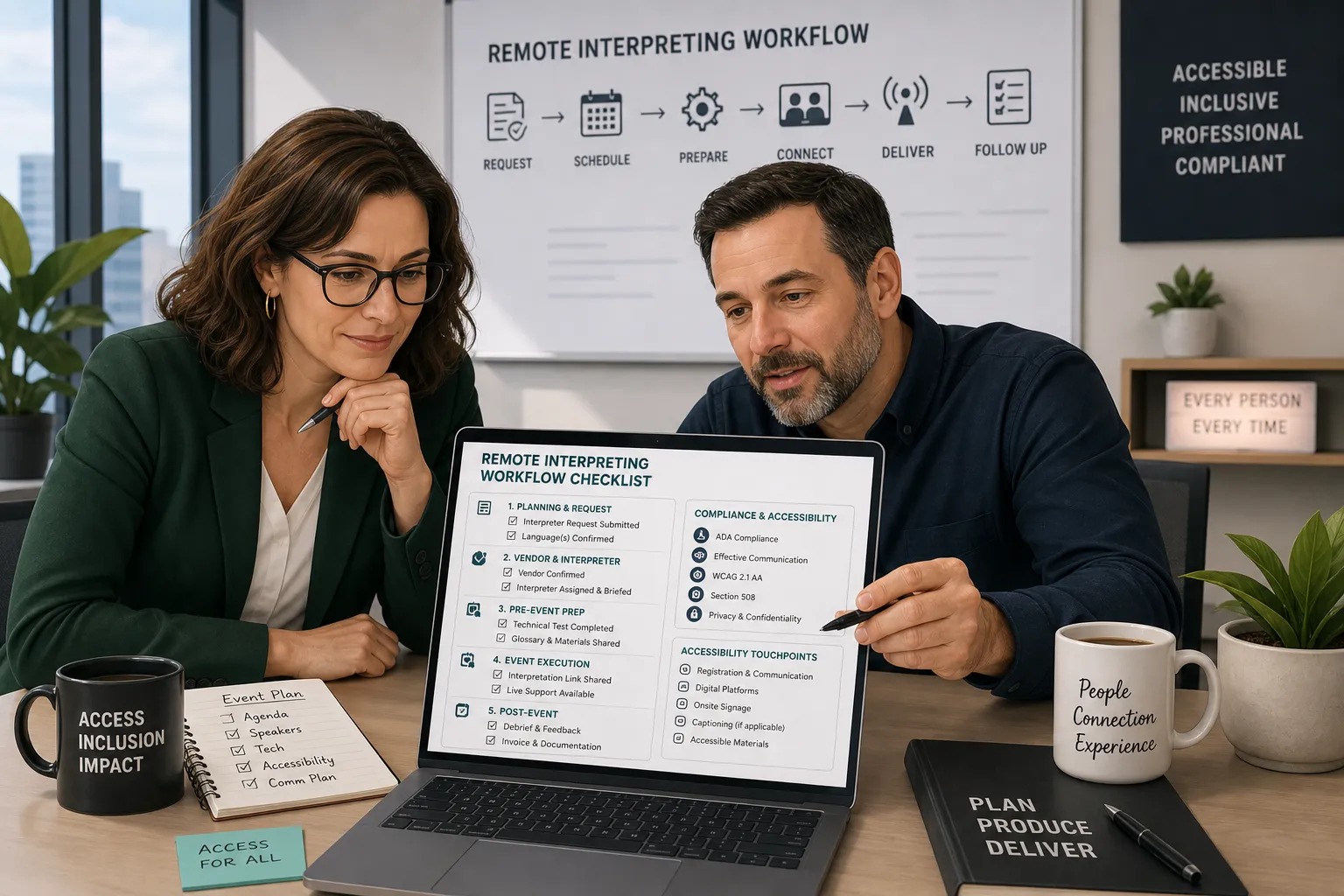
A practical planning checklist for event teams
Before booking, answer these questions:
|
Planning Question |
Why It Matters |
|---|---|
|
How many languages are needed? |
Determines interpreter count and technical routing |
|
Is the event live, virtual, or hybrid? |
Changes delivery model and equipment needs |
|
Will attendees ask questions? |
Affects interpreting mode and moderation flow |
|
Do you need captions too? |
Supports accessibility and comprehension |
|
Are there compliance or inclusion requirements? |
Impacts service design and documentation |
|
Which platforms are being used? |
Determines integration and testing needs |
|
Will recordings be reused later? |
Opens the door for subtitles, voiceover, and translation |
|
Is there onsite AV support? |
Essential for smooth multilingual delivery |
What about AI and human interpreters?
This is one of the most important 2026 questions.
AI-powered language tools are improving quickly. They can be helpful for:
-
fast multilingual support in lower-risk settings
-
rough comprehension
-
certain live translation workflows
-
multilingual content expansion at scale
But they are not a universal replacement for human interpreters.
Human professionals still matter when you need:
-
nuance
-
cultural judgment
-
speaker intent
-
confidentiality handling
-
technical terminology
-
live audience management
-
polished delivery under pressure
The smartest organizations are not choosing between human and AI in absolute terms. They are choosing the right blend. Team Stream’s approach reflects that reality: use accurate human expertise where precision and experience matter most, and layer in AI-powered tools where they improve efficiency, reach, or turnaround without compromising quality.
Understanding remote interpreter jobs and career interest
Because many readers are also curious about remote interpreter jobs, it is worth clarifying how the profession is evolving.
A remote interpreter today may work in:
-
healthcare
-
legal settings
-
business services
-
conference interpreting
-
media and broadcasting
-
nonprofit and faith-based communication
-
education and government support
The strongest opportunities tend to go to interpreters who bring more than bilingual fluency. In-demand professionals usually have:
-
formal interpreting training
-
specialization in a field
-
platform confidence
-
strong listening and memory skills
-
ethical discipline
-
ability to perform in live, high-pressure environments
For employers and buyers, this is an important reminder: being bilingual is not the same as being qualified to interpret professionally.
Common mistakes to avoid
Treating all remote interpreting as interchangeable
A town hall, deposition, worship service, and product launch do not have the same needs.
Waiting too long to plan
Even remote delivery benefits from prep time, especially for specialized languages, scripts, glossaries, and accessibility coordination.
Ignoring audio quality
If the interpreter cannot hear clearly, the audience will not understand clearly.
Forgetting accessibility
Interpreting and captioning often need to be planned together, not as separate afterthoughts.
Buying only on price
The cheapest option can become the most expensive if the experience fails, the audience disengages, or the event has to be fixed later.
Why Team Stream is a strong partner for remote interpreter services
Organizations do not just need a vendor. They need a partner that understands live communication in the real world.
Team Stream brings together the pieces that many providers separate:
-
accurate human and AI-powered translation and interpreting
-
real-time captioning for accessibility and engagement
-
live captioning, closed captioning, subtitling, and voiceover
-
end-to-end language and accessibility solutions tailored to each client
-
support for live, virtual, and hybrid events
-
compliance-friendly services for inclusive communication
-
equipment rental and technician support
-
in-person and remote delivery options
-
more than 25 years of experience
-
responsive service and reliable execution
That combination is especially useful for event teams, conference planners, internal communications leaders, churches, and businesses that want one experienced partner who can manage both the language side and the practical delivery side.
Final takeaway
Remote interpreter services in 2026 are not just about convenience. They are about making communication work across languages, locations, formats, and accessibility needs.
When done well, remote interpreting helps organizations:
-
move faster
-
include more people
-
reduce friction
-
improve audience outcomes
-
support compliance
-
extend the value of live and recorded content
If your organization is running multilingual meetings, hybrid events, training programs, broadcasts, or public-facing communications, the best next step is to choose a partner that can support the full communication experience – not just one isolated piece of it.
Team Stream is built for exactly that. With experienced interpreters, captioning and translation expertise, accessibility-first thinking, technical event support, and flexible human-plus-AI delivery, Team Stream helps you communicate clearly and inclusively wherever your audience is.
FAQ
Will interpreters be needed in the future?
Yes. As global business, hybrid events, healthcare access, and multilingual communication continue to expand, professional interpreters will remain essential. AI can assist in some settings, but high-stakes, nuanced, and accessibility-sensitive interactions still require skilled human interpreters.
How much do remote translators get paid?
Pay varies widely based on language pair, specialization, certifications, and whether the work is freelance or salaried. In general, specialized remote language professionals in legal, medical, technical, or conference settings tend to earn more than generalists.
Which type of interpreter makes the most money?
Conference interpreters and highly specialized legal or medical interpreters often command the highest rates, especially for simultaneous interpreting and complex live events. Earnings usually rise with expertise, rarity of language pair, and the stakes of the assignment.
Will AI take over interpreter jobs?
Not completely. AI will continue to support lower-risk and high-volume language workflows, but human interpreters remain critical for nuance, confidentiality, audience interaction, cultural context, and polished live delivery.
What type of interpreter makes the most money?
Usually, the highest earners are simultaneous conference interpreters and interpreters with deep specialization in law, medicine, or executive communications. Rates also increase when assignments require rare languages, advanced preparation, or event-grade performance.
