

Telephone Interpreter Services for Clear Calls
When a conversation has to be accurate, immediate, and easy to access, a telephone interpreter can be the fastest way to remove language barriers. Whether you are supporting a client call, coordinating a live event, handling a time-sensitive business issue, or making services accessible to multilingual audiences, the right telephone interpreter service helps everyone stay informed and confident.
For event organizers, conference teams, corporate communicators, churches, broadcasters, and operations leaders, the challenge is rarely just “translation.” It is making sure communication stays clear under pressure, works across live and remote environments, and supports accessibility and compliance without slowing everything down. That is exactly where professional phone interpreter services fit.
At Team Stream, we see telephone interpreting as part of a bigger language access strategy. A phone call interpreter may be the right answer for a quick one-on-one conversation, but in many organizations it also connects to broader needs like live interpreting, captioning, subtitling, accessibility support, technician-managed event workflows, and hybrid communication planning. With more than 25 years of experience, Team Stream helps clients choose the right mix of human expertise and AI-powered efficiency for every setting.
What Is a Telephone Interpreter?
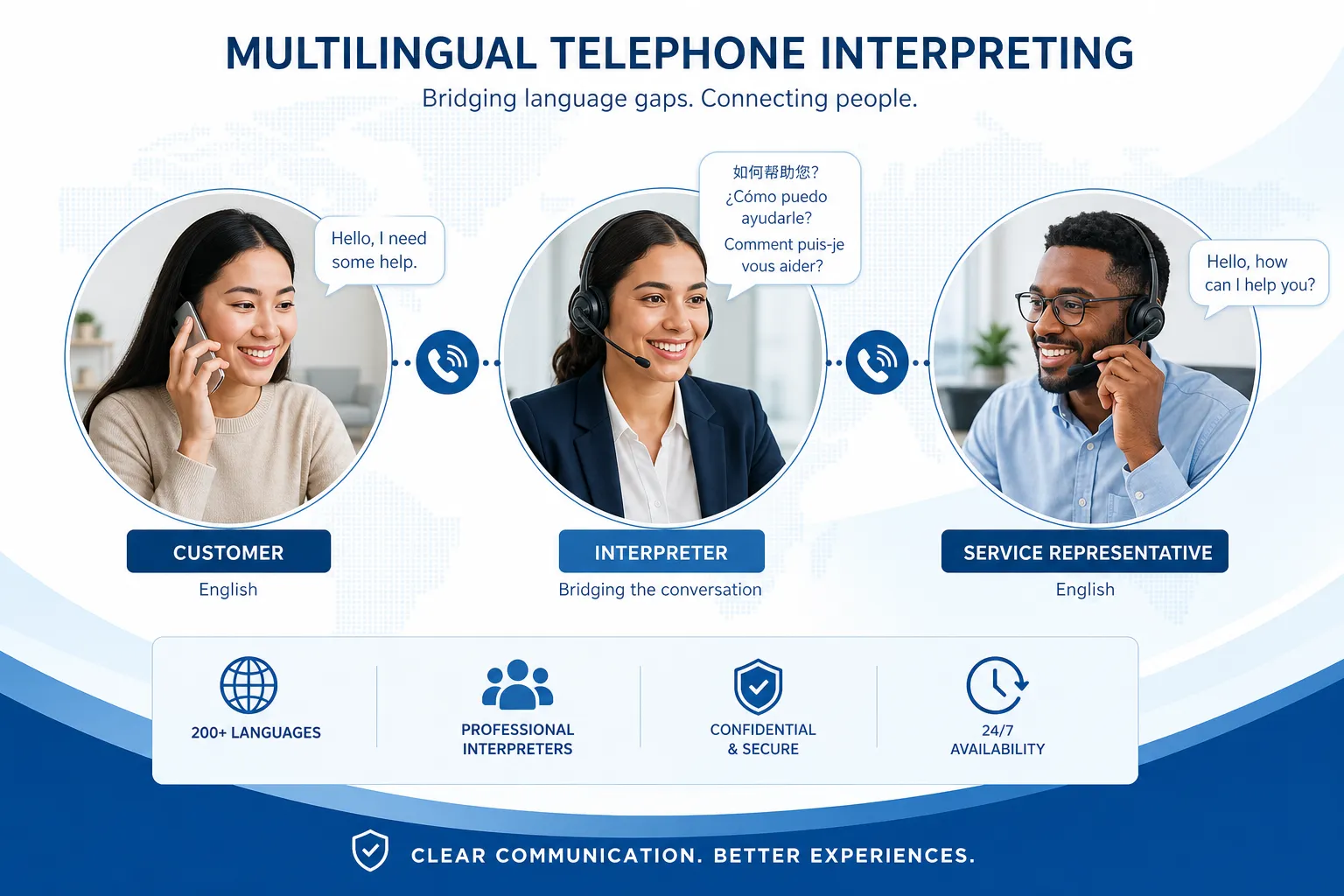
A telephone interpreter is a trained language professional who interprets spoken communication over an audio call between two or more people who do not share the same language.
Unlike written translation, telephone interpreting happens in real time. The interpreter listens to one speaker, renders the message accurately into the other language, and continues back and forth throughout the conversation. This can happen on a simple three-way call or through a larger call routing system used by businesses, government agencies, healthcare providers, contact centers, and event support teams.
Telephone Interpreting vs. Translation
These terms are often confused, but they are not the same:
|
Service |
Purpose |
Format |
Best For |
|---|---|---|---|
|
Telephone interpreting |
Real-time spoken communication |
Audio call |
Calls, urgent conversations, service support |
|
Video interpreting |
Real-time spoken communication with visual cues |
Video call |
Sign language, visual context, sensitive interactions |
|
Written translation |
Converting text from one language to another |
Documents, files, websites |
Forms, handouts, contracts, marketing copy |
|
Captioning/subtitling |
Text display for spoken content |
Live or recorded media |
Accessibility, engagement, compliance |
A strong provider should help you decide which solution fits the moment instead of pushing one format for every need.
How Telephone Interpreting Works
Most professional services follow a straightforward process. The exact workflow varies by provider, but the goal is always the same: connect people quickly and keep the conversation accurate.
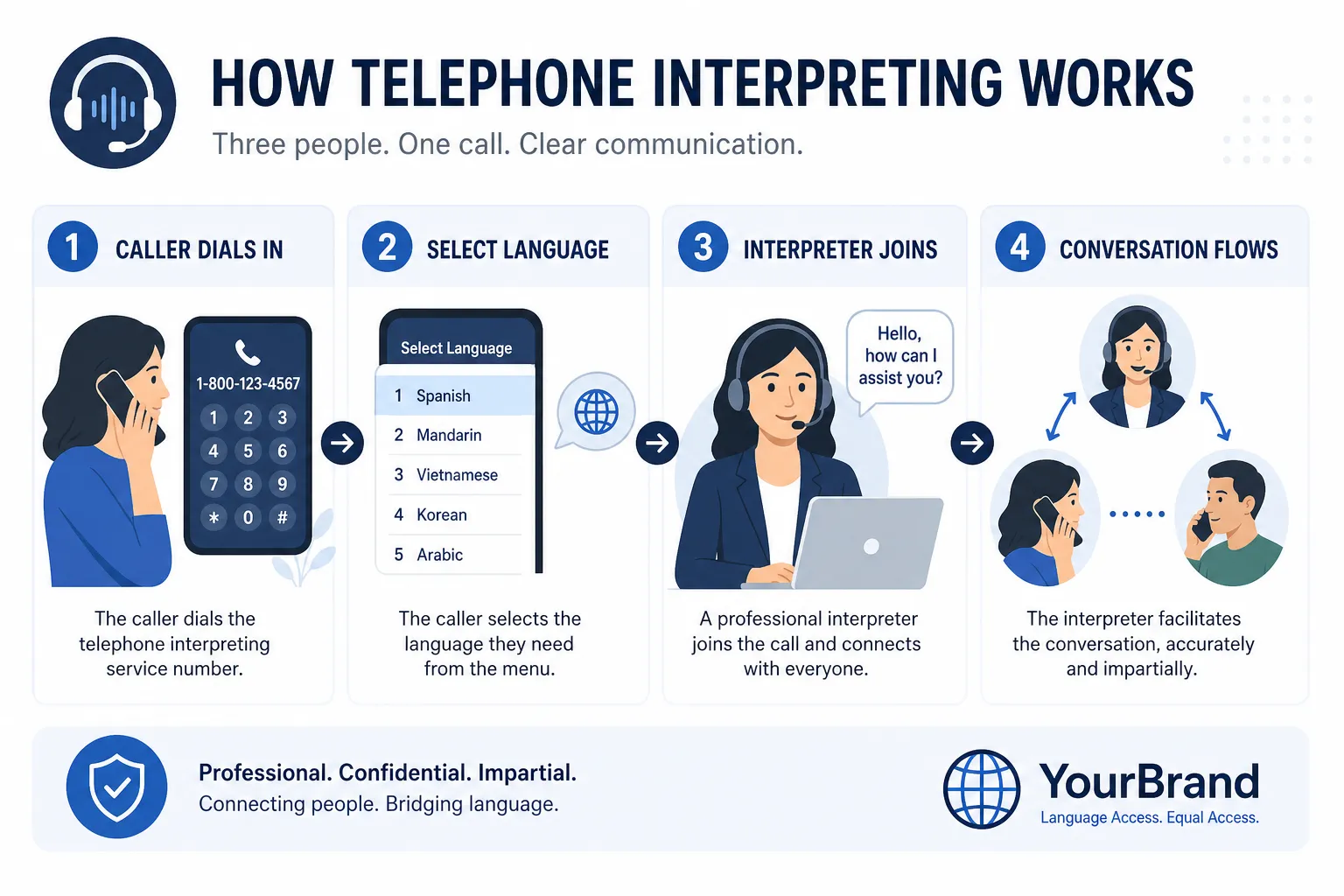
Step 1: Start the Call
A staff member, event coordinator, producer, support agent, or team lead dials into the service or uses a platform-integrated connection method.
Step 2: Request the Language
You specify the needed language and, in some cases, the subject matter or context. Some services also support gender preferences for sensitive calls.
Step 3: Connect With the Interpreter
The provider locates an available interpreter and bridges them into the conversation. In a high-performing setup, this happens in seconds for common languages and quickly for less common ones as well.
Step 4: Facilitate the Conversation
The interpreter enables communication between all parties, accurately relaying meaning, tone, and intent while remaining impartial and confidential.
Why Organizations Use Phone Interpreter Services
Telephone interpreting solves a practical problem: people need to communicate now, not after an onsite interpreter can be scheduled.
That immediacy matters across industries, but especially in environments where a delay can create confusion, risk, exclusion, or lost opportunities.
“Approximately 8.6% of the U.S. population aged 5 and older speak English less than ‘very well.'” – U.S. Census Bureau
That number is a reminder that multilingual communication is not a rare edge case. It is a daily operational reality for many organizations.
Key Benefits of Telephone Interpreting
Fast access
A telephone interpreter service is ideal when you need support immediately rather than scheduling days in advance.
Lower operational friction
No travel, room setup, or specialized onsite logistics are required for standard audio conversations.
Broad language coverage
Professional providers often support hundreds of languages, including many lower-incidence languages.
Flexibility across settings
Phone interpreter services work for inbound calls, outbound calls, internal discussions, remote support, and distributed teams.
Budget efficiency
For short, high-frequency, or unpredictable interactions, telephone interpreting can be more cost-effective than onsite support.
Better accessibility and inclusion
It helps organizations serve multilingual participants, customers, members, and stakeholders more equitably.
When a Telephone Interpreter Is the Best Choice
Not every conversation needs video or onsite support. In many cases, an audio-only solution is the smartest option.
Best-fit scenarios
-
Short service calls
-
Customer support and contact center interactions
-
Billing and scheduling conversations
-
Internal operational calls across regions
-
Event logistics calls with multilingual vendors or attendees
-
Church or ministry follow-up calls
-
Broadcast coordination calls
-
Urgent problem-solving when speed matters more than visual context
When to consider another option instead
Telephone interpreting may not be the best fit when:
-
Visual cues are essential
-
Sign language support is required
-
The setting is highly emotional or complex and benefits from face-to-face rapport
-
Multiple speakers are talking at once in a large live environment
-
You also need audience-facing accessibility tools like captions or projected interpretation feeds
In those cases, Team Stream often recommends a broader solution that may include video interpreting, live captioning, multilingual event audio, subtitling, or onsite technical support.
Common Use Cases Across Industries
Competitor content often focuses on healthcare, government, or legal settings. Those are important, but they are not the whole story. Today, phone call interpreter support is also valuable in event operations, corporate communications, ministry outreach, media production, and hybrid audience experiences.
Corporate teams
Corporate teams use telephone interpreting for HR calls, employee relations, customer support, vendor conversations, internal escalations, and multilingual stakeholder communication.
Conferences and live events
Event teams may use a phone interpreter before, during, or after an event for speaker coordination, exhibitor communication, registration support, and attendee assistance. For the event itself, that telephone support can expand into live multilingual interpreting, captioning, and equipment-backed accessibility services.
Churches and ministries
Faith-based organizations often need language access for pastoral care calls, member outreach, volunteer coordination, and community services. Audio interpreting can be a fast, low-barrier solution.
Broadcast and production teams
Broadcast environments move quickly. Producers, crews, contributors, and guests may need immediate language support during planning, rehearsals, or live issue resolution.
Healthcare and regulated services
Phone interpreter services remain a vital option for appointment scheduling, follow-up calls, care coordination, benefits communication, and non-visual patient interactions.
Government and public service
Agencies use telephone interpreting to improve public access, reduce misunderstandings, and support compliance obligations.
Compliance, Risk, and Why Professional Interpreters Matter
Using bilingual staff who are not trained interpreters may seem convenient, but it can create real risks: omissions, misunderstandings, confidentiality issues, and inconsistent terminology.
“Covered entities must provide free language assistance services, such as oral interpretation and written translation, to ensure effective communication with LEP individuals.” – HHS Office for Civil Rights
Even outside highly regulated industries, the principle is the same: if the message matters, the interpreter should be qualified.
What professional interpreting helps protect
-
Accuracy in high-stakes conversations
-
Participant trust and confidence
-
Privacy and confidentiality
-
Consistent terminology
-
Brand reputation
-
Accessibility and inclusion goals
-
Documentation of responsible language access practices
For many Team Stream clients, this matters beyond legal compliance. It is part of delivering a professional, welcoming experience.
What Competitors Usually Miss
After reviewing leading pages in this space, several patterns stand out. Most emphasize 24/7 availability, number of languages, and quick connections. Those are important, but they leave out several factors buyers actually need to evaluate.
1. The difference between language access and communication design
A provider may offer a phone interpreter, but your organization may need a full communication workflow that includes live captions, subtitling, multilingual production support, or technician-managed delivery.
2. The importance of channel fit
Telephone interpreting is excellent for audio-first situations, but the best partner will tell you when video, onsite interpreting, or captioning is the better choice.
3. Accessibility beyond language alone
Many teams need inclusive communication not just for multilingual audiences, but also for deaf and hard-of-hearing participants, mixed in-person/virtual audiences, and recorded content reuse.
4. Event-readiness
Most telephone interpreting pages are written for healthcare or customer service. Few address the needs of conference planners, trade show producers, churches, and live event teams that require synchronized support across calls, stages, streams, and attendee touchpoints.
5. Human expertise plus AI support
The market increasingly includes AI-powered tools, but not every interaction should be automated. The real value is knowing when AI can speed up workflows and when human interpreters are essential for nuance, trust, and accuracy.
How to Choose a Reliable Telephone Interpreter Service
A good provider connects calls. A great provider protects communication outcomes.
Questions to ask before you choose
|
What to Evaluate |
Why It Matters |
|---|---|
|
Interpreter qualifications |
Ensures language proficiency, professionalism, and subject familiarity |
|
Speed to connect |
Critical for urgent or high-volume communication |
|
Language coverage |
Important for both common and less common languages |
|
Confidentiality standards |
Protects sensitive business, event, or personal information |
|
Industry familiarity |
Reduces terminology mistakes and awkward misunderstandings |
|
Accessibility capabilities |
Helps if your needs expand beyond audio interpreting |
|
Delivery flexibility |
Supports phone, remote, hybrid, and onsite communication models |
|
Customer support responsiveness |
Essential when something changes fast |
Green flags in a provider
-
Clear onboarding
-
Real human support when needed
-
Transparent pricing
-
Practical recommendations, not one-size-fits-all packages
-
Ability to scale for live, virtual, and hybrid environments
-
Strong service culture and follow-through
Red flags to watch for
-
Vague interpreter screening standards
-
No discussion of confidentiality or compliance
-
No solution beyond a basic phone line
-
Overpromising AI without clear quality controls
-
Limited support when needs become more complex
Best Practices for Better Telephone Interpreting Calls
Even the best interpreter performs better when the call itself is well managed.
Before the call
-
Know the purpose of the conversation
-
Identify the correct language, and dialect if relevant
-
Gather any names, reference numbers, or key details
-
Brief the interpreter if the topic is specialized
During the call
-
Speak in short, complete thoughts
-
Avoid interrupting
-
Use plain language where possible
-
Pause regularly for interpretation
-
Address the other person directly, not the interpreter
After the call
-
Confirm next steps
-
Note any follow-up language needs
-
Evaluate whether future conversations would benefit from video, captions, or written translation
Telephone Interpreting vs. Other Language Access Solutions
The smartest language strategy is often a mix of services.
|
Need |
Best Option |
|---|---|
|
Fast audio-only support |
Telephone interpreting |
|
Conversations needing visual cues |
Video remote interpreting |
|
Large live multilingual audience |
Live interpreters with event audio support |
|
Accessibility for deaf or hard-of-hearing attendees |
Live captioning or CART |
|
Recorded multilingual content |
Subtitling, voiceover, translation |
|
Written handouts, signage, or forms |
Document translation |
This is where Team Stream offers an advantage. Rather than isolating one service, we help clients create end-to-end language and accessibility solutions tailored to the real communication environment. That can include accurate human and AI-powered translation and interpreting, real-time captioning for engagement and compliance, multilingual production support, remote and in-person delivery, equipment rental, and technician support for seamless execution.
Where Team Stream Fits In
If you only need a simple phone interpreter, the baseline requirement is accuracy and speed. But many organizations need more than that over time.
Team Stream supports clients who want communication that is:
-
Multilingual
-
Accessible
-
Reliable under live conditions
-
Flexible across virtual, hybrid, and in-person environments
-
Managed by experienced professionals
-
Backed by strong customer service
What makes Team Stream different
Human expertise with smart AI support
We help clients use AI where it improves speed and scale, while keeping professional human interpreters and language specialists in the loop where precision matters most.
Accessibility built in
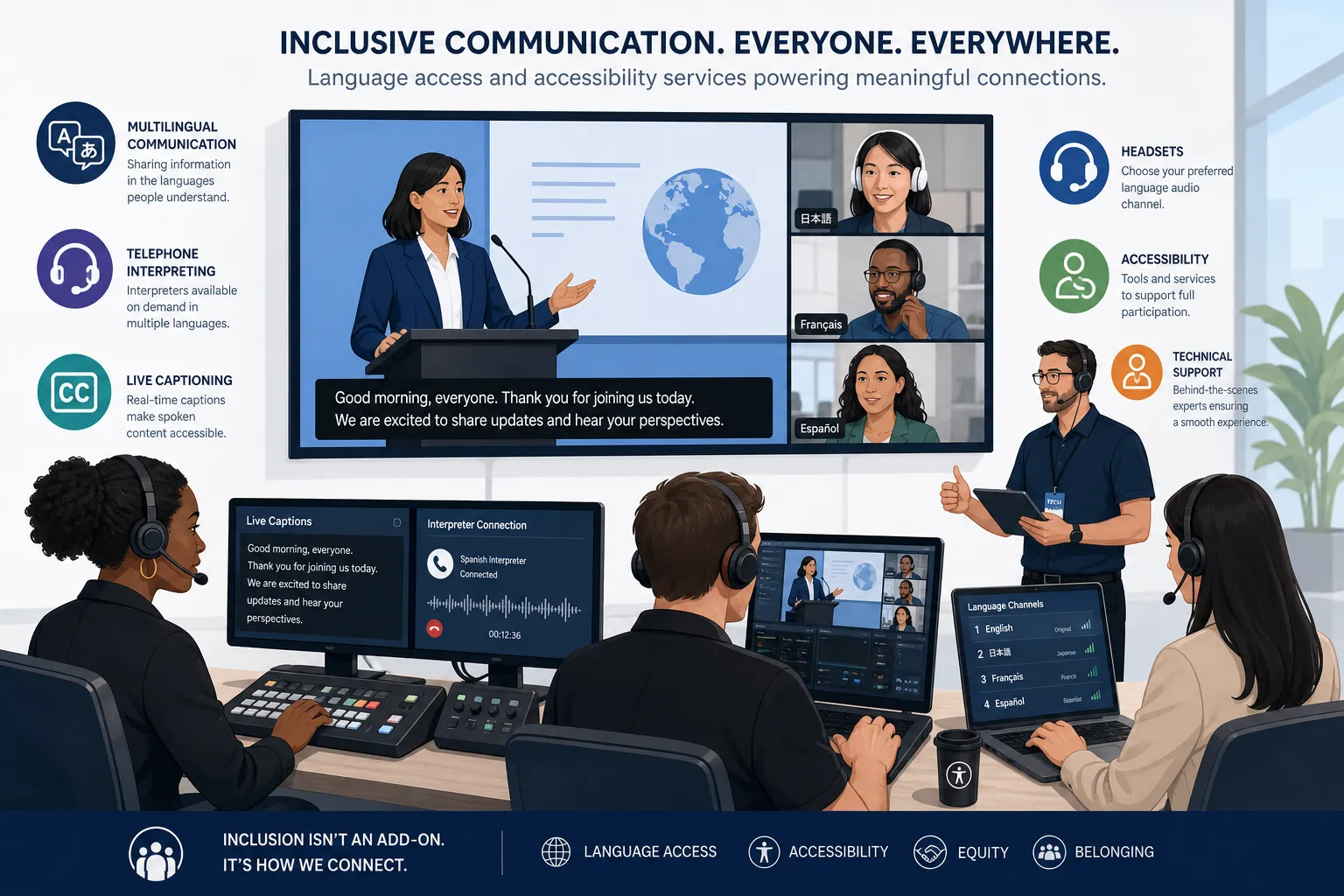
Telephone interpreting is only one part of inclusive communication. Team Stream also delivers real-time captioning, closed captioning, subtitling, voiceover, and accessibility-friendly support for meetings, events, broadcasts, and media.
Event and production capability
For conferences, trade shows, hybrid events, and church or corporate productions, we can support not just language delivery but the technical environment around it, including equipment rental and technician services.
Flexible service delivery
Some clients need remote support. Others need onsite execution. Many need both. Team Stream is built for that flexibility.
Experience you can trust
With over 25 years of expertise, we understand how to execute high-quality language access solutions without creating extra stress for your team.
Final Thoughts
A telephone interpreter service is one of the most practical ways to create clear communication fast. It is ideal for urgent calls, routine service interactions, multilingual operations, and many moments where speed and simplicity matter most.
But the best results come from choosing a provider that understands the bigger picture. If your needs touch events, broadcasts, accessibility, multilingual content, or compliance-sensitive communication, you need a partner that can do more than connect a line.
Team Stream helps organizations communicate clearly across languages, formats, and audience types. From telephone interpreting to live captioning, translation, subtitling, voiceover, accessibility support, and technician-backed event delivery, we bring together the tools and expertise needed to make communication work in the real world.
If you want a reliable partner for clear calls and inclusive communication at every level, Team Stream is ready to help.
FAQ
What is the best translation app for phone calls?
The best option depends on the level of accuracy and risk involved. For routine, low-stakes conversations, an app may help, but for important business, event, compliance, or client communication, a professional telephone interpreter service is usually the more reliable choice because it provides real-time human accuracy and better handling of nuance.
How to use a phone interpreter?
To use a phone interpreter, you typically dial the service, request the needed language, and connect the interpreter into the call. Once connected, speak in short, clear sentences, pause often, and address the other person directly so the interpreter can accurately relay the conversation.
