

Cantonese Translator for Business Growth
If your business is expanding into Hong Kong, serving Cantonese-speaking customers, producing multilingual video, or planning a live event with international audiences, hiring the right Cantonese translator can directly affect revenue, trust, compliance, and customer experience.
A professional Cantonese translator does far more than convert words from one language to another. They help your brand sound credible, culturally aware, and easy to understand across marketing, customer support, internal communications, events, and media. That matters because small errors in tone, terminology, or localization can weaken campaigns, confuse audiences, and create avoidable risk.
For event organizers, corporate teams, conference planners, churches, trade show producers, broadcasters, and communication leaders, the challenge is rarely just “getting a translation done.” The real challenge is choosing the right mix of human expertise, AI-enabled efficiency, accessibility support, and delivery format for the context.
At Team Stream, that is exactly where strategy matters. With more than 25 years of experience, Team Stream supports organizations with accurate human and AI-powered translation and interpreting, live captioning, subtitling, voiceover, technician support, equipment rental, and end-to-end multilingual and accessibility solutions for in-person, virtual, and hybrid environments.
Why Cantonese Matters for Business Expansion
Cantonese remains a critical language for organizations operating in or communicating with audiences connected to Hong Kong, Macau, Guangdong, and global diaspora communities. For many businesses, it is not enough to “translate into Chinese.” Audience expectations, written conventions, tone, and regional usage can differ significantly.
“According to Ethnologue 2025, there are approximately 86 million native Cantonese speakers globally.” – The Routledge Handbook of Cantonese Linguistics
That audience size alone makes Cantonese commercially important. But the real business case is stronger than reach. It is about relevance. When customers, attendees, employees, or stakeholders receive information in the language and style they naturally use, response rates, trust, and clarity improve.
“A 2020 survey by CSA Research found that 76% prefer to purchase products with information in their native language.” – CSA Research
For companies building relationships in Cantonese-speaking markets, language is not a finishing touch. It is part of the product, the experience, and the brand.
What a Professional Cantonese Translator Actually Does
A professional Cantonese translator works at the intersection of language accuracy, cultural fluency, business context, and audience intent. That includes much more than literal translation.

Core responsibilities include
-
Translating written content accurately and naturally
-
Preserving brand tone and intent
-
Adapting wording for local cultural expectations
-
Choosing correct terminology for legal, technical, medical, or corporate use
-
Aligning content with Traditional Chinese conventions when appropriate
-
Supporting multimedia content such as subtitles, scripts, and voiceover
-
Collaborating with interpreters, captioners, and production teams for live experiences
Translation vs interpretation
Businesses often use these terms interchangeably, but they solve different problems.
|
Service |
What it covers |
Best use cases |
|---|---|---|
|
Translation |
Written language conversion |
Websites, brochures, contracts, training materials, support docs |
|
Interpretation |
Spoken language conversion in real time |
Meetings, conferences, webinars, negotiations, interviews |
|
Captioning/Subtitling |
On-screen text for spoken content |
Live events, broadcasts, training videos, social video |
|
Localization |
Adapting content for a target market |
Marketing campaigns, product pages, UX copy, apps |
This distinction matters because many organizations do not just need a translator. They need a coordinated language access solution. That is where Team Stream offers an advantage: written translation, interpreting, captioning, subtitling, voiceover, and technical event support can all be managed as one integrated service.
When Businesses Need a Cantonese Translator
A business may need Cantonese language support long before it opens a new office or launches a regional campaign. In practice, demand often begins when communication starts to cross borders, departments, or audience types.
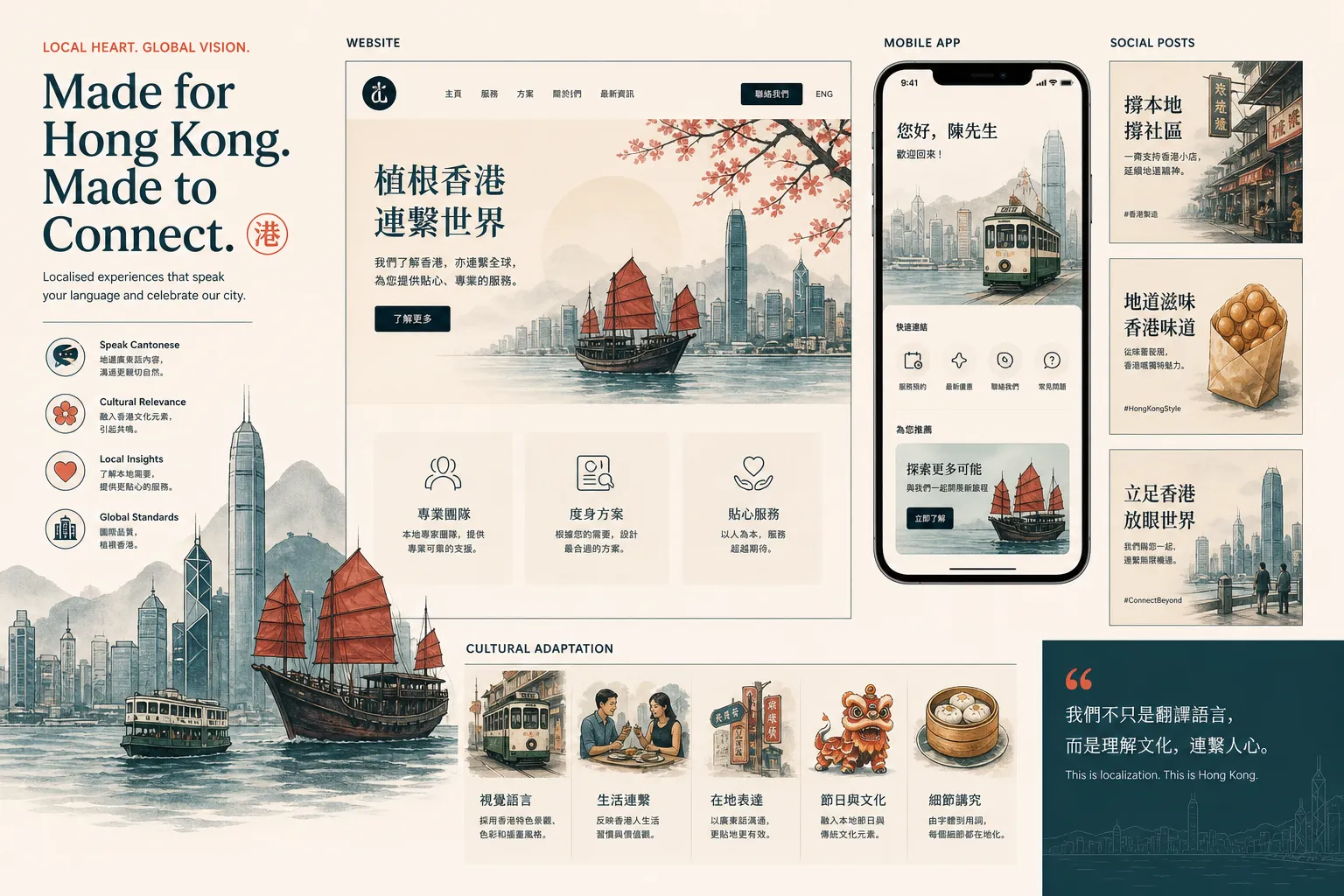
Marketing and Brand Localization
If you are running paid campaigns, publishing landing pages, localizing social media, or adapting product messaging for Hong Kong or Cantonese-speaking audiences, direct translation is rarely enough.
Why marketing translation needs extra care
Marketing language depends on nuance. Humor, urgency, aspirational tone, and calls to action all behave differently across cultures. A phrase that converts well in English may sound awkward, overly aggressive, or unclear when translated literally.
A skilled translator for business growth should help you:
-
Adapt headlines and taglines without losing intent
-
Choose culturally appropriate calls to action
-
Maintain consistency across ad copy, email, and web content
-
Avoid wording that feels imported or machine-made
-
Align with local reading habits and character preferences
For Team Stream clients, this often means combining human review with efficient AI-assisted workflows to scale content without sacrificing quality.
Customer Support and Client Communication
Support content is where poor translation becomes expensive. Misunderstood onboarding instructions, return policies, troubleshooting steps, or service emails can increase ticket volume and damage trust.
You may need a Cantonese translator for:
-
Help center articles
-
Support macros and canned responses
-
Chat and email support content
-
Service updates and outage notices
-
Appointment reminders and follow-up communication
For higher-stakes support, interpretation or real-time captioning may also be appropriate, especially in virtual service environments or multilingual meetings.
Video, Media, and Social Content
Video localization is one of the biggest content gaps in many business language strategies. Brands may translate their website but ignore webinars, product demos, CEO messages, training modules, and social clips.
Common video-related needs
-
Subtitles for recorded content
-
Closed captions for accessibility and compliance
-
Script translation for voiceover
-
Cantonese interpreting during live streams
-
Real-time captioning for hybrid and virtual events
Team Stream is especially well positioned here because multilingual communication and accessibility often overlap. If your audience includes Cantonese speakers and viewers who rely on captions, handling translation and accessibility together leads to better execution.
Conferences, Events, and Hybrid Experiences
Live events raise the stakes. In a meeting or on a stage, there is no time to fix confusing language after the fact. The translation has to work in real time, and the audience experience has to feel seamless.
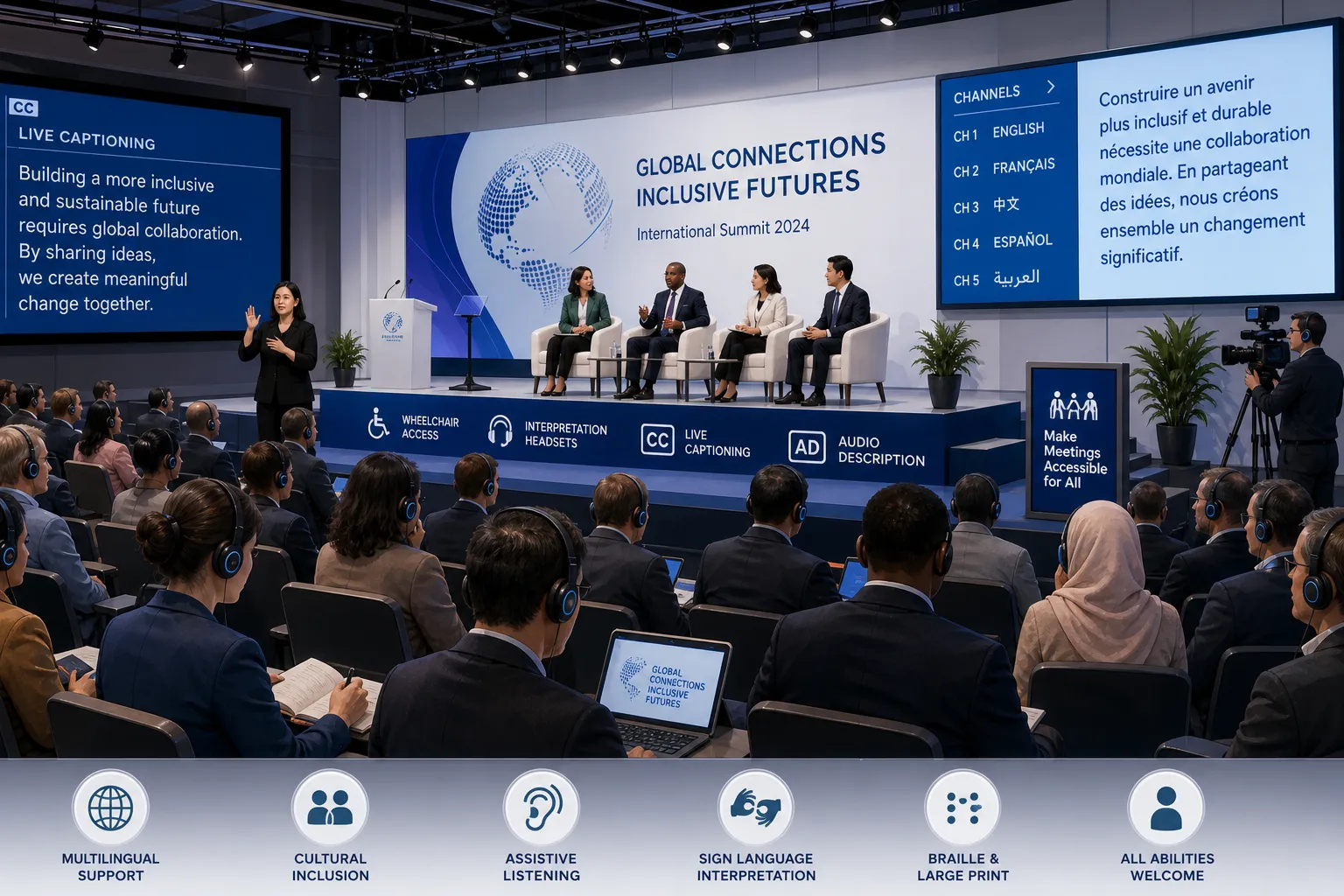
Event scenarios that often require Cantonese support
-
Corporate town halls
-
Product launches
-
Investor presentations
-
Trade show booth interactions
-
Leadership summits
-
Ministry or church events
-
International training sessions
-
Broadcasts and livestreams
What to plan for
|
Event need |
Recommended service |
|---|---|
|
Bilingual stage presentation |
Live interpretation |
|
Multilingual audience access |
Interpreting + receiver equipment |
|
Accessible online webinar |
Live captioning + language support |
|
Recorded post-event content |
Subtitling + translation |
|
On-site international guests |
In-person interpreters |
|
Virtual global attendees |
Remote interpretation and captioning |
This is a major area where Team Stream stands out. Beyond language services, the company also supports clients with equipment rental, technician services, and flexible deployment for live, hybrid, and remote productions. That reduces vendor sprawl and helps event teams avoid misalignment between language access and AV logistics.
Cross-Border Sales and Internal Communication
Business growth often creates internal communication challenges before it creates external ones. Sales enablement decks, HR documents, compliance training, and cross-border collaboration materials all need clarity.
A Cantonese translator can support:
-
Distributor communication
-
Partner onboarding
-
Internal memos
-
Training documents
-
Compliance materials
-
Sales proposals and presentations
-
Cross-border negotiation support
When internal and external communication are both in play, consistency matters. Using one coordinated language partner helps maintain terminology, tone, and process discipline across departments.
Accuracy Is More Than Correct Words
Accuracy in business translation means preserving meaning, intent, tone, and consequence. In high-stakes settings, a translation can be technically understandable and still be wrong for the audience or purpose.
What true accuracy includes
-
Correct terminology
-
Natural phrasing
-
Appropriate formality
-
Consistent brand voice
-
Localized references
-
Audience-specific readability
-
Subject-matter awareness
For example, a customer-facing promotion, executive memo, legal disclosure, and live event subtitle stream all require different translation decisions. Accuracy depends on context.
Why word-for-word translation fails
Literal translation often produces:
-
Unnatural phrasing
-
Misleading legal or technical meaning
-
Tone mismatch
-
Cultural awkwardness
-
Low conversion performance
-
Higher revision costs later
That is why Team Stream emphasizes tailored service rather than one-size-fits-all delivery. The right workflow depends on whether your priority is speed, sensitivity, accessibility, scale, or regulatory confidence.
Localization: The Difference Between Being Understandable and Being Effective
Many competitor pages talk about translation, but too few explain localization well. Localization is what makes content usable and persuasive in a real market context.
Localization for Cantonese-speaking audiences may involve
-
Choosing Traditional Chinese where appropriate
-
Adjusting idioms and expressions
-
Adapting dates, currencies, and formatting
-
Modifying layout for character-based text
-
Reworking slogans or product descriptions
-
Aligning terminology with regional expectations
-
Matching subtitles or captions to viewer habits
Localization is especially important in:
-
Ecommerce
-
SaaS onboarding
-
Mobile apps
-
B2B lead generation
-
Paid media
-
Event communications
-
Educational and training content
If your goal is business growth, localization is what turns language coverage into market performance.
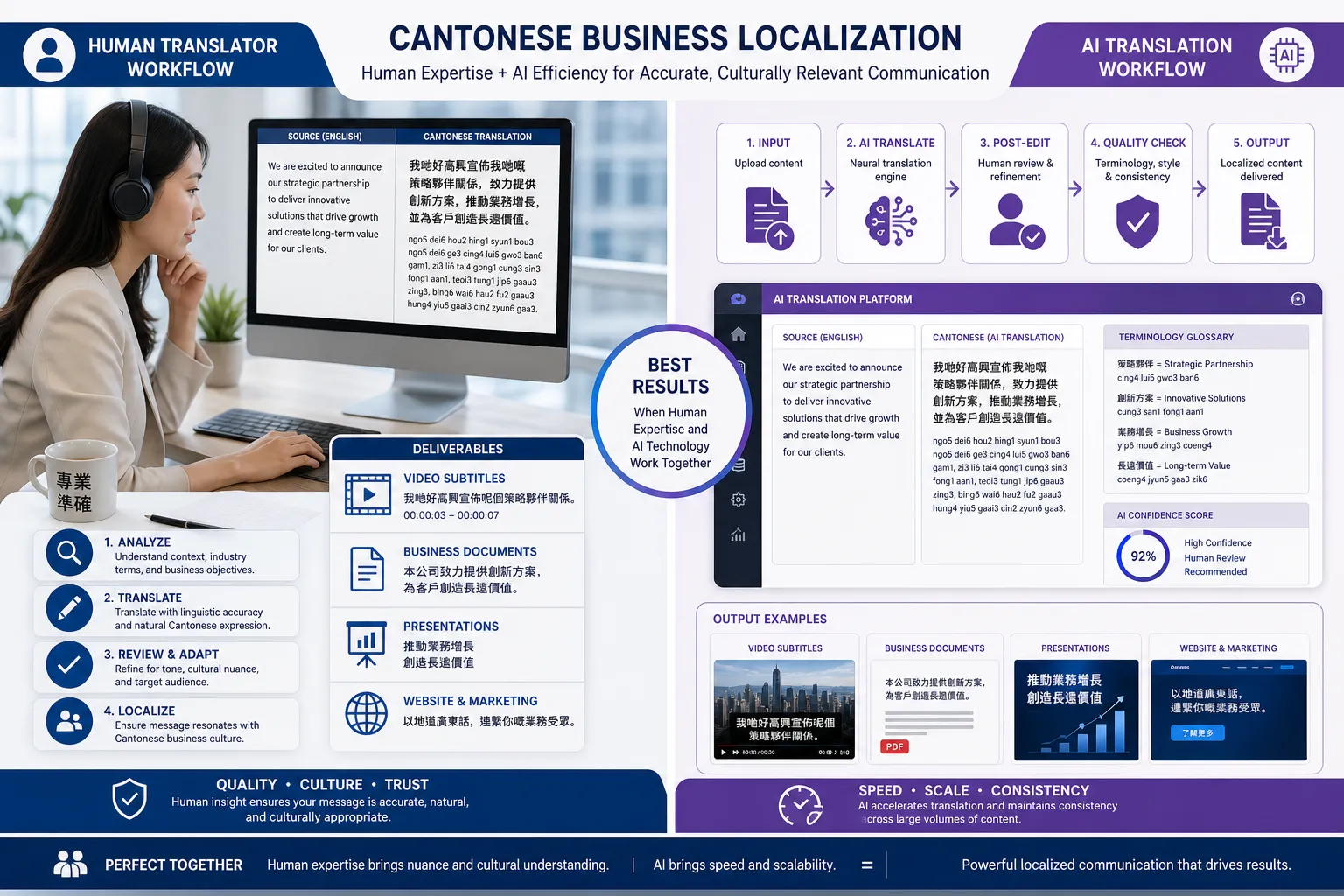
Human vs AI Translation: What Businesses Should Really Choose?
The best answer is usually not human or AI. It is human and AI, used strategically.
Where AI can help
AI-powered translation can be useful for:
-
First-pass drafts
-
Large-volume repetitive content
-
Internal reference material
-
Fast multilingual turnaround
-
Basic terminology extraction
-
Scalable subtitle or transcript preparation
Where human expertise is essential
Human translators are critical for:
-
Marketing and brand language
-
Legal and compliance-sensitive materials
-
Executive communication
-
Customer-facing support
-
Event interpreting
-
Voiceover scripts
-
Public-facing video subtitles
-
Anything where nuance affects trust or meaning
Practical decision framework
|
Content type |
AI only |
Human review |
Human-led |
|---|---|---|---|
|
Internal rough draft |
Good option |
Better |
Optional |
|
Product descriptions at scale |
Possible |
Recommended |
Sometimes |
|
Ad copy and landing pages |
Risky |
Recommended |
Best |
|
Contracts and regulated content |
No |
No |
Essential |
|
Live events and meetings |
No |
No |
Essential |
|
Captions for accessibility |
Limited |
Recommended |
Best for final delivery |
Team Stream’s model is built for this reality. Businesses want speed and cost efficiency, but they also need high-quality outcomes. By blending human expertise with AI-enabled processes, Team Stream helps clients move faster without treating accuracy or accessibility as optional.
Common Mistakes Businesses Make When Hiring a Cantonese Translator
Many translation problems begin before the work even starts. Poor scoping, unclear expectations, and overreliance on generic vendors are common reasons projects underperform.
Assuming “Chinese” is specific enough
Mandarin and Cantonese are not interchangeable. Neither are Simplified and Traditional Chinese. If your audience is in Hong Kong or expects Cantonese relevance, a generic Chinese workflow may miss the mark.
Buying only on price
Low-cost translation often creates hidden costs:
-
Revision rounds
-
Brand inconsistency
-
Audience confusion
-
Support escalation
-
Delays in launch or compliance review
Forgetting about accessibility
If your content includes video, live presentations, webinars, or public communications, you may also need captions, subtitling, or accessible formatting. Translation without accessibility planning leaves part of the audience behind.
Treating live events like static content
Stage remarks, panels, Q&A sessions, and hybrid productions require timing, technician coordination, and platform readiness. This is not the same as sending a document to a translator.
Not providing context
Translators work better when they receive:
-
Audience details
-
Glossaries
-
Brand guidelines
-
Past examples
-
Technical terminology
-
Final intended use
Waiting too long to plan
Language access works best when built into the timeline from the beginning, especially for events, launches, and multimedia production.
How to Choose the Right Cantonese Translation Service
The best provider is not simply bilingual. They are operationally reliable, context-aware, and able to match the service model to your business objective.
Look for these qualities
Business context awareness
Can they adapt their approach for marketing, customer support, legal, HR, events, and video?
Human quality control
Do they have experienced linguists reviewing sensitive or public-facing content?
AI capability used responsibly
Can they use AI to improve speed and efficiency without using it as a substitute for judgment?
Accessibility support
Can they integrate captioning, subtitling, and inclusive communication requirements?
Event readiness
If you run meetings or conferences, can they support live, remote, and hybrid formats with the right personnel and equipment?
Responsiveness and service
Do they communicate clearly, scope accurately, and stay available when plans change?
A practical evaluation checklist
|
Question |
Why it matters |
|---|---|
|
Do they specialize in business communication? |
Improves relevance and reduces revisions |
|
Can they support both written and spoken language needs? |
Helps unify translation and interpretation |
|
Do they offer accessibility services? |
Important for inclusion and compliance |
|
Can they support hybrid and live event formats? |
Critical for modern event execution |
|
Do they have technician and equipment support? |
Reduces coordination risk |
|
Can they tailor workflows instead of forcing packages? |
Ensures better fit and cost control |
This is where Team Stream offers unusual depth. Instead of treating translation as a standalone commodity, the company helps clients build complete communication workflows: translation, interpreting, captioning, subtitling, voiceover, equipment, technicians, and flexible remote or in-person delivery.
What Competitor Content Usually Misses
Most pages about Cantonese translation focus on basic claims like native speakers, fast turnaround, or affordable pricing. Those points matter, but they often miss the issues businesses actually face.
Common content gaps in the market
-
Little explanation of how Cantonese differs from generic Chinese workflows
-
Minimal guidance on live event language support
-
Weak coverage of accessibility and compliance
-
Oversimplified human vs AI discussion
-
Not enough detail on video, subtitles, and voiceover
-
Almost no advice for operations teams coordinating multiple vendors
-
Limited insight into choosing a provider for hybrid events and business-critical communication
These gaps matter because modern organizations do not just publish translated text. They host webinars, launch video campaigns, onboard remote teams, run hybrid conferences, and create content that must be both multilingual and accessible.
Why Team Stream Is a Smarter Partner for Business Growth
Team Stream is not just a translation vendor. It is a language access and accessibility partner built for real-world business communication.
What makes Team Stream different
-
Accurate human and AI-powered translation and interpreting
-
Real-time captioning for accessibility and engagement
-
End-to-end language and accessibility solutions tailored to each client
-
Support for live, virtual, and hybrid events
-
Compliance-friendly services for inclusive communication
-
Professional equipment rental and technician support
-
Flexible in-person and remote service delivery
-
More than 25 years of experience
-
Strong customer service and responsive execution
That combination is especially valuable when your business needs span multiple channels. You may need translated marketing copy, bilingual event support, live captions, and subtitled post-event video all in the same campaign cycle. Managing those pieces through separate vendors increases friction. Team Stream helps simplify that complexity.
Final Takeaway
A professional Cantonese translator can do much more than help you “reach” an audience. They help you communicate with clarity, credibility, and cultural precision where it counts: sales, service, events, media, and growth.
If your organization works across languages, platforms, or regions, the right solution is rarely translation alone. You may also need interpretation, captioning, subtitling, voiceover, accessibility planning, or technical event support. The more visible or time-sensitive the communication, the more important it is to choose a partner that can handle the full picture.
Team Stream brings together human expertise, AI-enabled efficiency, accessibility services, and event-ready execution to help businesses communicate well in every setting that matters.
If you want multilingual communication that feels polished, inclusive, and built for outcomes, Team Stream is ready to help you deliver it with confidence.
