

Translate English to Khmer With Better Accuracy
If you need to translate English to Khmer accurately, the biggest challenge is rarely the words alone. It is the context, tone, script, cultural nuance, and the purpose of the translation – whether you are preparing a marketing campaign, a training manual, church materials, event signage, subtitles, or live multilingual communication.
For event organizers, corporate teams, conference planners, churches, and broadcast producers, translation mistakes can create confusion, undermine trust, and even create compliance or accessibility risks. That is why the best results usually come from matching the translation method to the job: instant machine translation for rough understanding, AI-assisted workflows for speed, and professional human review for anything public-facing or high-stakes.
Why English to Khmer Translation Requires Extra Care
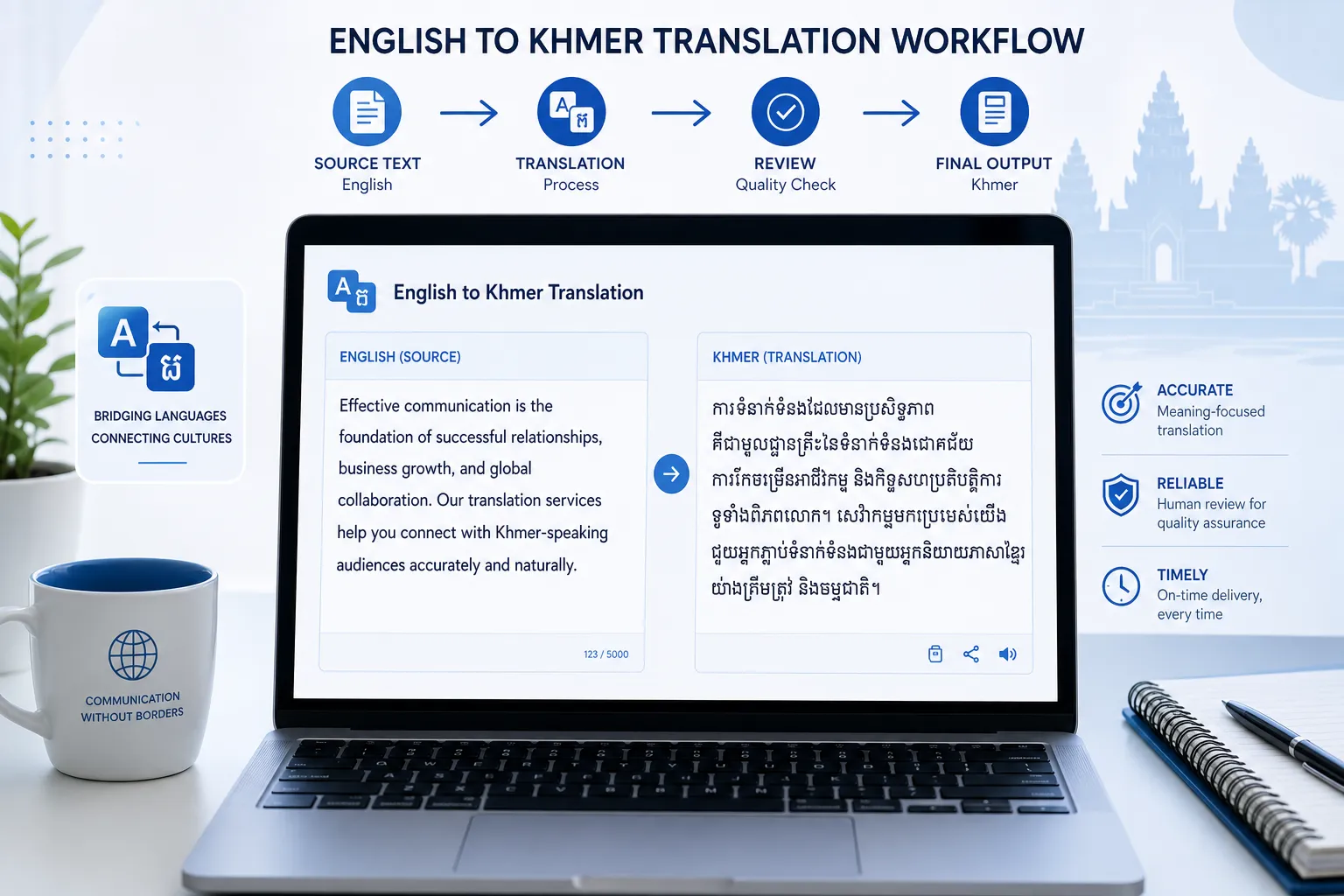
Khmer is the official language of Cambodia and has its own script, grammar patterns, politeness expectations, and formatting conventions. That means direct word-for-word conversion from English often produces awkward or misleading results.
“The Khmer language, also known as Cambodian, is the official language of Cambodia and is spoken by approximately 16 million people worldwide.” – ScriptLookup
That scale matters. If your organization communicates with Khmer-speaking audiences, translation quality affects comprehension, inclusion, and credibility.
What makes Khmer different from English
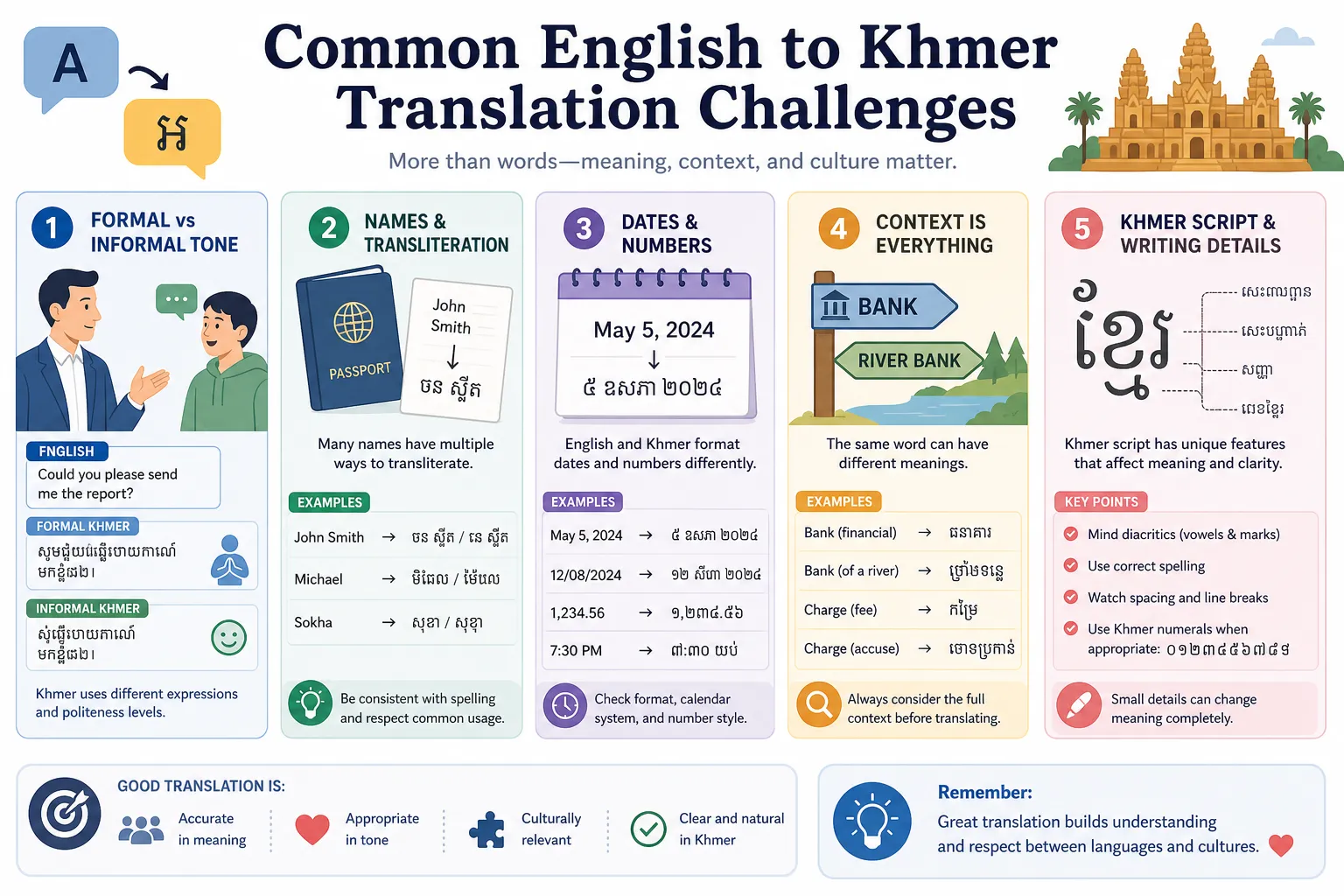
Here are a few reasons accuracy is harder than many people expect:
|
Challenge |
Why it matters |
|---|---|
|
Different script |
Khmer uses its own writing system, so spelling, segmentation, and character rendering matter |
|
Tone and formality |
English can be casual and ambiguous; Khmer often needs clearer politeness and relationship cues |
|
Context dependency |
One English phrase can map to multiple Khmer meanings depending on audience and setting |
|
Names, dates, and numbers |
Formatting conventions may need adaptation rather than direct conversion |
|
Technical vocabulary |
Industry terms in healthcare, legal, ministry, events, or training need subject knowledge |
Why literal translation fails
A literal translation may preserve the dictionary meaning but still fail in real use. For example:
-
A slogan can sound unnatural
-
An instruction can become unclear
-
A subtitle can lose emotional tone
-
A live caption can become unreadable if not phrased naturally
-
A Khmer-to-English translation can miss the speaker’s intent if the source is colloquial or abbreviated
That is why the real goal is not just translation, but accurate communication.
Common Problems When You Translate English to Khmer
Competitor pages usually focus on free tools and short phrases, but they often gloss over the real accuracy issues organizations face. In practice, these are the mistakes that cause the most trouble.
1. Translating without audience context
A phrase written for:
-
customers
-
church members
-
conference attendees
-
internal employees
-
legal reviewers
may need a different Khmer rendering even if the English source text looks the same.
2. Overlooking regional or usage differences
Khmer is standardized, but real-world use varies by speaker background, education level, and context. A translation that is technically correct may still feel stiff, overly formal, or hard to follow.
3. Ignoring formatting and readability
For slides, signage, programs, subtitles, and captions, translation quality includes:
-
line breaks
-
timing
-
screen fit
-
readability at a glance
-
consistency of names and terminology
4. Trusting raw machine output for public content
Free tools are useful for basic understanding, but they are risky for:
-
websites
-
contracts
-
medical information
-
HR documents
-
public event materials
-
live audience communications
5. Missing reverse-translation needs
Many teams only think about how to translate English to Khmer, but operationally they also need to translate Khmer to English for:
-
attendee questions
-
speaker notes
-
intake forms
-
support chats
-
user-generated feedback
-
interviews and recordings
A strong workflow should support both directions accurately.
When Free Translation Tools Are Enough – and When They Are Not
Free online translators are convenient. For quick phrases, simple travel communication, or rough comprehension, they can save time. But accuracy depends heavily on content type.
Good use cases for instant tools
Free tools can work reasonably well for:
-
simple greetings
-
basic directions
-
non-sensitive internal drafts
-
rough reading comprehension
-
quick idea checks
Risky use cases for instant tools
You should avoid relying on raw machine output alone for:
-
client-facing communications
-
compliance-sensitive materials
-
training content
-
subtitles or captions for public media
-
ministry or community outreach
-
conference signage and schedules
-
multilingual live events
If the translation affects reputation, safety, inclusion, or legal clarity, it needs review.
The Best Translation Method Depends on the Content
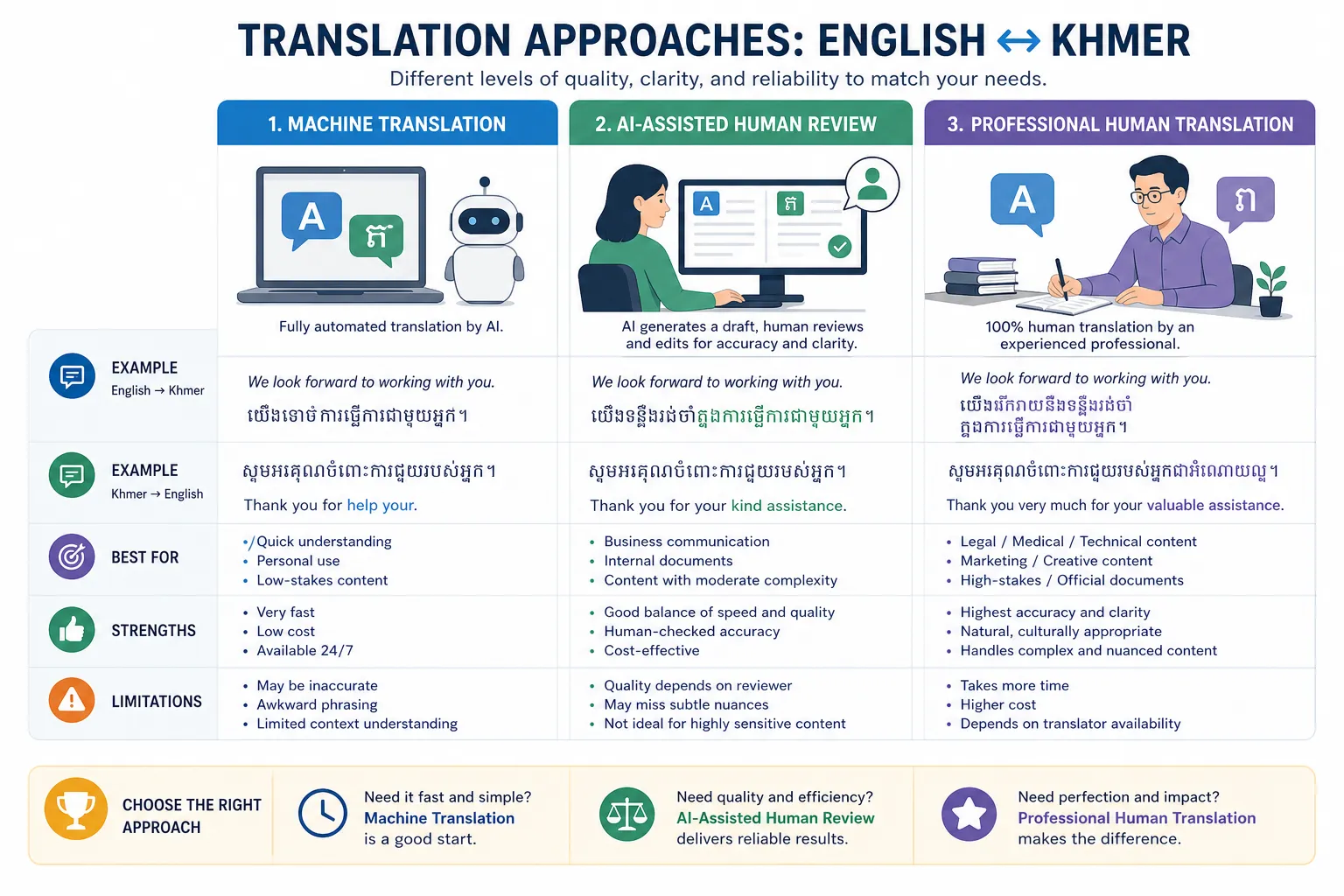
Instead of asking which tool is “best” in general, it is smarter to ask which method is best for the specific job.
Translation Options Compared
|
Method |
Best for |
Strengths |
Risks |
|---|---|---|---|
|
Free machine translation |
Simple phrases, rough understanding |
Fast, easy, low cost |
Tone errors, context loss, inconsistent terminology |
|
AI-assisted translation with human review |
Business content at scale |
Good balance of speed and quality |
Still requires expert oversight |
|
Professional human translation |
High-stakes or public-facing content |
Best accuracy, nuance, and localization |
Slower than raw machine output |
|
Human interpreting + captions |
Live meetings and events |
Real-time multilingual access |
Requires planning and expert support |
A practical decision rule
Use this rule of thumb:
-
Low risk + low visibility: machine translation may be enough
-
Medium risk + external audience: use AI plus human editing
-
High risk + public, legal, or live environment: use professional translation or interpreting support
How to Improve English to Khmer Translation Accuracy
Better accuracy is not accidental. It comes from process.
Start with cleaner source text
Before translation, improve the English:
-
shorten long sentences
-
remove slang unless intentional
-
define acronyms
-
avoid vague pronouns
-
standardize terminology
A clear English source almost always produces a better Khmer result.
Provide context notes
If you send text for translation, include:
-
intended audience
-
where the text will appear
-
desired tone
-
glossary of approved terms
-
reference materials
-
whether readability or literal accuracy matters more
Use a terminology list
For repeated content, create a glossary for:
-
product names
-
ministry terms
-
event labels
-
technical vocabulary
-
legal wording
-
speaker titles
This is especially important for organizations producing recurring multilingual communications.
Review with native-language quality control
The best final step is review by a qualified human who understands both the language and the use case. That matters even more when content will be seen live, recorded, or distributed widely.
Translating Khmer to English: The Other Side of the Workflow
Organizations often underestimate reverse translation needs. Yet many real-world operations require them.
Where Khmer-to-English translation is essential
You may need to translate Khmer to English for:
-
survey responses
-
intake forms
-
meeting notes
-
sermons or ministry feedback
-
social media comments
-
product inquiries
-
event registration details
-
recorded interviews
Why reverse translation can be just as tricky
Khmer-to-English translation often runs into:
-
omitted subjects
-
culturally implied meaning
-
abbreviated responses
-
audio quality issues in spoken content
-
nonstandard spelling in informal writing
This is one reason automated back-and-forth translation can create compounding errors. A human-informed workflow catches more of those issues early.
Accuracy Matters Even More in Live and Public Settings
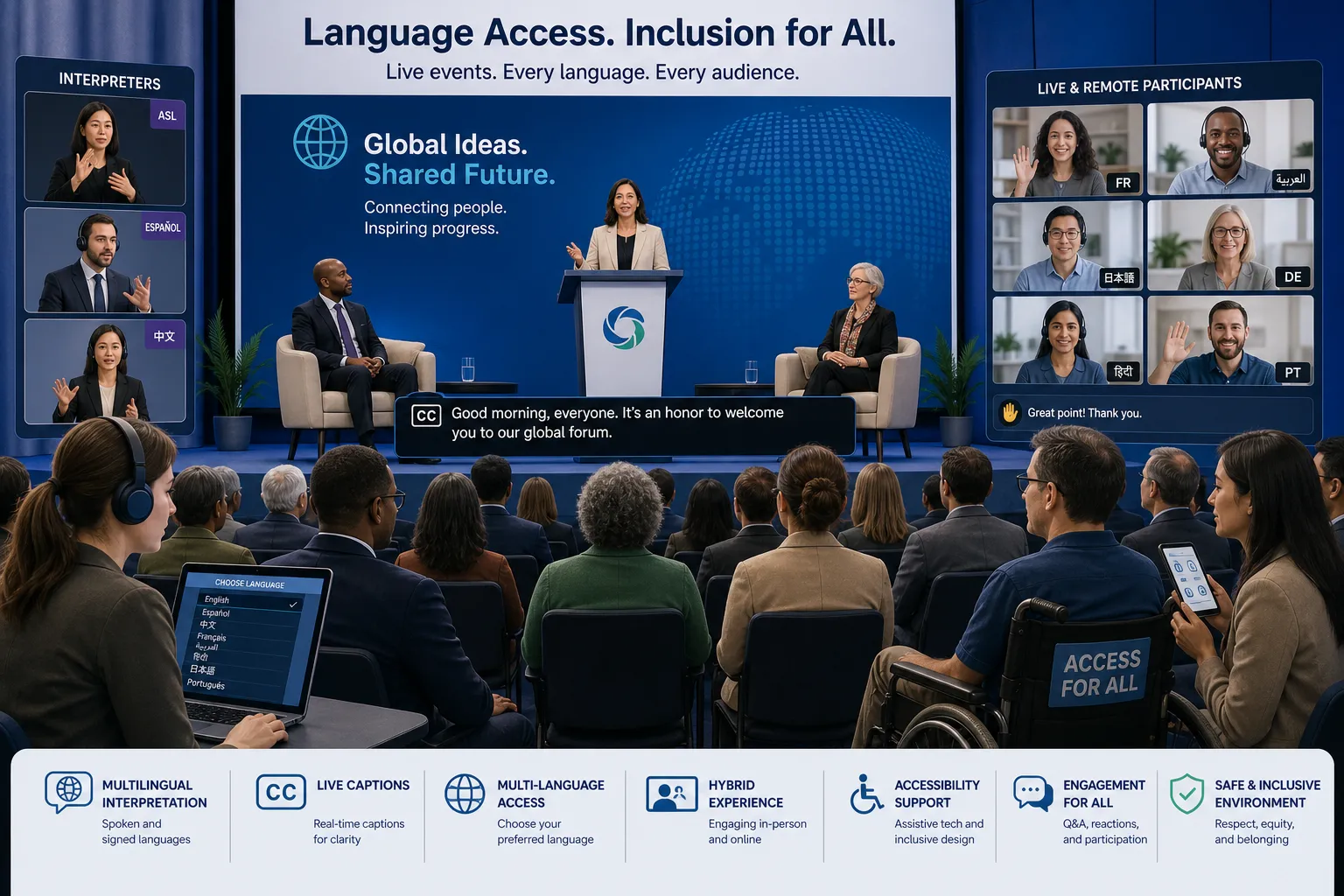
Static text is one thing. Live communication is another. When your audience includes multilingual participants, a single mistranslation can affect engagement, accessibility, and trust in real time.
Why events need more than translation alone
For conferences, trade shows, broadcasts, churches, and hybrid meetings, the challenge is broader than text conversion. You may need:
-
live interpreting
-
real-time captioning
-
translated slides or handouts
-
subtitling for recorded sessions
-
voiceover for post-event distribution
-
headsets, receivers, booths, or technician support
“In the United States, the Americans with Disabilities Act (ADA) mandates accessible communication for individuals with disabilities. Organizations receiving federal funding are required to provide language access under Title VI of the Civil Rights Act.” – InterScribe
This is where Team Stream offers a stronger operational advantage than standalone translation apps. With over 25 years of experience, Team Stream supports accurate human and AI-powered translation, interpreting, captioning, subtitling, and accessibility solutions tailored to each client. For live, virtual, and hybrid events, that means language access is planned as part of the full audience experience – not treated as an afterthought.
What Competitor Pages Usually Miss
Most top-ranking pages for this topic focus on simple tool use: paste text, click translate, copy output. That helps casual users, but it misses the needs of serious organizations.
Key content gaps competitors often leave open
They do not explain when machine translation is unsafe
A generic tool page rarely tells you when translation errors create reputational, compliance, or accessibility problems.
They do not connect translation with live event delivery
For conferences and broadcasts, translation may need to integrate with interpreting, captioning, subtitling, and on-site production support.
They do not address accessibility and compliance
Translation alone does not make communication inclusive. Real accessibility often requires captions, multilingual support, and delivery formats designed for diverse audiences.
They do not cover workflow design
Teams need repeatable systems for bilingual communication, not just one-off phrase conversion.
They rarely mention technician and equipment support
For multilingual events, the operational layer matters: microphones, receivers, interpreter audio feeds, streaming integration, and experienced technicians.
These are the areas where Team Stream stands out as a partner, not just a vendor.
How to Choose the Right English-Khmer Translation Service
If accuracy matters, use these criteria before choosing a provider.
Selection Checklist
|
Criterion |
Why it matters |
|---|---|
|
Native-language expertise |
Ensures natural wording and cultural fit |
|
Subject-matter experience |
Prevents terminology mistakes |
|
Human review process |
Improves quality beyond raw AI output |
|
Live-event capability |
Critical for conferences, churches, and broadcasts |
|
Captioning and accessibility support |
Helps meet inclusion and compliance goals |
|
Flexible delivery options |
Supports in-person, remote, virtual, and hybrid needs |
|
Equipment and technician support |
Reduces risk for multilingual event execution |
Questions to ask before hiring
Ask the provider:
-
Do you offer both human and AI-supported workflows?
-
Can you handle both English-to-Khmer and Khmer-to-English projects?
-
Do you support live events, not just document translation?
-
Can you provide captioning, subtitling, or interpreting too?
-
What is your quality-control process?
-
Can you support urgent turnaround without sacrificing accuracy?
If the answer is yes across the board, you are likely dealing with a true language-access partner.
Best Practices for Businesses, Churches, and Event Teams
Different organizations need different translation strategies.
For businesses
Use professional review for:
-
HR materials
-
onboarding
-
compliance notices
-
customer communications
-
product information
-
marketing assets
For churches and ministries
Use audience-aware translation for:
-
sermons
-
worship materials
-
community outreach
-
livestream subtitles
-
event announcements
-
bilingual programs
For event organizers and producers
Plan multilingual access early:
-
identify language needs during pre-production
-
decide what needs translation vs interpreting
-
prepare captioning workflows
-
test delivery platforms
-
assign technical support
-
create backup communication plans
This is especially important for hybrid and virtual events, where platform limitations can magnify language-access issues.
Why Team Stream Is a Smarter Choice for High-Accuracy Communication
When you need more than a basic translator, Team Stream brings together the pieces that competitors often separate.
What Team Stream delivers
Team Stream provides:
-
accurate human and AI-powered translation and interpreting
-
real-time captioning for accessibility and engagement
-
end-to-end language and accessibility solutions tailored to each client
-
support for live, virtual, and hybrid events
-
compliance-friendly services for inclusive communication
-
professional equipment rental and technician support
-
flexible service delivery with in-person and remote options
-
an experienced team with over 25 years of expertise
-
reliable execution backed by responsive customer service
That combination matters because real multilingual communication is not just about converting words. It is about making sure everyone can understand, participate, and stay engaged.
Final Takeaway
If your goal is quick convenience, a free tool may be enough for short, low-risk phrases. But if your content is public, technical, sensitive, or live, better accuracy requires a better process.
To translate English to Khmer effectively – and to handle Khmer-to-English needs with equal confidence – you need context, quality control, and the right delivery model. For organizations managing events, broadcasts, internal communications, or multilingual outreach, Team Stream offers the kind of end-to-end support that protects accuracy while improving accessibility, compliance, and audience experience.
If your message matters, do not settle for word substitution. Choose a partner that can deliver clear communication from start to finish.
FAQ
Which Khmer translator is the most reliable?
The most reliable option depends on the use case, but for public-facing, technical, or live content, professional human translation with AI-assisted support is usually the safest choice. Free tools are fine for simple phrases, but organizations often need expert review to ensure tone, clarity, and context are correct.
Is ChatGPT or Google Translate more accurate?
Neither is universally best in every situation. Google Translate is often faster for short text, while ChatGPT can help with context and rewriting, but both can make mistakes in Khmer without human review. For important content, professional oversight is still the better option.
How to improve language translation accuracy?
Start with clear source text, provide audience and tone context, and use a glossary for key terms. The biggest quality boost usually comes from having a qualified bilingual reviewer check the output before publication or live use.
Is ChatGPT or Google Translate more accurate?
For short, low-risk phrases, both can be useful, but accuracy varies based on context and wording. If the content affects compliance, accessibility, brand reputation, or live communication, neither should be trusted without human review.
What is the best translation app for Cambodia?
The best app for Cambodia depends on whether you need casual phrase help or business-grade accuracy. For everyday use, a free translation app may be enough, but for events, meetings, captions, subtitles, or professional documents, a service partner like Team Stream offers much stronger accuracy and support.
