

Interpretation and Translation Services Guide
If your organization serves multilingual audiences, the wrong language support can create confusion, compliance risk, and a poor attendee or customer experience. The right support does the opposite: it helps people understand, engage, participate, and trust what they hear or read.
That is why choosing between interpreting and translation matters.
For event organizers, corporate teams, conference planners, churches, media producers, and internal communications leaders, the challenge is rarely just “Do we need language help?” It is usually more specific:
-
Do we need live interpreters or translated documents?
-
Should we use human experts, AI tools, or both?
-
What works best for meetings, conferences, broadcasts, training, or worship services?
-
How do we make multilingual communication accessible and compliance-friendly?
-
What equipment, captions, technicians, or remote options are needed?
This guide breaks down interpretation and translation services in practical terms so you can choose the right solution for every format, audience, and message.
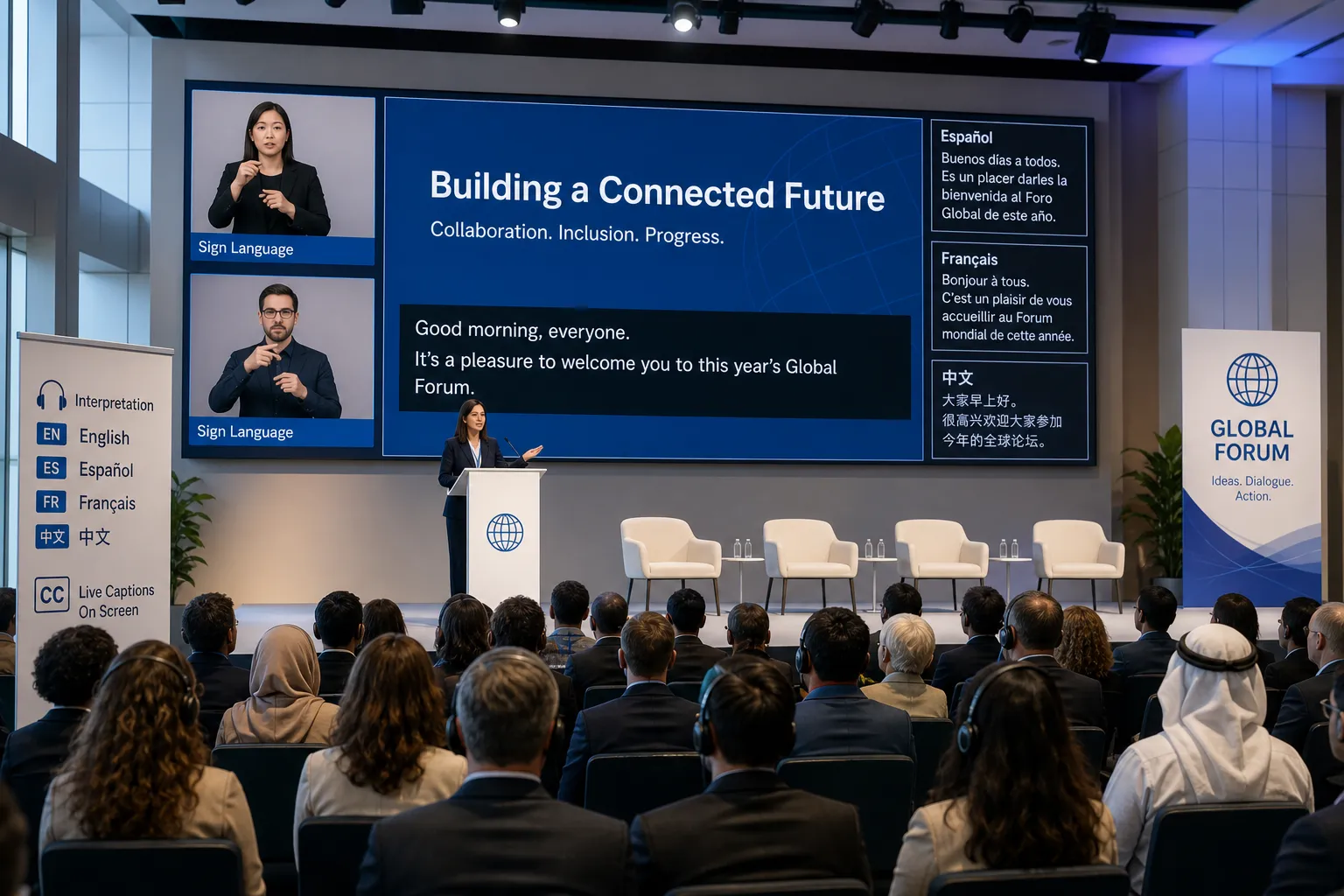
What interpretation and translation services actually mean
People often use these terms interchangeably, but they are not the same.
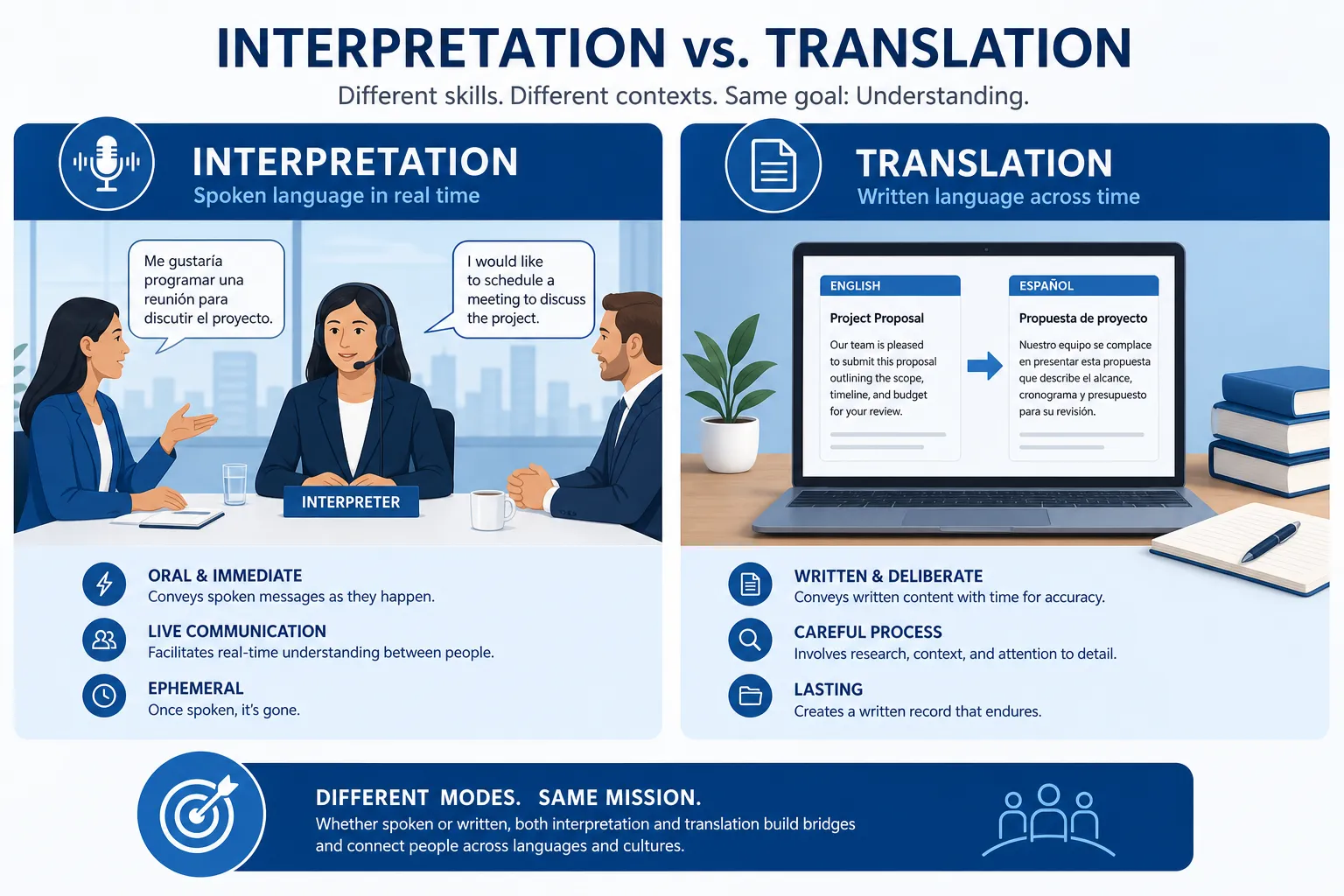
Interpretation is for spoken or signed communication
Interpretation converts spoken or signed language from one language into another in real time or near real time. It is used when people need to understand a live conversation, meeting, event, sermon, interview, training, or broadcast as it happens.
Examples include:
-
A live interpreter at a conference
-
Simultaneous interpretation for a multilingual keynote
-
Over-the-phone interpreting for customer support
-
Video remote interpreting for a virtual meeting
-
ASL interpreting for a live event or church service
Translation is for written content
Translation converts written text from one language into another. It is used when the message exists as a document, website page, slide deck, subtitle file, internal memo, handbook, contract, brochure, or script.
Examples include:
-
Employee communications translated into Spanish, French, or Arabic
-
Event signage and attendee materials
-
Marketing collateral and websites
-
Closed captions and subtitles
-
Scripts for voiceover production
The simplest way to remember the difference
If the message is being spoken live, you likely need interpreting.
If the message is written and needs to be read later, you likely need translation.
Why this distinction matters for businesses, events, churches, and media teams
Choosing the wrong service can waste budget and weaken communication.
For example:
-
Translating a presentation deck does not help attendees follow a fast-moving keynote in real time.
-
Hiring an interpreter for a legal document does not replace proper written translation.
-
Adding captions alone may improve accessibility, but it does not automatically create multilingual access.
-
Using raw AI output without human review can create errors in tone, terminology, or meaning.
The most effective multilingual strategies are built around the format of the content, the stakes of the message, and the needs of the audience.
A side-by-side comparison
|
Category |
Interpretation |
Translation |
|---|---|---|
|
Used for |
Spoken or signed communication |
Written content |
|
Timing |
Live or near real time |
Before publication or distribution |
|
Best for |
Meetings, conferences, worship, broadcasts, support calls |
Documents, websites, subtitles, signage, scripts |
|
Output format |
Spoken language, signed language, or live audio feed |
Written file, caption file, translated document |
|
Key skill |
Listening, comprehension, rapid reformulation |
Writing, terminology control, clarity, cultural adaptation |
|
Common delivery |
On-site, phone, video remote, simultaneous |
Documents, websites, subtitle files, voiceover scripts |
|
Typical priority |
Speed, clarity, live accuracy |
Accuracy, consistency, readability, formatting |
Common types of interpreting services
Not all interpreting is delivered the same way. The right modality depends on your audience size, venue, budget, subject matter, and technical setup.
Simultaneous interpreting
The interpreter speaks while the original speaker is still talking, with only a slight delay. This is ideal for conferences, large meetings, worship services, broadcasts, and multilingual events where people need seamless live access.
Best for:
-
Conferences
-
General sessions
-
Keynotes
-
Live-streamed events
-
Trade shows
-
Church services
Simultaneous interpreting often requires specialized audio routing, interpreter consoles, headsets, receivers, or virtual interpreting platforms.
Consecutive interpreting
The speaker pauses, then the interpreter renders the message. This works well for smaller meetings, interviews, training sessions, site visits, and one-on-one discussions.
Best for:
-
Business meetings
-
HR conversations
-
Training workshops
-
Press interviews
-
Small group sessions
Whispered interpreting
Also called chuchotage, this is a form of simultaneous interpreting delivered quietly to one or two listeners without a full audio setup.
Best for:
-
VIP guests
-
Executive meetings
-
Small in-room situations
Over-the-phone interpreting
This is audio-only interpreting delivered remotely. It is useful when speed matters and visuals are not essential.
Best for:
-
Customer support
-
Intake calls
-
Scheduling
-
Basic service interactions
Video remote interpreting
This combines interpreting with visual cues over video, which is especially helpful when body language, visuals, or signed languages matter.
Best for:
-
Virtual meetings
-
Hybrid consultations
-
Accessibility support
-
Remote team communication
Common types of translation services
Translation is broader than many organizations realize. It includes much more than documents.
Document translation
This covers contracts, handouts, policies, manuals, brochures, reports, and event materials.
Website and digital content translation
This includes web pages, landing pages, email sequences, app text, and digital campaigns.
Subtitling and caption translation
This is essential for multilingual videos, on-demand sessions, training content, and global marketing assets.
Voiceover and script adaptation
If content will be spoken in another language, the script usually needs translation and adaptation for natural delivery.
Accessibility-focused language adaptation
This includes plain-language revisions, caption formatting, subtitle timing, readability improvements, and audience-specific localization.
When to use interpretation and when to use translation
Many organizations do not need one or the other. They need both.
Use interpreting when the audience must understand live
You likely need interpreting for:
-
Conferences and conventions
-
Live webinars
-
Town halls
-
Company all-hands meetings
-
Church services and ministry events
-
Trade show presentations
-
Broadcast interviews
-
Press conferences
-
Training sessions with live Q&A
Use translation when the audience must read, review, or revisit content
You likely need translation for:
-
Presentation decks
-
Event agendas
-
Registration materials
-
Employee handbooks
-
Internal announcements
-
Legal and compliance documents
-
Marketing assets
-
Training guides
-
Video subtitles
-
Speaker scripts
Use both when the communication journey is bigger than a single moment
A multilingual event often needs:
-
Interpreting for the live session
-
Translation for agendas, signage, slides, and follow-up materials
-
Live captions for accessibility
-
Subtitles for post-event video distribution
-
Voiceover for repurposed content
This is where end-to-end planning makes a major difference.
How accessibility fits into language services
A strong language strategy is also an accessibility strategy.
That matters for legal compliance, audience inclusion, brand perception, and engagement.
Captions are not just a nice extra
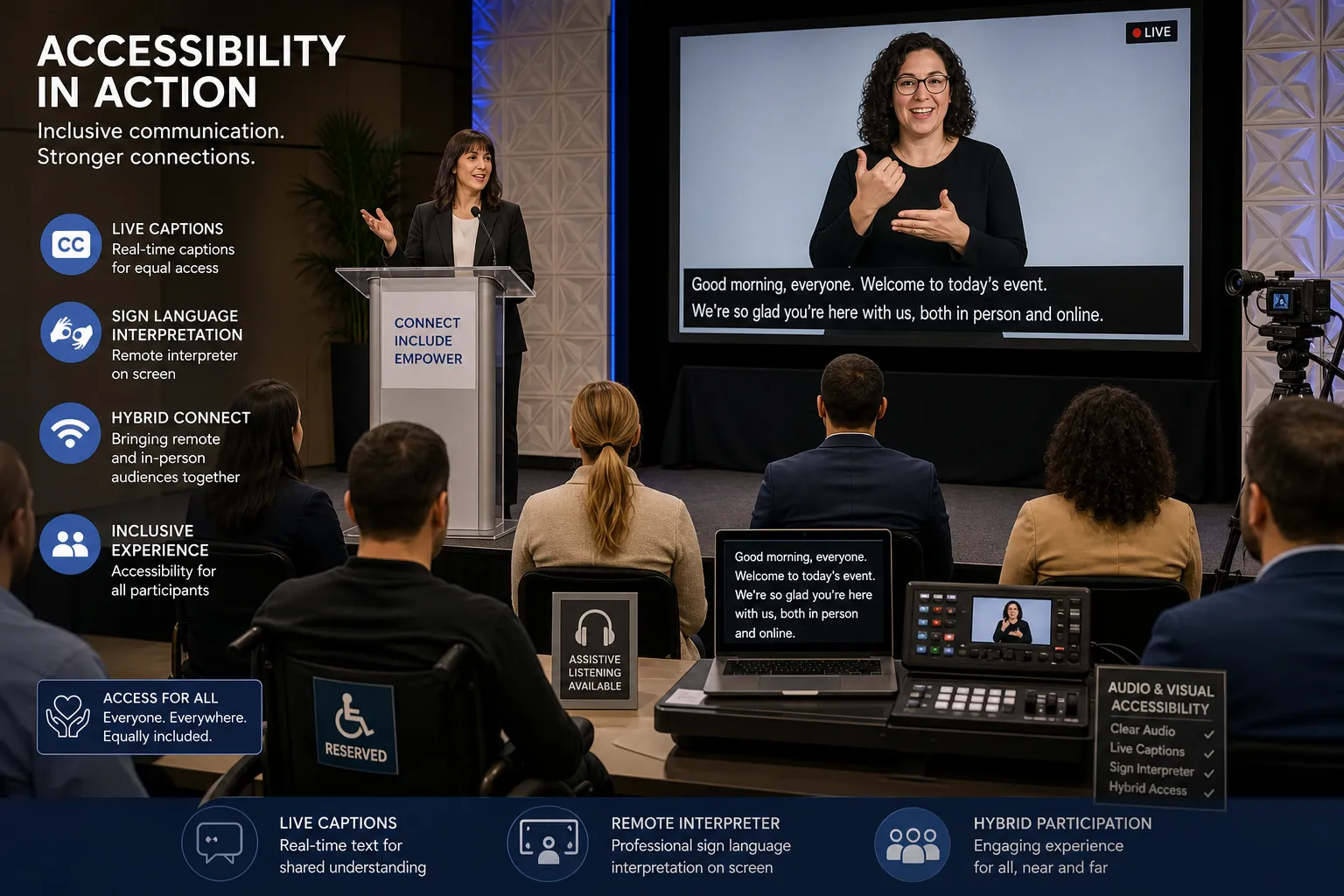
Real-time captioning helps:
-
Deaf and hard-of-hearing attendees
-
Non-native speakers following fast speech
-
People in noisy environments
-
Virtual attendees watching without sound
-
Audiences processing technical terminology
Interpreting and captioning solve different problems
They are related, but not interchangeable.
|
Need |
Best-fit solution |
|---|---|
|
A Spanish-speaking attendee needs to understand a keynote live |
Spanish interpretation |
|
A Deaf attendee needs text access to the session |
Live captioning |
|
A global audience will watch the recording later |
Subtitles and translated captions |
|
An in-room audience needs multilingual audio |
Simultaneous interpreting with receivers or app-based audio |
|
A hybrid event needs both inclusion and reach |
Interpreting, live captioning, and post-event subtitling |
Accessibility should be planned, not added at the last minute
Too many teams treat language access and accessibility as late-stage add-ons. In practice, they affect:
-
Run of show
-
Room setup
-
Streaming workflow
-
Audio routing
-
Screen design
-
Speaker prep
-
Budgeting
-
Registration communication
-
On-site signage
That is why experienced planning support matters.
What competitors often miss: the real decision is not translation vs interpretation
Most articles stop at definitions. That is helpful, but incomplete.
In the real world, buyers are also deciding:
-
Human vs AI
-
Remote vs in-person
-
Simultaneous vs consecutive
-
Captions vs subtitles
-
Event app audio vs headsets
-
One-off support vs a full language-access plan
-
Vendor-only support vs integrated language plus technical execution
Those decisions shape quality, cost, speed, and audience experience just as much as the interpretation-versus-translation distinction.
Human interpreters and translators vs AI-powered language tools
AI has changed what is possible, especially for speed and scale. But not every use case has the same risk level.
Where AI can work well
AI-powered language tools can be helpful for:
-
Low-stakes internal communications
-
Draft translations
-
Fast-turn subtitle generation
-
Supporting multilingual event experiences
-
Expanding captioning reach
-
Initial content triage
Where human expertise remains essential
Human professionals are still the safest choice for:
-
High-visibility live events
-
Executive messaging
-
Legal, regulated, or sensitive communication
-
Faith-based messaging where tone matters
-
Brand voice and nuance
-
Broadcast-quality delivery
-
Complex terminology and cultural context
The best approach is often hybrid
For many organizations, the smartest path is not choosing human or AI in isolation. It is combining them intentionally.
A hybrid approach can mean:
-
AI for speed, humans for review
-
Human interpreters for high-stakes sessions, AI support for lower-priority breakout content
-
Automated captioning plus professional correction
-
Machine-generated subtitle drafts finalized by experts
This is one of the biggest advantages of working with a partner that can deliver both accurate human services and AI-powered options without forcing a one-size-fits-all model.
Why quality matters more than many teams expect
Language errors do not just sound awkward. They can change outcomes.
“Misunderstandings due to language barriers can lead to misdiagnosis, incorrect treatment plans, and medication errors.” – NHS SBS
That quote comes from healthcare, but the principle applies widely. In events, worship, media, and business communication, language mistakes can lead to:
-
Audience confusion
-
Reduced engagement
-
Misstated policies
-
Brand damage
-
Exclusion of key participants
-
Missed sales or partnership opportunities
-
Accessibility failures
For compliance-sensitive organizations, the stakes can be even higher.
“Title VI and Department of Health and Human Services regulations, 45 C.F.R. Section 80.3(b)(2), require recipients of Federal financial assistance from HHS to take reasonable steps to provide meaningful access to Limited English Proficient (LEP) persons.” – HHS.gov
How to choose the right language support for your situation
A good buying decision starts with a few practical questions.
1. Is the content live or pre-produced?
-
Live = interpreting and/or live captioning
-
Pre-produced = translation, subtitles, voiceover, caption localization
2. How high are the stakes?
For low-risk communication, AI-assisted workflows may be enough.
For high-stakes communication, professional human support is usually the better investment.
3. What does the audience need to do?
Ask whether they need to:
-
Listen
-
Read
-
Follow along live
-
Rewatch later
-
Engage in Q&A
-
Access content through captions
-
Participate in another language
4. Is the event in-person, virtual, or hybrid?
Each format changes logistics.
|
Event format |
Common language/access needs |
|---|---|
|
In-person |
Interpreters, receivers or app audio, caption display, booth or portable equipment |
|
Virtual |
Remote interpreting, live captions, platform integration, multilingual streaming |
|
Hybrid |
Both in-room and remote audio paths, caption workflows, technician oversight, recording support |
5. Are technical services required?
Many multilingual experiences fail because language planning and AV planning are disconnected.
You may need:
-
Interpreter audio routing
-
Headset systems
-
Receivers
-
Booths
-
Technician support
-
Streaming integration
-
Caption display setup
-
Recording and post-production workflows
Best practices for multilingual events and meetings
If you are planning a multilingual event, these steps will improve results.
Plan language access early
Bring interpreting, translation, and captioning into pre-production instead of leaving them for final-stage logistics.
Match the service to the session type
A keynote may need simultaneous interpreting and live captioning, while a workshop may only need consecutive interpreting.
Prepare speakers and materials in advance
Interpreters and translators perform better when they receive:
-
Agendas
-
Speaker names
-
Slide decks
-
Scripts
-
Glossaries
-
Acronyms
-
Pronunciation notes
Think beyond the live moment
What happens after the event?
You may also need:
-
Translated recap emails
-
Edited captions
-
Subtitle files
-
Voiceover versions
-
Accessible video archives
Choose a partner that can coordinate execution
The more moving parts you have, the more valuable integrated support becomes.
A practical framework for common use cases
Corporate town hall
Recommended mix:
-
Simultaneous interpreting for key languages
-
Real-time captioning
-
Translated internal follow-up summary
-
Optional remote access for distributed teams
Conference or trade show
Recommended mix:
-
On-site or remote simultaneous interpreting
-
Headsets or app-based listening channels
-
Captioning for main stage sessions
-
Translated signage, agendas, and slide support
-
On-site technicians for smooth execution
Church service or ministry event
Recommended mix:
-
Live interpretation for sermons and announcements
-
Captioning for accessibility
-
Translation of sermon notes or program materials
-
Subtitles or voiceover for archived content
Webinar or hybrid broadcast
Recommended mix:
-
Video remote interpreting
-
Live captions
-
Subtitled recording for replay
-
Multilingual content packaging for wider reach
Training and education content
Recommended mix:
-
Consecutive or remote interpreting for live sessions
-
Written translation of handouts and assessments
-
Closed captioning and subtitles for on-demand modules
Red flags to watch for when choosing a provider
Not every vendor is built for complex multilingual communication.
Be cautious if a provider:
-
Offers only one delivery model no matter the use case
-
Cannot explain when human vs AI is appropriate
-
Does not ask about accessibility requirements
-
Lacks event or broadcast technical experience
-
Cannot support both remote and in-person delivery
-
Has no process for terminology preparation
-
Treats captioning, interpreting, and translation as unrelated silos
-
Cannot scale for hybrid or multi-session events
What strong language-service delivery looks like
The best outcomes usually come from partners that can provide:
-
Accurate human interpreters and translators
-
AI-enabled workflows where they add value
-
Real-time captioning for accessibility and engagement
-
Support for live, virtual, and hybrid formats
-
Compliance-friendly communication planning
-
Equipment rental and technician support
-
In-person and remote delivery options
-
Responsive project management
-
Consistent execution across events, meetings, video, and written content
That combination is especially important when your audience experience, accessibility goals, and event logistics are all connected.
Where Team Stream fits in
Team Stream is built for organizations that need more than isolated language services.
Instead of forcing you to coordinate multiple vendors for interpreting, translation, captioning, subtitling, voiceover, accessibility support, and technical execution, Team Stream can help unify the entire workflow.
What that means in practice
With Team Stream, clients can access:
-
Accurate human interpreting and translation
-
AI-powered language solutions where appropriate
-
Real-time captioning for accessibility and engagement
-
Closed captioning, subtitling, and voiceover
-
Support for live, virtual, and hybrid events
-
Compliance-friendly services for inclusive communication
-
Equipment rental, sales, and technician support
-
In-person and remote delivery options
-
Tailored solutions instead of fixed packages
For event organizers and communications teams, that reduces friction and improves reliability. For churches, media teams, and corporate leaders, it creates a clearer path to multilingual communication that actually works in the real world.
Why experience matters
When language services intersect with live production, small mistakes become very visible. Timing, audio routing, platform setup, screen display, speaker coordination, and audience access all need to work together.
With more than 25 years of experience, Team Stream brings the operational discipline and customer responsiveness needed for high-quality execution, not just good intentions.
Final takeaway
Interpretation and translation services solve different problems, but most modern organizations need a broader language-access strategy that includes both.
If your message is spoken live, use interpreting.
If your message is written, use translation.
If your audience is diverse, your content is important, and your delivery spans live, virtual, hybrid, or on-demand formats, you likely need a coordinated mix of interpreting, translation, captioning, subtitling, and accessibility support.
That is where the right partner makes all the difference.
Team Stream helps businesses, churches, event organizers, conference planners, and media teams deliver multilingual, accessible communication with confidence. If you want accurate language support, flexible delivery, and dependable execution backed by real technical and customer-service expertise, Team Stream is a strong partner to consider.
Ready to make your next meeting, event, video, or broadcast more inclusive and effective? Connect with Team Stream to build a language and accessibility plan tailored to your audience, format, and goals.
